Source numbers link to evidence. [Inference] marks analytical judgment, including motion classifications and causal explanations. Public evidence does not establish every internal decision or metric.
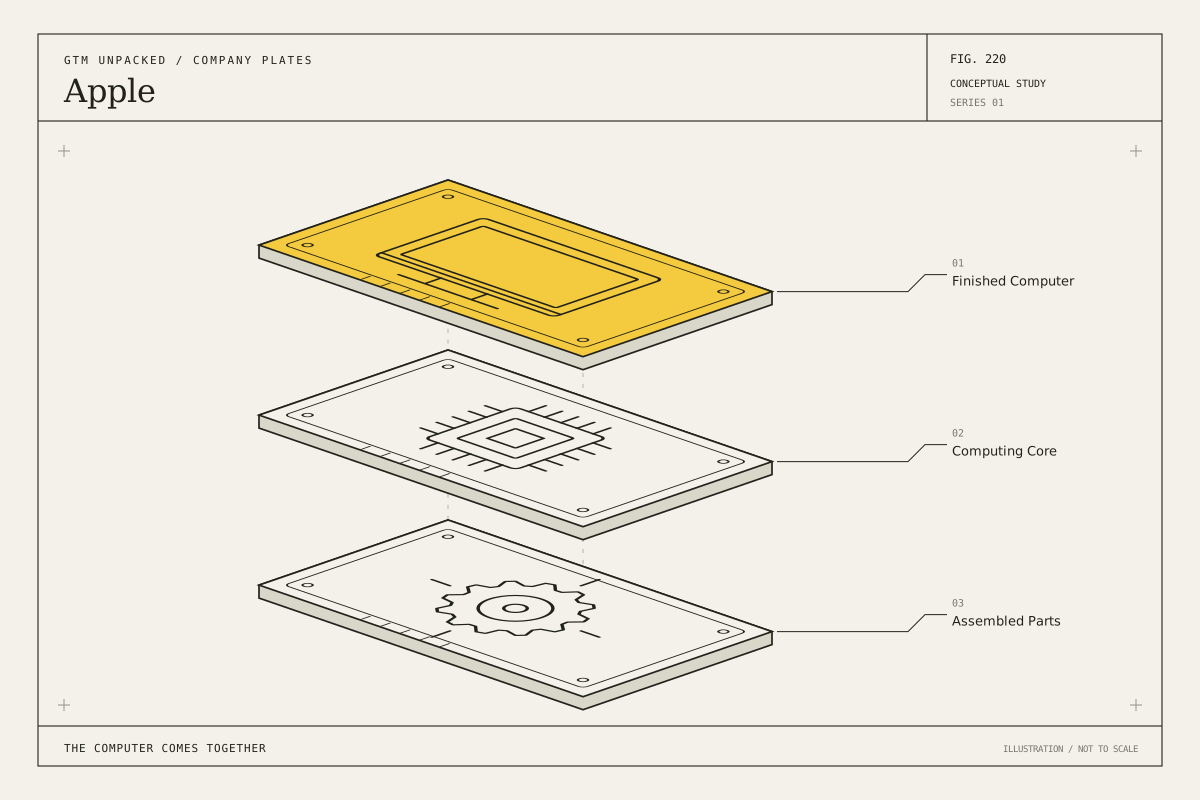
Conceptual illustration of a complete computer beside its symbolic electronic and mechanical elements, exploring the distinction between components and a finished object.
- Company
- Apple · Computing · apple.com
- Conversion motions
- [Inference] This research classifies Apple as Human Led, Partner Led and Marketing Led.
- Apple beachhead
- Computer hobbyists and specialist retail.
- Apple target customer
- Early personal-computer buyers through a specialist retailer.
- Product complexity
- [Inference] Assembly and usability made the early product materially more complex than a finished consumer appliance.
- Decision-making unit
- [Inference] A retailer purchased inventory before end-user purchase.
- Market at entry
- Category awareness and competing alternatives at initial launch require further historical research.
- Market today
- The historical source is not evidence of the current competitive position; present-day market maturity remains to be assessed.
- Evidence
- Source-backed brief · 1 linked source · research date · method and limitations
The ten-step Revenue Engine reading map
These links locate relevant evidence. A linked section does not imply every detail of the step is publicly established.
- Acquire Your First Customers: Founder Led Sales Read first customers
- Embrace GTM Experimentation Not established in this entry
- Understand Your GTM Motion Options Read GTM motion
- Pick Your GTM Motion Not established in this entry
- Generate a Lead Read GTM motion
- Turn Leads into Paying Customers Read GTM motion
- Retain and Grow Your Customers Read retain & expand
- Build Your GTM Team Not established in this entry
- Plan Your Tech Stack Not established in this entry
- Optimize and Scale Through Metrics Read pricing & economics
Apple: The evidence: origins and growth
The Steve Jobs Archive preserves Jobs’s account of a computer store ordering 50 early Apple computers on the condition that they arrive fully assembled. The order forced the founders to learn sales and distribution rather than only supply hobbyist technology. The archive identifies Jobs and Steve Wozniak’s 1976 beginnings. This is a formative early-channel story, not an account of Apple’s modern retail engine. [1]
[1]Apple: Revenue Engine interpretation
[Inference] A first serious buyer can reshape product packaging. Channel requirements are design constraints, not merely distribution details. [1]
[1]Apple: Enablement and expansion
The reviewed source does not establish the customer-success organization, named account managers, onboarding cost, or account-level expansion results.
Apple: Pricing and economic constraints
[Inference] Working capital and assembly labor had to be financed before retail sell-through. Actual CAC, gross margin, payback, and cohort retention were not established by this research pass.
Apple economics at a glance: Pricing is only half the story.
Historical and current price cards have not been verified.
Not established by the source reviewed
[Inference] Working capital and assembly labor had to be financed before retail sell-through.
Not established by the source reviewed
Not established by the source reviewed
The people in the Apple GTM story: People & capabilities.
Steve Jobs
Co-founderThe archive documents his early work with Steve Wozniak.
Responded to a retailer order that required assembled computers.
[1]Steve Wozniak
Co-founderTechnical creator involved in the early Apple machines.
Developed the computer technology around which the initial retail order formed.
[1]Apple GTM: critical reading and analysis: Why it worked.
Where it breaks.
What worked—and why
[Inference] A first serious buyer can reshape product packaging. Channel requirements are design constraints, not merely distribution details. [1]
What did not work
This brief does not establish a documented failed GTM experiment; absence of evidence is not evidence of flawless execution.
What could have been better
[Inference] Validate the conversion and retention of the beachhead cohort before treating reach or cumulative user counts as proof of a repeatable revenue engine.
What another founder can use
[Inference] A first serious buyer can reshape product packaging. Channel requirements are design constraints, not merely distribution details.
Apple go-to-market FAQ: The questions that matter.
What is the documented GTM lesson from Apple?
[Inference] A first serious buyer can reshape product packaging. Channel requirements are design constraints, not merely distribution details. [1]
Which go-to-market motions is Apple classified under?
[Inference] This research classifies Apple as Human Led, Partner Led and Marketing Led. Motion labels describe routes across segments and periods, not measured revenue shares.
Apple sources and open questions: Follow the sources.
- Make Something Wonderful | Steve Jobs book.stevejobsarchive.com · interview
Source inspected for the specific facts and attributed account in this brief.
What remains unverified
Research brief, not a completed company investigation.
First paying-customer identity and founder-led sales sequence are incomplete unless explicitly documented above.
Named early sales, success and account-management hires, biographies, training and internal GTM tools need further evidence.
Current pricing, cohort economics, market evolution and historical website screenshots have not all been verified.
No verified visual capture is attached to this entry. A current screenshot is not a substitute for a historical capture.