
Dissecting growth with
The Revenue Engine.
Every company in GTM Unpacked is examined through the framework in Disciplined Entrepreneurship: The Revenue Engine by Emmanuelle Skala, Adam Blake, and Max Faingezicht. It provides the common structure for investigating how a company found customers, converted demand into revenue, and built the people, processes, and systems needed to retain and grow accounts.
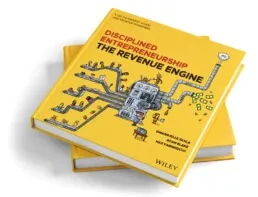
Ten steps. Four motions.
A complete revenue function.
The authors describe the book as growing out of their Entrepreneurial Sales teaching at MIT Sloan. Its scope connects customer acquisition, purchase, retention, and expansion with team design, technology, and measurement.
Explore the book and its authors →The MIT and Martin Trust Center connection
At the Massachusetts Institute of Technology (MIT), MIT Sloan’s Entrepreneurial Sales course, 15.387, covers selecting and executing GTM motions, building the sales organization, and establishing the processes and measurement needed to grow revenue. The current MIT catalog lists Blake, Faingezicht, and Skala among its instructors.
The Martin Trust Center for MIT Entrepreneurship includes Entrepreneurial Sales in its entrepreneurship course resources. In the broader educational foundation, the Center’s interview with Paul Cheek about New Enterprises explains how that course uses Bill Aulet’s 24-step Disciplined Entrepreneurship framework. This supplies the related context for questions about market opportunity, the customer, and the beachhead.
These references identify the framework’s educational provenance. They do not indicate endorsement, sponsorship or validation of this research by MIT, MIT Sloan or the Martin Trust Center. The company research, classifications, and critical judgments on this site are GTM Unpacked’s application of that framework.
How the ten steps become research questions
The ten steps structure the investigation across the entire corpus. The table below maps each step to what we look for in a company’s history. Chapter names and page references follow a prepublication manuscript of the book; the questions describe our research method.
| Book step | What we investigate |
|---|---|
| 01 · pp. 5–16Acquire Your First Customers: Founder Led Sales | Who first tried, paid, and committed? How did the founders reach them, handle objections, and learn? We distinguish a waitlist, an unpaid pilot, and a paying customer. |
| 02 · pp. 17–30Embrace GTM Experimentation | What hypothesis did a launch, channel test, pricing change, or sales experiment examine? What happened, and what did the team change or stop? |
| 03 · pp. 31–80Understand Your GTM Motion Options | What actually converted the prospect into a customer: product experience, a seller, a partner, or marketing? We separate the conversion mechanism from the source of attention. |
| 04 · pp. 81–108Pick Your GTM Motion | How did the motion fit the customer, deal complexity, market maturity, and unit economics? How did that fit change across segments and stages? |
| 05 · pp. 109–124Generate a Lead | Where did prospects come from? What signaled fit or intent? We look for documented outbound, content, community, referrals, partnerships, and product usage. |
| 06 · pp. 125–142Turn Leads into Paying Customers | What had to happen before purchase? We examine demos, trials, proofs of concept, decision makers, security review, procurement, and the commercial commitment. |
| 07 · pp. 143–152Retain and Grow Your Customers | How did customers reach value and expand? We examine onboarding, enablement, support, services, renewal ownership, account management, upsell, and cross-sell. |
| 08 · pp. 153–166Build Your GTM Team | Who made the motion repeatable? We trace named hires, responsibilities, relevant experience, documented training, and the handoff from founder selling. |
| 09 · pp. 167–182Plan Your Tech Stack | Which tools supported automation, visibility, and the system of record? We connect documented technology choices to a specific commercial or customer-service job. |
| 10 · pp. 183–192Optimize and Scale Through Metrics | Which measures exposed a bottleneck or justified expansion? We examine conversion, cycle time, deal size, productivity, retention, margin, and acquisition payback when disclosed. |
How we classify the four GTM motions
Classification follows the purchase mechanism and the relevant customer segment. A company can use more than one motion at the same time, and its mix can change. A motion label is an analytical classification; it is not a measured share of revenue unless the case provides that evidence.
The product carries conversion.
Use of the product creates the conviction to pay, often through a trial, a free tier, or a usage threshold. A free product that only supplies leads to sellers does not by itself establish product-led conversion.
02 / HUMAN LEDA person helps win the purchase.
A founder or salesperson guides evaluation and secures the commitment. Inside sales, field sales, and technical selling are designs within this motion.
03 / PARTNER LEDA partner participates in the sale.
A reseller, distributor, integrator, or commercial marketplace supplies the selling or purchasing route. A supplier relationship or a lead referral alone is insufficient evidence.
04 / MARKETING LEDMarketing creates the purchase.
The customer buys through the marketing experience without a salesperson closing the deal. Content, paid media, or a creator campaign can also support other motions, so a channel name alone does not settle the classification.
The four constraints behind motion fit
- Unit economics
- Can the account’s gross profit support the effort required to acquire, onboard, and serve it? We distinguish revenue growth from profitable expansion and keep undisclosed CAC, retention, and margins explicit.
- Customer profile
- Who is the user, champion, economic buyer, and approver? We examine the beachhead, purchasing habits, budget, and the setting in which the customer works.
- Deal complexity
- How difficult is it to evaluate, approve, buy, and deploy? Product complexity and decision-making-unit complexity are assessed separately: an easy interface can still require a complicated enterprise purchase.
- Market maturity
- Did buyers recognize the problem and category when the company began selling? We compare early education and budget creation with today’s awareness, alternatives, and established buying routes.
From framework to a critical company story
For each company, the research follows the sequence from early customer contact to repeatable acquisition, then retention and expansion. Product, market, pricing, process, and people are examined together. Named hires and partnerships are placed at the stage when they mattered; current capabilities are not automatically projected back onto the founding period.
The post-sale analysis asks who owned value realization, support, renewals, and expansion, and what customers had to accomplish before buying more. The people analysis separates documented experience or training from inferred capabilities. The technology analysis looks for evidence of actual use and purpose, rather than treating a current integration logo as proof of a historical operating system.
The critical reading then asks what the evidence supports, which conditions may explain the result, what failed, and what a different company could reasonably test. Causal explanations and alternative strategies are labeled [Inference]. The aim is a comparable account of how the revenue function developed, with enough context to judge where a lesson might apply.
A common framework, with explicit evidence limits.
All company profiles use the same analytical lens; the depth of public evidence varies. Extended cases cover more of the ten steps than shorter briefs. Missing customer names, internal metrics, or team details remain gaps. Applying the framework retrospectively does not establish that a company used the book, or that a single GTM choice caused its growth. We use the motion-selection worksheet as a thinking tool, not a numerical company score.
Framework sources & further reading
- The Revenue Engine — official book and author page Authors, teaching origins, scope, four motions, and publication information. Book cover reproduced from this page.
- MIT course catalog — Entrepreneurial Sales, 15.387 Official course description and instructor listing.
- Martin Trust Center for MIT Entrepreneurship — Courseorama The Center’s course resources, including Entrepreneurial Sales.
- Martin Trust Center — New Enterprises with Paul Cheek Disciplined Entrepreneurship’s 24-step foundation and its place in entrepreneurship teaching.
- GTM Unpacked — the ten-step reading guide Manuscript page references and links into company examples.
Edition note: this research used a prepublication manuscript. As checked on November 10, 2026, the official book page lists publication on January 20, 2027. Page references follow that manuscript.
Scope and coverage
The corpus starts from three lists: 19 AI companies chosen as a priority cohort; a 250-entry list of companies grouped into nine go-to-market categories; and 80 companies from a third-party Top 100 list that ranks companies by candidate interest (80 of its 100 entries were visible in the copy used; the other 20 are not included). Deduplication produces 339 companies. Inclusion reflects those lists; it is not a random sample and is not evidence of commercial success.
This edition contains 19 extended cases and 320 shorter source-backed briefs. A source-backed brief is not equivalent to a deep dive. Research depth is not yet uniform across the corpus: 96 of the shorter briefs are partial records, and 197 of the 339 company pages currently cite a single source.
Three different kinds of statements
- Sourced facts: supported by a linked document, article, interview, filing, or page.
- Company-reported claims: attributed to their issuer; not treated as audited or independently established.
- [Inference]: our classification, economic interpretation, causal argument, critique, or counterfactual recommendation.
Revenue and unit economics
The starting list for the 19 priority companies carried headline dollar figures with no metric definition, period or footnote explanation. They are treated as unverified and are never used as ARR, valuation or realized revenue. Where a case mentions its figure, it is to say what the evidence does and does not support. Run rate, ARR, bookings, GMV, contracted capacity, and recognized revenue must not be compared as if interchangeable.
Where CAC, retention, contribution margin, payback, or cohort data are undisclosed, the case says so. Cost structure and motion fit may be analyzed without inventing an exact financial ratio.
Historical evidence
Current screenshots are dated current evidence. An archive is historical evidence only when its actual capture date and page can be established. A pricing changelog, launch post, or contemporaneous interview can support a historical claim; it does not count as a screenshot of that old page. Failed archive access and missing periods remain gaps.
People and tools
Public roles, prior employment, education, and documented contributions are attributed. Experience does not establish private training, individual sales performance, or causal credit. A job advertisement may describe a desired operating model; it does not prove the employee was hired or the process performed well. Current website technology does not establish a historical internal GTM stack.
Critical reading
These companies are a selected sample, not a controlled experiment. Survivorship bias, founder access, capital, timing, and changing market conditions can confound the apparent success of a playbook. Recommendations are counterfactual analysis, not verified outcomes.
Source handling
The framework attribution above identifies the book and its educational context. The manuscript is not reproduced here. Short quotations retain attribution. Paywalled material is used only when accessible; inaccessible content is not presented as read.
Data access and citation
The full corpus is available as structured data (research-data.json) and as a company index (company-index.md). Cite the company page URL and the research date. Each company page is a standalone HTML document with a canonical URL and its own source list; the company pages listed in the sitemap also carry structured data. A sitemap and llms.txt describe the site; they do not guarantee indexing, ranking or inclusion in any answer engine.
The site is published openly; indexing and answer-engine inclusion depend on search-engine behavior. The sitemap lists the 19 extended cases, the 114 multi-source briefs and the larger pattern pages. The 206 entries that the company index labels evidence brief or research brief, the individual person pages and the small topic lists remain published and linked, and carry a noindex directive until their research is deepened. These features do not establish a ranking outcome.
Research date: November 10, 2026. Source publication and event dates vary and are shown where available.