Source numbers link to evidence. [Inference] marks analytical judgment, including motion classifications and causal explanations. Public evidence does not establish every internal decision or metric.
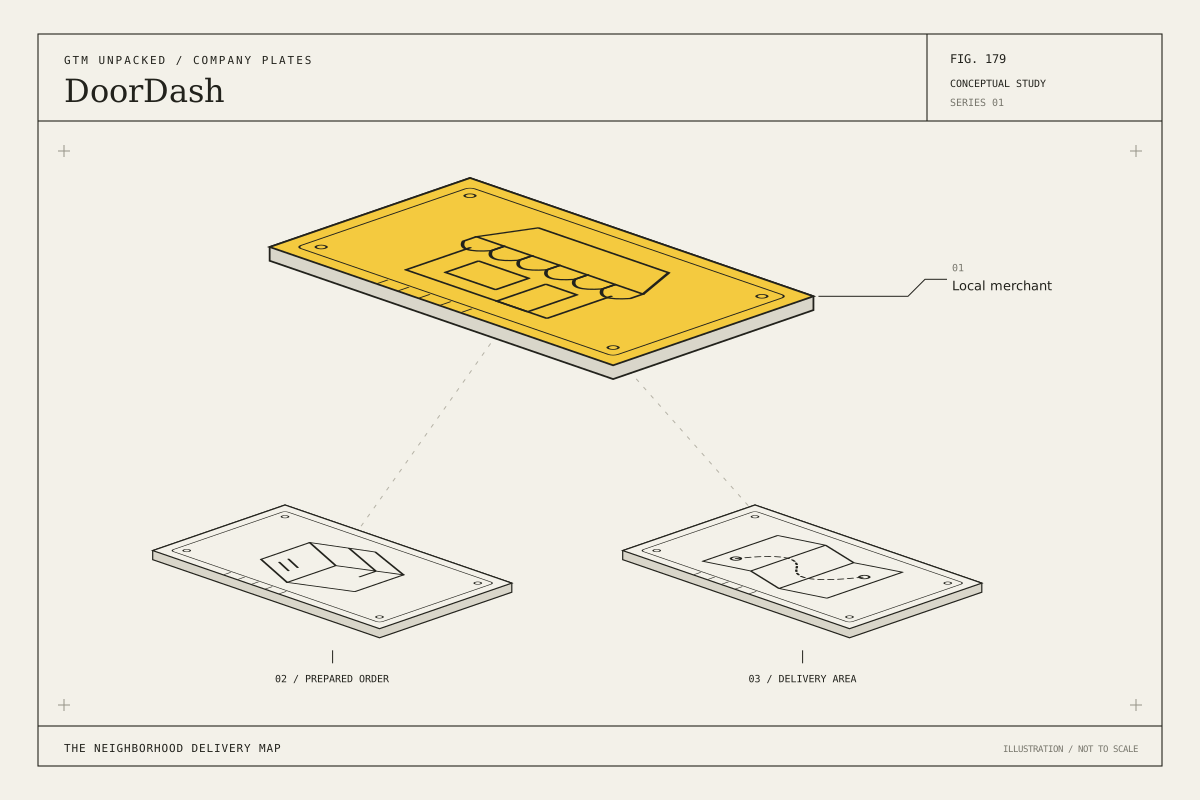
Conceptual illustration placing a storefront, package, and neighborhood map in a balanced local-commerce composition, suggesting movement between places without drawing actual delivery operations.
- Company
- DoorDash · Local-commerce marketplaces · doordash.com
- Conversion motions
- [Inference] This research classifies DoorDash as Human Led and Product Led.
- DoorDash beachhead
- Palo Alto and suburban delivery needs, with a merchant-centered entry point. [1]
- DoorDash target customer
- Local merchants seeking delivery capacity, customers seeking convenience, and couriers seeking paid work.
- Product complexity
- [Inference] Placing an order is simple; matching preparation, pickup, routing and customer expectations across three parties is complex. Growth requires reliable fulfillment, not just conversion at checkout.
- Decision-making unit
- [Inference] Consumers decide per order, merchants assess commercial and operating terms, and couriers evaluate earning opportunities. Each side requires its own value proposition and retention measures.
- Market at entry
- Category awareness and competing alternatives at initial launch require further historical research.
- Market today
- The historical source is not evidence of the current competitive position; present-day market maturity remains to be assessed.
- Evidence
- Source-backed brief · 1 linked source · research date · method and limitations
The ten-step Revenue Engine reading map
These links locate relevant evidence. A linked section does not imply every detail of the step is publicly established.
- Acquire Your First Customers: Founder Led Sales Read first customers
- Embrace GTM Experimentation Not established in this entry
- Understand Your GTM Motion Options Read GTM motion
- Pick Your GTM Motion Not established in this entry
- Generate a Lead Read GTM motion
- Turn Leads into Paying Customers Read GTM motion
- Retain and Grow Your Customers Read retain & expand
- Build Your GTM Team Not established in this entry
- Plan Your Tech Stack Not established in this entry
- Optimize and Scale Through Metrics Read pricing & economics
DoorDash: The evidence: origins and growth
In Sequoia’s founder interview, Tony Xu says the team spoke with hundreds of small businesses before identifying delivery demand that a Palo Alto shop owner, Chloe, could not fulfill. Xu, Stanley Tang, Andy Fang and Evan Moore met through Stanford’s Startup Garage. The company then favored suburban markets, where collecting food required more effort for customers. Investor Alfred Lin describes restaurant clusters on main streets as a counterweight to the apparent lack of urban density. [1]
[1]DoorDash: Revenue Engine interpretation
[Inference] Choose a beachhead by customer need and operating evidence together. A dense market can still be commercially unattractive if the customer already has convenient alternatives; a suburban market can work when concentrated pickup points and repeat demand support the service. [1]
[1]DoorDash: Enablement and expansion
Xu recalls a September 2013 Stanford football-game surge producing late orders. Founders refunded customers and delivered homemade cookies overnight; he says the refund exceeded 40% of their bank balance. [1]
[1]DoorDash: Pricing and economic constraints
[Inference] Lower geographic density does not automatically imply worse economics if willingness to pay is higher, competition weaker and pickup locations clustered. That proposition must be tested with delivery contribution, repeat orders and courier utilization in each market. Actual CAC, gross margin, payback, and cohort retention were not established by this research pass.
DoorDash economics at a glance: Pricing is only half the story.
Historical and current price cards have not been verified.
Merchant commissions and customer delivery demand, balanced against courier payment. Exact historical rates were not verified.
[Inference] Lower geographic density does not automatically imply worse economics if willingness to pay is higher, competition weaker and pickup locations clustered. That proposition must be tested with delivery contribution, repeat orders and courier utilization in each market.
Not established by the source reviewed
Not established by the source reviewed
The people in the DoorDash GTM story: People & capabilities.
Alfred Lin
Sequoia investor and board memberSequoia investor; broader biography not established here.
Assessed the suburban operating evidence.
[1]DoorDash GTM: critical reading and analysis: Why it worked.
Where it breaks.
What worked—and why
[Inference] Choose a beachhead by customer need and operating evidence together. A dense market can still be commercially unattractive if the customer already has convenient alternatives; a suburban market can work when concentrated pickup points and repeat demand support the service. [1]
What did not work
The football-game surge exposed an operational capacity failure before the service could meet its promised experience. [1]
What could have been better
[Inference] Make order-volume limits and delivery-time accuracy part of launch readiness. Service recovery can preserve trust, but a repeatable system needs capacity forecasts and explicit escalation rules.
What another founder can use
[Inference] Choose a beachhead by customer need and operating evidence together. A dense market can still be commercially unattractive if the customer already has convenient alternatives; a suburban market can work when concentrated pickup points and repeat demand support the service.
DoorDash website and pricing captures: Product, positioning & pricing.
Captures and image sources are dated individually. Historical gaps are kept explicit. Explore the visual archive

DoorDash go-to-market FAQ: The questions that matter.
What is the documented GTM lesson from DoorDash?
[Inference] Choose a beachhead by customer need and operating evidence together. A dense market can still be commercially unattractive if the customer already has convenient alternatives; a suburban market can work when concentrated pickup points and repeat demand support the service. [1]
Which go-to-market motions is DoorDash classified under?
[Inference] This research classifies DoorDash as Human Led and Product Led. Motion labels describe routes across segments and periods, not measured revenue shares.
DoorDash sources and open questions: Follow the sources.
- DoorDash ft. Tony Xu – The “Wrong” Moves That Built a Giant | Sequoia Capital sequoiacap.com · interview
Source inspected for the specific facts and attributed account in this brief.
What remains unverified
Research brief, not a completed company investigation.
First paying-customer identity and founder-led sales sequence are incomplete unless explicitly documented above.
Named early sales, success and account-management hires, biographies, training and internal GTM tools need further evidence.
Current pricing, cohort economics, market evolution and historical website screenshots have not all been verified.