
Source numbers link to evidence. [Inference] marks analytical judgment, including motion classifications and causal explanations. Public evidence does not establish every internal decision or metric.
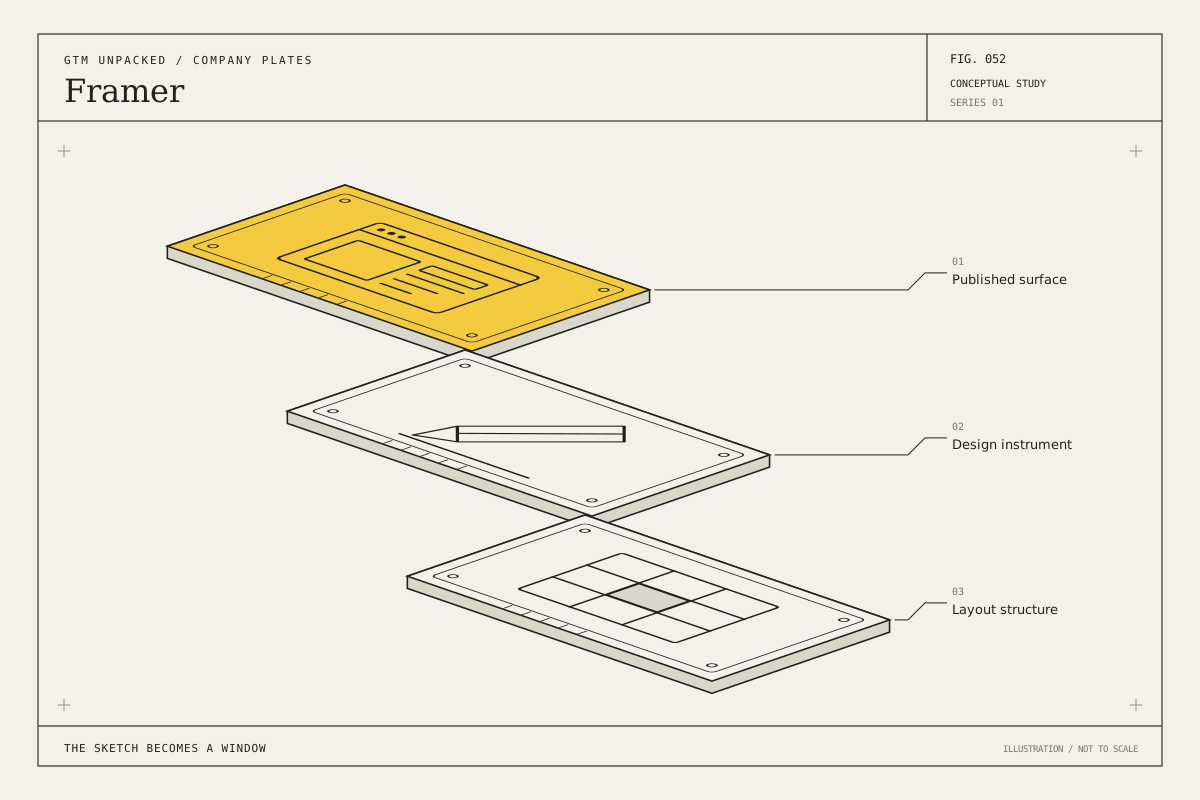
Conceptual illustration of a browser window, drawing pen, and layout grid, placing design and publication on the same plate without reproducing a product interface.
- Company
- Framer · Website creation · framer.com
- Conversion motions
- [Inference] This research classifies Framer as Product Led, Human Led and Partner Led.
- Framer beachhead
- Designers using a prototyping tool; the later beachhead became visually designed websites. [1][2]
- Framer target customer
- Creators, agencies and organizations publishing and operating websites. [3][4]
- Product complexity
- [Inference] Visual building lowers coding requirements; CMS, localization and production hosting add operational complexity.
- Decision-making unit
- [Inference] A creator can choose alone; a company’s production website adds marketing, IT and procurement.
- Market at entry
- The original 2014 product focused on prototyping. [1]
- Market today
- Current packaging includes production hosting, collaboration and enterprise identity controls. [3]
- Evidence
- Source-backed brief · 4 linked sources · research date · method and limitations
The ten-step Revenue Engine reading map
These links locate relevant evidence. A linked section does not imply every detail of the step is publicly established.
- Acquire Your First Customers: Founder Led Sales Read first customers
- Embrace GTM Experimentation Read experiments & lessons
- Understand Your GTM Motion Options Read GTM motion
- Pick Your GTM Motion Read beachhead & buyer · Read product & market
- Generate a Lead Read GTM motion · Read experiments & lessons
- Turn Leads into Paying Customers Read GTM motion · Read people & process
- Retain and Grow Your Customers Read retain & expand
- Build Your GTM Team Read people & process
- Plan Your Tech Stack Read experiments & lessons · Read people & process · Read product & pricing archive
- Optimize and Scale Through Metrics Read pricing & economics
Framer origin and first customers: The founders had built and sold design software
Framer’s official history describes Koen Bok and Jorn van Dijk building Sofa, a Mac-software business acquired by Facebook in 2011. They subsequently worked at Facebook and launched Framer in 2014. [1]
[1]Framer beachhead and buyer: From a design step to a finished business output
The founders’ Foundation Capital interview describes a stalled prototyping product and the May 2022 launch of the website builder. [2]
[Inference] A prototype is an intermediate artifact; a published site is a recurring operational asset. Hosting creates an ongoing reason to pay and a clearer connection to a business outcome, though this does not establish cohort retention.
[2]Framer GTM motion: Self-service and professional delivery coexist
Current pricing supports free entry, online paid plans and enterprise contact. [3] Framer’s Expert program recruits designers to deliver client websites and promotes approved professionals. [4]
The Expert program offers commissions when clients accept project handoffs and purchase a plan. Its examples name Adriano Reis working with Zapier and Matt Jumper on Whereby’s migration. These are delivery examples, not independently measured acquisition outcomes. [4]
[Inference] A professional can make the platform choice while a client funds the project. That is a distinct route to adoption, with delivery quality and partner incentives affecting the end customer’s experience.
[3] [4]Framer product and market: The pivot changed the value proposition
[Inference] Framer’s design capabilities became commercially more direct when users could publish the result. That also changed the reliability obligation: customers need updates, domains and production availability after the creative work is finished.
Framer people and process: Role changes accompanied the product change
The founder interview describes Koen concentrating on product while Jorn took greater responsibility for commercial work. [2] Framer’s history emphasizes Bok’s combined design/engineering skills and van Dijk’s graphic design and typography background. [1]
[Inference] The division paired product craft with explicit commercial ownership. It does not prove that either founder had a pre-existing enterprise-sales playbook; early rep training remains unverified.
[1] [2]Framer retention and expansion: Partners and enterprise support address different needs
Enterprise packaging includes dedicated support; Pro Experts receive free editor access on client projects. [3]
[Inference] Free professional access removes friction from maintenance and handoff. Enterprise support serves a different need: an organization requires accountable help when its production site is business-critical. Neither proves a named CSM structure.
[3]Framer pricing and economics: Site capacity and collaboration create expansion
The November 2026 page lists Basic at $10 and Pro at $30 per month with yearly billing, plus custom Enterprise. Paid capacity, additional editors and add-ons provide expansion paths. [3]
[Inference] Revenue can grow through more demanding sites and collaboration rather than only by adding new logos. Hosting, support and AI-generation costs make unlimited usage economically consequential.
[3]Framer experiments and lessons: A stalled product required a changed job
The founder interview explicitly identifies the earlier prototyping business as stalled. [2]
[Inference] Better marketing would not necessarily have solved that limitation. Publishing moved the product closer to a budgeted outcome, but platform dependence and migration difficulty can become adoption objections that sales and onboarding must address.
[2]Framer website and pricing history: A discontinuity, not a single growth curve
The official timeline distinguishes the 2014 launch from the 2022 website era. [1]
[Inference] Earlier prototyping users should not automatically be counted as evidence of website product-market fit. Historical screenshots and exact pricing migration evidence remain incomplete.
[1]Framer economics at a glance: Pricing is only half the story.
Basic $10 and Pro $30 monthly on yearly billing at review; Enterprise custom. [3]
Site subscriptions, usage/capacity additions, editors and enterprise contracts. [3]
[Inference] Hosting, AI usage and professional support have costs; partner-driven accounts require clear ownership of delivery.
Not established by the sources reviewed.
Not established by the sources reviewed.
The people in the Framer GTM story: People & capabilities.
Jorn van Dijk
Co-founderSofa co-founder and former Facebook employee; graphic design and typography experience. [1]
Took commercial responsibility during the pivot. [2]
[1] [2]Framer GTM: critical reading and analysis: Why it worked.
Where it breaks.
What worked—and why
[Inference] Publishing connected strong design capabilities to a recurring business need.
What did not work
The founders describe the prototyping business as stalled before the pivot. [2]
What could have been better
[Inference] Measure customer outcomes after agency handoff and make migration/maintenance responsibilities explicit.
What another founder can use
[Inference] Changing the job a product completes can matter more than increasing promotion of its original job.
Framer go-to-market FAQ: The questions that matter.
How did Framer get its first customers?
Framer’s official history describes Koen Bok and Jorn van Dijk building Sofa, a Mac-software business acquired by Facebook in 2011. They subsequently worked at Facebook and launched Framer in 2014. [1]
Which go-to-market motions is Framer classified under?
[Inference] This research classifies Framer as Product Led, Human Led and Partner Led. Motion labels describe routes across segments and periods, not measured revenue shares.
Framer sources and open questions: Follow the sources.
- About Framer Framer · primary
Founders, Sofa/Facebook backgrounds and product timeline.
- Lessons from Framer at SXSW Foundation Capital · interview · 2026-04-01
Founder interview on stalled prototyping, role changes and website pivot.
- Framer pricing Framer · primary
Current plans, enterprise support, editor and capacity expansion.
- Become a Framer Expert Framer · primary
Professional program and client-site delivery route.
What remains unverified
First paying customer, early AE/CSM biographies and training are not established by the sources reviewed.
No channel-level CAC, retention or complete historical pricing/screenshot sequence established.
No verified visual capture is attached to this entry. A current screenshot is not a substitute for a historical capture.