
Source numbers link to evidence. Motion classifications, causal explanations and the critique are this site’s analysis. Public evidence does not establish every internal decision or metric.
- Company
- Gorgias · Ecommerce customer experience · gorgias.com
- Conversion motions
- This research classifies Gorgias as Product Led, Human Led and Partner Led.
- Gorgias beachhead
- Shopify merchants whose support agents needed order context inside customer conversations. [2]
- Gorgias target customer
- Ecommerce brands, with current self-service signup and enterprise demo paths. [4][7]
- Product complexity
- An accessible inbox hides complex permissions, commerce integrations and AI workflow controls. [4][5]
- Decision-making unit
- A founder or support leader can sponsor adoption; larger brands also need operational and technical agreement. [3][5]
- Market at entry
- The founder positioned the 2019 offer around growing direct-to-consumer brands and their need to own customer relationships. [2]
- Market today
- The current offer combines helpdesk, AI Agent and optional Voice/SMS within an ecommerce specialization. [4]
- Evidence
- Source-backed brief · 9 linked sources · research date · method and limitations
The ten-step Revenue Engine reading map
These links locate relevant evidence. A linked section does not imply every detail of the step is publicly established.
- Acquire Your First Customers: Founder Led Sales Read first customers
- Embrace GTM Experimentation Read experiments & lessons
- Understand Your GTM Motion Options Read GTM motion
- Pick Your GTM Motion Read beachhead & buyer · Read product & market
- Generate a Lead Read GTM motion · Read experiments & lessons
- Turn Leads into Paying Customers Read GTM motion · Read people & process
- Retain and Grow Your Customers Read retain & expand
- Build Your GTM Team Read people & process
- Plan Your Tech Stack Read experiments & lessons · Read people & process · Read product & pricing archive
- Optimize and Scale Through Metrics Read pricing & economics
Gorgias GTM timeline: From wedge to engine.
Shopify focus documented
Founder reports 2,000 customers after two years focused on Shopify merchants. [2]
Customer becomes channel builder
Roireau describes agency relationships and his earlier merchant experience. [3]
Billing boundary
Current documentation distinguishes accounts predating this legacy-pricing cutoff. [6]
Gorgias origin and first customers: Origin & first customers
Gymglish support work inspired Alex Plugaru’s writing templates. He teamed with Romain Lapeyre and described an extended search for product-market fit in San Francisco. [1]
Working the support queue supplied a concrete task to improve, but that experience did not automatically define a repeatable market. The evidence supports a progression from an internal pain to a narrower commercial problem; it does not identify a verified first paid contract or its amount.
[1]Gorgias beachhead and buyer: Beachhead & target segment
Lapeyre's November 2019 account says the company had spent the previous two years concentrating on Shopify merchants and reached 2,000 customers. Named examples included Rothy's, MVMT and Steve Madden. The proposition combined customer messages with order data rather than presenting an all-purpose inbox. [2]
Shopify provided a common data model, familiar merchant problems and a bounded ecosystem in which recommendations could travel. That focus made a demo more specific: show the actual order and support action instead of explaining a horizontal platform from first principles.
[2]Gorgias GTM motion: How the GTM motion developed
In a 2020 interview, partnerships leader Philippe Roireau described discovering Gorgias through a Shopify contact while operating an ecommerce business. He later joined the company and developed relationships with agencies, including Milk Bottle, alongside ecommerce events. Current pages offer both free signup and a booked demo. [3][4]
These are distinct conversion routes: a merchant can evaluate the product directly, an agency can supply trust and implementation context, and a salesperson can coordinate a larger purchase. Integration availability alone would not prove partner-led selling; Roireau's account supplies the missing distribution mechanism.
[3] [4]Gorgias product and market: Product, buying committee & market maturity
The present website focuses on ecommerce customer experience and connects multiple messaging channels, store data and AI resolution. In 2020, Lapeyre described a sequence in merchant priorities: improve quality and speed, control cost, then use service to support sales. [4][7][8]
The buying conversation therefore changes as customer operations mature. A small store needs fewer repetitive tasks; a larger brand needs consistent workflows, safe automation and clear accountability. Claims about extra merchant revenue should be tested separately from evidence that the helpdesk handles messages efficiently.
[4] [7] [8]Gorgias people and process: People, capabilities & selling process
Plugaru brought direct engineering and support experience from Gymglish. Roireau's interview recounts work at Microsoft and Google, followed by running an ecommerce business and using Gorgias himself. His later partnerships role connected those merchant problems with agencies serving similar stores. [1][3]
Customer experience became an operating qualification, not simply a testimonial. A former buyer could explain implementation objections and economic trade-offs in the buyer's language. The sources do not establish a complete AE hiring sequence, formal sales training curriculum or individual performance metrics.
[1] [3]Gorgias retention and expansion: Enablement, success & expansion
A Gorgias plan guide updated in May 2026 describes self-service resources and webinars for smaller merchants, individual implementation for a middle segment, and dedicated customer success plus optional on-site support for larger accounts. Its allocation is tied to merchant scale and contract size rather than only a product tier. [5]
This separates the price of software consumption from the cost of helping a customer realize value. Expansion can follow higher support volumes, new channels and AI adoption, while larger implementations justify specialist time. Cohort expansion rates and the division of renewal ownership were not verified.
[5]Gorgias pricing and economics: Pricing & implied economics
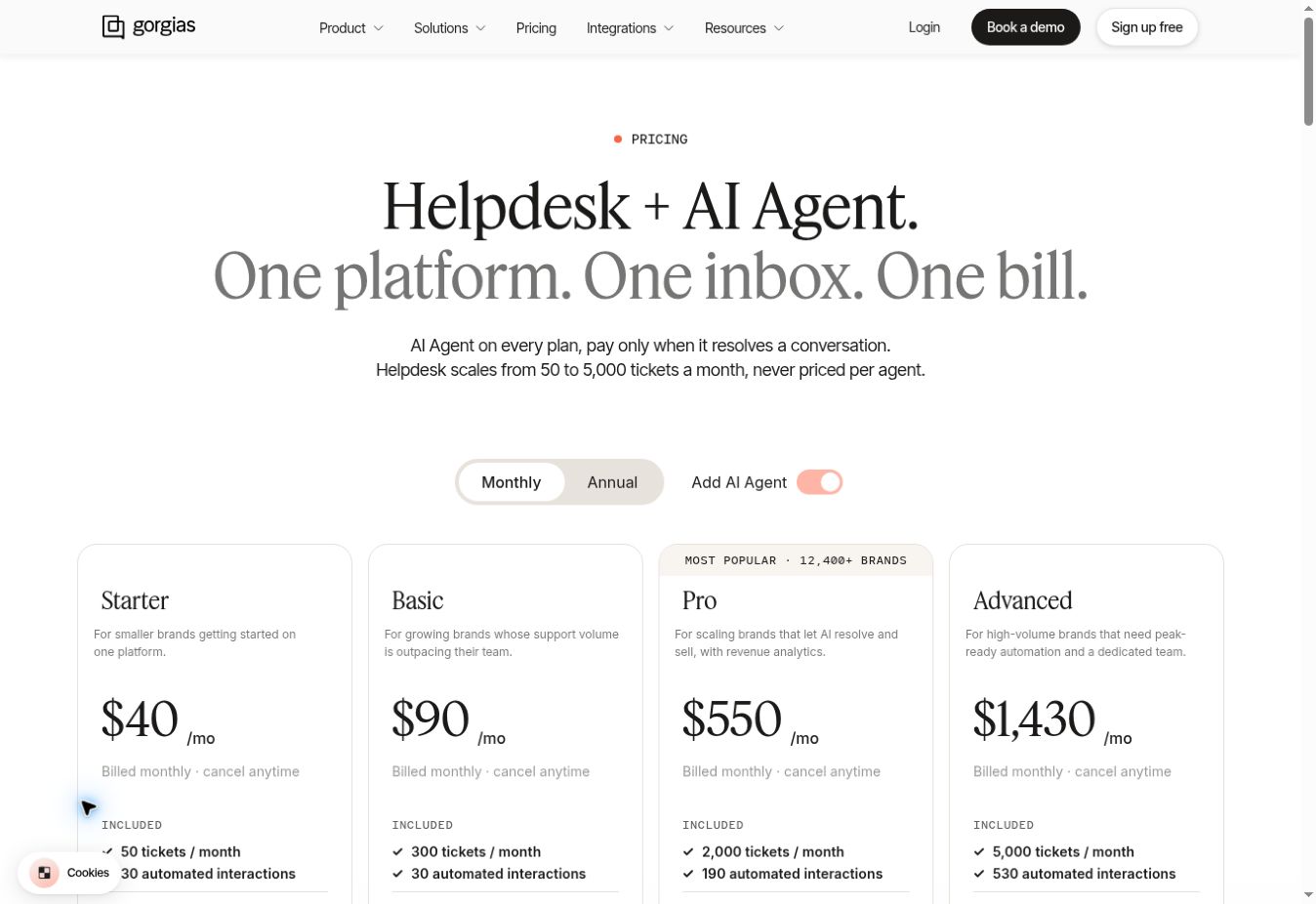
Current billing documentation distinguishes helpdesk ticket charges from additional outcome-based automation charges. It states that an AI-resolved ticket can incur both, and identifies legacy treatment for accounts opened before May 28, 2025. The pricing page says helpdesk plans scale by volume rather than agent seats. [4][6]
Usage pricing can follow merchant activity without penalizing the addition of support staff. It also makes definitions of an automated outcome commercially important. Ticket fees, automation fees, compute expense and service effort must be separated before estimating margin; neither published pricing nor customer counts reveals CAC or payback.
[4] [6]Gorgias experiments and lessons: Experiments, mistakes & operating tools
The original template utility, later Shopify focus and Roireau's trial period before joining show several forms of learning. The 2020 company update described expanding integrations, self-service help and messaging channels in response to merchant needs. It did not publish a controlled comparison of acquisition channels. [1][2][3][8]
A better expansion discipline would evaluate AI resolution quality, billing clarity and implementation workload together. A successful demo is insufficient if exception handling transfers hidden work to the merchant. No verified internal CRM, paid-channel CAC series or documented failed channel is established in this brief.
[1] [2] [3] [8]Gorgias website and pricing history: Website, product & pricing evolution
The read sources show movement from templates to an ecommerce helpdesk, then a broader AI and channel offer. The current billing documentation is more precise about AI ticket charges than the May 2026 marketing guide, which says fully automated responses do not count toward billable tickets. A verified July 2020 replay is attached below. [1][2][4][5][6]
Buyers should rely on current billing definitions and their agreement when older explanatory pages conflict. Keeping product education synchronized with the commercial contract is part of enablement: otherwise a successful automation rollout can create an unexpected invoice and undermine trust.
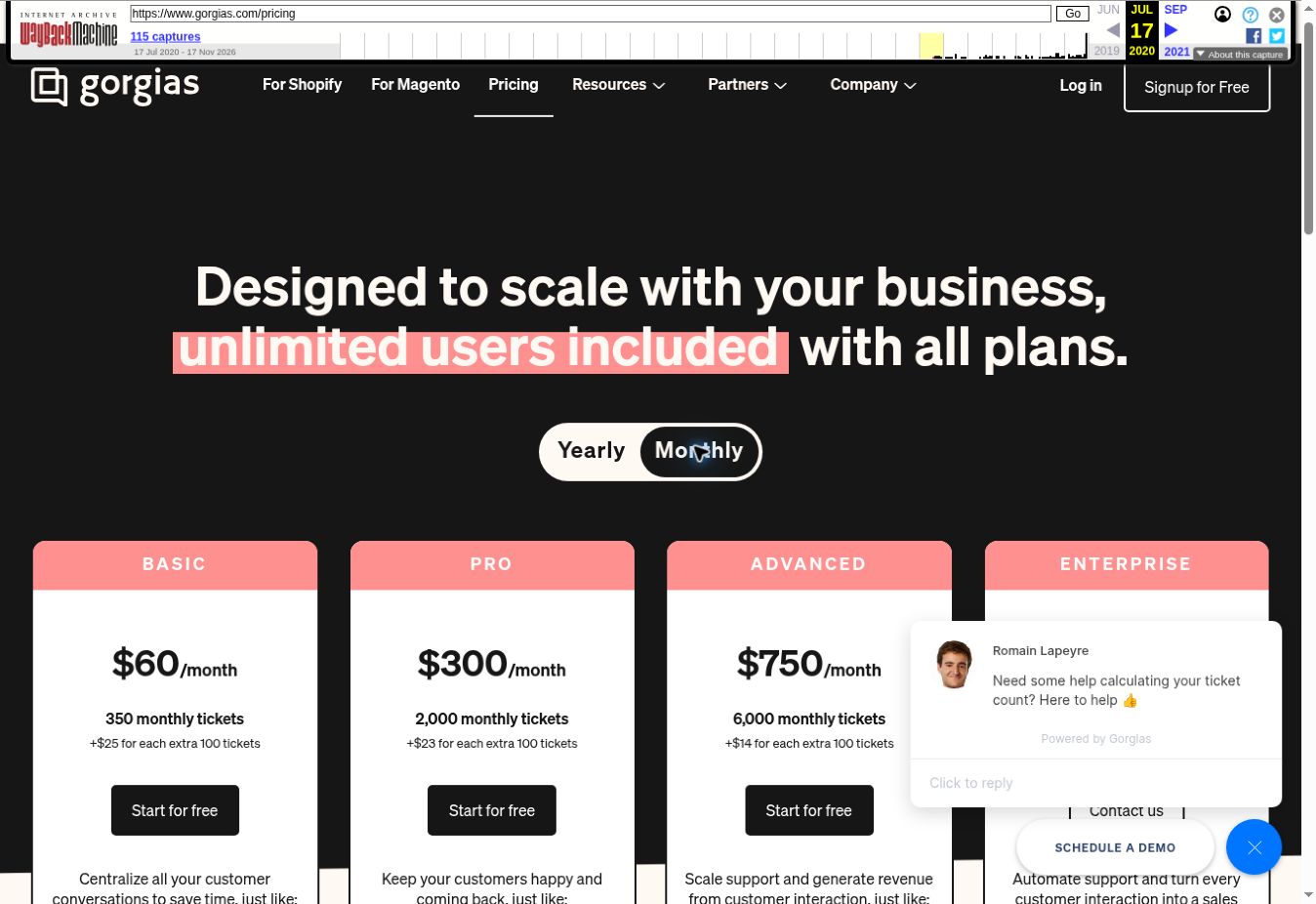
A July 17, 2020 Wayback capture offers a concrete baseline: monthly Basic cost $60 for 350 tickets, Pro $300 for 2,000, and Advanced $750 for 6,000. All included unlimited users; onboarding progressed from self-service to light and full assistance. The annual-billing equivalents were lower. [9]
The historical offer already separated a low-friction entry from more supported adoption. The current screenshot includes an AI Agent bundle, whereas the 2020 table does not; comparing headline prices alone would confuse changes in price, allowances and product scope. [4][9]
[1] [2] [4] [5] [6] [9]Gorgias economics at a glance: Pricing is only half the story.
Helpdesk volume fees plus conditional AI outcome charges; optional channel add-ons. [4][6]
Compute, onboarding and exception handling create costs beyond the message count.
Not verified.
Cohort retention and NRR not verified.
The people in the Gorgias GTM story: People & capabilities.
Alex Plugaru
Co-founder and CTO in the 2023 accountEngineer who volunteered for Gymglish customer support. [1]
Built the template prototype. [1]
[1]Philippe Roireau
Head of business development and partnerships in the 2020 interviewDescribed Microsoft and Google experience, then operating a Shopify ecommerce business. [3]
Moved from customer to employee and developed agency relationships and event presence. [3]
[3]Gorgias GTM: critical reading and analysis: Why it worked.
Where it breaks.
What worked—and why
Shopify specialization made the value demonstration and partner conversation concrete. [2][3]
What did not work
No reliably quantified failed channel was verified. Current billing guidance and the marketing plan guide differ on automated-ticket treatment. [5][6]
What could have been better
Maintain one authoritative billing definition across commercial and educational pages; measure automation quality alongside cost savings.
What another founder can use
Recruit experienced customers when their practical understanding fills a specific distribution or implementation gap. [3]
Gorgias website and pricing captures: Product, positioning & pricing.
Captures and image sources are dated individually. Historical gaps are kept explicit. Explore the visual archive
Gorgias go-to-market FAQ: The questions that matter.
How did Gorgias find its market?
The founders narrowed their customer-service product toward Shopify merchants; Lapeyre documented that focus in 2019. [2]
How did partnerships help Gorgias grow?
Roireau describes recruiting agencies and participating in Shopify events after first using Gorgias as a merchant. [3]
Which go-to-market motions is Gorgias classified under?
This research classifies Gorgias as Product Led, Human Led and Partner Led. Motion labels describe routes across segments and periods, not measured revenue shares.
Gorgias sources and open questions: Follow the sources.
- 10 Years: Big Things Have Small Beginnings Gorgias · primary · 2023-03-29
Plugaru recounts Gymglish support work, templates, accelerators and the later product-market-fit search.
- Our journey from product-market fit to series A Gorgias · primary · 2019-11-26
2019 Shopify specialization, 2,000 customers, order context and the conversational-commerce proposition.
- How Gorgias can help you and your customers Milk Bottle Labs · interview · 2020-03-17
Roireau describes Microsoft/Google history, merchant use, a Shopify referral and agency partnership work.
- Gorgias pricing Gorgias · primary
Current ticket-volume, AI-resolution and channel structure; signup and demo routes. Dynamic rate table not exposed in text.
- Which Gorgias Plan Should You Choose? Gorgias · primary · 2026-05-14
Support tiers by merchant scale; marketing-guide ticket treatment differs from present billing documentation.
- How you're billed for using Gorgias Gorgias · primary
Authoritative helpdesk and outcome-fee definitions, possible double charge, legacy cutoff.
- About Gorgias Gorgias · primary
Current ecommerce AI customer-experience positioning and product/channel ecosystem.
- Why we raised our Series B Gorgias · primary · 2020-12-10
2020 merchant needs sequence and planned help-center, integration and channel expansion.
- Gorgias pricing, archived 17 July 2020 Gorgias / Internet Archive · primary archive · 2020-07-17
Original monthly and annual plan text retrieved over HTTP and the monthly tab inspected in an actual Wayback replay. Ticket allowances, unlimited users and differentiated onboarding are visible.
What remains unverified
First paid contract and customer identity not established.
CAC, NRR, seller quotas, CRM vendors and complete CS hiring sequence not verified.
Plan-guide billing language conflicts with current documentation. Current and 2020 screenshots have different bundle contents; no like-for-like price inflation is inferred.
Only one historical pricing snapshot was inspected. The replay includes a third-party chat widget; the archived plan text, rather than widget content, supports the historical claims.