
Source numbers link to evidence. [Inference] marks analytical judgment, including motion classifications and causal explanations. Public evidence does not establish every internal decision or metric.
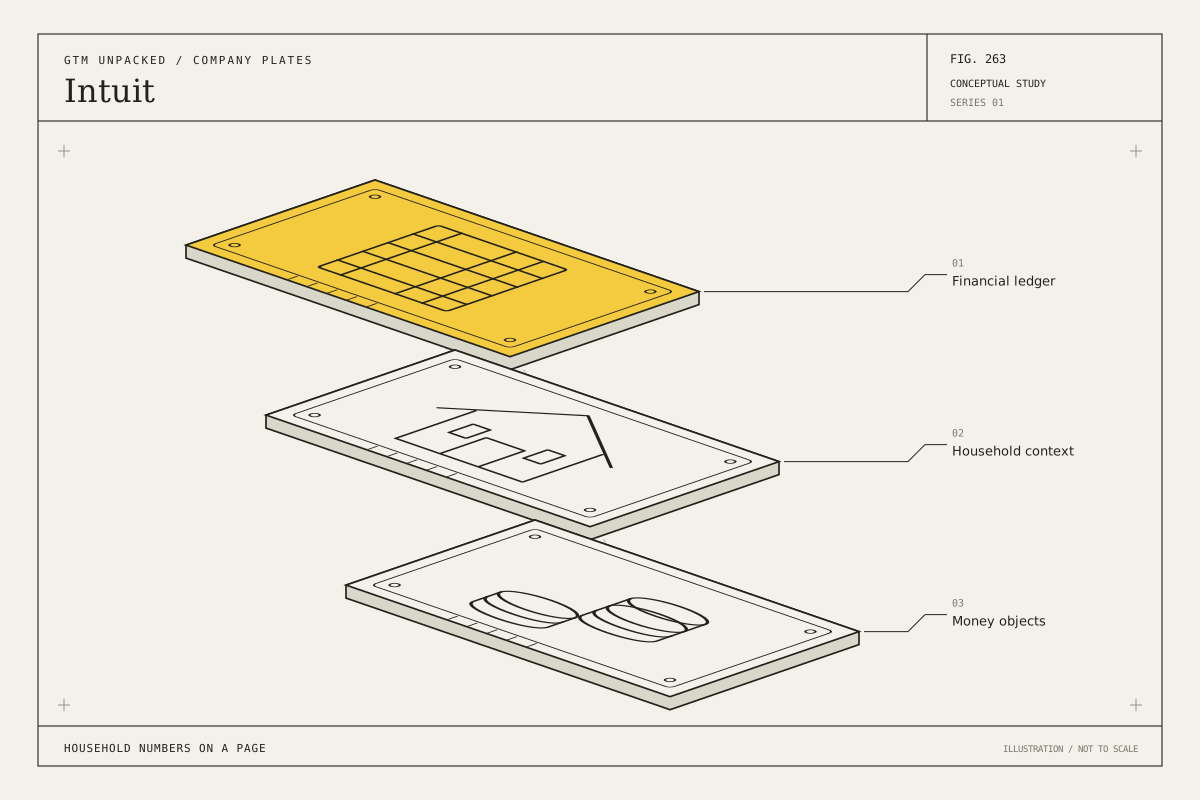
Conceptual illustration of a ledger, home outline, and coins, gathering everyday financial objects into a technical plate without implying a specific budgeting method.
- Company
- Intuit, also listed as Intuit (QuickBooks/TurboTax) · Financial software · intuit.com
- Conversion motions
- [Inference] This research classifies Intuit as Product Led, Marketing Led and Partner Led.
- Intuit beachhead and target customer
- [Inference] Initially household personal-finance users; later consumers, small businesses and accounting professionals.
- Product and buying complexity
- [Inference] A single consumer purchase is simpler than a business accounting deployment involving advisers and financial controls.
- Market at entry
- [Unverified] This focused brief does not establish the full market conditions at first sale.
- Evidence
- Evidence brief · 1 linked source · research date · method and limitations
The ten-step Revenue Engine reading map
These links locate relevant evidence. A linked section does not imply every detail of the step is publicly established.
- Acquire Your First Customers: Founder Led Sales Read first customers
- Embrace GTM Experimentation Read experiments & lessons
- Understand Your GTM Motion Options Read GTM motion
- Pick Your GTM Motion Not established in this entry
- Generate a Lead Read GTM motion · Read experiments & lessons
- Turn Leads into Paying Customers Read GTM motion
- Retain and Grow Your Customers Read retain & expand
- Build Your GTM Team Not established in this entry
- Plan Your Tech Stack Read experiments & lessons
- Optimize and Scale Through Metrics Not established in this entry
Intuit: Origin and evidence boundary
The first paid customer and founder closing sequence were not established in this focused evidence brief.
Intuit’s own origin account says Scott Cook observed the difficulty of balancing a household checkbook in 1983. Cook and Tom Proulx built Quicken around the emerging personal computer. The company describes successive transitions across desktop, web, mobile and cloud; its current portfolio includes consumer and small-business financial products. [1]
[1]Intuit: Motion and buyer logic
[Inference] Initially household personal-finance users; later consumers, small businesses and accounting professionals.
[Inference] A single consumer purchase is simpler than a business accounting deployment involving advisers and financial controls.
[1]Intuit: Retention and expansion hypothesis
[Inference] Recurring financial records create opportunities for additional workflows, but each product has a different buyer and adoption cycle.
[Unverified] Individual CSM ownership, enablement conversion and renewal cohorts were not established in this brief.
Intuit: Critical reading
[Inference] A clear existing job can reduce category education. Do not flatten four decades of distinct products and distribution choices into one timeless motion.
[Unverified] The inspected material does not establish failed-channel experiments or a complete causal account of growth.
Intuit economics at a glance: Pricing is only half the story.
Exact current pricing was not verified in this brief.
[Inference] Recurring financial records create opportunities for additional workflows, but each product has a different buyer and adoption cycle.
[Inference] A clear existing job can reduce category education. Do not flatten four decades of distinct products and distribution choices into one timeless motion.
Not publicly verified in this brief.
Not publicly verified in this brief.
The people in the Intuit GTM story: People & capabilities.
Scott Cook and Tom Proulx
People identified in the sourceScott Cook and Tom Proulx — founders named in the company history.
See the source-backed account above; additional skills and training are not inferred as fact.
[1]Intuit GTM: critical reading and analysis: Why it worked.
Where it breaks.
What worked—and why
[Inference] A clear existing job can reduce category education. Do not flatten four decades of distinct products and distribution choices into one timeless motion.
What did not work
No substantiated failed experiment established in the inspected evidence.
What could have been better
[Inference] Validate the proposed growth mechanism with paid conversion, implementation cost and retained customer outcomes.
What another founder can use
[Inference] Recurring financial records create opportunities for additional workflows, but each product has a different buyer and adoption cycle.
Intuit go-to-market FAQ: The questions that matter.
What does this case establish about Intuit?
The inspected source supports the specific product, people or distribution facts in the origin section; a full chronological reconstruction remains incomplete. [1]
Is the full GTM history of Intuit verified?
No. This is a focused evidence brief. The page distinguishes inspected claims from analytical hypotheses and lists the remaining gaps.
Which go-to-market motions is Intuit classified under?
[Inference] This research classifies Intuit as Product Led, Marketing Led and Partner Led. Motion labels describe routes across segments and periods, not measured revenue shares.
Intuit sources and open questions: Follow the sources.
- Intuit — inspected company evidence Intuit · primary
Origin, product, team or current commercial route described in the source; narrower claims are attributed in the text.
What remains unverified
Evidence brief rather than a full historical GTM reconstruction.
First contracts, complete hiring sequence, pricing history, CAC and retention require further source verification.
No historical website screenshot or named account expansion is represented as verified.
No verified visual capture is attached to this entry. A current screenshot is not a substitute for a historical capture.