Source numbers link to evidence. Motion classifications, causal explanations and the critique are this site’s analysis. Public evidence does not establish every internal decision or metric.
- Company
- Weebly · Website builders · weebly.com
- Conversion motions
- This research classifies Weebly as Product Led.
- Weebly beachhead
- Nontechnical people needing a publishable personal or small-business website.
- Weebly target customer
- Individuals and merchants who need editing, hosting and commerce in one workflow.
- Product complexity
- Hosting integration reduces the deployment work required after editing.
- Decision-making unit
- An individual can buy directly; commerce needs add operational requirements.
- Market at entry
- Founder accounts describe portfolio sites and manual web publishing as early friction. [1][2]
- Market today
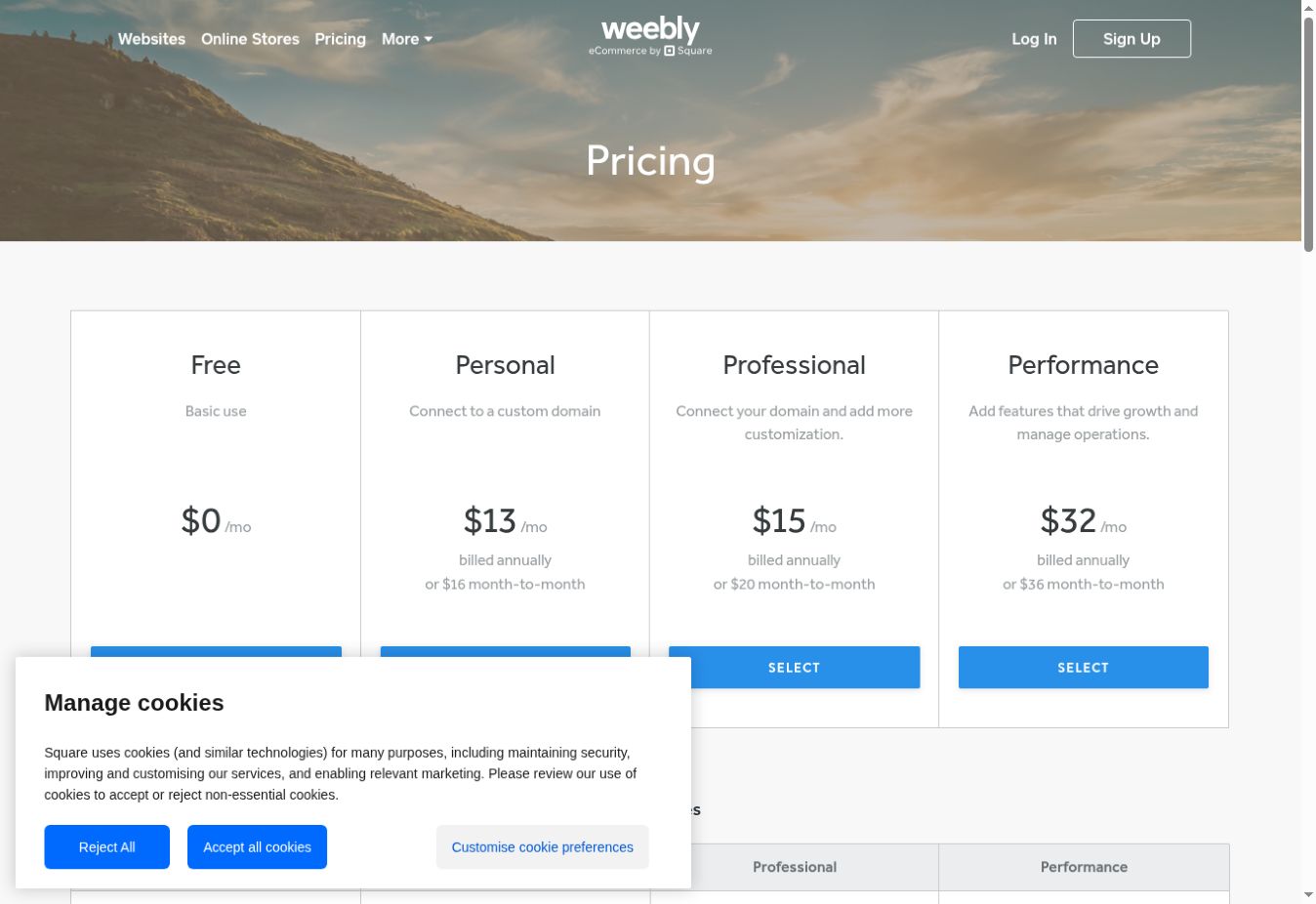
- The current localized price page still separates free and paid plans; current product leadership is unverified. [5]
- Evidence
- Source-backed brief · 5 linked sources · research date · method and limitations
The ten-step Revenue Engine reading map
These links locate relevant evidence. A linked section does not imply every detail of the step is publicly established.
- Acquire Your First Customers: Founder Led Sales Read first customers
- Embrace GTM Experimentation Read experiments & lessons
- Understand Your GTM Motion Options Read GTM motion
- Pick Your GTM Motion Read beachhead & buyer · Read product & market
- Generate a Lead Read GTM motion · Read experiments & lessons
- Turn Leads into Paying Customers Read GTM motion · Read people & process
- Retain and Grow Your Customers Read retain & expand
- Build Your GTM Team Read people & process
- Plan Your Tech Stack Read experiments & lessons · Read people & process · Read product & pricing archive
- Optimize and Scale Through Metrics Read pricing & economics
Weebly origin and first customers: Origin & first customers
David Rusenko’s Penn State interview traces the project to students struggling with required portfolios and tools such as FrontPage. The team shifted toward a general website builder and demonstrated it at New York Tech Meetup. Early demonstrations were not proof of paid demand. [2]
The originating problem offered a concrete acceptance test: could someone without web-development knowledge create a credible page? That is stronger than merely asking whether people like a simpler editor. However, student enthusiasm would still need testing against users with ongoing publishing needs and a reason to pay. The first invoice and first paying customer are not established here.
[2]Weebly beachhead and buyer: Beachhead & target segment
The beachhead was defined by a capability gap rather than a single industry: people who needed a website but could not comfortably build and publish one. A student, club or small merchant could encounter the same technical obstacle while having very different purchasing power. Treating all registrations as one addressable paid segment would therefore obscure the business problem.
Rusenko recalled initial skepticism from technical audiences who thought everyone needing a website could already make one. His investor demonstrations recreated existing websites quickly; these were investor pitches, not documented customer contracts. [2]
[2]Weebly GTM motion: How the GTM motion developed
In the Mixergy interview, Rusenko described allowing users to try premium elements before paying; those elements would not appear on the published page without an upgrade. He attributed roughly 80% of new users at that time to offline word of mouth. [1]
Word of mouth is the acquisition channel. The conversion mechanism is product led: build something useful, encounter a meaningful premium requirement, and decide whether to purchase. This separates recommendation from monetization. A large free audience can help discovery while producing few subscribers; the reviewed evidence does not support a current free-to-paid rate or an ARR calculation from cumulative signups.
[1]Weebly product and market: Product, buying committee & market maturity
The acquisition announcement described free hosting alongside paid design, hosting, stores and marketing tools. Square proposed combining those capabilities with payments, hardware and software for merchants operating across channels. [3]
A simple website can have one decision maker. A merchant connecting orders, stock and payments has a wider operating problem even if the owner still signs alone. The integration opportunity expands the product’s value but also increases the consequences of failures. The later buyer journey should therefore be evaluated through completion of real transactions, not solely through whether a page was published successfully.
[3]Weebly people and process: People, capabilities & selling process
Rusenko named Dan Veltri and Chris Fanini as fellow founders. He credited Veltri with pushing for integrated hosting and answering early customer email. [1]
The Penn State interview identifies an early designer only as Justin, hired around mid-2008; his surname and a complete hiring sequence were not verified. [2]
The documented capability additions addressed product adoption and customer understanding. They do not establish an enterprise sales organization. Founder support can feed product decisions, but a scalable organization needs a way to preserve the objections and confusion those founders hear. No named early account executive, customer-success leader, CRM or support platform is established by this source set.
[1] [2]Weebly retention and expansion: Enablement, success & expansion
The current pricing page lists chat and email support, with telephone and priority support appearing in higher-plan comparisons. Its extracted table does not preserve every column association, so this brief does not map each support feature to a specific tier. [5]
For a website business, retention depends on continued operation of the customer’s site and business. For a store, successful order handling adds another recurring value test. Customer assistance should be assessed by whether it restores publishing or selling, not merely by ticket closure. Named renewal owners, response-time outcomes and cohort retention remain unknown; cross-selling a payment product is an opportunity, not evidence that every website owner wants one.
[5]Weebly pricing and economics: Pricing & implied economics
The November 19, 2026 rendered price card showed Personal €11, Professional €17 and Performance €30 per month when billed annually, versus €14, €22 and €40 month-to-month. This is a localized euro variant, not a universal US price list. [5]
Square’s quarterly filing describes hosting fees generally billed at inception and recognized over the relevant service term. [4]
Upfront cash collection, recognized revenue and annualized subscription value are different measurements. A sustainable free tier requires paid contribution to cover hosting and support across the broader user base. Published plan rates alone cannot establish that balance, customer lifetime value or whether an assisted acquisition channel would pay back.
[4] [5]Weebly experiments and lessons: Experiments, mistakes & operating tools
Rusenko described testing the placement and naming of an unfinished collaboration feature using a truthful coming-soon notice. He also described pricing experiments. These are not evidence of a measured lift, which the interview did not provide. [1]
This is a useful distinction between testing discoverability and proving a product outcome. A click can help choose a label without proving willingness to pay or durable adoption. A better experimental record would connect exposure, actual collaboration, upgrade and later cancellation. The case does not claim that Weebly ran fake payment failures; the interview explicitly attributes that anecdote to another business.
[1]Weebly website and pricing history: Website, product & pricing evolution
Square announced the agreement on April 26, 2018, citing more than 625,000 paid subscribers. [3] Its filing records the acquisition of all Weebly shares on May 31, 2018. [4]
The defensible historical arc is from an accessible publishing task toward a broader merchant operating system. A strategic purchase is not itself proof that the original freemium economics were optimal. Current leadership specific to the Weebly product was not established. Support pages returned JavaScript-only content, and no archived website capture was obtained; therefore no discontinuation date or visual redesign chronology is asserted.
[3] [4]Weebly economics at a glance: Pricing is only half the story.
Localized euro card observed 2026-11-19: Personal €11/€14, Professional €17/€22, Performance €30/€40 monthly equivalents, annual/monthly billing respectively. [5]
Subscription hosting and premium features.
Published pricing does not establish acquisition cost, service labor, contribution margin or payback.
Not publicly verified in this research.
No audited cohort retention established.
The people in the Weebly GTM story: People & capabilities.
David Rusenko
Cofounder and historical CEOPenn State information sciences and technology graduate.
Explained product demonstrations and the merchant integration problem in his later interview.
[2]Dan Veltri
CofounderKnew Rusenko at Penn State.
Advocated hosting within the product and handled early customer emails.
[1]Chris Fanini
CofounderMet Rusenko through college friends.
Joined the founding team; a specific commercial remit was not established.
[1]Weebly GTM: critical reading and analysis: Why it worked.
Where it breaks.
What worked—and why
Publishing a usable website made the upgrade credible; commerce widened the job.
What did not work
Rusenko recalled weak initial reception and product usability obstacles; no quantified failed paid-acquisition experiment was established. [2]
What could have been better
Measure publication, repeated use, upgrade and support effort separately for informational sites and commerce merchants.
What another founder can use
Reproduce the mechanism only when the target customer, required trust and cost to serve are comparable.
Weebly website and pricing captures: Product, positioning & pricing.
Captures and image sources are dated individually. Historical gaps are kept explicit. Explore the visual archive
Weebly go-to-market FAQ: The questions that matter.
What remains unverified in the Weebly research?
First paying customer, initial contract and complete paid conversion cohorts not verified. Current Weebly-specific leadership and named sales/success hires not verified.
Which go-to-market motions is Weebly classified under?
This research classifies Weebly as Product Led. Motion labels describe routes across segments and periods, not measured revenue shares.
Weebly sources and open questions: Follow the sources.
- How Weebly Quietly Became A Giant Publishing Platform Mixergy · interview
Historical founder interview on hosting, upgrades and conversion tests.
- Building Weebly with Founder David Rusenko — transcript Invent Penn State · interview
Founder account of the initial publishing problem and product development.
- Square to Acquire Weebly Square · primary · 2018-04-26
Acquisition announcement and historical customer scope.
- Square Form 10-Q, quarter ended June 30, 2018 Square / SEC · primary
Acquisition closing and accounting disclosure.
- Weebly Pricing Weebly · primary
Localized live pricing; currency variants differ.
What remains unverified
First paying customer, initial contract and complete paid conversion cohorts not verified.
Current Weebly-specific leadership and named sales/success hires not verified.
Pricing rendered in EUR for the author and USD for the root screenshot; neither observation is a universal regional price.
The support pages could not be read; no claim is made about a service sunset.
Internal CRM, support stack, CAC, NRR and contribution margin not verified.
No historical website screenshot or visual redesign chronology established.