
Source numbers link to evidence. [Inference] marks analytical judgment, including motion classifications and causal explanations. Public evidence does not establish every internal decision or metric.
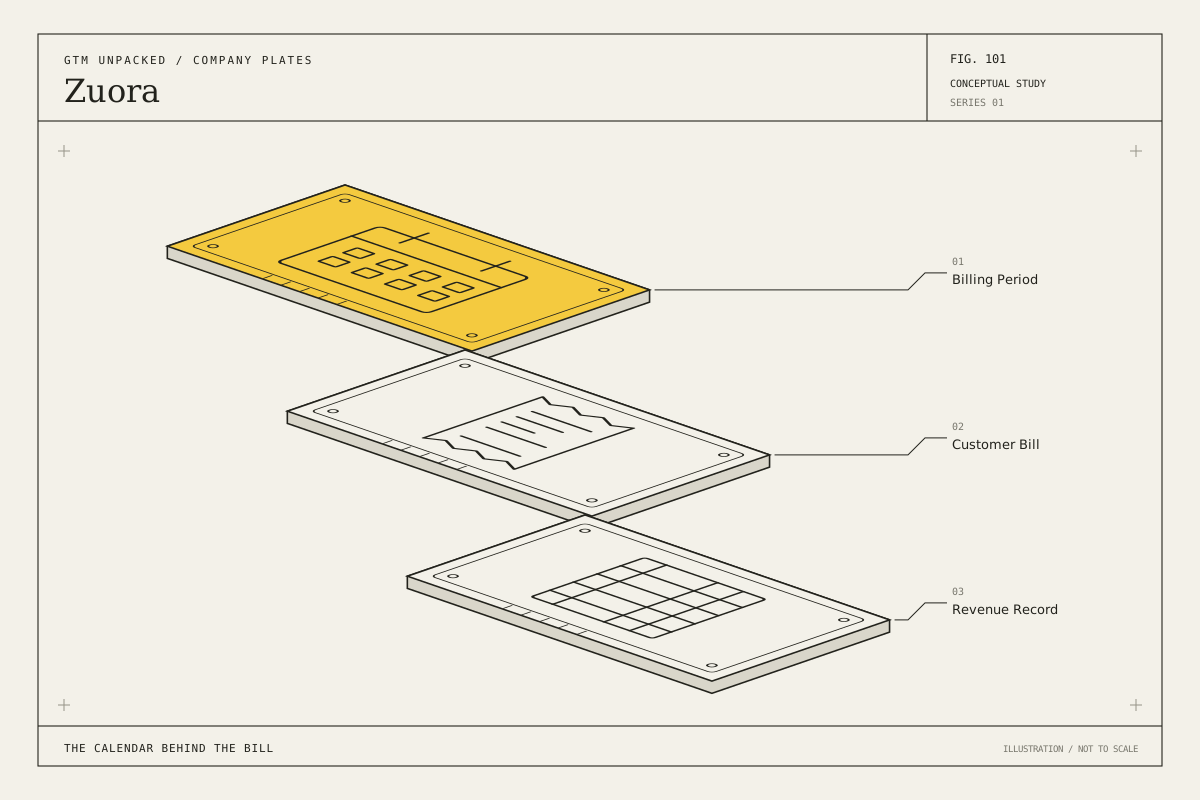
Conceptual illustration of recurring billing through a calendar, receipt and ledger, presenting time, a bill and its record as related commercial objects.
- Company
- Zuora · Billing and monetization · zuora.com
- Conversion motions
- [Inference] This research classifies Zuora as Human Led, Marketing Led and Partner Led.
- Zuora beachhead
- Subscription businesses outgrowing basic billing
- Zuora target customer
- Recurring-revenue companies and enterprises changing monetization models
- Product complexity
- High: billing, finance and revenue workflows
- Decision-making unit
- [Inference] Finance, IT, product, revenue operations and executive sponsors
- Market at entry
- Emerging SaaS subscriptions alongside established ERP systems
- Market today
- [Inference] Recurring billing is established; hybrid and usage monetization extend the problem
- Evidence
- Source-backed brief · 5 linked sources · research date · method and limitations
The ten-step Revenue Engine reading map
These links locate relevant evidence. A linked section does not imply every detail of the step is publicly established.
- Acquire Your First Customers: Founder Led Sales Read first customers
- Embrace GTM Experimentation Read experiments & lessons
- Understand Your GTM Motion Options Read GTM motion
- Pick Your GTM Motion Read beachhead & buyer · Read product & market
- Generate a Lead Read GTM motion · Read experiments & lessons
- Turn Leads into Paying Customers Read GTM motion · Read people & process
- Retain and Grow Your Customers Read retain & expand
- Build Your GTM Team Read people & process
- Plan Your Tech Stack Read experiments & lessons · Read people & process · Read product & pricing archive
- Optimize and Scale Through Metrics Read pricing & economics
Zuora origin and first customers: Origin & first customers
Zuora began in 2007 around a shift from product transactions to recurring customer relationships. Stanford’s 2017 case summary describes a progression from startups to customers including Box, Financial Times, Ford, GM and Caterpillar, with $100 million ARR reached in 2016. The case supports the segment evolution, but its publicly accessible summary does not document the first paid contract or the founders’ exact first-customer outreach. [1]
[1]Zuora beachhead and buyer: Beachhead & buyer
[Inference] The narrow initial customer was a business whose revenue model created problems that conventional accounting and invoicing workflows handled poorly. Subscription startups understood that pain without needing a general lecture on recurring revenue. Traditional enterprises represented a larger opportunity but needed internal agreement about changing commercial models. That difference explains why the same technical platform could require very different selling effort by segment.
Zuora GTM motion: GTM motion & lead conversion
Tien Tzuo’s Subscription Economy positioning and the Subscribed event series provided a language and gathering place for prospective buyers. In 2014, Zuora added a large-enterprise conference track while reporting almost 50 customer implementations per quarter. [2] [Inference] Marketing helped create urgency and executive sponsorship; field teams still had to convert that interest into a scoped, integrated finance project. Category leadership should not be mistaken for a low-touch purchasing motion.
[2]Zuora product and market: Product, market & buying complexity
[Inference] Billing is easy to demonstrate with a sample invoice, but difficult to deploy across real pricing plans, legacy data and financial controls. The buyer must ask what happens to revenue if migration fails, not simply whether the interface is attractive. A sales process therefore needs a defined launch scope, data migration responsibilities and evidence that finance can operate the result. The critical competitor may be postponement as much as another software vendor.
Zuora people and process: People & operating process
Marc Diouane joined in 2014 as executive vice president of global field operations. Zuora described more than 20 years of leadership experience, including international sales and global services and partners at PTC, with expansion experience in Europe and Asia. [2] [Inference] Hiring a leader who had managed sales, alliances and delivery addressed the complete enterprise adoption problem. It was not merely an attempt to add more quota-carrying capacity.
[2]Zuora retention and expansion: Customer success & expansion
The 2018 filing describes sales to companies adopting, transforming and expanding subscriptions, alongside professional services. Dollar-based retention increased from 100% in fiscal 2016 to 110% in fiscal 2018; customers with at least $100,000 ACV rose from 242 to 415. [3] [Inference] Expansion worked through deeper revenue operations and larger account commitments, but those figures do not identify which customer-success activities caused improvement or establish retention in the present.
[3]Zuora pricing and economics: Pricing & economic constraints
Professional-services gross margin was negative 3% in fiscal 2018, improved from negative 9% the previous year, according to the filing. [3] [Inference] Services could enable valuable subscriptions while still consuming economic resources. A useful unit-economics model must combine implementation subsidy, selling time and recurring gross profit. Current negotiated subscription prices and CAC were not verified; transaction volume managed by customers is not Zuora revenue.
[3]Zuora experiments and lessons: Experiments, lessons & critique
In its fiscal-2024 results, Tzuo said new-customer acquisition accelerated through smaller, faster initial deployments. [4] [Inference] This is an important counterweight to the expansive category narrative: transformation stories can generate ambitious projects that take too long to close or implement. A better operating discipline is a narrow first production use case with explicit expansion gates, while preserving the longer-term platform vision.
[4]Zuora website and pricing history: Positioning & pricing evolution
Tzuo’s later commentary describes flexible monetization beyond a pure fixed subscription, including hybrid consumption, top-ups and other models. [5] [Inference] The category must evolve with actual buying behavior; insisting that every customer adopt a recurring bundle would constrain the market. This brief reconstructs messaging through dated documents rather than claiming a verified visual archive. A historical pricing-page sequence remains an evidence gap.
[5]Zuora economics at a glance: Pricing is only half the story.
Negotiated subscription rates not verified.
Subscription software with professional services
[Inference] Complex integration creates selling and implementation expense.
Not publicly verified
Dollar-based retention 110% in fiscal 2018; historical, not current. [3]
The people in the Zuora GTM story: People & capabilities.
Marc Diouane
Global field operations leader, appointed 2014PTC international sales, global services and partner leadership.
Brought integrated enterprise sales and delivery experience across geographies. [2]
[2]Zuora GTM: critical reading and analysis: Why it worked.
Where it breaks.
What worked—and why
[Inference] Category education reached executives while field operations handled implementation. [2]
What did not work
[Inference] Negative services margins show delivery was not costless; they do not prove the overall strategy failed. [3]
What could have been better
[Inference] Start with smaller deployments and explicit production milestones. [4]
What another founder can use
[Inference] A category narrative works best when the first contract has a manageable implementation boundary.
Zuora go-to-market FAQ: The questions that matter.
How did Zuora find its GTM motion?
Tien Tzuo’s Subscription Economy positioning and the Subscribed event series provided a language and gathering place for prospective buyers. In 2014, Zuora added a large-enterprise conference track while reporting almost 50 customer implementations per quarter. [2] [Inference] Marketing helped create urgency and executive sponsorship; field teams still had to convert that interest into a scoped, integrated finance project. Category leadership should not be mistaken for a low-touch purchasing motion.
What can founders learn from Zuora?
[Inference] A category narrative works best when the first contract has a manageable implementation boundary.
Zuora sources and open questions: Follow the sources.
- Zuora in 2017: Leading the Subscription Economy Revolution — public case summary Stanford GSB · primary
Search-indexed public summary; full case unavailable.
- Zuora appoints Marc Diouane Zuora · primary · 2014-04-01
- Zuora S-1/A SEC / Zuora · primary · 2018-04-10
- Fiscal 2024 results Zuora · primary
- Is the Subscription Economy Over? Zuora · primary
What remains unverified
No verified historical website screenshot was available for this brief.
Early CRM, sales engagement and enablement tools were not verified; product integrations are not treated as internal GTM tools.
Exact first paid contract and early funnel conversion are not publicly verified in the inspected sources.
No verified visual capture is attached to this entry. A current screenshot is not a substitute for a historical capture.