
Source numbers link to evidence. [Inference] marks analytical judgment, including motion classifications and causal explanations. Public evidence does not establish every internal decision or metric.
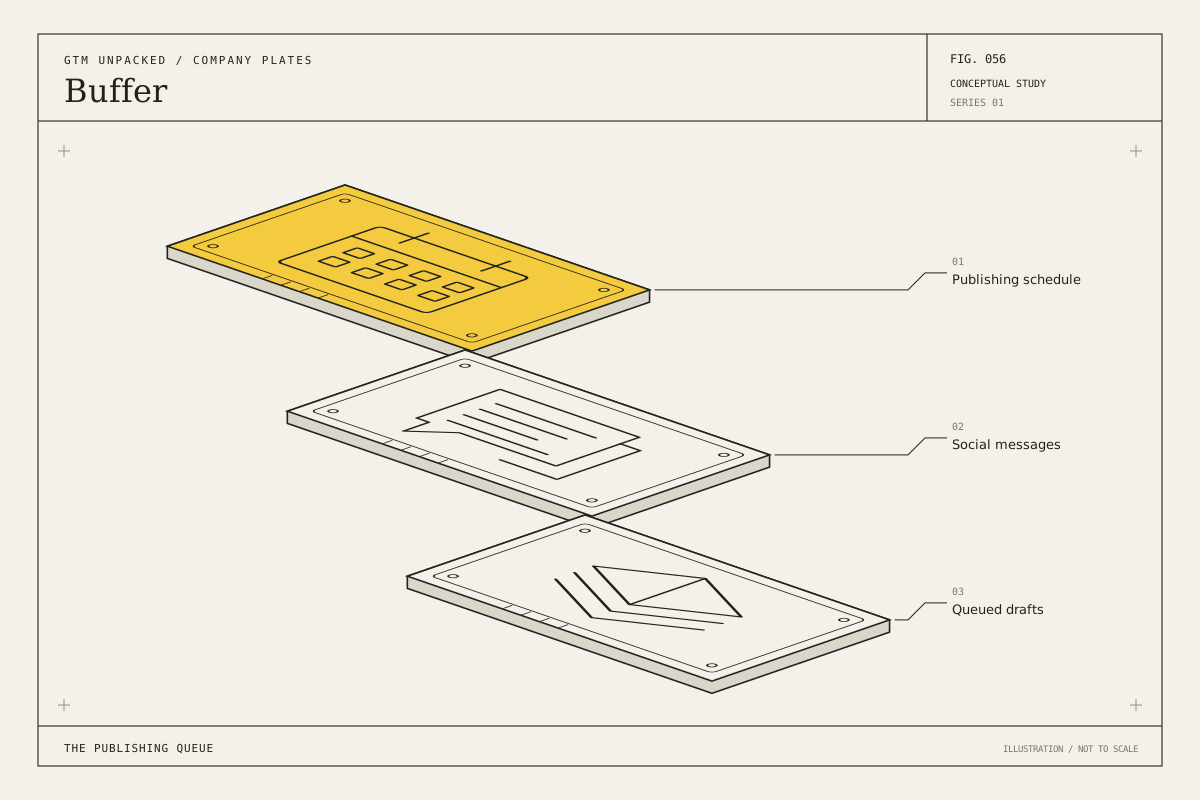
Conceptual illustration for Buffer: a calendar, message bubbles, and layered sheets evoke social publishing arranged into a calm queue, without representing verified technical architecture.
- Company
- Buffer · Social publishing · buffer.com
- Conversion motions
- [Inference] This research classifies Buffer as Product Led and Marketing Led.
- Buffer beachhead
- People who wanted to queue tweets without scheduling each one separately. [1]
- Buffer target customer
- Creators, small businesses and agencies managing social channels. [4]
- Product complexity
- [Inference] Queueing a post is simple; permissions, approvals and multi-brand operations add complexity.
- Decision-making unit
- [Inference] An individual can subscribe alone; an agency or team also needs workflow and access agreement.
- Market at entry
- The founder saw existing Twitter schedulers but wanted a better queueing experience. [1]
- Market today
- Current packaging spans multiple social channels, analytics and team approvals. [4]
- Evidence
- Source-backed brief · 4 linked sources · research date · method and limitations
The ten-step Revenue Engine reading map
These links locate relevant evidence. A linked section does not imply every detail of the step is publicly established.
- Acquire Your First Customers: Founder Led Sales Read first customers
- Embrace GTM Experimentation Read experiments & lessons
- Understand Your GTM Motion Options Read GTM motion
- Pick Your GTM Motion Read beachhead & buyer · Read product & market
- Generate a Lead Read GTM motion · Read experiments & lessons
- Turn Leads into Paying Customers Read GTM motion · Read people & process
- Retain and Grow Your Customers Read retain & expand
- Build Your GTM Team Read people & process
- Plan Your Tech Stack Read experiments & lessons · Read people & process · Read product & pricing archive
- Optimize and Scale Through Metrics Read pricing & economics
Buffer origin and first customers: The landing page tested interest, not payment
Gascoigne’s February 2011 account describes tweeting a two-page concept, then inserting a pricing page to observe plan choices. He reports the first actual payer within four days after launching the functioning product. The pre-product clicks were not sales. [1]
[1]Buffer beachhead and buyer: One useful feature could stand alone
[Inference] A narrowly defined queueing problem made both the promise and the initial test understandable. The founder could ask whether users would pay for a small recurring convenience, rather than validate an entire social-management suite at once.
Buffer GTM motion: Writing created access to other audiences
Kevan Lee’s 2014 account credits Leo Widrich with roughly 150 guest posts over nine months. Buffer then developed syndication relationships with publications including Fast Company and The Next Web, with early content contributor Belle helping establish the work. [2]
[Inference] This approach required editorial labor and relationship building. Repeated publication created opportunities for discovery, but traffic and registrations still need to be separated from paid, retained customers.
[2]Buffer product and market: The simple entry point can become a team workflow
Current plans differentiate individual publishing from approvals, access controls and unlimited team members. [4]
[Inference] The expansion job is coordination: several people must produce, approve and publish consistently. Additional features are commercially stronger when they remove that friction rather than merely increase the size of the menu.
[4]Buffer people and process: A developer learned to balance building and selling
Gascoigne explicitly credits Eric Ries’s lean-startup ideas and says the first payment prompted him to rebalance development toward marketing and customer learning. [1] Lee’s account describes Widrich’s concise, publication-specific pitches. [2]
[Inference] These are observable working methods, rather than evidence of formal sales credentials. They pair product delivery with an ability to earn distribution through useful writing.
[1] [2]Buffer retention and expansion: Support accompanies the inexpensive plan
The current pricing page includes email support and a self-service knowledge base. Its Team plan adds approvals and access levels. [4]
[Inference] At low subscription values, repeatable help and simple account administration matter to service economics. No dedicated account-manager model or named early CSM is established here.
[4]Buffer pricing and economics: Channels are the expansion unit
At review, annual-billing prices were $5 per channel/month for Essentials and $10 for Team; Free allowed three channels. [4]
[Inference] A customer can expand by connecting more brands or channels rather than paying for each collaborator. This supports agency use, while platform/API dependencies and support work remain costs. No current CAC or retention estimate is inferred.
[4]Buffer experiments and lessons: Growth did not protect against overhiring
In June 2016, Gascoigne disclosed ten layoffs and attributed the crisis to growing the team too quickly. He also identified abandoned content-suggestion and Daily-app work; an earlier Buffer for Business launch had helped address a prior slowdown. [3]
[Inference] A promising upgrade path can improve revenue, but it is not a substitute for cash planning. Staffing ahead of validated demand can consume the advantage created by inexpensive acquisition.
[3]Buffer website and pricing history: The original test is visually documented
The 2011 founder article includes images of the concept and pricing-page experiments. [1] This brief links the original evidence; a complete series of captured website/pricing screenshots remains incomplete.
[1]Buffer economics at a glance: Pricing is only half the story.
November 2026 annual billing: Essentials $5 and Team $10 per channel/month; Free has three channels. [4]
Freemium subscriptions expanding with connected channels and team features. [4]
[Inference] Content production, support and external social-platform dependencies constrain economics.
Not established by the sources reviewed.
Not established by the sources reviewed.
The people in the Buffer GTM story: People & capabilities.
Leo Widrich
Co-founderBuilt a large guest-writing portfolio and publication relationships. [2]
Developed content distribution and targeted editorial pitches. [2]
[2]Buffer GTM: critical reading and analysis: Why it worked.
Where it breaks.
What worked—and why
[Inference] A narrow task made the initial test interpretable, and editorial work opened additional distribution.
What did not work
The founder documented overhiring, ten layoffs and abandoned product experiments. [3]
What could have been better
[Inference] Connect hiring plans to retained revenue and cash forecasts; distinguish landing-page interest from paid activation.
What another founder can use
[Inference] Validate a small paid job, then build repeatable distribution without assuming acquisition efficiency removes operating risk.
Buffer go-to-market FAQ: The questions that matter.
How did Buffer get its first customers?
Gascoigne’s February 2011 account describes tweeting a two-page concept, then inserting a pricing page to observe plan choices. He reports the first actual payer within four days after launching the functioning product. The pre-product clicks were not sales. [1]
Which go-to-market motions is Buffer classified under?
[Inference] This research classifies Buffer as Product Led and Marketing Led. Motion labels describe routes across segments and periods, not measured revenue shares.
Buffer sources and open questions: Follow the sources.
- Idea to paying customers in seven weeks Buffer / Joel Gascoigne · primary · 2011-02-16
Landing-page/pricing test, first payer, founder method and original images.
- Guest blogging and syndication Buffer / Kevan Lee · primary · 2014-05-08
Widrich’s guest writing, publication relationships and pitch method.
- Ten layoffs and the mistakes behind them Buffer / Joel Gascoigne · primary · 2016-06-16
Overhiring, abandoned experiments and earlier business-plan response.
- Buffer pricing Buffer · primary
Channel-based pricing, collaboration and support.
What remains unverified
First payer identity, early support-hire biographies and dedicated account-management practices are not established.
The original test images are linked, but a complete captured history and audited unit economics remain incomplete.
No verified visual capture is attached to this entry. A current screenshot is not a substitute for a historical capture.