
Source numbers link to evidence. [Inference] marks analytical judgment, including motion classifications and causal explanations. Public evidence does not establish every internal decision or metric.
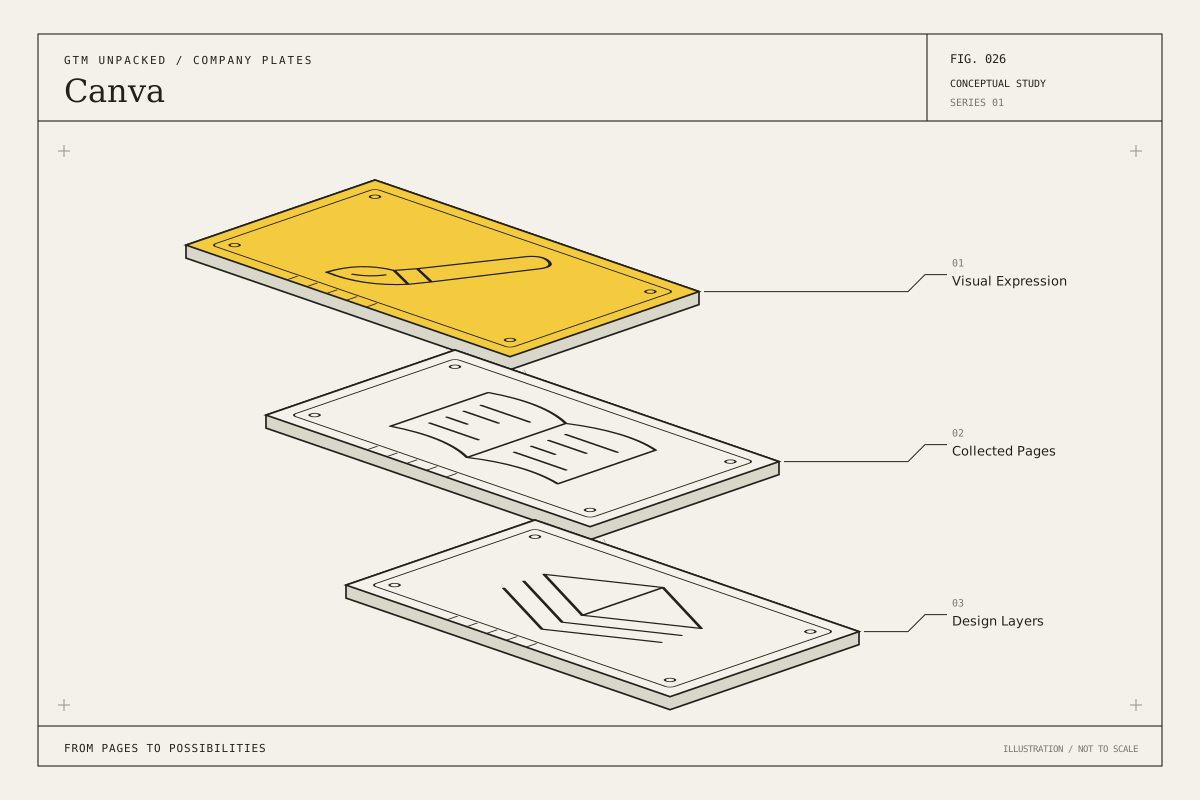
Conceptual illustration of visual design growing beyond a bound collection of pages, with a brush and layered surfaces extending the compositional space.
- Company
- Canva · Visual communication · canva.com
- Conversion motions
- [Inference] This research classifies Canva as Product Led and Human Led.
- Canva beachhead
- Canva’s precursor served school yearbook teams; this is not evidence that Canva itself initially targeted only schools. [1]
- Canva target customer
- Individuals, teams and enterprises creating visual communication. [3]
- Product complexity
- [Inference] Templates simplify entry; brand management and organizational rollout add complexity.
- Decision-making unit
- [Inference] An individual creator can start alone; enterprise purchasing adds brand, IT and procurement stakeholders.
- Market at entry
- Perkins encountered difficult desktop design tools while teaching students. [1]
- Market today
- Canva’s enterprise offer now includes brand governance, security and implementation support. [3]
- Evidence
- Source-backed brief · 3 linked sources · research date · method and limitations
The ten-step Revenue Engine reading map
These links locate relevant evidence. A linked section does not imply every detail of the step is publicly established.
- Acquire Your First Customers: Founder Led Sales Read first customers
- Embrace GTM Experimentation Read experiments & lessons
- Understand Your GTM Motion Options Read GTM motion
- Pick Your GTM Motion Read beachhead & buyer · Read product & market
- Generate a Lead Read GTM motion · Read experiments & lessons
- Turn Leads into Paying Customers Read GTM motion · Read people & process
- Retain and Grow Your Customers Read retain & expand
- Build Your GTM Team Read people & process
- Plan Your Tech Stack Read experiments & lessons · Read people & process · Read product & pricing archive
- Optimize and Scale Through Metrics Read pricing & economics
Canva origin and first customers: The first sale belonged to the precursor
Perkins recounts teaching design in Perth and building Fusion Books with Cliff Obrecht. Its first website-generated customer paid a $100 deposit in March 2008 for roughly 200–250 yearbooks. The pair also mailed schools, with family members helping fold envelopes. These are Fusion Books customer-acquisition facts, not Canva customer figures. [1]
[1]Canva beachhead and buyer: A bounded workflow before a general platform
[Inference] A school yearbook has a deadline, a defined output and an identifiable coordinator. That makes it a useful environment for learning whether non-designers can finish a collaborative design task. The broader platform could reuse that learning without retaining the same narrow buyer.
Canva GTM motion: Broader distribution and a paid work tier
Canva’s official timeline records a 2013 launch with a 50,000-person waiting list, a 2014 designer marketplace and Guy Kawasaki’s appointment as chief evangelist, followed by Canva for Work in 2015. [2]
[Inference] Marketplace content and advocacy improve product discovery and usefulness; the conversion mechanism remains self-service for many users, with a separate sales-assisted enterprise path. A famous evangelist is not proof that marketing closed every transaction.
[2]Canva product and market: The product makes professional work approachable
[Inference] The key reduction in friction is reaching an acceptable visual result without mastering a specialist tool. For organizations, the problem shifts toward consistent brand use, permissions and scalable production. Those needs support expansion but create a different buying process.
Canva people and process: Complementary capabilities
Lars Rasmussen introduced Perkins to Cameron Adams, whose background included Google Wave and the startup fluent.io, according to Perkins’s account. Adams combined design and web-development experience. [1] Kawasaki’s role in the timeline was international evangelism. [2]
[Inference] Product craft, direct customer experience and public advocacy served distinct jobs; combining them under a single “growth” label hides the organizational design.
[1] [2]Canva retention and expansion: Service is explicit at enterprise scale
The enterprise page offers 24/7 support and case management for administrators. Contracts of 150 or more seats include a dedicated customer-success manager, with creative/IT setup and technical services described alongside education resources. [3]
[Inference] A larger seat commitment finances human adoption support. This is economically different from providing a dedicated manager to every free creator.
[3]Canva pricing and economics: From personal utility to organizational value
The dated timeline establishes a 2015 paid workplace product; the current enterprise page uses a sales contact. [2][3]
[Inference] Paid organizational value rests on collaboration, control and service as well as design output. Content acquisition, free-user compute and education remain costs; no CAC or payback number is established here.
[2] [3]Canva experiments and lessons: Keep the precursor and platform stories separate
[Inference] The useful lesson is disciplined learning in a constrained market before broadening the proposition. It would be misleading to count every Fusion Books tactic as a proven Canva acquisition channel. The reviewed sources do not establish a specific failed Canva campaign.
Canva website and pricing history: A dated product sequence
The official history distinguishes launch, creator marketplace, Canva for Work and internationalization. [2] The source includes historical imagery, but this brief does not claim to have captured a complete website or pricing archive.
[2]Canva economics at a glance: Pricing is only half the story.
Canva for Work launched in 2015; exact historical/current tier prices not compared. [2]
[Inference] Enterprise support capacity and free-user service costs need different economic models.
Not established by the sources reviewed.
Not established by the sources reviewed.
The people in the Canva GTM story: People & capabilities.
Melanie Perkins
Co-founderTaught design part-time and co-founded Fusion Books. [1]
Learned from school customers and articulated the simpler-design proposition. [1]
[1]Cameron Adams
Co-founderFormer Google Wave designer and fluent.io founder, with design and web-development experience. [1]
Supplied product design and implementation expertise. [1]
[1]Guy Kawasaki
Chief evangelist from 2014Named in Canva’s official timeline. [2]
Supported international evangelism; detailed training history is not established here. [2]
[2]Canva GTM: critical reading and analysis: Why it worked.
Where it breaks.
What worked—and why
[Inference] The precursor supplied a concrete customer job; the later platform expanded the addressable market.
What did not work
A specific failed Canva growth experiment is not established.
What could have been better
[Inference] Track creator activation separately from enterprise adoption and brand-governance outcomes.
What another founder can use
[Inference] A narrow learning market can precede a broad product, but the customer evidence must be attributed to the correct business.
Canva go-to-market FAQ: The questions that matter.
How did Canva get its first customers?
Perkins recounts teaching design in Perth and building Fusion Books with Cliff Obrecht. Its first website-generated customer paid a $100 deposit in March 2008 for roughly 200–250 yearbooks. The pair also mailed schools, with family members helping fold envelopes. These are Fusion Books customer-acquisition facts, not Canva customer figures. [1]
Which go-to-market motions is Canva classified under?
[Inference] This research classifies Canva as Product Led and Human Led. Motion labels describe routes across segments and periods, not measured revenue shares.
Canva sources and open questions: Follow the sources.
- 21 questions with Melanie Perkins, part one Canva · primary
First Fusion Books order, school outreach and founder backgrounds.
- Canva’s ten-year timeline Canva · primary
Launch, marketplace, evangelist and paid workplace milestones.
- Canva Enterprise Canva · primary
Current enterprise service, security and CSM eligibility.
What remains unverified
Canva’s own first paying customer and named early sales/CS hires are not established.
Full portrait, historical screenshot and unit-economics research remains incomplete.
No verified visual capture is attached to this entry. A current screenshot is not a substitute for a historical capture.