
Source numbers link to evidence. [Inference] marks analytical judgment, including motion classifications and causal explanations. Public evidence does not establish every internal decision or metric.
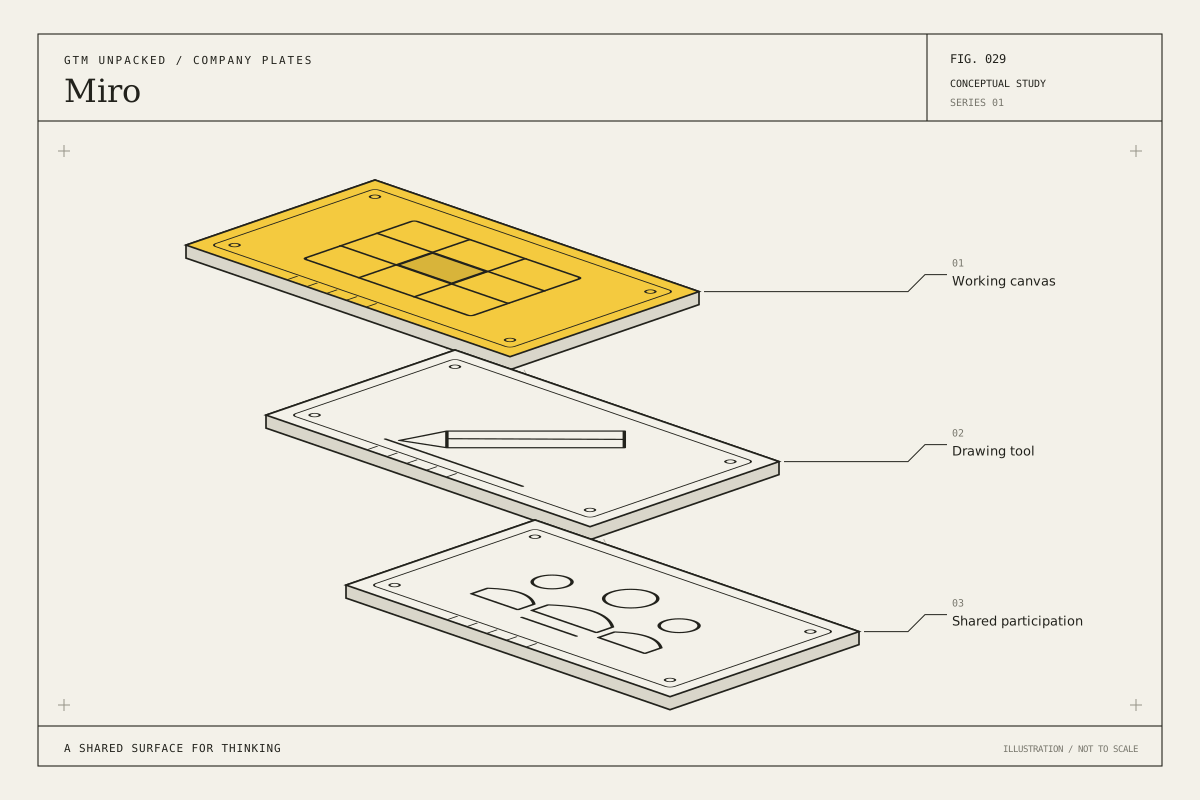
Conceptual illustration of a broad grid, drawing instrument, and participant markers, arranging collaborative thinking on a common surface without reproducing a board or team workflow.
- Company
- Miro · Visual collaboration · miro.com
- Conversion motions
- [Inference] This research classifies Miro as Product Led and Human Led.
- Miro beachhead
- Distributed creative collaboration, informed by Khusid’s agency experience. [1]
- Miro target customer
- Teams and large organizations coordinating visual work and transformation programs. [1][3]
- Product complexity
- [Inference] A canvas is approachable; workflow design, facilitation and enterprise administration require expertise.
- Decision-making unit
- [Inference] Team adoption can start small; company-wide transformation involves business leaders, IT and procurement.
- Market at entry
- Khusid’s agency encountered difficulty collaborating with distant clients. [1]
- Market today
- Current enterprise services cover adoption, value realization and architecture optimization. [3]
- Evidence
- Source-backed brief · 4 linked sources · research date · method and limitations
The ten-step Revenue Engine reading map
These links locate relevant evidence. A linked section does not imply every detail of the step is publicly established.
- Acquire Your First Customers: Founder Led Sales Read first customers
- Embrace GTM Experimentation Read experiments & lessons
- Understand Your GTM Motion Options Read GTM motion
- Pick Your GTM Motion Read beachhead & buyer · Read product & market
- Generate a Lead Read GTM motion · Read experiments & lessons
- Turn Leads into Paying Customers Read GTM motion · Read people & process
- Retain and Grow Your Customers Read retain & expand
- Build Your GTM Team Read people & process
- Plan Your Tech Stack Read experiments & lessons · Read people & process · Read product & pricing archive
- Optimize and Scale Through Metrics Read pricing & economics
Miro origin and first customers: The agency problem and the enterprise request
In a December 2025 interview, Khusid traces the product to collaboration problems at his creative agency. RealtimeBoard became Miro in 2019. He recalls an unnamed US financial-services company requesting enterprise capabilities in early 2017; the team committed contractually to deliver them. [1]
[1]Miro beachhead and buyer: A shared surface for distributed work
[Inference] The initial product could serve several collaborative jobs without requiring industry-specific software. That breadth made actual usage especially important for identifying which accounts had the budget and organizational need for a managed deployment.
Miro GTM motion: Sales acted on an existing user base
Khusid describes individuals using free accounts or credit cards before enterprise conversion. [1] A 2023 Pocus webinar documents Miro using Pocus to prioritize users and accounts, support warm prospecting and run stage-specific playbooks. [2]
[Inference] Product activity supplies evidence for sales prioritization. It does not mean every active account is ready to buy; reps must still establish an organizational problem, sponsor and purchasing process.
[1] [2]Miro product and market: Enterprise demand changed the commitment
The early financial-services buyer was undertaking an agile transformation across offices. [1]
[Inference] This changes the product’s commercial role from convenient canvas to an enabler of a larger operating program. The possible contract grows, but so do implementation expectations and the consequences of failing to deliver.
[1]Miro people and process: A sales leader with scaling experience
The 2023 webinar identifies Adam Carr as Head of Global Sales, then three and a half years into Miro. His prior organizations included Classy, Fivestars and Box. [2]
[Inference] That background fits the task of building repeatable sales around an existing user base. The interview does not establish his individual win rate or a specific sales-training curriculum.
[2]Miro retention and expansion: Service packages define expansion work
Miro’s current Standard success package provides digital onboarding and learning. Advanced adds an assigned CSM, onboarding consultants and a joint success plan; Signature adds dedicated guidance, quarterly reviews and train-the-trainer eligibility. Paid add-ons include premium support. [3]
[Inference] The account plan turns usage into agreed business outcomes. Expansion is easier to defend when a sponsor can explain what changed, rather than only how many boards were created.
[3]Miro pricing and economics: A free canvas and paid organizational capability
Current pricing offers Free, Starter, Business and Enterprise, with enterprise sales and administration features. [4]
[Inference] Product use can reduce prospecting uncertainty, while dedicated success packages allocate costly expertise to larger commitments. Neither benefit proves a short CAC payback without conversion, contract-value and cost data.
[4]Miro experiments and lessons: A custom commitment has two sides
The founder’s enterprise story includes a contractual promise to deliver requested capabilities. [1]
[Inference] A committed customer can fund and focus learning, but one customer’s requirements can distort the roadmap. The repeatability test is whether the delivered controls serve additional qualified accounts.
[1]Miro website and pricing history: Renaming and enterprise evolution
The founder interview dates the RealtimeBoard-to-Miro rebrand to 2019. [1] The current product and success pages show a broader organizational offer; historical screenshots and exact price migrations remain incomplete.
[1]Miro economics at a glance: Pricing is only half the story.
[Inference] Enterprise implementation and dedicated success work consume human capacity; product signals can improve its allocation.
Not established by the sources reviewed.
Not established by the sources reviewed.
The people in the Miro GTM story: People & capabilities.
Andrey Khusid
Co-founder and CEOCreative-agency experience informed the remote-collaboration problem. [1]
Described the product vision and early enterprise commitment. [1]
[1]Miro GTM: critical reading and analysis: Why it worked.
Where it breaks.
What worked—and why
[Inference] Actual usage informed sales prioritization, while success plans connected adoption to business outcomes.
What did not work
No quantified failed acquisition experiment established; the founder reports a risky custom enterprise commitment. [1]
What could have been better
[Inference] Gate custom promises on reusable demand and clear delivery ownership.
What another founder can use
[Inference] Product-qualified selling requires a usable account view and explicit next actions, not merely access to a dashboard.
Miro go-to-market FAQ: The questions that matter.
How did Miro get its first customers?
In a December 2025 interview, Khusid traces the product to collaboration problems at his creative agency. RealtimeBoard became Miro in 2019. He recalls an unnamed US financial-services company requesting enterprise capabilities in early 2017; the team committed contractually to deliver them. [1]
Which go-to-market motions is Miro classified under?
[Inference] This research classifies Miro as Product Led and Human Led. Motion labels describe routes across segments and periods, not measured revenue shares.
Miro sources and open questions: Follow the sources.
- The Committed Innovator: Andrey Khusid McKinsey · interview · 2025-12-17
Agency origins, 2017 enterprise deal and rebrand.
- Miro’s guide to scaling product-led sales Pocus · interview · 2023-05-09
Adam Carr transcript; verified use of Pocus for prioritization and playbooks.
- Miro customer success packages Miro · primary
Onboarding, success plans, dedicated resources and reviews.
- Miro pricing Miro · primary
Current free/paid and enterprise packaging.
What remains unverified
The early enterprise customer is unnamed; first payer and early sales-hire identities are not established.
Pocus is verified; the vendor’s generic Salesforce/Snowflake examples are not asserted as Miro’s stack.
Historical screenshots and cohort economics remain incomplete.
No verified visual capture is attached to this entry. A current screenshot is not a substitute for a historical capture.