
Source numbers link to evidence. [Inference] marks analytical judgment, including motion classifications and causal explanations. Public evidence does not establish every internal decision or metric.
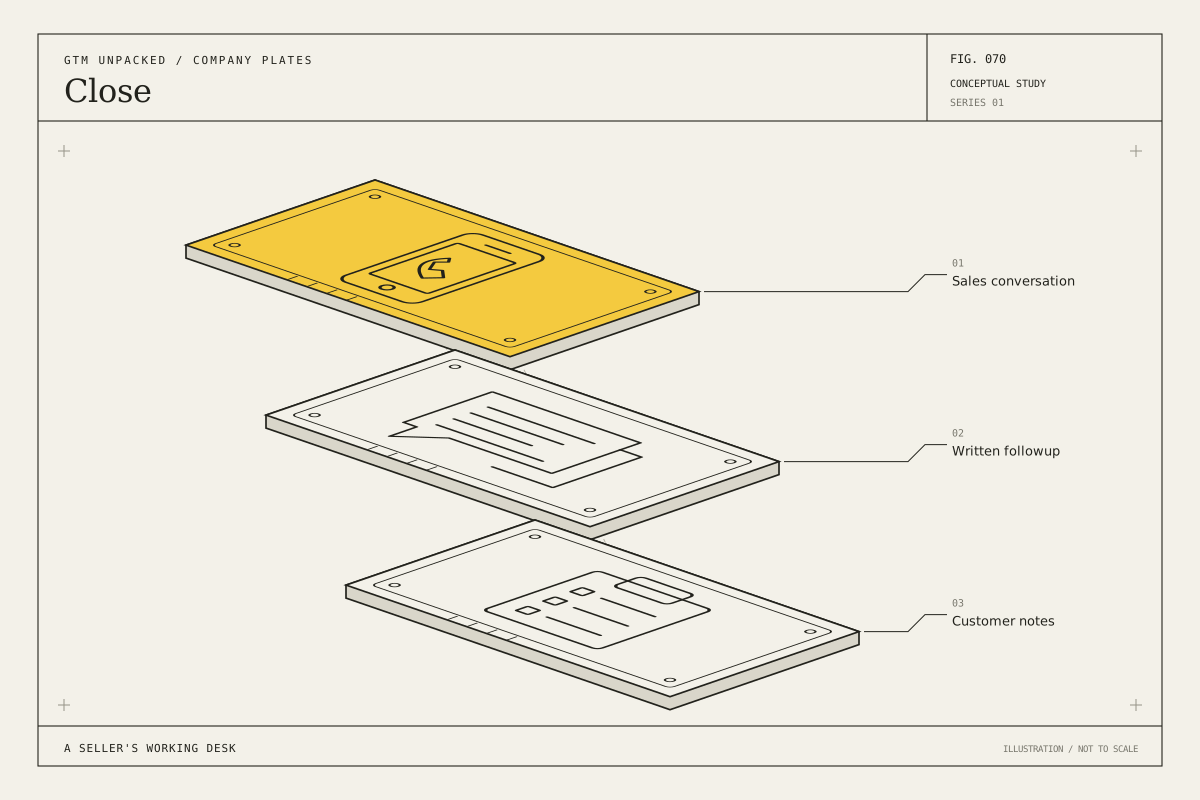
Conceptual illustration for Close: a telephone, message panel, and clipboard arrange the practical materials of sales conversations into an accessible editorial workbench.
- Company
- Close · Sales CRM · close.com
- Conversion motions
- [Inference] This research classifies Close as Product Led and Human Led.
- Close target customer
- Solo operators, small sales teams and larger high-volume organizations. [4]
- Product complexity
- [Inference] Easy to understand as a seller's workspace, harder to configure around data, routing and automation.
- Decision-making unit
- [Inference] Founder or sales leader can sponsor; operations and daily users determine migration success.
- Market at entry
- [Inference] CRM was established, leaving room to differentiate by seller workflow rather than database breadth.
- Market today
- [Inference] Crowded sales software category converging on AI agents and automation. [4]
- Evidence
- Source-backed brief · 5 linked sources · research date · method and limitations
The ten-step Revenue Engine reading map
These links locate relevant evidence. A linked section does not imply every detail of the step is publicly established.
- Acquire Your First Customers: Founder Led Sales Read first customers
- Embrace GTM Experimentation Read experiments & lessons
- Understand Your GTM Motion Options Read GTM motion
- Pick Your GTM Motion Read beachhead & buyer · Read product & market
- Generate a Lead Read GTM motion · Read experiments & lessons
- Turn Leads into Paying Customers Read GTM motion · Read people & process
- Retain and Grow Your Customers Read retain & expand
- Build Your GTM Team Read people & process
- Plan Your Tech Stack Read experiments & lessons · Read people & process · Read product & pricing archive
- Optimize and Scale Through Metrics Read pricing & economics
Close origin and first customers: An operating service became the discovery laboratory
Efti's interview traces Close to ElasticSales, which provided outsourced selling for venture-backed startups. The team built a communication-centered CRM and released Close.io in January 2013. [1] In a company-hosted fireside chat he says the service worked with about 200 startups and that software ultimately overtook the original business. That is a founder account of learning exposure, not a verified list of the first 200 software customers. [2]
[1] [2]Close beachhead and buyer: A specific user inside a mature category
[Inference] Close's wedge was the person making calls and sending follow-ups, rather than the executive seeking another reporting dashboard. Embedding communication meant a seller could feel utility during ordinary work. That is a more concrete beachhead than 'all companies need CRM,' but it excludes organizations whose primary purchase criteria are complex platform customization or enterprise-wide standardization. [1]
[1]Close GTM motion: A sales expert did not automatically choose outbound
The historical interview explicitly says Close prioritized improving its inbound funnel and had not yet needed outbound, despite the founders' sales expertise. [1]
[Inference] This is a useful correction to founder-identity bias: knowing how to cold-call does not mean cold-calling is the next best growth investment. Public teaching can attract a buyer who already recognizes the problem, while trial and human help handle conversion.
[1]Close product and market: Software knowledge came from repeated daily use
The early product combined calls, email and automatic activity capture. [1]
[Inference] Running sales for multiple clients exposes recurring work that a single-company internal tool might miss. The risk is overfitting to the service team's own habits. A stronger validation standard is whether independent customer teams become effective without reproducing the founders' training, management style or level of support.
[1]Close people and process: An early seller returned with broader operating experience
Efti names Nick as an early ElasticSales salesperson who became Close's first sales-and-marketing person, left for a customer and later founded a company before returning. [2] Close's official biography identifies him as Nick Persico and records subsequent revenue-operations and product work. [5]
[Inference] That path connects firsthand selling, customer implementation and product decisions; it is more informative than assuming a conventional executive hiring sequence.
[2] [5]Close retention and expansion: Success sells practical expertise
Close positions its success team as experienced sellers. A customer testimonial specifically credits Matt Bonde with help on lead distribution, reports and Zapier configuration. The page offers free migration and a 14-day trial, alongside human demos. These are company-presented customer statements, not independent performance measurements. [3]
[Inference] Migration help reduces switching friction, while process advice makes adoption more likely to survive the initial enthusiasm.
[3]Close pricing and economics: More sellers and more automation create expansion
The pricing page observed November 10, 2026 lists Solo, Essentials, Growth and Scale. Annual-billing headlines are $9, $35, $99 and $139 per user monthly, with higher month-to-month prices. Automation and dialing capabilities differentiate tiers; AI credits add another usage dimension. [4]
[Inference] Seat expansion is straightforward, but telephony, AI and hands-on implementation complicate gross-margin assumptions. No representative CAC or retention data were verified.
[4]Close experiments and lessons: The content promise creates an obligation
[Inference] A vendor teaching sales can win trust before purchase, but it also invites customers to expect business advice beyond software troubleshooting. That can be valuable differentiation or expensive scope creep. Close should evaluate assistance by customer activation and retained contribution, not merely satisfaction scores. A scalable library of repeatable implementation patterns would preserve expertise without making every small account a bespoke consulting engagement.
[3]Close website and pricing history: From CRM experiment to a broader action platform
[Inference] The historical story emphasizes removing communication administration; current positioning adds AI agents, workflows and advanced controls. The strategic test is whether those additions increase useful selling time without rebuilding the complexity the original product challenged. The reviewed material does not provide a complete historical price series, independently verified first paying account, or archived website screenshots. [1][4]
[1] [4]Close economics at a glance: Pricing is only half the story.
Annual-billed per-user headlines observed: $9 Solo, $35 Essentials, $99 Growth, $139 Scale; monthly options cost more. [4]
Seats, feature tiers and usage allowances.
[Inference] Communication services, AI usage and consultative help affect contribution margin.
Not verified.
Not verified.
The people in the Close GTM story: People & capabilities.
Steli Efti
Co-founder and CEOOperated ElasticSales before launching the CRM; public sales educator. [1]
Converted repeated selling experience into product positioning and inbound education.
[1]Nick Persico
Early sales and marketing operator; later revenue operations and productOfficial accounts document work across ElasticSales, Close, a customer and his own venture. [2][5]
Connected seller workflow and customer implementation to product decisions.
[2] [5]Matt Bonde
Customer-facing success practitionerNamed in a published customer testimonial; earlier training not verified. [3]
Helped with lead routing, reporting and Zapier configuration according to that customer.
[3]Close GTM: critical reading and analysis: Why it worked.
Where it breaks.
What worked—and why
[Inference] A functioning services business supplied unusually concrete product discovery. [1][2]
What did not work
No quantified failed acquisition channel verified; the choice to defer outbound was a prioritization decision, not a documented outbound failure. [1]
What could have been better
[Inference] Measure the implementation effort required for each segment alongside retention and account expansion.
What another founder can use
[Inference] Productize repeated customer work only after separating transferable workflow from your team's unusual expertise.
Close go-to-market FAQ: The questions that matter.
What drove Close's GTM?
Close emerged from ElasticSales, a service selling for venture-backed startups. [1][2]
Which evidence about Close remains unavailable?
Exact first paying software customer not verified. Early price history, internal marketing stack, CAC and retention unavailable. Individual success biography and historical screenshots not verified.
Which go-to-market motions is Close classified under?
[Inference] This research classifies Close as Product Led and Human Led. Motion labels describe routes across segments and periods, not measured revenue shares.
Close sources and open questions: Follow the sources.
- Steli Efti on building Close Leveling Up · interview
Steli Efti on building Close
- Fireside chat with Steli Efti Close · interview
Fireside chat with Steli Efti
- Meet the customer success team Close · primary
Meet the customer success team
- Pricing Close · primary
Pricing
- The founder's guide to sales operations; Nick Persico biography Close · primary
The founder's guide to sales operations; Nick Persico biography
What remains unverified
Exact first paying software customer not verified.
Early price history, internal marketing stack, CAC and retention unavailable.
Individual success biography and historical screenshots not verified.
No verified visual capture is attached to this entry. A current screenshot is not a substitute for a historical capture.