
Source numbers link to evidence. [Inference] marks analytical judgment, including motion classifications and causal explanations. Public evidence does not establish every internal decision or metric.
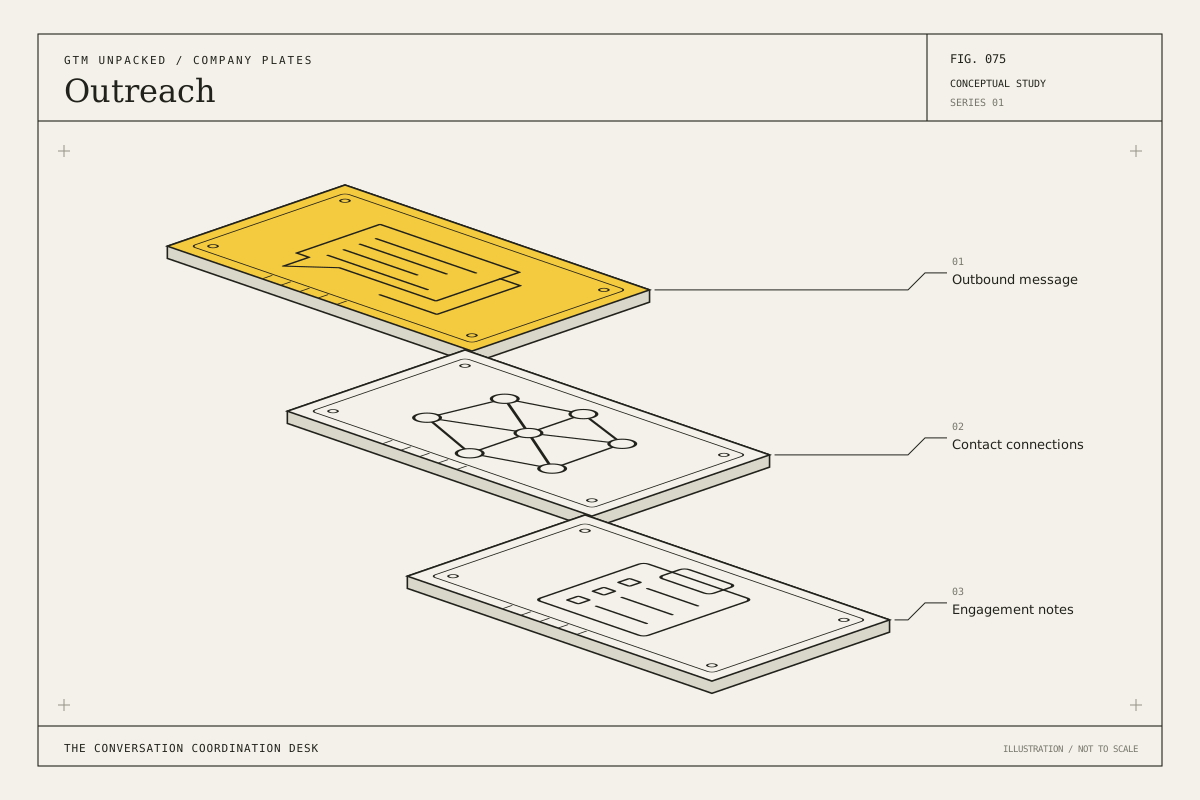
Conceptual illustration for Outreach: a message panel, connected nodes, and clipboard form a coordination desk for thinking about communication and organized followup.
- Company
- Outreach · Sales engagement and revenue workflows · outreach.ai
- Conversion motions
- [Inference] This research classifies Outreach as Human Led.
- Outreach beachhead
- Recruiters first, followed by technology-company sales teams. [1]
- Outreach target customer
- Revenue organizations spanning prospecting, deal execution, management and forecasting. [4]
- Product complexity
- [Inference] A sequence is easy to demonstrate; CRM synchronization, governance and changing rep behavior are complex.
- Decision-making unit
- [Inference] Sales leader, operations, administrators and end users must align; larger deployments add IT and procurement.
- Market at entry
- [Inference] CRM was established, but daily seller execution remained fragmented.
- Market today
- [Inference] Mature sales-engagement category broadening into AI and revenue orchestration.
- Evidence
- Source-backed brief · 5 linked sources · research date · method and limitations
The ten-step Revenue Engine reading map
These links locate relevant evidence. A linked section does not imply every detail of the step is publicly established.
- Acquire Your First Customers: Founder Led Sales Read first customers
- Embrace GTM Experimentation Read experiments & lessons
- Understand Your GTM Motion Options Read GTM motion
- Pick Your GTM Motion Read beachhead & buyer · Read product & market
- Generate a Lead Read GTM motion · Read experiments & lessons
- Turn Leads into Paying Customers Read GTM motion · Read people & process
- Retain and Grow Your Customers Read retain & expand
- Build Your GTM Team Read people & process
- Plan Your Tech Stack Read experiments & lessons · Read people & process · Read product & pricing archive
- Optimize and Scale Through Metrics Read pricing & economics
Outreach origin and first customers: The buyer asked for a different product
Manny Medina's 2020 founder interview says recruiting agencies wanted GroupTalent's personalized-email and follow-up engine rather than the service it powered. He identifies AppDynamics and Cloudera as the first two customers arising from subsequent conversations: recruiting teams introduced the product to sales leaders. The founders observed users, changed software overnight and returned to test it. [1] These are specific early accounts, not a claim that their first contracts already represented enterprise-wide rollout.
[1]Outreach beachhead and buyer: Adjacent buyers revealed the stronger beachhead
[Inference] Recruiting supplied the discovery context, but selling teams offered a wider seat base and a more recurring revenue-execution workflow. The transfer happened through customer introductions, not a market-sizing exercise alone. That distinction matters: a related user with the same communication problem can validate a new segment faster than a broad campaign aimed at every business that sends email. [1]
[1]Outreach GTM motion: Founder selling mixed physical observation with targeted outreach
Medina recounts calling companies listed on other vendors' customer pages because existing users understood the category. [1]
[Inference] This is competitive replacement prospecting, with qualification supplied by an existing purchase. It can shorten education but requires a credible switching benefit. Founder proximity also accelerated feedback, although the same field-intensive approach would be expensive if copied indiscriminately into small accounts.
[1]Outreach product and market: A workflow product needs more than a convincing demo
Current professional services cover workflow mapping, CRM configuration, content and persona strategy, training and ongoing optimization. [5]
[Inference] These activities reveal the real product boundary: successful adoption changes how people work and how systems exchange data. The decision-making unit therefore includes operations and managers who may never send a sequence themselves. Ignoring those stakeholders can produce signed contracts with weak implementation.
[5]Outreach people and process: The scaling hire did not come from SaaS central casting
Mayfield's account records Medina hiring Matt Millen after sales work for Tony Robbins and T-Mobile, despite limited SaaS experience. It later describes former CFO/COO Anna Baird moving into the CRO role. [2]
[Inference] The useful commonality is operating judgment and an ability to organize people, not identical prior product experience. These appointments should be understood as stage-specific choices rather than a universal argument against experienced SaaS leaders.
[2]Outreach retention and expansion: Education reduced the human burden of onboarding
Outreach's 2021 account describes Express Start for smaller customers, replacing much consultant-led instruction with courses and targeted advice. It reports reducing required face-to-face time from 12 hours to two. The program used Outreach University and Outreach sequences, with consultant follow-up informed by whether customers had logged in and used the product. [3]
[Inference] This is a concrete stack-to-process link: automation directs human help toward a visible adoption gap.
[3]Outreach pricing and economics: Price discovery also changed the customer mix
Medina recalls an original price around $60 per seat and repeated increases; he also describes reversing a multi-mailbox feature that let teams avoid buying additional seats. [1]
[Inference] Packaging can accidentally undermine the intended value metric. Today the official page combines seats and AI-consumption credits with custom quotations, so the historical price is not a current benchmark. [4] Verified segment CAC and retention were unavailable.
[1] [4]Outreach experiments and lessons: Scaling should preserve the learning loop
[Inference] The founders' original advantage was seeing actual behavior and responding quickly. A large implementation organization can preserve that advantage through structured workflow reviews, or lose it through generic training and quarter-end selling. A stronger operating system would compare promised use cases, activation milestones and renewal reasons by sales cohort, while checking that automation improves buyer outcomes rather than simply increasing activity volume. [3][5]
[3] [5]Outreach website and pricing history: From engagement software to an AI revenue platform
[Inference] The current website's packages cover more personas and workflows than the original email engine. That raises expansion potential and evaluation complexity together. The 2021 onboarding experiment remains useful because it distinguishes reducing live teaching from abandoning customers. No complete archived pricing series or verified historical screenshot set was established for this brief; current AI claims are not treated as independently measured performance. [3][4]
[3] [4]Outreach economics at a glance: Pricing is only half the story.
Founder-recalled early price about $60/seat; current custom pricing combines seats and AI credits. [1][4]
Seat subscriptions plus consumption and implementation services.
[Inference] Onboarding labor, integration complexity and usage costs influence payback.
Not verified.
No verified quantitative cohort rate.
The people in the Outreach GTM story: People & capabilities.
Manny Medina
Co-founderFounder of GroupTalent and Outreach; interviewed about direct selling and pivot decisions. [1]
Connected customer demand, field observation and rapid product iteration.
[1]Matt Millen
Sales leader during scalingPrior sales leadership at Tony Robbins and T-Mobile, according to investor account. [2]
Brought people leadership and selling experience from outside the usual SaaS hiring pool.
[2]Anna Baird
Former CFO/COO, later CROOperating and financial leadership before taking revenue responsibility. [2]
Connected revenue leadership with broader business operations.
[2]Outreach GTM: critical reading and analysis: Why it worked.
Where it breaks.
What worked—and why
[Inference] Customer introductions moved the product into a more scalable adjacent workflow. [1]
What did not work
Medina describes reversing a feature that allowed multiple users to operate behind one paid seat. [1]
What could have been better
[Inference] Test packaging against real team behavior and align sales promises with adoption milestones.
What another founder can use
[Inference] The first market may reveal the problem while an adjacent team supplies the stronger economics.
Outreach go-to-market FAQ: The questions that matter.
What drove Outreach's GTM?
Outreach's founders built outreach automation while operating the recruiting marketplace GroupTalent. [1][2]
Which evidence about Outreach remains unavailable?
Current segment economics and complete early AE/CSM biographies not verified. Historical screenshot sequence and exact first-contract values unavailable.
Which go-to-market motions is Outreach classified under?
[Inference] This research classifies Outreach as Human Led. Motion labels describe routes across segments and periods, not measured revenue shares.
Outreach sources and open questions: Follow the sources.
- Manny Medina: from hell and back Starting Greatness · interview · 2020-06-11
Manny Medina: from hell and back
- How Outreach grew Mayfield · primary
How Outreach grew
- Flipped classroom onboarding Outreach · primary · 2021-06-29
Flipped classroom onboarding
- Pricing and packages Outreach · primary
Pricing and packages
- Professional services Outreach · primary
Professional services
What remains unverified
Current segment economics and complete early AE/CSM biographies not verified.
Historical screenshot sequence and exact first-contract values unavailable.
No verified visual capture is attached to this entry. A current screenshot is not a substitute for a historical capture.