Source numbers link to evidence. [Inference] marks analytical judgment, including motion classifications and causal explanations. Public evidence does not establish every internal decision or metric.
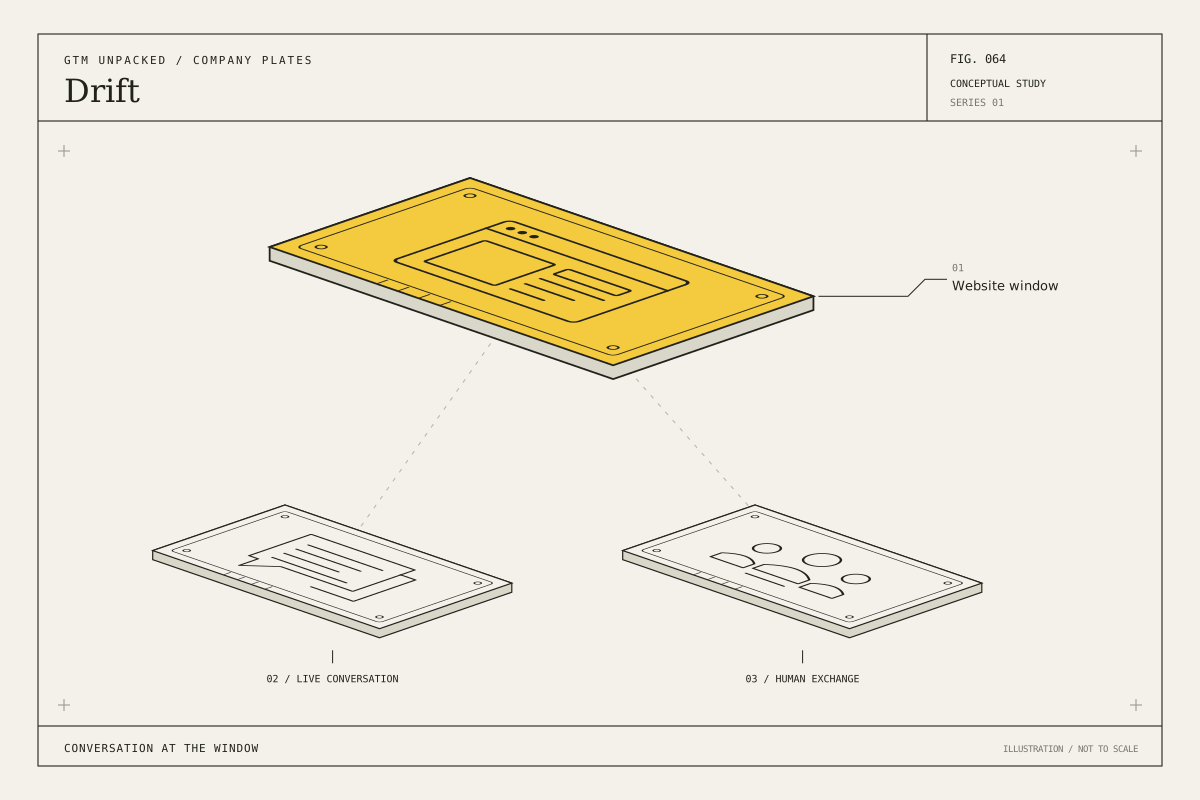
Conceptual illustration for Drift: a browser window, message bubbles, and grouped figures evoke website conversations bringing people into the picture, without representing verified technical architecture.
- Company
- Drift · Conversational marketing · drift.com
- Conversion motions
- [Inference] This research classifies Drift as Product Led and Human Led.
- Drift beachhead
- Initially self-service website/live-chat users; later SMB and mid-market B2B teams, then larger enterprise-technology organizations. [1]
- Drift target customer
- Marketing and sales organizations qualifying website visitors, scheduling meetings and routing conversations. [3]
- Product complexity
- [Inference] Simple chat installation becomes complex with global routing, account ownership, multiple brands and systems integration.
- Decision-making unit
- [Inference] A small-business marketer can start; enterprise marketing, sales operations and IT must coordinate.
- Market at entry
- [Inference] Live chat was familiar, but framing it around pipeline and immediate buyer conversations required repositioning.
- Market today
- [Inference] Conversational functionality is established and bundled into wider revenue platforms. [5]
- Evidence
- Source-backed brief · 5 linked sources · research date · method and limitations
The ten-step Revenue Engine reading map
These links locate relevant evidence. A linked section does not imply every detail of the step is publicly established.
- Acquire Your First Customers: Founder Led Sales Read first customers
- Embrace GTM Experimentation Read experiments & lessons
- Understand Your GTM Motion Options Read GTM motion
- Pick Your GTM Motion Read beachhead & buyer · Read product & market
- Generate a Lead Read GTM motion · Read experiments & lessons
- Turn Leads into Paying Customers Read GTM motion · Read people & process
- Retain and Grow Your Customers Read retain & expand
- Build Your GTM Team Read people & process
- Plan Your Tech Stack Read experiments & lessons · Read people & process · Read product & pricing archive
- Optimize and Scale Through Metrics Read pricing & economics
Drift origin and first customers: Founder experience shaped the hypothesis
Cancel had founded Performable, which HubSpot acquired, and then served as HubSpot chief product officer before starting Drift with Elias Torres. His 2020 interview explains a thesis about buyers expecting immediate digital conversations. The first named paying customer is not established in the reviewed record. It is therefore more defensible to reconstruct the early conversion method than to invent a first founder-closed account. [1][2]
[1] [2]Drift beachhead and buyer: A small interface could solve a larger routing problem
Cancel says early larger customers exposed stronger value in managing different segments, markets and product lines. [1]
[Inference] This is a useful example of an ICP changing because the same feature solves a more expensive problem. A chat box's appearance does not reveal the complexity behind routing a qualified enterprise buyer to the correct owner.
[1]Drift GTM motion: The sales team was an experiment
In the retrospective, Cancel describes 2017 as touchless freemium, then a 2018 test of adding salespeople. He wanted both conversion evidence and more customer conversations. The resulting approach was high-velocity inside sales before more enterprise adoption emerged. [1]
[Inference] Hiring sellers was a test of a distinct conversion mechanism, rather than a declaration that product-led growth had failed.
[1]Drift product and market: Brand explained the category; people closed some deals
The GTMnow discussion names Dave Gerhardt as marketing leader and Armen Zildjian as sales leader alongside Cancel. The session centers on conversational marketing and how the company acquired customers. [2]
[Inference] Founder media, brand and education can make a new category understandable, while assisted selling handles qualification and commitment. Treating all of this as 'marketing-led' would conceal the different jobs each team performed.
[2]Drift people and process: Named operators and capability boundaries
Cancel's previous product-leadership experience is documented; the reviewed sources verify Gerhardt and Zildjian's Drift roles but do not establish a detailed training or education history for either. [1][2]
[Inference] A founder with customer-product experience and separate sales and marketing leaders can distribute learning across functions, but no public evidence here reveals compensation design, rep ramp or an exact hiring sequence beyond the founder's motion timeline.
[1] [2]Drift retention and expansion: A mature customer organization becomes visible after acquisition
Salesloft's 2024 enablement account describes migrating about 125 former Drift employees from Gong recordings to Salesloft Conversations. The users included sales, CSMs, renewals managers and professional-services staff. The team interviewed users, tailored training, used office hours and a Slack support channel. [4] This verifies organizational functions and an actual historical tool migration, not the identity of every Drift account owner.
[4]Drift pricing and economics: Packaging reflects operational complexity
Current official package documentation lists Premium, Advanced, Enterprise, Startup and Essentials. Features include qualification bots, meeting scheduling, live chat, account recognition, routing and SSO. Exact contract prices are not disclosed in the page reviewed. [3]
[Inference] Expansion can follow more complex account targeting and orchestration, but that requires implementation and service capacity; generic chat usage is a weak proxy for contract value.
[3]Drift experiments and lessons: Critical reading of the strategy
[Inference] The inside-sales experiment worked in Cancel's account because it followed observable demand and produced customer learning. Its replication risk is premature enterprise expansion: complex routing can make the product valuable while also multiplying support costs. An appropriate scorecard would compare qualified meetings and accepted pipeline against total program cost and customer response experience, rather than simply count chats or booked meetings.
[1] [3]Drift website and pricing history: The current product is not the original startup
Salesloft confirms acquiring Drift in February 2024. [5]
[Inference] Today's packaging and customer organization belong to a broader platform context. The transferable lesson is to test conversion motions by segment and preserve the feedback loop. This brief does not verify a causal marketing ROI, audited retention, or an archived pricing sequence, and does not attribute every later sale to the original freemium engine.
[5]Drift economics at a glance: Pricing is only half the story.
Package-based enterprise/self-service history; current exact contract amounts not disclosed in reviewed documentation. [3]
Subscription packages and expanded routing/AI functionality.
[Inference] Implementation and service complexity increase with global customer routing.
Not verified.
Not verified.
The people in the Drift GTM story: People & capabilities.
David Cancel
Co-founder; CEO in historical accountPerformable founder and former HubSpot chief product officer.
Described staged tests of freemium, inside sales and larger accounts.
[1]Elias Torres
Co-founderRole verified; detailed prior training not researched here.
Technical/product founding partner.
[2]Dave Gerhardt
VP Marketing in historical GTM discussionRole verified; full career and training not established in this brief.
Category communication and demand generation.
[2]Armen Zildjian
VP Sales in historical GTM discussionRole verified; full career and training not established here.
Named commercial leader in the assisted-conversion organization.
[2]Drift GTM: critical reading and analysis: Why it worked.
Where it breaks.
What worked—and why
[Inference] Motion experiments followed changing account complexity. [1]
What did not work
No quantified failed channel was verified; the risks of broad category claims should not be mislabeled as documented failure.
What could have been better
[Inference] Evaluate pipeline quality and service burden alongside chat conversion.
What another founder can use
[Inference] Treat sales hiring as a measurable conversion experiment with segment-specific economics.
Drift go-to-market FAQ: The questions that matter.
What drove Drift's GTM?
David Cancel's retrospective describes Drift moving from touchless freemium conversion in 2017 to an inside-sales experiment in 2018, then larger customers whose routing complexity made the product more valuable. [1][2]
Which evidence about Drift remains unavailable?
First paying customer, exact historical prices and segment unit economics not verified. No named individual CSM's background verified. No historical screenshot recovered.
Which go-to-market motions is Drift classified under?
[Inference] This research classifies Drift as Product Led and Human Led. Motion labels describe routes across segments and periods, not measured revenue shares.
Drift sources and open questions: Follow the sources.
- In Conversation with David Cancel Matt Turck · interview · 2020-09-24
In Conversation with David Cancel
- How Drift flipped customer acquisition GTMnow · interview
How Drift flipped customer acquisition
- Drift packages and availability Salesloft · primary · 2026-10-06
Drift packages and availability
- Migrating former Drift teams to Salesloft Conversations Salesloft · primary · 2024-08-02
Migrating former Drift teams to Salesloft Conversations
- Salesloft revenue orchestration announcement Salesloft · primary · 2024-09-03
Salesloft revenue orchestration announcement
What remains unverified
First paying customer, exact historical prices and segment unit economics not verified.
No named individual CSM's background verified.
No historical screenshot recovered.
No verified visual capture is attached to this entry. A current screenshot is not a substitute for a historical capture.