
Source numbers link to evidence. [Inference] marks analytical judgment, including motion classifications and causal explanations. Public evidence does not establish every internal decision or metric.
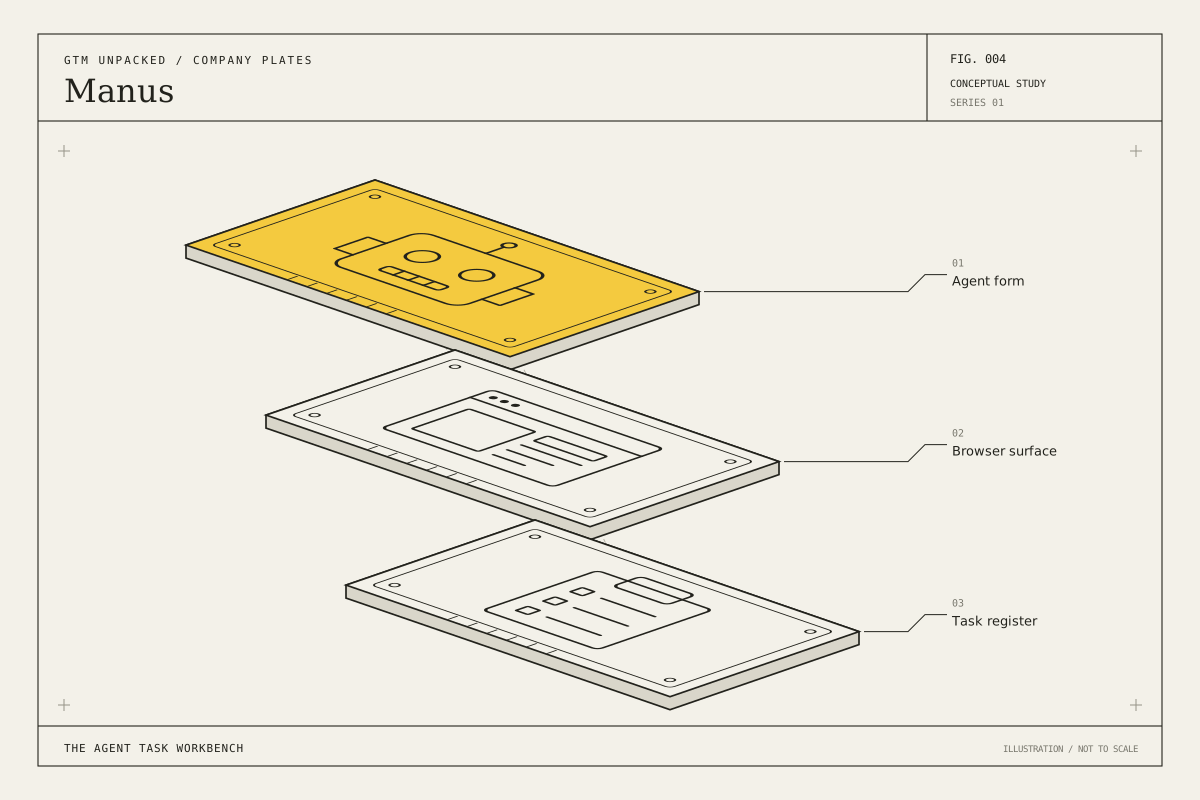
Conceptual illustration assembling a robot, browser window, and clipboard to frame a general agent's task environment without claiming an actual autonomous execution architecture.
- Company
- Manus · General AI agents · manus.im
- Conversion motions
- [Inference] This research classifies Manus as Product Led, Partner Led and Human Led.
- Manus beachhead
- Early adopters willing to delegate multi-step digital tasks, with demonstration-led appeal across research, analysis and website creation. A single initial vertical is not verified. [2]
- Manus target customer
- Individuals and knowledge workers, then collaborative teams and enterprises needing integrations, shared workflows and governance. [5][6]
- Product complexity
- A simple prompt interface conceals substantial complexity in browser operation, tool use, context, verification and task permissions. [3]
- Decision-making unit
- [Inference] Personal credit purchases have a simple buyer. Connected enterprise work adds IT administrators, security, data owners and procurement. [6][8]
- Market at entry
- [Inference] General agents were a nascent category in March 2025; demos made the promise legible before reliable execution and buying conventions were established.
- Market today
- [Inference] The category has developed team pricing, shared workflows, enterprise controls, training and platform distribution, while output reliability and switching remain competitive challenges. [5][6][8]
- Evidence
- Deep research · 16 linked sources · research date · method and limitations
The ten-step Revenue Engine reading map
These links locate relevant evidence. A linked section does not imply every detail of the step is publicly established.
- Acquire Your First Customers: Founder Led Sales Read first customers
- Embrace GTM Experimentation Read experiments & lessons
- Understand Your GTM Motion Options Read GTM motion
- Pick Your GTM Motion Read beachhead & buyer · Read product & market
- Generate a Lead Read GTM motion · Read experiments & lessons
- Turn Leads into Paying Customers Read GTM motion · Read people & process
- Retain and Grow Your Customers Read retain & expand
- Build Your GTM Team Read people & process
- Plan Your Tech Stack Read experiments & lessons · Read people & process · Read product & pricing archive
- Optimize and Scale Through Metrics Read pricing & economics
Manus GTM timeline: From wedge to engine.
Monica precedes Manus
Browser-assistant work preceded the general agent; founder interviews describe the transition. [1]
Invite-only agent launch
Public demonstrations and invitation codes create attention; paid offers follow. [1] [2] [13]
Microsoft ecosystem partnership
Agent 365 collaboration adds enterprise infrastructure and distribution. [8]
Education and revenue milestones
Academy launches; company distinguishes $100M ARR from $125M total run-rate. [5] [15]
Joins Meta
Official announcement of joining Meta. [16]
Manus origin and first customers: A browser-product team learned its way into agents
ChinaTalk's translated founder interviews trace Xiao Hong's path through WeChat software and Monica, the browser assistant that preceded Manus. Ji Yichao, also known as Peak, brought a browser-building background and joined the effort in late 2022. The account describes Manus's March 6, 2025 launch as invitation-only. It does not identify a first paying account or a founder-negotiated enterprise contract. [1]
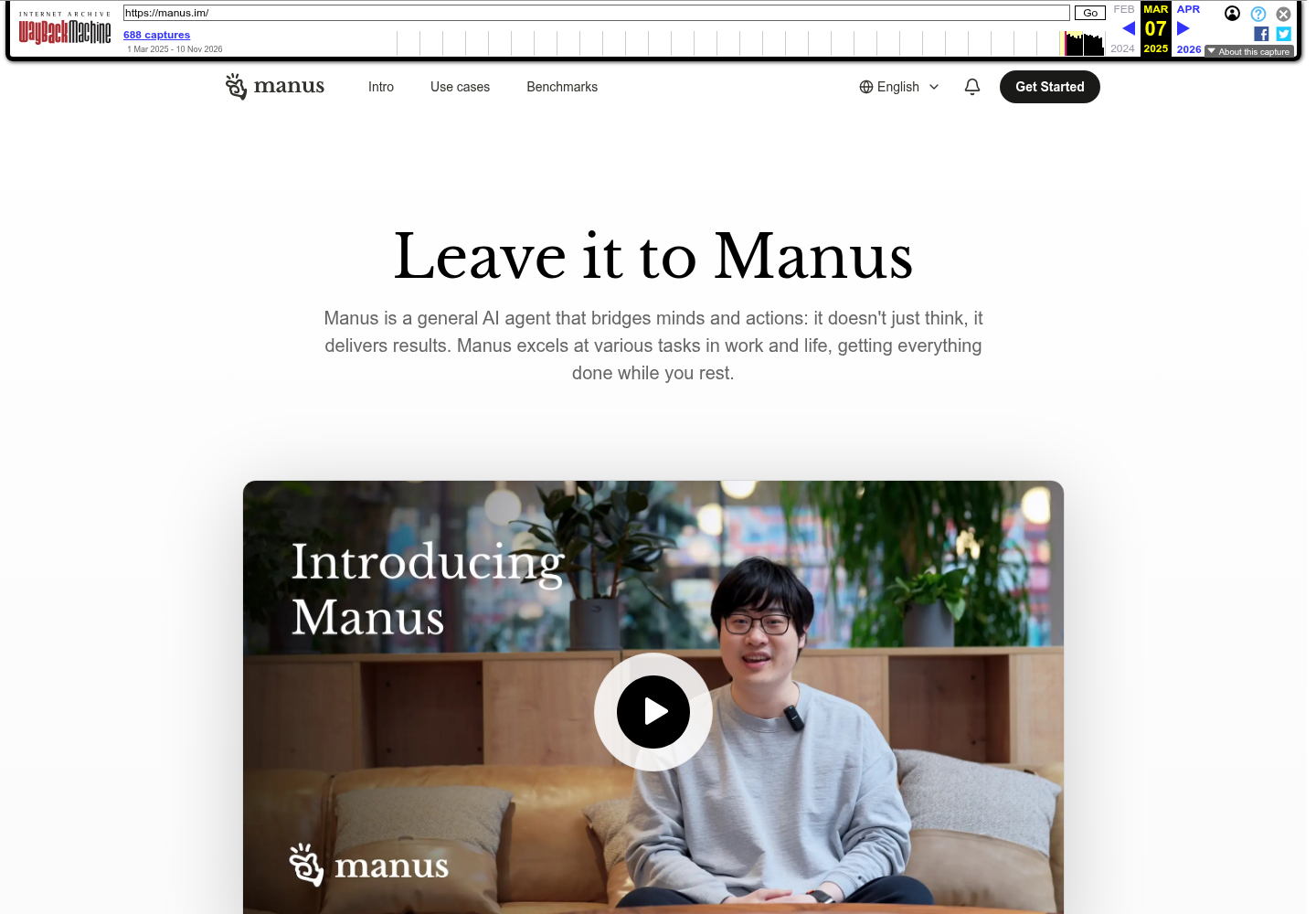
The March 7 archived homepage makes the initial promise concrete: a general agent completing work, with replayable examples spanning travel, research, data analysis, education and productivity. A stock-analysis example is a demonstration of the product's intended range, not evidence of a financial-services beachhead or a named customer. [2]
[Inference] Founder-led product discovery is better supported than founder-led sales. Existing experience distributing useful browser software plausibly helped the team package a new capability for everyday users, but no disclosed conversion data isolates Monica's installed base from the viral launch. A scarcity queue is a demand signal, not proof of paid retention.
[1] [2]Manus beachhead and buyer: Sell completed work, then teach repeatable workflows
The early site organized demand around finished tasks rather than a job title. By December 2025, Manus Academy targeted explicit professional workflows in investment research, corporate finance, business analysis and data science. It offered build-along instruction, more than 20 use cases and a learning community. That is evidence of later segmentation through use cases, not proof that finance was the first market. [2][5]
The k-ID customer story supplies a concrete expansion example. Manus reports that active users at the Singapore startup grew from 14 to 32 over six months. Product lead Crystal built internal tools, including customer-success tracking that consolidated HubSpot and Linear information. Founder Kieran Donovan describes a regulatory-intelligence workflow connected through MCP. These are vendor-published account outcomes, not independent validation of compliance accuracy. [7]
[Inference] The practical beachhead is a recurring, verifiable task with enough manual effort to justify credits and review. Broad ambition can acquire curiosity; reusable workflows are more likely to support a habit. k-ID illustrates how an individual tool builder can expose value to product, operations and customer-facing colleagues.
[2] [5] [7]Manus GTM motion: Self-service conversion acquired enterprise complements
Stripe's customer account says influencers circulated invitation codes and Manus needed a payment system quickly after launch. Stripe identifies subscription billing, payments, tax, fraud tooling and invoicing as deployed components; it reports implementation in under a month. This is partner testimony about the monetization mechanism, not independently audited revenue attribution. [4]
Manus's November 2025 Microsoft announcement describes launch-partner participation in Agent 365. Users would access Manus after IT administrators configured it; the integration extended its Windows and Microsoft productivity presence. The announcement establishes a distribution and governance relationship, not a disclosed reseller commission structure or booked-revenue contribution. [8]
[Inference] Product-led conversion remains the clearest core motion: experience the task output, buy credits, increase usage. Microsoft adds partner distribution; the current Team and Enterprise contact-sales surface adds a human-assisted route. The reviewed evidence does not justify saying that a scaled field-sales organization was the original growth engine. [6][8]
[4] [6] [8]Manus product and market: A simple interface, an expensive reasoning loop
Peak Ji's July 2025 engineering essay explains the decision to build on frontier models through context engineering instead of training an end-to-end agent. He connects that choice to a previous startup where custom NLP models became obsolete. The team had rebuilt its agent framework four times. He identifies cache efficiency as important to latency and cost, and describes an average input/output token ratio near 100:1 at that time. These are technical operating disclosures, not gross-margin figures. [3]
The current team product advertises shared projects and skills, model routing, SSO, audit logs, SIEM integration and connector policies. A personal task can be bought by one person; enterprise work involving internal systems introduces permissions and organizational responsibility. [6]
[Inference] The market's maturation is visible in what must surround the model: identity, data access, administration, teaching and output checks. A polished chat box does not make deployment simple. The customer must decide which work can be delegated, who reviews it, and whether the finished artifact is worth the compute and oversight.
[3] [6]Manus people and process: Product builders, a named marketer and education partners
Xiao Hong's verified public background is product entrepreneurship: WeChat tools, then Monica. Peak Ji's own essay supplies the more useful capability evidence than a generic technical-founder label: experience with NLP model obsolescence and a deliberate preference for fast application iteration. The public record supports distinct product-distribution and agent-engineering roles; it does not disclose a formal sales training curriculum. [1][3]
Tao Zhang, co-founder and chief product officer, describes an October 2026 internal operating system in which engineers direct and review parallel Manus and Codex sessions. Slack carries requests; an internal context entry point called Mono connects repository knowledge and architectural decisions. He also acknowledges that isolated AI additions initially produced noise and that verification became a bottleneck. [9]
Similarweb's January 2026 announcement identifies Henry Yang as co-founder and CMO. The integration gives agents digital-market data, with expanded access for joint customers. Yang's role is verified by the partner announcement; his earlier employment and formal training were not independently established here. Build Club founder Annie Liao is a separate education partner, not a Manus employee or account manager. [5][12]
[1] [3] [5] [9] [12]Manus retention and expansion: Enablement becomes a growth product
Manus Academy partnered with Build Club on more than 30 hours of structured training, community activity and practical use cases. The launch offered 8,000 credits to the first 500 course completers and English, Japanese and Portuguese content. That links instruction to product activation with a concrete incentive; no public completion-to-paid-conversion experiment was disclosed. [5]
The customer-success evidence is strongest in product and operations: reusable shared work, help documentation, integrated billing and customer support. Stripe reports use of Smart Retries and card updates to reduce failed-payment losses. Those are payment-retention mechanisms; they are not evidence that users continue deriving value or that Manus has high net retention. [4][6]
[Inference] A useful expansion path is task success → repeatable shared workflow → additional collaborators and credits. Customer stories should be assessed for actual recurring adoption, not just impressive one-off artifacts. No named CSM portfolio, QBR process, renewal owner or expansion compensation plan was verified.
[4] [5] [6] [7]Manus pricing and economics: Credits aligned spend with workload, but obscured unit value
March 2025 launch plans cost $39 and $199 monthly. [13] The official help center accessed November 10, 2026 lists Free with 300 daily credits, Pro from $20 for 4,000 monthly credits or $40 for 8,000, and Team from $20 per seat monthly. Annual billing advertises a 17% discount. These are separate dated offers rather than a continuous, fully reconstructed price history. [14]
On December 17, 2025 Manus claimed $100 million ARR and a $125 million total revenue run-rate, explicitly distinguishing recurring subscriptions from other usage-based revenue. It also reported 105 employees and large token and virtual-machine volumes. These measures do not verify the $500 million figure in this project's starting list as ARR, nor disclose acquisition cost or margin. [15]
[Inference] Credits create a way to monetize intensive work and limit free consumption, while the buyer still needs to understand cost per useful result. Caching, task retries, model choice and support demand can materially affect contribution margin. Precise CAC, gross margin, payback, renewal and cohort retention were not verified, so a sustainable-economics verdict would be premature.
[3] [13] [14] [15]Manus experiments and lessons: The largest interruption was strategic, not a funnel test
Manus announced joining Meta on December 29, 2025. Its August 2026 transition notice then explained a return to independence, with regulatory requirements causing deletion of certain users' post-acquisition data. The company supplied backup and restoration tools, reminders, a non-billing period and welcome-back incentives. It explicitly said this was not a security breach. Its September 1 announcement confirmed formal independent operations. [10][11][16]
[Inference] This is an unusually sharp reminder that distribution strategy and customer trust are connected. A larger platform may promise reach, but ownership and regulatory dependencies can interrupt users' workflows. The available sources do not quantify resulting churn or establish that an alternative ownership decision would have avoided every disruption.
[Inference] The constructive counterfactual is operational: design export, restore and workflow portability before a crisis, and test whether users can recover valuable work without assistance. For everyday agent adoption, track completed recurring workflows and user review effort alongside signups and credit consumption.
[10] [11] [16]Manus website and pricing history: The website moved from autonomy spectacle to work infrastructure
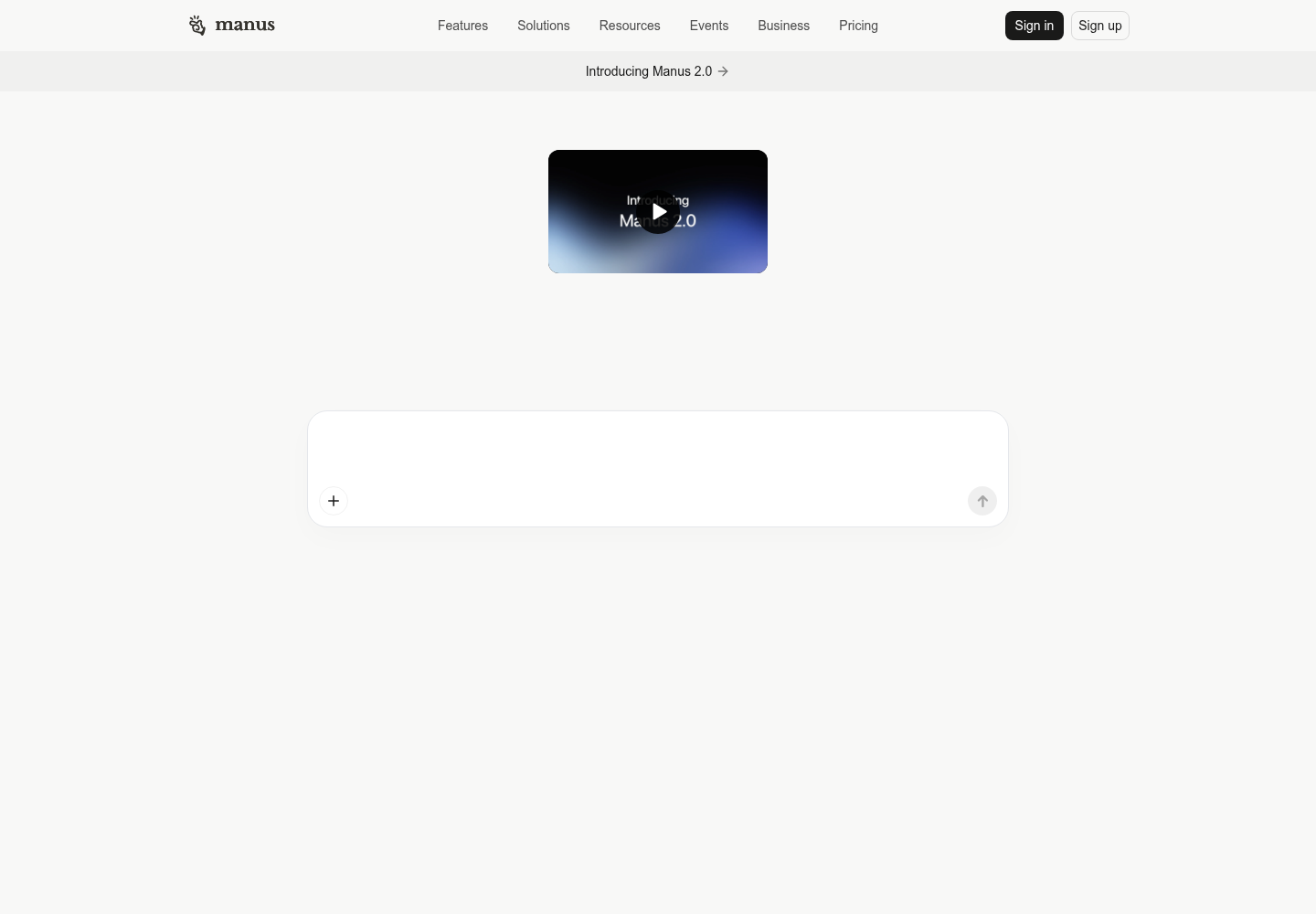
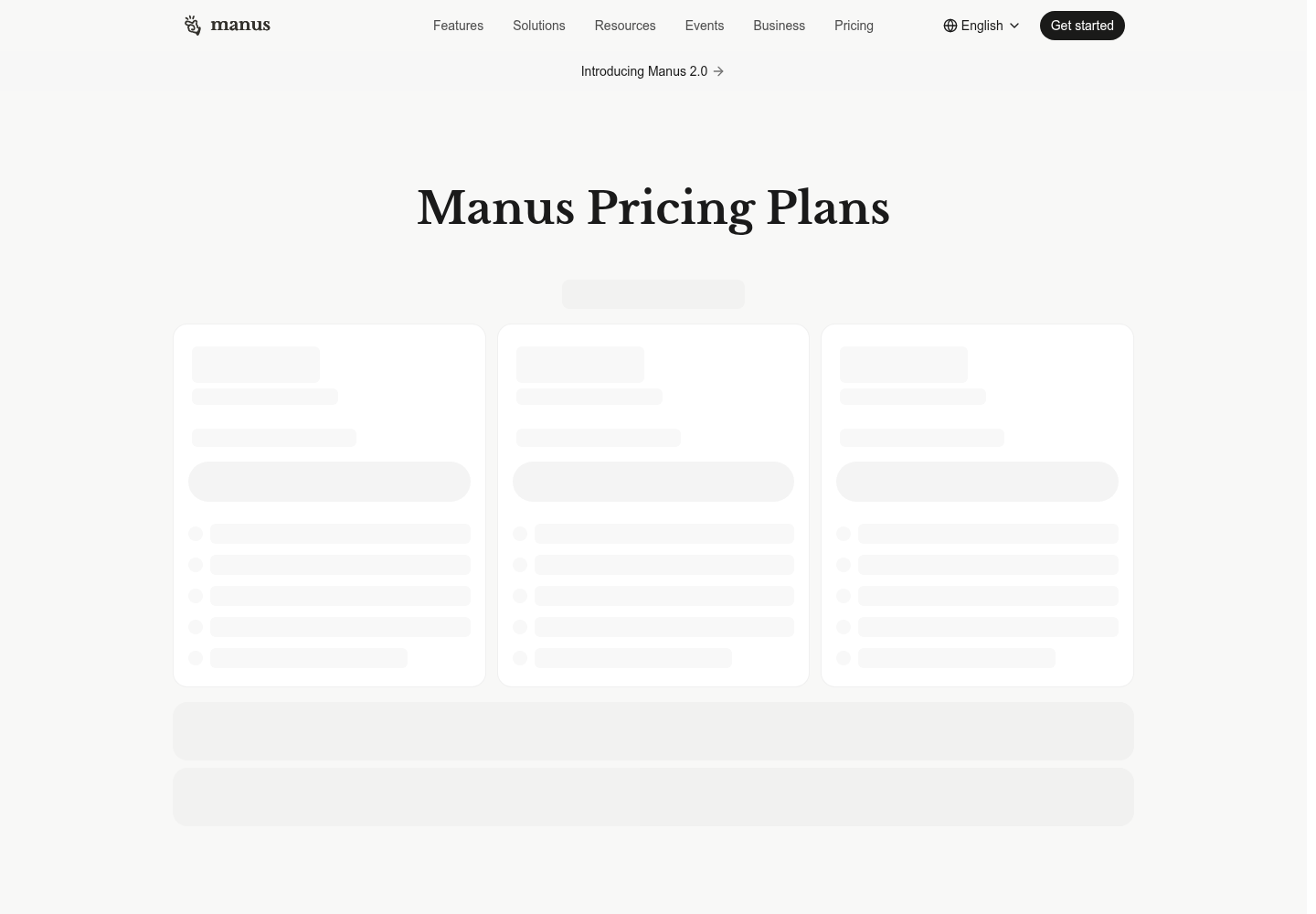
The real March 2025 Wayback image shows a general-agent promise and replayable task examples. The current homepage, pricing and team surfaces add a wider range of output types, business controls and collaboration. Both current and historical screenshots are preserved with their actual capture dates; archived pages are not recreated illustrations. [2][6][14]
[Inference] The enduring lesson is that a viral demonstration needs an operational conversion system behind it: payments while interest is high, repeatable workflows to earn reuse, and governance as the buyer broadens. Manus's strongest evidence is the connective tissue around the agent, while its most important unanswered question is durable, profitable retention.
[2] [4] [6] [14]Manus economics at a glance: Pricing is only half the story.
Nov 10, 2026 official help: Free; Pro from $20/month (4,000 credits) or $40 (8,000); Team from $20/seat/month; annual discount advertised. [14]
Subscription allocations plus credits/usage and team expansion.
[Inference] Long contexts, browser/VM execution, retries and model choice influence cost per useful completed task. [3]
Not publicly verified.
No verified cohort retention, NRR or churn. k-ID active-user growth is one vendor-published account example, not a portfolio rate. [7]
The people in the Manus GTM story: People & capabilities.
Xiao Hong (Red)
Co-founder and CEOHuazhong University of Science and Technology alumnus; founded WeChat software business Nightingale before Monica, according to translated founder coverage.
[Inference] Prior application distribution experience complemented the agent's technical novelty.
[1]Yichao 'Peak' Ji
Co-founder and chief scientistBrowser builder and NLP entrepreneur; first-person essay describes lessons from training models that later became obsolete.
Chose context engineering and rapid framework iteration; connected cache behavior to cost and latency.
[1] [3]Henry Yang
Co-founder and CMORole verified in Similarweb's announcement; previous employers and training not verified.
Named executive spokesperson for market-intelligence integration and more grounded business analysis.
[12]Annie Liao
Build Club founder; education partnerFounder of the partner learning community; not a Manus employee.
Academy partnership links practical training, community and task examples to activation.
[5]“the real gap is not awareness — it is capability”Manus Academy launch [5]
Manus GTM: critical reading and analysis: Why it worked.
Where it breaks.
What worked—and why
[Inference] Rapid payment implementation captured a short attention window; practical teaching addressed the next bottleneck of repeatable use. [4][5]
[Inference] Partnerships added capabilities users would otherwise assemble themselves: enterprise access through Microsoft and market data through Similarweb. [8][12]
What did not work
The Meta separation disrupted access and required affected users to back up and restore data; Manus acknowledged the burden. [10][11]
Tao Zhang describes early disconnected AI additions as creating noise before the workflow was redesigned. [9]
What could have been better
[Inference] Make expected credit cost and verification effort visible before long tasks, and show actual cost per accepted deliverable afterward.
[Inference] Treat data portability and recoverability as product features from the start; measure transition completion and support burden, not just notices sent.
What another founder can use
[Inference] General-purpose products can segment through repeatable workflows and education without pretending to have started in a narrow vertical.
[Inference] Vendor partnerships may accelerate billing and distribution, but their conversion contribution should be measured separately from the product's organic demand.
Manus website and pricing captures: Product, positioning & pricing.
Captures and image sources are dated individually. Historical gaps are kept explicit. Explore the visual archive
Manus go-to-market FAQ: The questions that matter.
Was Manus originally sales-led?
The clearest early evidence is an invite-only product launch followed by self-service paid plans. A first founder-closed enterprise account was not verified. [1][4]
How did Manus enable customers?
Task examples, help resources and the Build Club Academy taught practical workflows, with credits for early course completion. [2][5]
Is Manus still part of Meta?
Its September 1, 2026 announcement confirms that it resumed independent operations. [11]
Manus sources and open questions: Follow the sources.
- Manus: China's Latest AI Sensation ChinaTalk · interview · 2025-03-10
Translated founder interviews and background; Monica lineage, founders, invitation-only debut.
- Manus homepage — March 7, 2025 archive Manus via Internet Archive · primary · 2025-03-07
Actual launch-era homepage and use-case gallery; screenshot saved.
- Context Engineering for AI Agents Manus · primary · 2025-07-18
Peak Ji's technical choices, previous model-building lesson, cache economics and framework iteration.
- Manus uses Stripe to rapidly monetize its viral AI product Stripe · primary
Vendor case: launch payments, named billing/fraud/tax tools, implementation and payment recovery.
- Manus Academy Launch Manus · primary · 2025-12-19
Build Club, Annie, course hours, languages, credits and professional workflows.
- Manus for Teams and Enterprise Manus · primary
Current collaboration, sales route, enterprise governance and shared work.
- k-ID Builds its Compliance Engine with Manus Manus · primary · 2026-05-29
Vendor-published active-user expansion, Kieran Donovan, product lead Crystal and connected internal tooling.
- Manus announces collaboration with Microsoft Manus · primary · 2025-11-19
Agent 365 launch partnership and IT-admin deployment requirements.
- Rebuilding Manus with Manus Manus · primary · 2026-10-30
Tao Zhang's internal process account: Slack, Codex, Mono, verification and organizational bottlenecks.
- A Note to Our Users Manus · primary · 2026-08-11
Data-transition requirements, support, credits, billing relief; explicitly not a security incident.
- Manus Resumes Independent Operations Manus · primary · 2026-09-01
Formal independence and acknowledgement of user backup/restore burden.
- Manus Collaborates with Similarweb Similarweb · primary · 2026-01-13
Data integration and Henry Yang's co-founder/CMO role.
- Manus launches paid subscription plans and a mobile app TechCrunch · reporting · 2025-03-31
Launch price points.
- Current membership pricing Manus Help Center · primary
Current Free/Pro/Team prices and credit quantities, accessed November 10, 2026.
- Manus Update: $100M ARR, $125M revenue run-rate Manus · primary · 2025-12-17
Company-reported distinction between ARR and total run-rate.
- Manus joins Meta for next era of innovation Manus · primary · 2025-12-29
Transaction announcement, subsequently superseded by independence.
What remains unverified
First paying customer and founder-led contract process not verified.
No verified CAC, margin, retention, sales cycle or stage conversion data.
No named AE or CSM with verified portfolio and career history; marketing and partner roles are distinguished.
Official founder portrait was not verified; no synthetic person images are substituted.
Current pricing screenshot has partially rendered animated digits; precise prices are sourced to the official help center.