Source numbers link to evidence. [Inference] marks analytical judgment, including motion classifications and causal explanations. Public evidence does not establish every internal decision or metric.
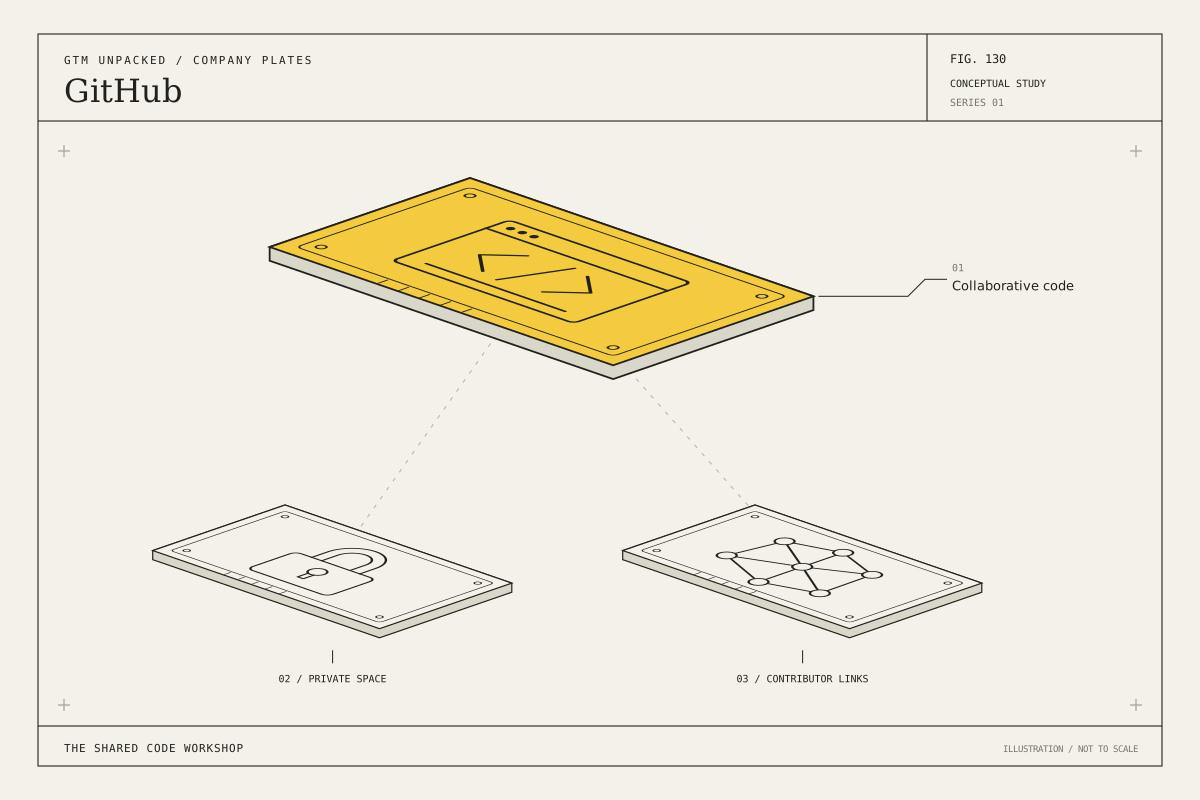
Conceptual illustration arranging code brackets, a lock, and linked nodes to distinguish collaborative software work from access boundaries within a shared editorial workshop.
- Company
- GitHub · Developer collaboration · github.com
- Conversion motions
- [Inference] This research classifies GitHub as Product Led and Human Led.
- GitHub beachhead and target customer
- [Inference] Developers collaborating on code, with privacy-sensitive teams supplying the initial paid use case.
- Product and buying complexity
- [Inference] An individual repository is straightforward to adopt, while organization-wide source-code access creates governance and integration requirements.
- Market at entry
- [Unverified] This focused brief does not establish the full market conditions at first sale.
- Evidence
- Evidence brief · 1 linked source · research date · method and limitations
The ten-step Revenue Engine reading map
These links locate relevant evidence. A linked section does not imply every detail of the step is publicly established.
- Acquire Your First Customers: Founder Led Sales Read first customers
- Embrace GTM Experimentation Read experiments & lessons
- Understand Your GTM Motion Options Read GTM motion
- Pick Your GTM Motion Not established in this entry
- Generate a Lead Read GTM motion · Read experiments & lessons
- Turn Leads into Paying Customers Read GTM motion
- Retain and Grow Your Customers Read retain & expand
- Build Your GTM Team Not established in this entry
- Plan Your Tech Stack Read experiments & lessons
- Optimize and Scale Through Metrics Not established in this entry
GitHub: Origin and evidence boundary
The founder interview identifies beta users requesting a paid private-repository offering; it does not name the first payer. [1]
In a 2010 founder interview, Chris Wanstrath says GitHub’s free beta users asked to pay for private repositories. The service launched publicly in April 2008 with paid subscriptions, while public collaboration remained accessible. The interview names Tom Preston-Werner and PJ Hyett as co-founders and describes Scott Chacon’s Git training and customer-relationship work. [1]
[1]GitHub: Motion and buyer logic
[Inference] Developers collaborating on code, with privacy-sensitive teams supplying the initial paid use case.
[Inference] An individual repository is straightforward to adopt, while organization-wide source-code access creates governance and integration requirements.
[1]GitHub: Retention and expansion hypothesis
[Inference] More teams and private work can expand a relationship; training can help organizations translate interest into effective collaboration.
[Unverified] Individual CSM ownership, enablement conversion and renewal cohorts were not established in this brief.
GitHub: Critical reading
[Inference] Let a recurring user need define the paid boundary. Free public participation and paid organizational privacy can reinforce each other when the distinction is understandable.
[Unverified] The inspected material does not establish failed-channel experiments or a complete causal account of growth.
GitHub economics at a glance: Pricing is only half the story.
Exact current pricing was not verified in this brief.
[Inference] More teams and private work can expand a relationship; training can help organizations translate interest into effective collaboration.
[Inference] Let a recurring user need define the paid boundary. Free public participation and paid organizational privacy can reinforce each other when the distinction is understandable.
Not publicly verified in this brief.
Not publicly verified in this brief.
The people in the GitHub GTM story: People & capabilities.
Chris Wanstrath
People identified in the sourceChris Wanstrath — co-founder and interviewee; Tom Preston-Werner and PJ Hyett — co-founders; Scott Chacon — Git training and customer work.
See the source-backed account above; additional skills and training are not inferred as fact.
[1]GitHub GTM: critical reading and analysis: Why it worked.
Where it breaks.
What worked—and why
[Inference] Let a recurring user need define the paid boundary. Free public participation and paid organizational privacy can reinforce each other when the distinction is understandable.
What did not work
No substantiated failed experiment established in the inspected evidence.
What could have been better
[Inference] Validate the proposed growth mechanism with paid conversion, implementation cost and retained customer outcomes.
What another founder can use
[Inference] More teams and private work can expand a relationship; training can help organizations translate interest into effective collaboration.
GitHub go-to-market FAQ: The questions that matter.
What does this case establish about GitHub?
The inspected source supports the specific product, people or distribution facts in the origin section; a full chronological reconstruction remains incomplete. [1]
Is the full GTM history of GitHub verified?
No. This is a focused evidence brief. The page distinguishes inspected claims from analytical hypotheses and lists the remaining gaps.
Which go-to-market motions is GitHub classified under?
[Inference] This research classifies GitHub as Product Led and Human Led. Motion labels describe routes across segments and periods, not measured revenue shares.
GitHub sources and open questions: Follow the sources.
- Bootstrapped, Profitable, and Proud: GitHub Signal v. Noise founder interview · interview · 2010-08-03
Origin, product, team or current commercial route described in the source; narrower claims are attributed in the text.
What remains unverified
Evidence brief rather than a full historical GTM reconstruction.
First contracts, complete hiring sequence, pricing history, CAC and retention require further source verification.
No historical website screenshot or named account expansion is represented as verified.
No verified visual capture is attached to this entry. A current screenshot is not a substitute for a historical capture.