
Source numbers link to evidence. [Inference] marks analytical judgment, including motion classifications and causal explanations. Public evidence does not establish every internal decision or metric.
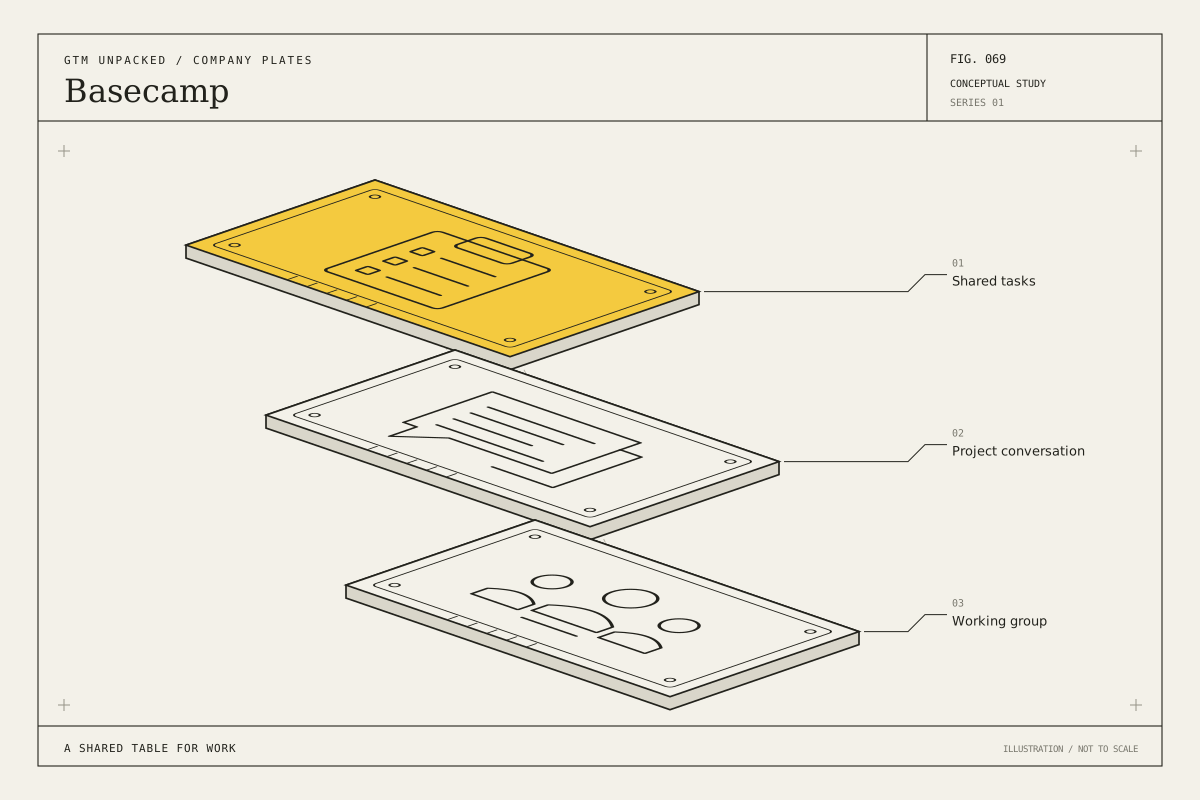
Conceptual illustration of a task sheet, conversation panel, and working group, using a shared arrangement to suggest coordination without reproducing a product interface.
- Company
- Basecamp, also listed as Basecamp (37signals) · Project collaboration · basecamp.com
- Conversion motions
- [Inference] This research classifies Basecamp as Product Led and Marketing Led.
- Basecamp beachhead
- Design and client-service firms coordinating work with clients. [1]
- Basecamp target customer
- Small organizations and project teams, with current packages scaling by projects, people and storage. [3]
- Product complexity
- [Inference] Simple communication-centered core; organization-wide migration and habits are more difficult than feature comprehension.
- Decision-making unit
- [Inference] An owner or project lead can buy, but successful use requires colleagues and clients to participate.
- Market at entry
- [Inference] Web-based subscriptions were less familiar and heavyweight project-management software emphasized a different job.
- Market today
- [Inference] Mature crowded collaboration market; simplicity must compete with integrated suites and specialized workflows.
- Evidence
- Source-backed brief · 6 linked sources · research date · method and limitations
The ten-step Revenue Engine reading map
These links locate relevant evidence. A linked section does not imply every detail of the step is publicly established.
- Acquire Your First Customers: Founder Led Sales Read first customers
- Embrace GTM Experimentation Read experiments & lessons
- Understand Your GTM Motion Options Read GTM motion
- Pick Your GTM Motion Read beachhead & buyer · Read product & market
- Generate a Lead Read GTM motion · Read experiments & lessons
- Turn Leads into Paying Customers Read GTM motion · Read people & process
- Retain and Grow Your Customers Read retain & expand
- Build Your GTM Team Read people & process
- Plan Your Tech Stack Read experiments & lessons · Read people & process · Read product & pricing archive
- Optimize and Scale Through Metrics Read pricing & economics
Basecamp origin and first customers: Clients experienced the product before launch
Jason Fried's origin account says 37signals was a web-design consultancy whose growing workload made email coordination unreliable. The team built a shared place for messages, tasks and milestones. Clients subsequently wanted it for their own businesses. Basecamp launched in February 2004; roughly a year later software generated more business than consulting and the firm stopped accepting new design work. [1]
[1]Basecamp beachhead and buyer: A beachhead with built-in exposure
The founder identifies design and client-service firms as early adopters. [1]
[Inference] This segment had a distribution advantage: each project could expose an outside client to the product in a real working context. Such exposure is stronger than a static referral because the prospective buyer experiences the workflow. It is still not proof that every invited user becomes a paying organization; the relevant metric would be conversion from external collaborator to independent account.
[1]Basecamp GTM motion: Low-friction buying fit the operating philosophy
Fried's 2016 essay explains why the company avoided allowing a handful of customers to pay dramatically more than everyone else: he feared returning to a consulting relationship dominated by those customers. [4]
[Inference] This helps explain the emphasis on a broadly reusable product and subscription conversion. It is a strategic choice about customer influence as well as acquisition cost, and gives up some enterprise contract value.
[4]Basecamp product and market: Product constraints shaped the promise
Shape Up's official origin chapter says Fried led design, David Heinemeier Hansson programmed the product and Ryan Singer worked on usability and interfaces. Hansson had only ten programming hours per week during the first build. [5]
[Inference] That constraint encouraged selecting a narrow coordination problem. A simple promise is credible only if the team also rejects features that would turn onboarding into a consulting engagement.
[5]Basecamp people and process: A small team needed complementary craft
The same account describes Singer learning programming concepts and applying them to product planning; it also recounts the difficulty of unifying several products and customer sign-ins in 2009. [5]
[Inference] The relevant skills were not just speed of coding. Interface design, scope control and migration design determined whether customers could keep using the service as its architecture changed. A detailed early account-management hiring sequence was not verified.
[5]Basecamp retention and expansion: Service supports the product model
The live support page accepts both pre-sales and customer questions and points users toward classes, community and help resources. [6] The current top package includes personal onboarding and priority support. [3]
[Inference] These are human interventions around a standardized product. Expansion can be earned by increasing the number of useful projects and participants; there is no basis here to claim a traditional enterprise account-executive organization drove the original growth.
[3] [6]Basecamp pricing and economics: A visible history of price experimentation
Fried records launch tiers of $9, $19, $39 and $59 in 2004, based partly on what the founders would pay. By his 2008 post, the ladder was $12 through $149. [2]
[Inference] This was pragmatic price discovery, not a documented willingness-to-pay study. It should not be confused with evidence that those levels maximized retention-adjusted revenue.
[2]Basecamp experiments and lessons: The tradeoff in refusing complexity
[Inference] A standardized small-business product can protect roadmap coherence and limit costly exceptions. The counterfactual cost is losing customers whose governance or implementation requirements are economically attractive. A sensible improvement would be to measure which objections reflect incompatible enterprise needs and which are common usability failures. Refusing the former does not justify ignoring the latter. The reviewed sources do not supply a controlled comparison of these choices.
[4]Basecamp website and pricing history: Today's ladder is not the launch ladder
Observed November 10, 2026, the pricing page lists free Personal, $29 Freelancer, $79 Pro, $99 Pro Plus and $199 monthly Pro Unlimited billed annually. Lower tiers have project and user limits; Unlimited removes those limits. [3]
[Inference] That mix combines an accessible starting point with account expansion while limiting the marginal tax on collaboration at the top. Historical screenshots were not independently captured for this brief.
[3]Basecamp economics at a glance: Pricing is only half the story.
Current packages range from free to $199/month annual-billed Unlimited; historical launch paid ladder began at $9. [2][3]
Subscription tiers; current project, user and storage limits.
[Inference] A standard product limits bespoke service obligations, but support costs still matter.
Not verified.
Not verified.
The people in the Basecamp GTM story: People & capabilities.
Jason Fried
Co-founderWeb-design consultancy founder and original product design lead. [1][5]
Translated a client communication problem into a focused product and articulated its commercial philosophy.
[1] [5]David Heinemeier Hansson
Co-founderProgrammed Basecamp and created Ruby on Rails as a by-product. [5]
Built the first product under severe time constraints.
[5]Ryan Singer
Early designer and product practitionerUsability and interface designer who describes learning programming and product-planning methods. [5]
Connected product scope, interface design and migration execution.
[5]Basecamp GTM: critical reading and analysis: Why it worked.
Where it breaks.
What worked—and why
[Inference] The first distribution context also demonstrated the product's usefulness. [1]
What did not work
The official product history documents difficult customer-facing migration during suite unification. [5]
What could have been better
[Inference] Measure usability-driven churn separately from intentionally rejected enterprise requirements.
What another founder can use
[Inference] A consultancy can supply discovery and initial exposure, but scaling software requires explicitly leaving bespoke delivery behind.
Basecamp go-to-market FAQ: The questions that matter.
Which evidence about Basecamp remains unavailable?
Exact first paying organization and early sales/support hiring chronology not verified. CAC, retention, archived screenshots and controlled attribution unavailable.
Which go-to-market motions is Basecamp classified under?
[Inference] This research classifies Basecamp as Product Led and Marketing Led. Motion labels describe routes across segments and periods, not measured revenue shares.
Basecamp sources and open questions: Follow the sources.
- Basecamp: the origin story Jason Fried · primary · 2015-10-06
Basecamp: the origin story
- How did you come up with pricing? 37signals · primary · 2008-10-09
How did you come up with pricing?
- Current pricing Basecamp · primary
Current pricing
- Don't let anyone overpay you Jason Fried · primary · 2016-06-21
Don't let anyone overpay you
- Shape Up introduction Basecamp · primary
Shape Up introduction
- Customer support and learning resources Basecamp · primary
Customer support and learning resources
What remains unverified
Exact first paying organization and early sales/support hiring chronology not verified.
CAC, retention, archived screenshots and controlled attribution unavailable.
No verified visual capture is attached to this entry. A current screenshot is not a substitute for a historical capture.