

Source numbers link to evidence. [Inference] marks analytical judgment, including motion classifications and causal explanations. Public evidence does not establish every internal decision or metric.
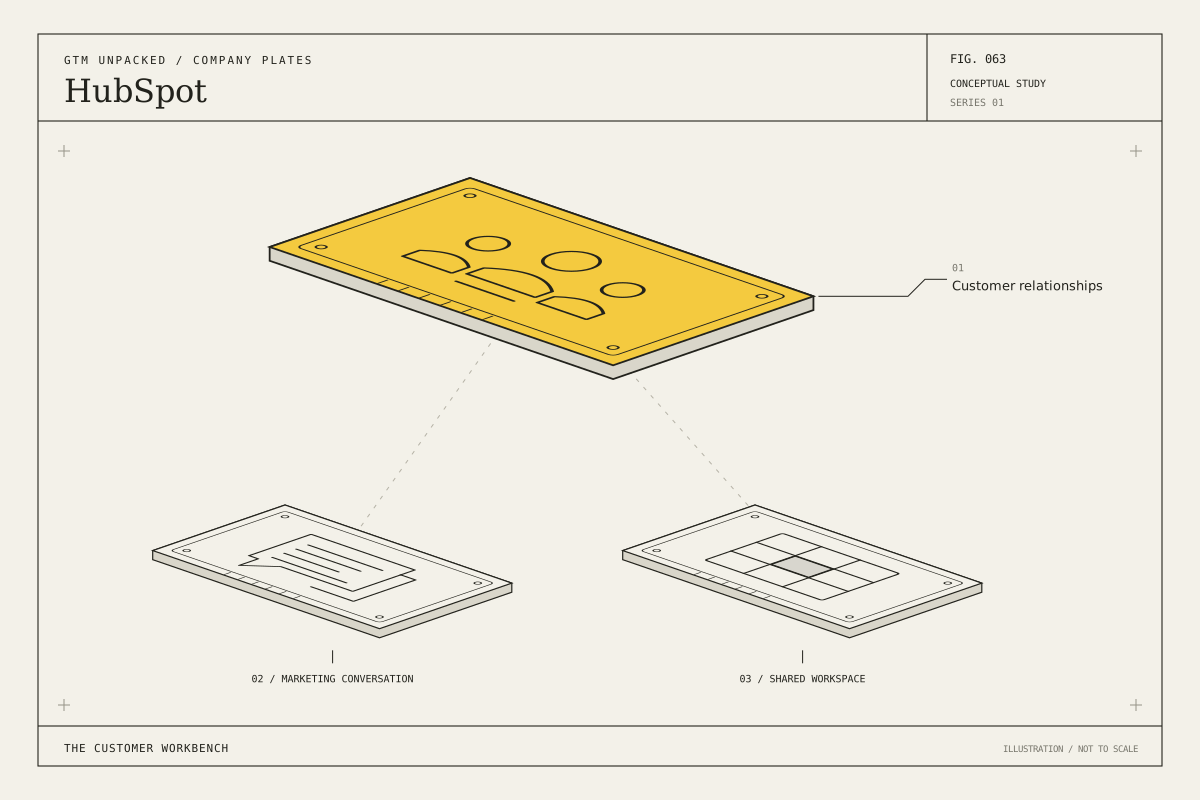
Conceptual illustration for HubSpot: people, a message panel, and a working grid form a broad customer-workbench metaphor with a deliberately human center.
- Company
- HubSpot · CRM and marketing software · hubspot.com
- Conversion motions
- [Inference] This research classifies HubSpot as Human Led, Partner Led and Product Led.
- HubSpot beachhead
- Small businesses and marketing professionals adopting inbound marketing; the earliest release described very small businesses and a broader hosted suite. [1][2]
- HubSpot target customer
- Growing businesses across marketing, sales, service, content and data functions. [5]
- Product complexity
- [Inference] A starter tool can be simple; multi-hub CRM, automation and customer-data integration require process and configuration work.
- Decision-making unit
- [Inference] Small-business owner or marketer initially; multiple revenue-team and data stakeholders as platform scope grows.
- Market at entry
- [Inference] Online discovery was changing buying behavior and inbound marketing required education. [1][2]
- Market today
- [Inference] Mature CRM/marketing automation with AI, integrations and consolidation pressures. [5]
- Evidence
- Source-backed brief · 6 linked sources · research date · method and limitations
The ten-step Revenue Engine reading map
These links locate relevant evidence. A linked section does not imply every detail of the step is publicly established.
- Acquire Your First Customers: Founder Led Sales Read first customers
- Embrace GTM Experimentation Read experiments & lessons
- Understand Your GTM Motion Options Read GTM motion
- Pick Your GTM Motion Read beachhead & buyer · Read product & market
- Generate a Lead Read GTM motion · Read experiments & lessons
- Turn Leads into Paying Customers Read GTM motion · Read people & process
- Retain and Grow Your Customers Read retain & expand
- Build Your GTM Team Read people & process
- Plan Your Tech Stack Read experiments & lessons · Read people & process · Read product & pricing archive
- Optimize and Scale Through Metrics Read pricing & economics
HubSpot origin and first customers: The original product story was broader than inbound marketing
HubSpot's seed announcement describes a hosted suite for very small businesses, including website, CRM, project and collaboration functions. It identifies Dharmesh Shah's prior company Pyramid Digital Solutions, acquired by SunGard, and Brian Halligan's worldwide-sales role at Groove Networks. These founders brought different operating experience. The release is evidence of early positioning, not proof that all advertised applications became the durable beachhead. [1]
[1]HubSpot beachhead and buyer: A clearer marketing buyer shaped the operating model
Mark Roberge's first-person account says the early sales team focused on marketing professionals and the SMB market. It chose inside sales rather than building an outside-sales route. [2]
[Inference] That is a motion decision grounded in buyer and deal economics: a large pool of smaller accounts requires repeatable remote selling. Inbound content supplies interest, but a person can still do the work of qualification and conversion.
[2]HubSpot GTM motion: The agency channel started as an experiment
The original partner announcement says a December 2008 pilot tested value for both customers and marketing agencies before the June 2009 launch. Halligan explained that some customers would obtain better results with agency help. [3]
[Inference] The channel addressed an implementation gap as well as lead generation. A software license alone could not create a customer's marketing content, operating habits or campaign expertise.
[3]HubSpot product and market: From marketing purchase to shared customer platform
The current site presents separate Marketing, Sales, Service, Content, Data and Revenue products around a CRM, with free and premium paths. [5]
[Inference] Expansion now crosses function boundaries. A marketer can start a conversation, but shared data and workflows bring sales, support, operations and administration into the decision. The historical inside-sales model should not be assumed to describe every contemporary enterprise deal.
[5]HubSpot people and process: Train sellers by making them do the buyer's job
Roberge identifies himself as the fourth employee and first salesperson. His training program had recruits build websites, publish blogs, run landing pages and analyze conversion using HubSpot itself. He also acknowledges early mistakes in planning for rep ramp, attrition and demand generation. [2]
[Inference] This trained diagnostic fluency rather than memorized product claims, and connected the commercial organization to the actual work customers needed to accomplish.
[2]HubSpot retention and expansion: Partners supplied a second enablement organization
HubSpot's early training announcement names Peter Caputa IV and Carol Ortenberg on the reseller team, with Brian Halligan and marketing leader Mike Volpe supporting the curriculum. It reports monthly webinars, more than 70 early resellers and matching hundreds of customer service requests. These are company-reported program outcomes. [4]
[Inference] Partner certification and education are part of customer success when the partner performs the adoption work.
[4]HubSpot pricing and economics: Retention changed the sales incentive
Roberge describes a churn investigation that found little difference by CSM but meaningful variation by salesperson. The team changed training and methodology; he says compensation aligned to customer success had the greatest effect. [2]
[Inference] This is a warning against treating retention as solely a post-sale team's problem. Acquisition quality, expectation setting and incentives influence which customers ever have a reasonable chance to succeed.
[2]HubSpot experiments and lessons: Pricing and economic boundaries
Current official pricing offers free and paid editions with feature, seat and usage distinctions; this brief does not compress a configurable platform into one universal price. [6]
[Inference] Expansion across products can increase account value, but it can also add onboarding and administration costs. The reviewed historical anecdotes do not establish a current CAC or payback figure, and no current metric is reverse-engineered from company scale.
[6]HubSpot website and pricing history: Critical lesson
[Inference] HubSpot worked as a connected system: education created interest, sellers diagnosed needs, partners supplied expertise, and retention analysis corrected incentives. Copying only the content engine omits the conversion and delivery machinery. A better early scorecard would join lead source, salesperson, customer fit, activation and retention from the beginning, making the churn pattern visible before rapid acquisition magnified it.
[2] [3] [4]HubSpot economics at a glance: Pricing is only half the story.
Configurable free and paid product editions; current exact package quote depends on product and usage. [6]
Subscriptions, seats, usage and multi-product expansion.
[Inference] Content acquisition requires conversion capacity; onboarding and partners affect realized value.
No current CAC or segment payback verified.
Historical churn diagnosis verified as Roberge's account; no current retention series used.
The people in the HubSpot GTM story: People & capabilities.
Brian Halligan
Co-founder; early CEOPreviously head of worldwide sales at Groove Networks.
Commercial founding experience and sponsorship of the agency channel.
[1] [3]Dharmesh Shah
Co-founder and CTOPreviously founder/CEO of Pyramid Digital Solutions, acquired by SunGard.
Software-building background and original small-business product thesis.
[1]Mark Roberge
First salesperson; later sales leaderMet Shah while at MIT; first-person account identifies employee four.
Inside-sales training, planning and compensation tied to customer success.
[2]Peter Caputa IV and Carol Ortenberg
Early reseller/partner teamRoles documented in early company announcement; earlier careers not established here.
Monthly partner webinars and practical agency curriculum.
[4]Mike Volpe
Early marketing leaderNamed as VP Marketing in the historical announcement.
Supported inbound education and partner curriculum.
[4]HubSpot GTM: critical reading and analysis: Why it worked.
Where it breaks.
What worked—and why
[Inference] Training connected sellers to real buyer work; agency delivery complemented software. [2][4]
What did not work
Roberge recounts poor-fit selling and expectation setting contributing to churn. [2]
What could have been better
[Inference] Connect acquisition attribution with activation and renewal before scaling quotas.
What another founder can use
[Inference] Demand generation, conversion and customer delivery are distinct jobs that must work together.
HubSpot go-to-market FAQ: The questions that matter.
What drove HubSpot's GTM?
HubSpot's familiar inbound story includes a less simple commercial engine: founder experience in software and sales, an inside-sales organization built by Mark Roberge, agency partners trained to deliver outcomes, and compensation changes when poor-fit selling hurt retention. [1][2]
Which evidence about HubSpot remains unavailable?
Exact first customer contract not established in these sources. No current segment CAC, payback or retention cohort verified. Historical announcements read, but no historical screenshot recovered for this brief.
Which go-to-market motions is HubSpot classified under?
[Inference] This research classifies HubSpot as Human Led, Partner Led and Product Led. Motion labels describe routes across segments and periods, not measured revenue shares.
HubSpot sources and open questions: Follow the sources.
- HubSpot announces seed funding HubSpot · primary
HubSpot announces seed funding
- 10 Sales Leadership Lessons From 10 Years at HubSpot Mark Roberge · primary · 2016-08-10
10 Sales Leadership Lessons From 10 Years at HubSpot
- Launching the HubSpot Partner Program HubSpot · primary
Launching the HubSpot Partner Program
- Partner training curriculum HubSpot · primary
Partner training curriculum
- HubSpot's story and current platform HubSpot · primary
HubSpot's story and current platform
- Marketing software pricing HubSpot · primary
Marketing software pricing
What remains unverified
Exact first customer contract not established in these sources.
No current segment CAC, payback or retention cohort verified.
Historical announcements read, but no historical screenshot recovered for this brief.
No verified visual capture is attached to this entry. A current screenshot is not a substitute for a historical capture.


