Source numbers link to evidence. [Inference] marks analytical judgment, including motion classifications and causal explanations. Public evidence does not establish every internal decision or metric.
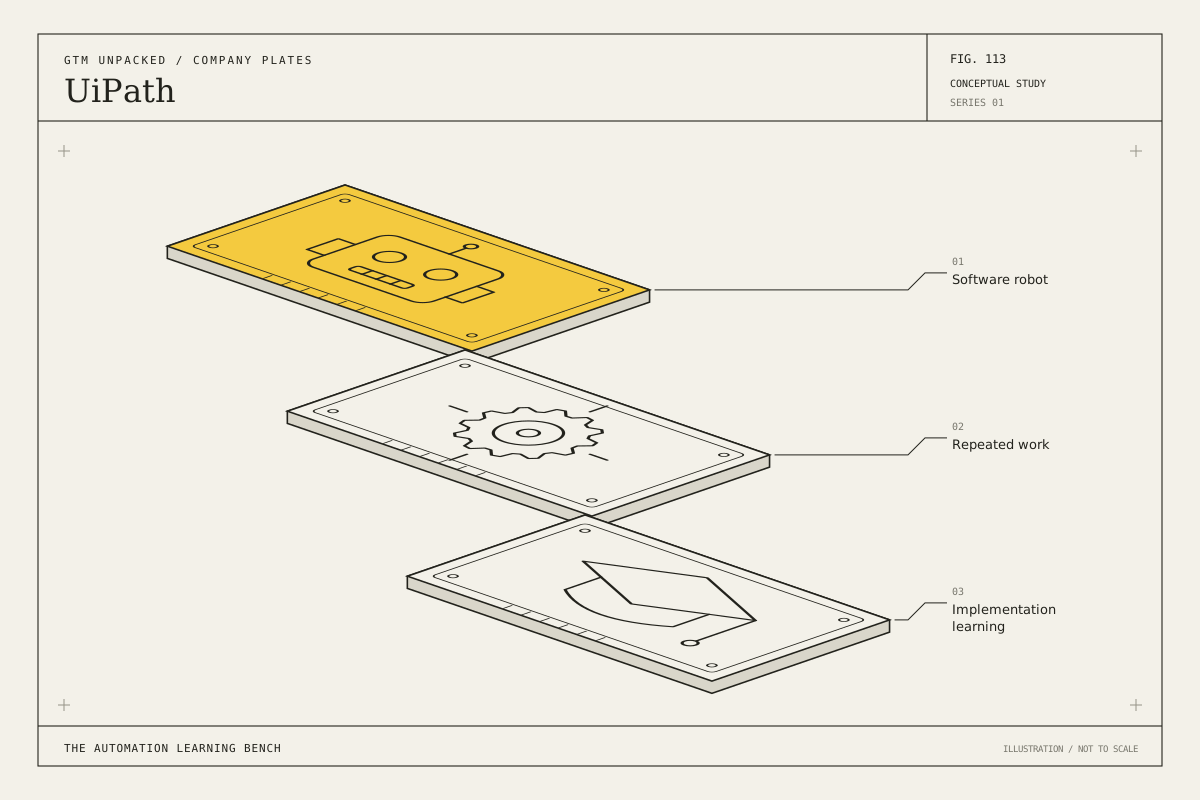
Conceptual illustration for UiPath: a robot, gear, and graduation cap form an automation learning bench, pairing a mechanical metaphor with trained human practice.
- Company
- UiPath · Enterprise automation · uipath.com
- Conversion motions
- [Inference] This research classifies UiPath as Partner Led, Human Led and Product Led.
- UiPath beachhead
- Business-process automation in repetitive enterprise work
- UiPath target customer
- Operations, automation centers and enterprise IT
- Product complexity
- High workflow and exception complexity despite low-code tooling
- Decision-making unit
- [Inference] Process owner, IT, compliance, finance and executive sponsors
- Market at entry
- Emerging RPA category alongside established outsourcing and legacy applications
- Market today
- [Inference] Mature automation category extending toward agentic workflows
- Evidence
- Source-backed brief · 8 linked sources · research date · method and limitations
The ten-step Revenue Engine reading map
These links locate relevant evidence. A linked section does not imply every detail of the step is publicly established.
- Acquire Your First Customers: Founder Led Sales Read first customers
- Embrace GTM Experimentation Read experiments & lessons
- Understand Your GTM Motion Options Read GTM motion
- Pick Your GTM Motion Read beachhead & buyer · Read product & market
- Generate a Lead Read GTM motion · Read experiments & lessons
- Turn Leads into Paying Customers Read GTM motion · Read people & process
- Retain and Grow Your Customers Read retain & expand
- Build Your GTM Team Read people & process
- Plan Your Tech Stack Read experiments & lessons · Read people & process · Read product & pricing archive
- Optimize and Scale Through Metrics Read pricing & economics
UiPath origin and first customers: Origin & first customers
Daniel Dines’ interviews describe a Romanian company that moved from outsourcing and developer toolkits toward robotic process automation after an unexpected customer inquiry from India. His 2024 MAD interview calls a Chennai phone call pivotal and identifies GE among early American customers. [1] A 2019 interview names an online-only Dutch insurer among early customers and says there was no sales force in 2015–2016. [2] Exact first-contract details remain incomplete.
[1] [2]UiPath beachhead and buyer: Beachhead & buyer
[Inference] The beachhead was repetitive work performed across existing applications where replacing the entire IT estate was unrealistic. Outsourcing providers and large operations teams understood both the workload and its cost. This made partners potential amplifiers rather than inevitable enemies: automation could become another service they implemented and managed. The product had to handle real interfaces and exceptions, not only a scripted demo.
UiPath GTM motion: GTM motion & lead conversion
UiPath made its product free for individuals, educational projects and small businesses before launching free Academy training in April 2017. [3] [Inference] Free software and training expanded the supply of people able to evaluate and implement it. Enterprise contracts still needed human sales, technical validation and process selection. The motion combined bottom-up skill formation with top-down purchasing and partner delivery.
[3]UiPath product and market: Product, market & buying complexity
[Inference] A robot can be easy to demonstrate and hard to operate at scale. The organization needs stable process definitions, exception handling, access permissions and ownership when an underlying application changes. A serious proof of value therefore evaluates maintainability and operating effort alongside hours saved. Selling automation to everyone without qualifying process suitability would create deployment failures that later undermine renewals.
UiPath people and process: People & operating process
Sequoia’s founder profile identifies Marius Tîrcă as an engineer hired in 2005 who became co-founder and CTO a decade later. [4] Dines’ own 2019 update describes combining regional direct and partner sales teams to improve customer experience and efficiency. [5] [Inference] The scaling requirement evolved from technical ingenuity into a coordinated field organization able to align customer, partner and product teams.
[4] [5]UiPath retention and expansion: Customer success & expansion
UiPath’s partner Academy later gave partners role-specific enablement and access to the same product training as employees. Capgemini’s Adam Bujak described the firm as a partner since 2015 and an Academy user since 2017. [6] [Inference] This reduced a real ecosystem bottleneck: customers cannot expand automations faster than the available implementation and maintenance skills. Training is part of delivery capacity, not merely brand marketing.
[6]UiPath pricing and economics: Pricing & economic constraints
The IPO filing reported dollar-based net retention of 145% at January 2021. The fiscal-2026 annual report gives 107% at January 2026, versus 110% a year earlier. [7][8] [Inference] The contrast shows why a celebrated growth-era expansion rate should not be assumed permanent. The figures do not by themselves isolate product saturation, macro conditions, competition or execution as causes. CAC and comparable process-level service margins remain unverified.
[7] [8]UiPath experiments and lessons: Experiments, lessons & critique
[Inference] UiPath’s successful adaptation was listening to an unexpected use case and building the people ecosystem required to scale it. Its risk was treating early explosive demand as evidence that all future deployment capacity and sales hiring would be equally productive. The 2019 organizational simplification is a documented correction. [5] A better operating model measures maintained production automations, realized process value and implementation effort before expanding the commercial footprint.
[5]UiPath website and pricing history: Positioning & pricing evolution
The evolution from developer toolkits to RPA, free Community access, Academy and coordinated partner enablement is supported by the inspected sources. [1][3][6] No historical pricing screenshot sequence was verified. [Inference] The lesson is that product adoption, implementation skills and enterprise procurement are three different growth constraints. A durable automation business needs all three to move together, especially as the market’s initial novelty fades.
[1] [3] [6]UiPath economics at a glance: Pricing is only half the story.
Free community/training entry and enterprise subscriptions; contract rates not verified.
Enterprise subscription plus ecosystem delivery
[Inference] Process maintenance and skills constrain realized customer value.
Not publicly verified
The people in the UiPath GTM story: People & capabilities.
Daniel Dines
Co-founder and CEOSoftware entrepreneur whose company began with outsourcing and developer toolkits.
Recognized the unexpected automation demand and built an international business. [1][2]
[1] [2]Marius Tîrcă
Co-founder and CTOHired as an engineer in 2005; became co-founder/CTO a decade later.
Provided continuity of technical leadership through the pivot. [4]
[4]Adam Bujak
Capgemini automation leader; partner-side operatorGlobal intelligent-automation leadership at Capgemini.
Publicly described partner adoption of UiPath Academy. [6]
[6]UiPath GTM: critical reading and analysis: Why it worked.
Where it breaks.
What did not work
Direct and partner teams were consolidated in 2019 to improve efficiency. [5]
What could have been better
[Inference] Scale against maintained production value, not demo enthusiasm.
What another founder can use
[Inference] A technical category grows when the supply of capable users and implementers grows with it.
UiPath go-to-market FAQ: The questions that matter.
How did UiPath find its GTM motion?
UiPath made its product free for individuals, educational projects and small businesses before launching free Academy training in April 2017. [3] [Inference] Free software and training expanded the supply of people able to evaluate and implement it. Enterprise contracts still needed human sales, technical validation and process selection. The motion combined bottom-up skill formation with top-down purchasing and partner delivery.
What can founders learn from UiPath?
[Inference] A technical category grows when the supply of capable users and implementers grows with it.
UiPath sources and open questions: Follow the sources.
- Daniel Dines interview The MAD Podcast · interview
- Making automation easy strategy+business · interview · 2019-11-20
- UiPath Academy launch UiPath · primary · 2017-04-12
- Daniel Dines: Architect of the New Automation Sequoia Capital · primary
- Update from Daniel Dines UiPath · primary
- Partner training strategy UiPath · primary
- UiPath S-1 SEC / UiPath · primary · 2021-03-26
- Fiscal 2026 annual report SEC / UiPath · primary
What remains unverified
No verified historical website screenshot was available for this brief.
Early CRM, sales engagement and enablement tools were not verified; product integrations are not treated as internal GTM tools.
Exact first paid contract and early funnel conversion are not publicly verified in the inspected sources.
No verified visual capture is attached to this entry. A current screenshot is not a substitute for a historical capture.