
Source numbers link to evidence. [Inference] marks analytical judgment, including motion classifications and causal explanations. Public evidence does not establish every internal decision or metric.
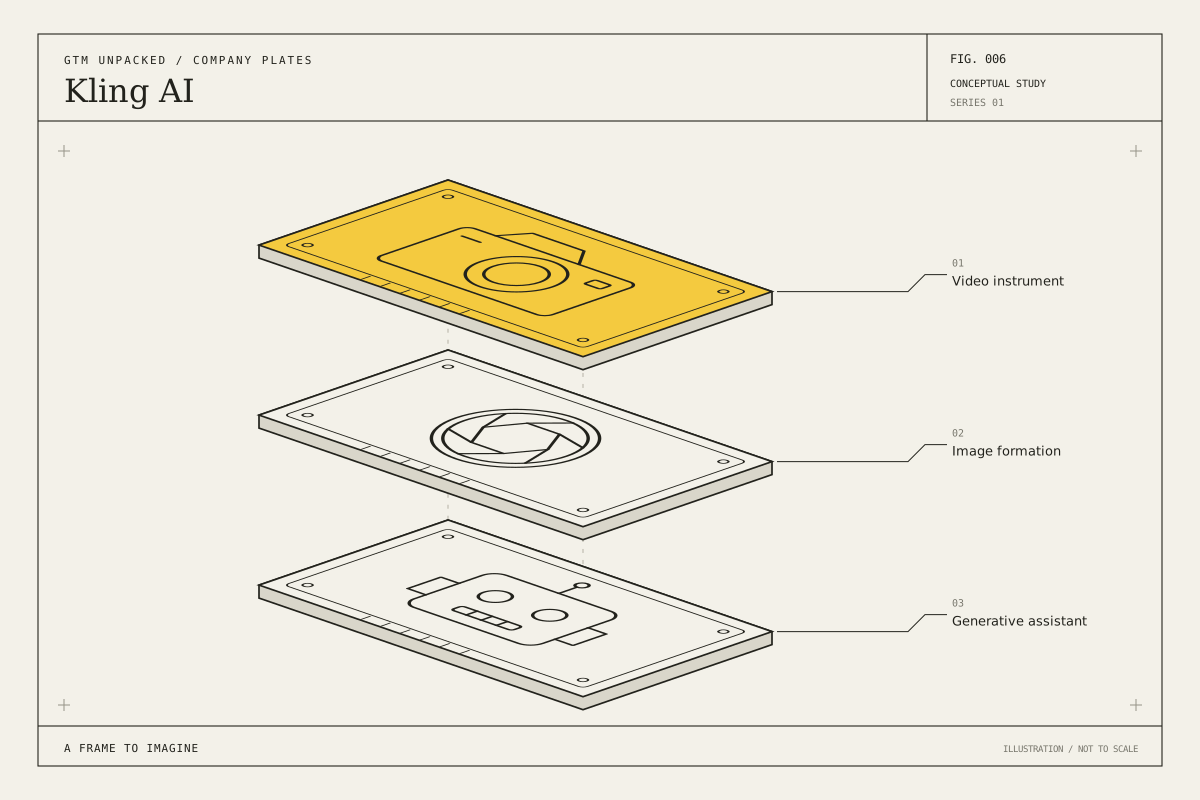
Conceptual illustration for Kling AI: a camera, aperture, and agent figure form a creative technical plate about constructing and examining imagined video.
- Company
- Kling AI · Generative media · kling.ai
- Conversion motions
- [Inference] This research classifies Kling AI as Product Led and Partner Led.
- Kling AI beachhead
- Early video creators willing to test generative video; later professional film, advertising, e-commerce and gaming workflows. [1][3]
- Kling AI target customer
- Independent creators, creative teams, production organizations and application platforms distributing Kling through APIs. [3][6]
- Product complexity
- [Inference] A first clip is easy to test; coherent scenes, controlled revisions and production integration are substantially harder.
- Decision-making unit
- [Inference] A creator subscription can be an individual decision. Production and API adoption adds technical owners, commercial approval and content stakeholders.
- Market at entry
- [Inference] Short-video creation was mature, but usable generative video was emerging. Kuaishou already operated an established content ecosystem. [1]
- Market today
- [Inference] Buyers increasingly compare generation cost, control, reliability and workflow integration alongside visual quality. [4][8]
- Evidence
- Deep research · 9 linked sources · research date · method and limitations
The ten-step Revenue Engine reading map
These links locate relevant evidence. A linked section does not imply every detail of the step is publicly established.
- Acquire Your First Customers: Founder Led Sales Read first customers
- Embrace GTM Experimentation Read experiments & lessons
- Understand Your GTM Motion Options Read GTM motion
- Pick Your GTM Motion Read beachhead & buyer · Read product & market
- Generate a Lead Read GTM motion · Read experiments & lessons
- Turn Leads into Paying Customers Read GTM motion · Read people & process
- Retain and Grow Your Customers Read retain & expand
- Build Your GTM Team Read people & process
- Plan Your Tech Stack Read experiments & lessons · Read people & process · Read product & pricing archive
- Optimize and Scale Through Metrics Read pricing & economics
Kling AI GTM timeline: From wedge to engine.
Applications open
Company reports over a million applicants in the initial period. [1]
Global beta and regional paid plans
Daily credits and Chinese paid memberships announced. [1]
Creative platform distribution
WAIC release names API ecosystem participants. [6]
$240M annualized run rate
Company calculates monthly operating revenue times twelve. [2]
Approximately $500M annualized run rate
Reported in first-quarter results published in May. [3]
Kling AI origin and first customers: A product launch inside an incumbent
Kuaishou’s July 2024 announcement says applications opened on June 6, more than a million people applied and over 300,000 received early access. Global web beta opened July 25 with daily credits. These are company-reported application and access counts, not paying subscribers. [1]
The same announcement introduced paid Chinese plans while describing international paid access as forthcoming. It does not identify a first customer or a founder-negotiated first contract. Kuaishou’s founders should therefore not be inserted into a fictional founder-led Kling sales story. The verified launch mechanism is controlled product access followed by a capacity-based purchase. [1]
[1]Kling AI beachhead and buyer: From impressive clips to professional jobs
[Inference] The initial wedge was a result users could watch. A creator did not need to understand the model to decide whether a clip was worth exploring. However, that quality demonstration is only the start of a professional sale: an advertiser needs usable product imagery, a filmmaker needs continuity and an application developer needs predictable integration behavior.
Kuaishou’s first-quarter 2026 report identifies film, advertising, e-commerce and gaming as professional sectors. It names work on Swords Into Plowshares and hundreds of shots in House of David. These are supplier-reported production examples; the release does not disclose contract amounts or identify the buyer who approved them. [3]
[3]Kling AI GTM motion: Self-serve and embedded distribution
[Inference] The public membership purchase is Product Led. API integration adds Partner Led distribution when another product becomes the user’s entry point. Large production engagements may involve people, but the inspected material does not expose an AE process, stage definitions, sales-cycle distribution or a field-sales coverage model. “Enterprise users” alone is insufficient proof of those details.
A company-supplied WAIC release names FAL CTO Gorkem Yurtseven describing a Kling partnership serving e-commerce, marketing and design users. It also includes Freepik CEO Joaquín Cuenca Abela and Lovart CTO Zhibo Chen discussing usage. This is attributable promotional evidence; it is not independent measurement of partner revenue. [6]
[6]Kling AI product and market: The control layer changes the sale
Kuaishou’s October 2026 Kling 4.0 release describes longer video generation and reference/keyframe controls, with API access described as forthcoming at announcement. A planned release should not be counted as already-delivered distribution. [8]
[Inference] More control can move a model from ideation into production. It also creates enablement requirements: users must learn how to specify a scene, manage references and judge whether output is suitable. As the buyer shifts from an individual experimenter to a production organization, the buying criteria expand to consistency, data handling, throughput and support. A product with a simple prompt box can still face a complicated decision-making unit.
[8]Kling AI people and process: Research, product operations and the parent platform
The CVPR 2025 tutorial identifies Pengfei Wan as head of Kuaishou’s Visual Generation and Interaction Center, the Kling team. It records a 2015 HKUST PhD and work on intelligent content creation and immersive interaction. His talk emphasizes model architecture, control, evaluation and multimodal understanding. [5]
The distributed WAIC release names Li Yang as Head of Product and Operations, and Gai Kun as a Kuaishou senior vice president overseeing Kling and community science. [Inference] The visible division combines research with product operations and parent-company distribution. Detailed sales training and prior role histories for these commercial/product leaders were not verified here. [6]
[Inference] An incumbent’s assets are a boundary condition on the lesson. Research talent, infrastructure and access to creators can reduce some startup constraints, but they do not establish low standalone CAC. Internal distribution and shared services still have economic costs even if they do not appear in a product-level marketing budget.
[5] [6]Kling AI retention and expansion: Team expansion is visible; account ownership is not
The first-quarter 2026 report introduces a Team Plan supporting up to fifteen members. [Inference] Team collaboration creates an expansion path beyond one person buying more credits: more collaborators, shared projects and larger production volume. The disclosure does not show seat activation, renewal rates or which role owns expansion. [3]
The current membership page links to a LiveXAI customer-support product. That is an observed support technology, not proof of a particular staffing model or service quality. No named CSM or account manager could be tied to a documented customer expansion in the inspected record. [7]
[Inference] A useful post-sale operating model would distinguish creative guidance from infrastructure support. A prompt-quality problem, an API error and an internal approval delay require different interventions. Without that distinction, increased support volume can mask a weak product workflow rather than help a customer reach sustained value.
[3] [7]Kling AI pricing and economics: Annualized revenue is not contracted recurring revenue
The January 2026 company disclosure says December 2025 monthly operating revenue exceeded $20 million, corresponding to a $240 million annualized run rate. It explicitly defines the measure as monthly operating revenue multiplied by twelve. It also reported more than 60 million creators and 30,000 enterprise users; neither label is a verified count of active paying contracts. [2]
In May 2026, Kuaishou reported Kling first-quarter revenue above RMB650 million and a March annualized run rate of about $500 million. The $500M figure in this project’s starting list thus has a dated company disclosure, but it should retain that definition and date. [3]
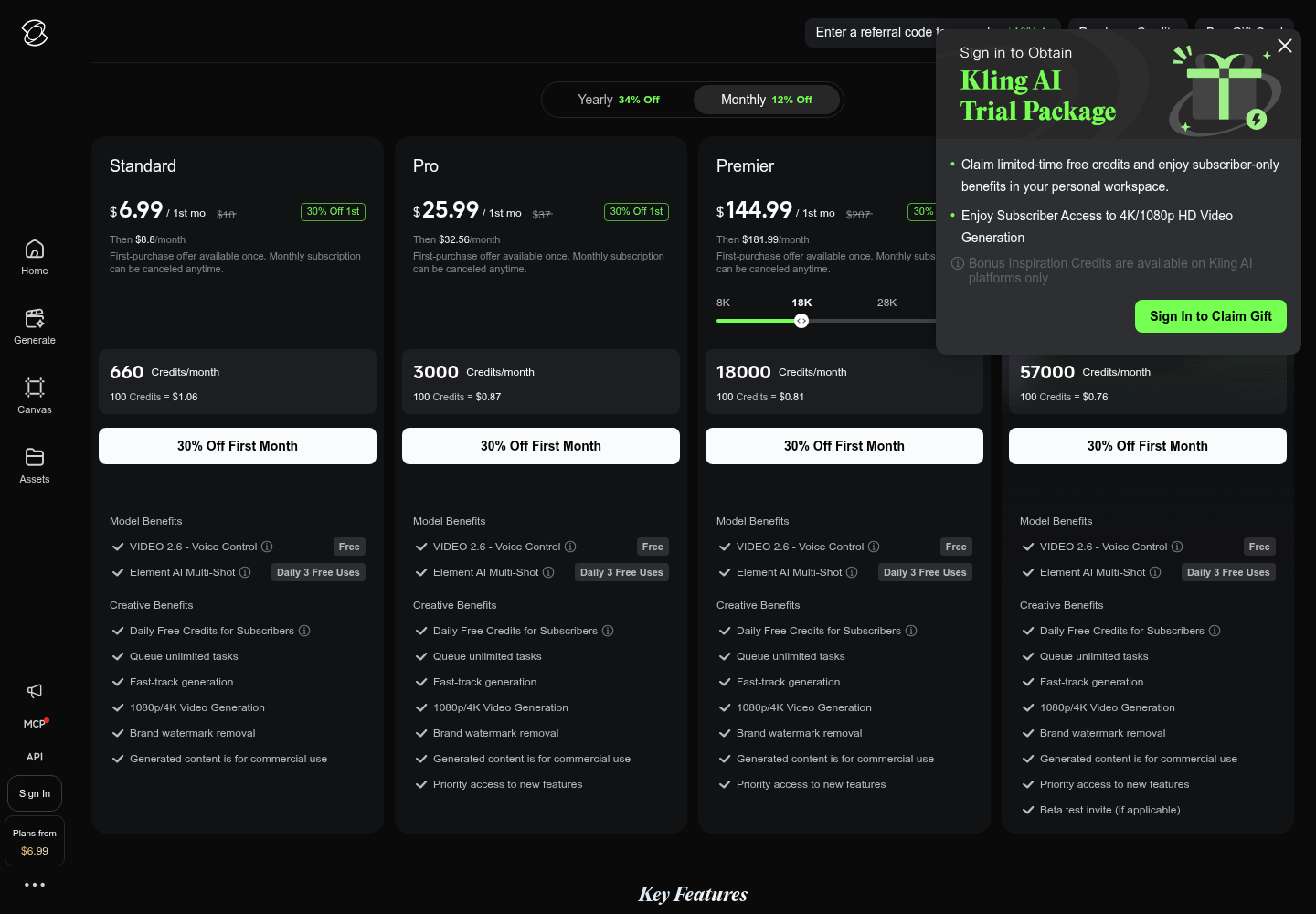
The November 10 membership capture showed a 660-credit package with a $10 reference price, a $6.99 first-month offer and an $8.80 subsequent monthly rate. Larger credit packages, top-ups and other offers were displayed. This is a live promotional snapshot, not a stable universal price. [7]
[2] [3] [7]Kling AI experiments and lessons: Economics improved through product engineering
Kuaishou’s third-quarter 2025 report said Kling 2.5 Turbo reduced creators’ per-video generation costs by nearly 30%. That is a company claim about user generation cost, not a disclosed Kling gross-margin improvement. Parent-company consolidated margin cannot be substituted for this product’s margin. [4]
[Inference] Lower generation cost can support more experimentation per creative brief and improve conversion to a paid workflow. But cheaper attempts do not necessarily mean cheaper accepted output. The useful operating measure is cost per accepted clip, including retries and review. Public disclosures do not reveal that distribution.
[Inference] The main evidence gap is failed experimentation. The inspected corporate sources emphasize launches and wins; they do not expose abandoned channels, lost deals or churn cohorts. A critical case should state that limitation rather than invent a failure to create narrative balance.
[4]Kling AI website and pricing history: From regional paid beta to a global workspace
The July 2024 announcement anchors historical Chinese pricing: Gold RMB66, Platinum RMB266 and Diamond RMB666 monthly, with a launch discount and different credit allowances. The live global membership page uses a different currency and promotion structure. These are not directly comparable like-for-like price increases. [1][7]
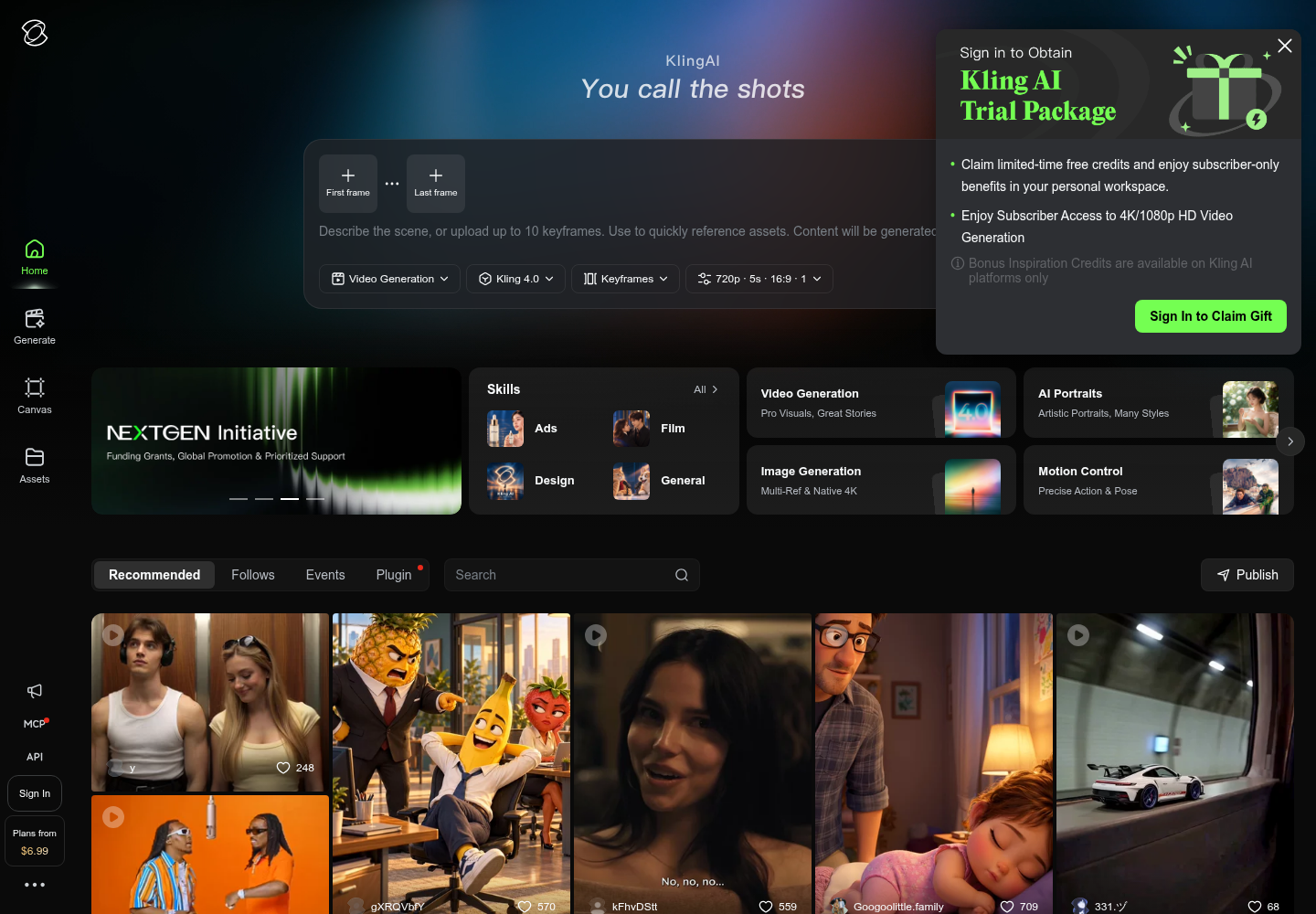
The current home and pricing screenshots were captured after waiting for the application to render. The attempted 2024 archive was an empty application shell and is not presented as a historical product screenshot. The dated official launch announcement provides the historical evidence instead.
[1] [7]Kling AI economics at a glance: Pricing is only half the story.
July 2024 China plans: RMB66/266/666 before launch discount. November 2026 global 660-credit offer: $6.99 first month, $8.80 thereafter versus $10 reference price. [1][7]
Subscriptions, credits and API/enterprise use; segment revenue shares not disclosed.
[Inference] Compute, retries, support and channel economics matter; parent consolidated margin is not Kling margin.
Not publicly verified; incumbent distribution is not free by definition.
No verified paid cohort retention or NRR disclosure.
The people in the Kling AI GTM story: People & capabilities.
Pengfei Wan
Head of Visual Generation and Interaction CenterHKUST PhD, 2015; intelligent content creation and immersive interaction research. [5]
Leads the team developing Kling’s generation models and controls. [5]
[5]Gorkem Yurtseven
FAL CTO; distribution partnerRole verified in the company-supplied release. [6]
Described partnership distribution to creative and commerce applications. [6]
[6]Kling AI GTM: critical reading and analysis: Why it worked.
Where it breaks.
What worked—and why
[Inference] A watchable output made the capability easy to sample.
[Inference] APIs and creative platforms extend distribution to users who may never visit Kling’s own website. [6]
What did not work
The inspected primary record does not disclose failed channels, lost accounts or cohort churn.
What could have been better
[Inference] Report active paying accounts separately from creators, enterprise users and annualized run rate.
[Inference] Measure accepted-output economics and workflow retention before extrapolating generated-video volume.
What another founder can use
[Inference] Package a model around the creative control needed for repeated work; account for the incumbent assets behind a successful launch.
Kling AI website and pricing captures: Product, positioning & pricing.
Captures and image sources are dated individually. Historical gaps are kept explicit. Explore the visual archive
Kling AI go-to-market FAQ: The questions that matter.
Is Kling an independent startup?
No. It is a generative-video product developed by Kuaishou. Its growth should be assessed with that parent-company context. [1]
What does Kling’s $500M figure mean?
Kuaishou reported an approximately $500M annualized revenue run rate for March 2026. Its disclosed methodology annualizes monthly operating revenue. [2][3]
Which go-to-market motions is Kling AI classified under?
[Inference] This research classifies Kling AI as Product Led and Partner Led. Motion labels describe routes across segments and periods, not measured revenue shares.
Kling AI sources and open questions: Follow the sources.
- Kuaishou launches full Kling AI beta globally Kuaishou · primary · 2024-07-25
June waitlist, global beta, daily credits and initial Chinese subscription tiers.
- Kling AI reaches $240M annualized revenue run rate Kuaishou · primary · 2026-01-13
Defines run rate as monthly operating revenue times twelve.
- First quarter 2026 unaudited financial results Kuaishou · primary · 2026-05-27
Kling revenue, team plan, production examples and March run rate.
- Third quarter 2025 unaudited results Kuaishou · primary · 2025-11-19
Turbo cost reduction, product improvements and group economics.
- From Video Generation to World Model, CVPR tutorial CVPR tutorial organizers · primary · 2025-06-11
Pengfei Wan biography and research focus.
- Kling AI at WAIC 2025 Kling AI, distributed via Brand News 24 · primary · 2025-09-11
Company-supplied release names product leadership and platform partners.
- Kling membership pricing Kling AI · primary · 2026-11-10
Observed promotion, credit packages and LiveXAI support link.
- Kling AI launches Kling 4.0 Kuaishou · primary · 2026-10-17
Longer generation, creative controls and planned API availability.
- Kling AI homepage Kling AI · primary · 2026-11-10
Current creative tools and self-serve entry.
What remains unverified
No verified first paying customer or founder-led contract story.
No verified named AE, CSM or account manager tied to expansion.
No product-specific CAC, gross margin, NRR or revenue share by channel.
Failed experiments and historical visual captures remain incomplete.