
Source numbers link to evidence. [Inference] marks analytical judgment, including motion classifications and causal explanations. Public evidence does not establish every internal decision or metric.
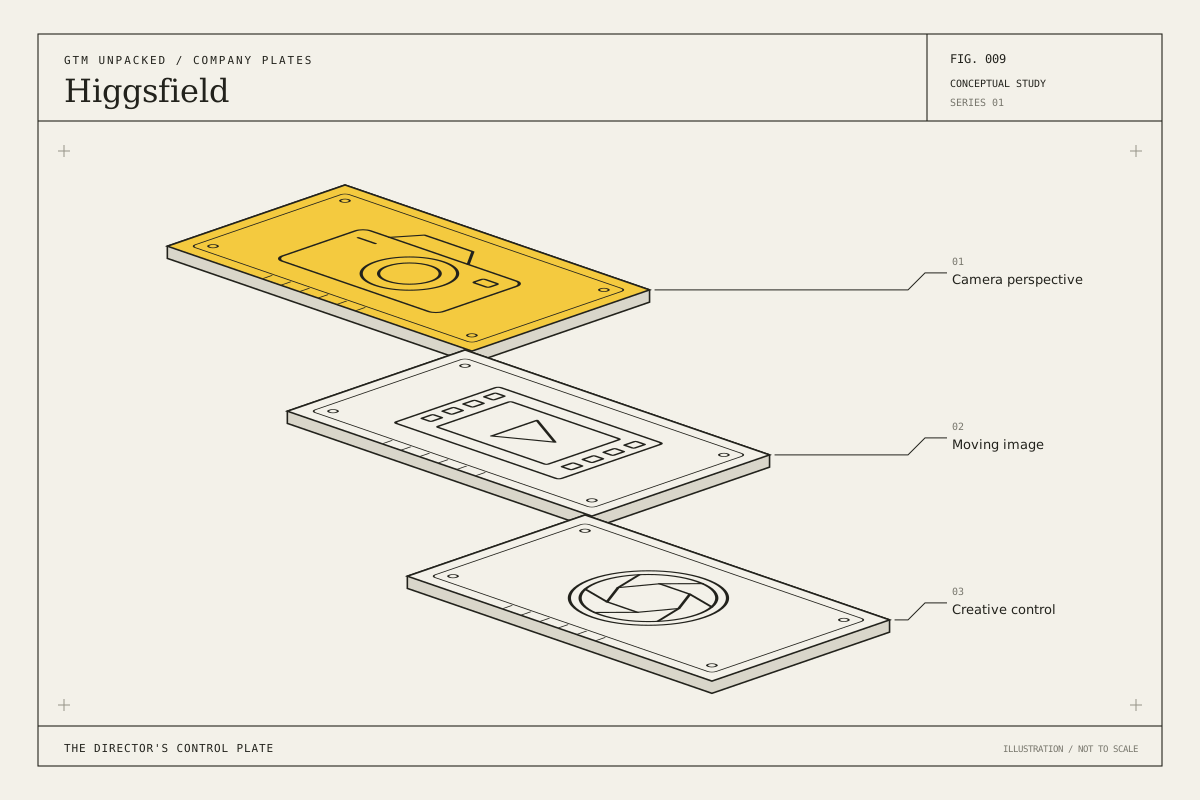
Conceptual illustration for Higgsfield: a camera, a filmstrip, and an aperture evoke moving-image creation through a director’s visual instruments, without representing verified technical architecture.
- Company
- Higgsfield · Generative media · higgsfield.ai
- Conversion motions
- [Inference] This research classifies Higgsfield as Product Led and Human Led.
- Higgsfield beachhead
- Initial consumer mobile novelty; later professional creators, VFX practitioners and marketing teams needing repeatable visual control. [1][2]
- Higgsfield target customer
- Independent creators, advertising agencies, brand content teams and enterprises producing visual campaigns. [7]
- Product complexity
- [Inference] Presets simplify first creation; reliable branded work remains complex because art direction, model choice and revision matter.
- Decision-making unit
- [Inference] Single-person subscriptions at the low end; enterprise creative leaders, procurement, security and brand/legal stakeholders at the high end. [7]
- Market at entry
- [Inference] Demand for social video was established while generative-video tools were still emerging; mobile entertainment and professional production were distinct jobs.
- Market today
- [Inference] Model aggregation competes on workflow, control, production reliability and education as well as access to the latest model.
- Evidence
- Deep research · 11 linked sources · research date · method and limitations
The ten-step Revenue Engine reading map
These links locate relevant evidence. A linked section does not imply every detail of the step is publicly established.
- Acquire Your First Customers: Founder Led Sales Read first customers
- Embrace GTM Experimentation Read experiments & lessons
- Understand Your GTM Motion Options Read GTM motion
- Pick Your GTM Motion Read beachhead & buyer · Read product & market
- Generate a Lead Read GTM motion · Read experiments & lessons
- Turn Leads into Paying Customers Read GTM motion · Read people & process
- Retain and Grow Your Customers Read retain & expand
- Build Your GTM Team Read people & process
- Plan Your Tech Stack Read experiments & lessons · Read people & process · Read product & pricing archive
- Optimize and Scale Through Metrics Read pricing & economics
Higgsfield GTM timeline: From wedge to engine.
Diffuse mobile proposition
Archived homepage emphasizes personalized mobile video. [1]
Desktop professional pivot
Founder dates desktop launch to March 31. [2]
Creator distribution becomes explicit
Founder discusses organic and paid creator acquisition. [3]
Marketing and service backlash
Forbes documents complaints and company responses. [5]
Scale and infrastructure claims
Company reports >$1B annualized run rate and NVIDIA collaboration. [4]
Higgsfield origin and first customers: Origin & the first real customer signal
The April 2024 archive promoted a foundational video model and Diffuse, an iOS experience that personalized video from a selfie. Its calls to action were a mobile download and a model waitlist. This is direct evidence of an earlier product thesis, rather than retrospective positioning as an enterprise suite. [1]
In a January 2026 interview, Alex Mashrabov said the mobile app reached a million users within two months but retained them poorly. Power users wanted VFX control and professional production tools. He described the subsequent desktop launch on March 31, 2025. Sacra labels its conversation as conducted via Sacra AI; the page is a founder interview transcript, not an audited cohort dataset. [2]
[1] [2]Higgsfield beachhead and buyer: A change in willingness to pay
[Inference] The pivot altered both job frequency and economic value. A playful clip may satisfy curiosity once. A creator or marketing team needs fresh assets repeatedly and can compare the subscription with production labor and delivery time. The company did not merely add more features to the same customer journey; it sought users whose recurring work made those features valuable.
Mashrabov’s Product Market Fit Show interview describes early demand for controllable effects, product placement and access to leading models. He said AI educators on YouTube, Instagram and Twitter helped introduce the product. Early posts were largely unpaid, with some affiliates; closer paid creator work increased later. The inspected interview does not name the very first paying customer. [3]
[3]Higgsfield GTM motion: Marketing generates the lead; the product closes it
[Inference] A short creator demonstration can show the output and teach the workflow simultaneously. That makes creator content an effective acquisition hypothesis. The consumer transaction is still self-serve: the user buys access and generation capacity. Calling everything “marketing led” would hide the separate conversion and retention mechanisms.
Mashrabov said the organic-to-paid mix moved from roughly five or six to one toward two to one, and described six marketing people in a team of about sixty at the December 2025 interview. These are founder recollections, not channel-level CAC or attribution reports. [3]
The enterprise landing page adds contact-sales forms, security review, shared workspaces and tailored capacity. [Inference] This is a separate human-led route for an organization buying a dependable creative process, even when individual product use generated the lead. [7]
[3] [7]Higgsfield product and market: Workflow ownership above the model layer
The Sacra interview describes orchestration across models and a fal.ai relationship. [Inference] Aggregation gives the customer a reason to stay when the best underlying model changes: a familiar workflow can survive supplier substitution. It also creates supplier dependence, variable unit costs and a need to explain which model is suitable for each task. [2]
[Inference] The relevant buying test is not whether one clip looks impressive. It is whether a team can produce approved work at a predictable total cost, including unsuccessful generations, editing and review. An agency must also protect client material and coordinate multiple people. The decision-making unit grows with the workflow, even if the first user arrived through a viral tutorial.
[2]Higgsfield people and process: The capabilities behind the pivot
Mashrabov previously co-founded AI Factory and led generative AI work at Snap; his podcast account discusses the earlier acquisition and consumer AI experience. [3]
The current company announcement names co-founders Alex Mashrabov, AI engineer Yerzat Dulat and Mahi De Silva. It identifies NVIDIA Dynamo and successive GPU generations as part of the infrastructure collaboration. This is verified vendor and company material; an investment announcement alone would not establish a sales partnership. [4]
[Inference] Mashrabov’s consumer-product experience helps explain an emphasis on accessible visual demonstrations. It is not evidence that consumer retention would automatically translate to enterprise success. Dulat’s verified role is technical; specific education and training were not established from the inspected primary sources. De Silva publicly handled responses to commercial controversy, but a complete independently verified career history is outside the evidence collected here. [4][5]
[3] [4] [5]Higgsfield retention and expansion: Teaching a production workflow
The live enterprise page promises onboarding by a dedicated AI Educator around the customer’s first project, followed by a private Slack channel and a dedicated account manager. It also advertises creative-tool integrations. These are provider promises; no onboarding completion or time-to-value distribution is published with them. [7]
The enterprise FAQ describes configurable seats and concurrency, shared contract volume and account-manager involvement in expansion. Monthly credit allowances normally reset; API and web credit systems are separate. This makes volume, seats and parallel production distinct expansion paths. [8]
[Inference] The first successful campaign is a better adoption milestone than a completed product tour. Expansion should follow a second team or repeatable workflow with an accountable owner. Teaching prompt technique without teaching brief interpretation, quality review and cost control would leave the expensive part of adoption unresolved.
[7] [8]Higgsfield pricing and economics: The price is not the production cost
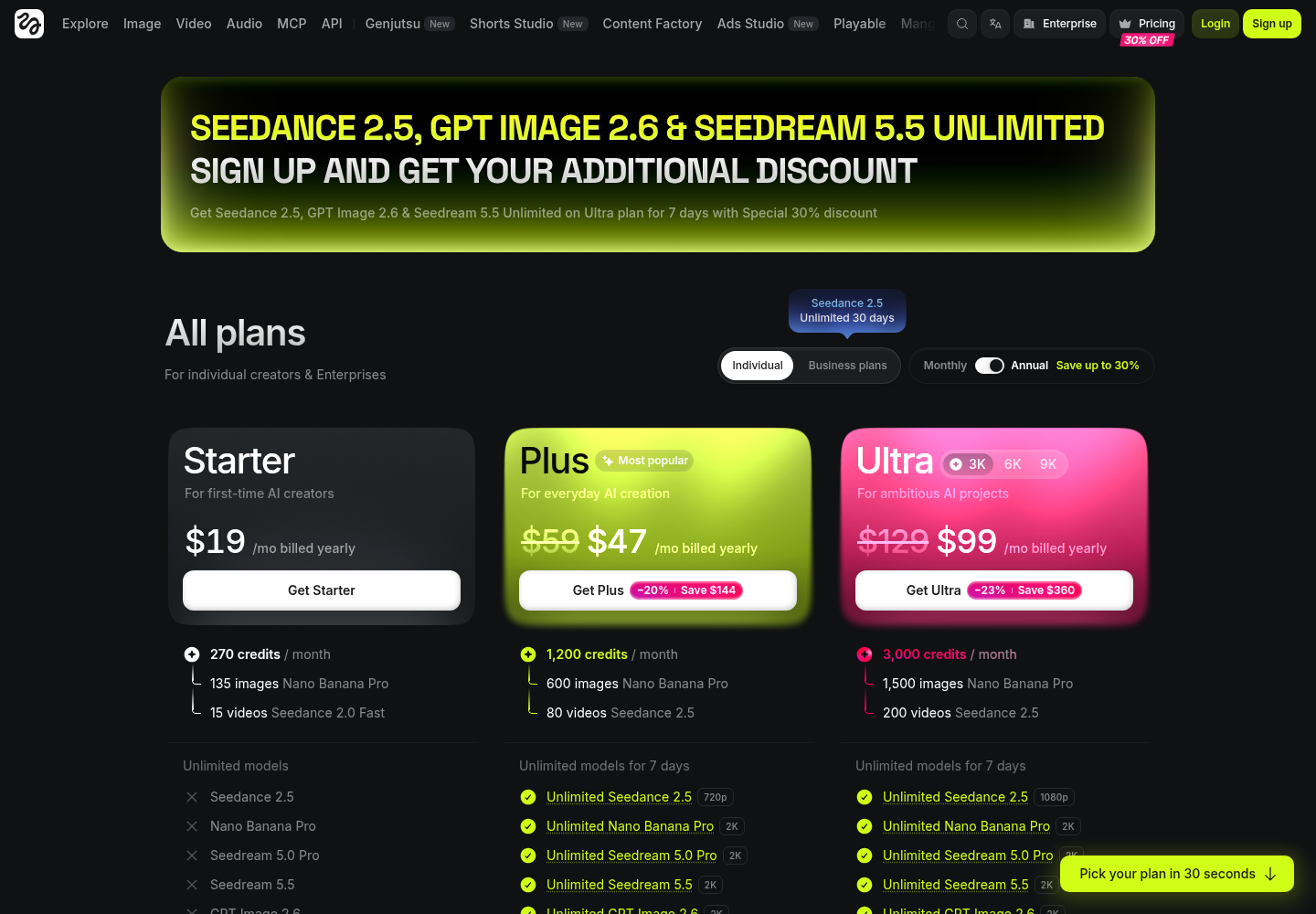
The November 10 pricing capture displayed annual-equivalent offers including Starter at $19 per month, Plus at $47 and Ultra at $99, with crossed-out reference prices and model-specific allowances. Promotions and billing cadence matter: these are not universal month-to-month quotes. The page also qualifies unlimited access with speed-related conditions. [6]
[Inference] Credit packs can align revenue with generation expense, while broad unlimited claims can create a mismatch between customer expectations and available capacity. The meaningful unit is an accepted deliverable, including retries. Without paid acquisition expense, supplier rates, utilization, refunds and retained cohorts, neither headline run rate nor a low advertised entry price proves healthy unit economics.
[6]Higgsfield experiments and lessons: Growth exposed a trust and service bottleneck
Forbes reported in February 2026 that promotional materials included stock templates presented as AI output and offensive content sent to creators. Mahi De Silva acknowledged mistakes and process failures. The report also documented payout complaints and throttling concerns; the company cited fraud and heavy traffic and said it had issued refunds. These are reported allegations and company responses, not findings by a court. [5]
[Inference] The problem is directly commercial: creators act as both customers and distributors. Misleading demonstrations damage both relationships at once. A rapid publishing system needs provenance checks, clear sponsorship terms and a process for paying legitimate contributors. Controls should be judged by whether they preserve truthful acquisition and reliable delivery, not only by release speed.
[5]Higgsfield website and pricing history: From mobile download to creative workspace
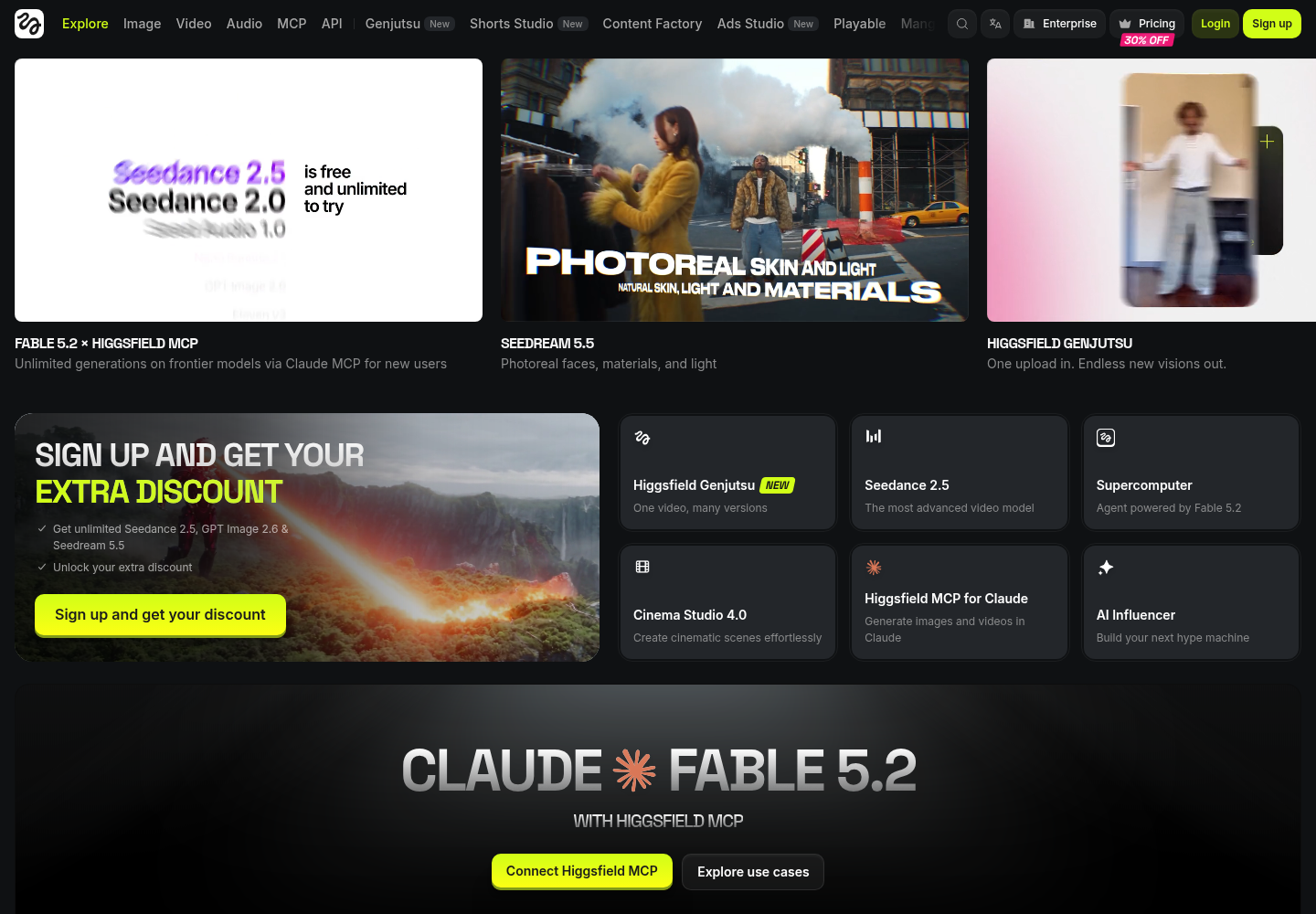
The April 2024 archive shows the mobile-first proposition. The current homepage exposes a broad model and studio menu; enterprise pages sell managed workspaces and onboarding. The October 2026 company announcement reports more than $1 billion in annualized revenue run rate reached in September. That is a company-reported run rate, not independently audited recurring contracted revenue; it should not be casually substituted for the unverified $500M figure in this project’s starting list. [1][4][10]
The April 28, 2025 archived pricing text has the annual billing tab selected: Basic is shown at $9/month, Pro at a promotional $20/month, and Ultimate at $55/month, all billed annually. The packages allocate 150, 600, and 1,500 monthly credits, respectively, and distinguish concurrent jobs, model access, and commercial use. The page rendered incompletely during screenshot capture, so its text is cited without presenting the blank capture as visual proof. [11]
[Inference] This is evidence of packaging around generation capacity and workflow priority. It should not be compared mechanically with a later plan price without aligning billing period, promotions, model access, and included credits. [11]
[1] [4] [10] [11]Higgsfield economics at a glance: Pricing is only half the story.
Observed annual-equivalent offers: Starter $19, Plus $47, Ultra $99 monthly; promotions and model allowances differ. [6]
[Inference] Supplier inference costs, failed generations, support, refunds and creator-acquisition payments all affect contribution margin.
Not publicly verified; organic-to-paid content ratios are not acquisition cost.
Founder reported poor early mobile retention. No current paid-cohort retention metric verified. [2]
The people in the Higgsfield GTM story: People & capabilities.
Yerzat Dulat
Co-founder; technical leadershipDescribed by the company as an AI engineer; detailed training not independently verified here. [4]
Part of the technical founding team. [4]
[4]Mahi De Silva
Co-founder and chief strategy officerRole verified in reporting; detailed prior career not independently verified in this case. [5]
Publicly addressed promotional and service failures. [5]
[5]Higgsfield GTM: critical reading and analysis: Why it worked.
Where it breaks.
What worked—and why
[Inference] Professional control addressed a recurring job with a budget.
[Inference] Creator education can combine product demonstration and acquisition in one artifact.
What did not work
Founder described weak early mobile retention. [2]
Forbes documented promotional and customer-service failures with company responses. [5]
What could have been better
[Inference] Validate every promotional demo’s provenance and clearly distinguish paid from independent creator claims.
[Inference] Make capacity limits and expected generation latency visible before annual purchase.
[Inference] Track retained gross profit by creator cohort, including payouts and refunds.
What another founder can use
[Inference] The right pivot may change the customer’s job and willingness to pay, not just the interface.
Higgsfield website and pricing captures: Product, positioning & pricing.
Captures and image sources are dated individually. Historical gaps are kept explicit. Explore the visual archive

Higgsfield go-to-market FAQ: The questions that matter.
Higgsfield: What changed after the mobile launch?
The founder describes poor retention followed by a desktop focus on professional creative control. [2]
How does Higgsfield support enterprise expansion?
Its public materials describe educators, account managers, private Slack support, configurable seats and additional generation capacity. These are provider descriptions, not measured outcomes. [7][8]
Which go-to-market motions is Higgsfield classified under?
[Inference] This research classifies Higgsfield as Product Led and Human Led. Motion labels describe routes across segments and periods, not measured revenue shares.
Higgsfield sources and open questions: Follow the sources.
- Higgsfield archived homepage Higgsfield via Internet Archive · primary · 2024-04-03
Mobile Diffuse app and foundational-video-model positioning.
- Alex Mashrabov on AI video production Sacra · interview · 2026-01-05
Founder interview on mobile retention, professional pivot and model orchestration.
- Alex Mashrabov on A Product Market Fit Show A Product Market Fit Show · interview · 2025-12-04
Founder transcript: previous company, early creators and paid acquisition.
- Higgsfield extends Series B with TCV and NVIDIA Higgsfield · primary · 2026-10-23
Reported growth, NVIDIA infrastructure and academy.
- The dark side of Higgsfield’s super-fast growth Forbes Australia · reporting · 2026-02-12
Reported promotional failures, creator/payment complaints and company responses.
- Higgsfield pricing Higgsfield · primary · 2026-11-10
Current annual-equivalent promotional plans and usage conditions.
- Higgsfield Enterprise Higgsfield · primary · 2026-11-10
Dedicated educator, account manager, private Slack and commercial workflow packaging.
- Enterprise FAQ Higgsfield Help Center · primary · 2026-07-23
Credits, seats, concurrency and expansion through account manager.
- GTM — Enterprise Higgsfield · primary · 2026-11-10
Hiring specification for product-led enterprise conversion and onboarding.
- Higgsfield homepage Higgsfield · primary · 2026-11-10
Current creative suite, model menu and workflow studios.
- Higgsfield archived pricing — 2025-04-28 Higgsfield / Internet Archive · primary · 2025-04-28
Timestamped pricing page inspected during research. Rendering limits are stated in the case.
What remains unverified
Exact first paying customer and first enterprise contract were not verified.
No named account executive or account manager could be tied to a verified customer expansion.
Current cohort retention, gross margin, CAC and partner compensation remain undisclosed in inspected sources.
Full founder education and commercial-hire histories were not verified.