Source numbers link to evidence. [Inference] marks analytical judgment, including motion classifications and causal explanations. Public evidence does not establish every internal decision or metric.
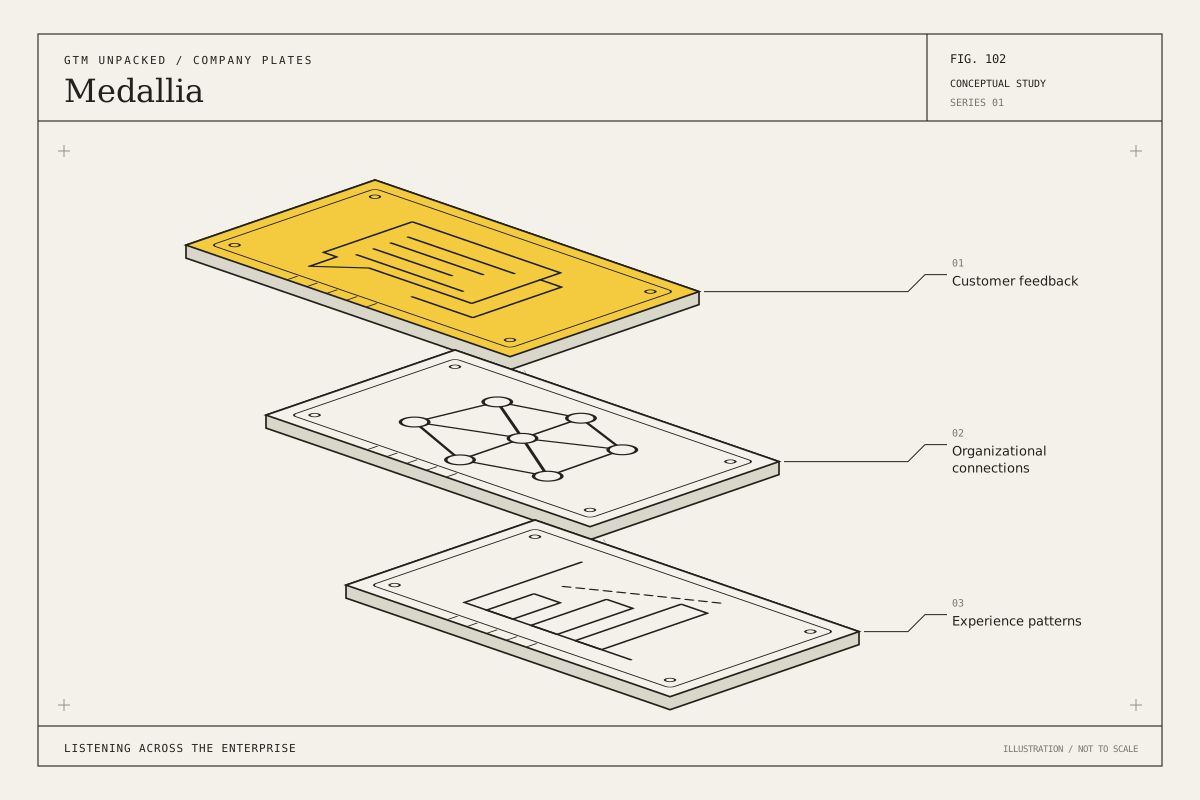
Conceptual illustration for Medallia: message bubbles, connected nodes, and a chart evoke customer feedback considered across an organizational landscape, without representing verified technical architecture.
- Company
- Medallia · Experience management · medallia.com
- Conversion motions
- [Inference] This research classifies Medallia as Human Led and Partner Led.
- Medallia beachhead
- Large hotel companies
- Medallia target customer
- Enterprises managing customer and employee experience
- Product complexity
- High data and workflow integration; role-specific use
- Decision-making unit
- [Inference] CX, operations, IT, executive leadership and local business managers
- Market at entry
- Slow survey-based research; emerging enterprise feedback software
- Market today
- [Inference] Established experience platforms compete on action and broader signal capture
- Evidence
- Source-backed brief · 4 linked sources · research date · method and limitations
The ten-step Revenue Engine reading map
These links locate relevant evidence. A linked section does not imply every detail of the step is publicly established.
- Acquire Your First Customers: Founder Led Sales Read first customers
- Embrace GTM Experimentation Read experiments & lessons
- Understand Your GTM Motion Options Read GTM motion
- Pick Your GTM Motion Read beachhead & buyer · Read product & market
- Generate a Lead Read GTM motion · Read experiments & lessons
- Turn Leads into Paying Customers Read GTM motion · Read people & process
- Retain and Grow Your Customers Read retain & expand
- Build Your GTM Team Read people & process
- Plan Your Tech Stack Read experiments & lessons · Read people & process · Read product & pricing archive
- Optimize and Scale Through Metrics Read pricing & economics
Medallia origin and first customers: Origin & first customers
Medallia’s early customer story is unusually specific. A 2010 account reports a pitch to a top-five hotel company on September 10, 2001, a commitment to proceed on September 12, and a prototype becoming the replacement system after six months. It does not disclose the initial contract’s price. The founders were Borge Hald and Amy Pressman; the latter had seen the relationship between customer loyalty and performance while consulting at BCG. [1]
[1]Medallia beachhead and buyer: Beachhead & buyer
The IPO filing identifies hospitality as the initial market, Hilton as the first enterprise customer in 2002, and expansion into other industries from 2007. [2] [Inference] Hotels supplied repeated service encounters, identifiable locations and managers who could act on feedback. That made operational improvement more observable than a broad survey product would have been. One successful chain also provided a reference recognizable to similar buyers.
[2]Medallia GTM motion: GTM motion & lead conversion
[Inference] The conversion mechanism was consultative enterprise selling supported by an initial implementation, not survey virality. A pilot had to prove that feedback reached somebody able to change the customer experience. The sales story could then travel horizontally into new industries and vertically through additional properties or business units. Founder access and sector learning mattered before a scaled field organization could reliably reproduce the sale. [1][2]
[1] [2]Medallia product and market: Product, market & buying complexity
[Inference] The software’s end-user task could be straightforward—read feedback and respond—while the organizational change was complex. Headquarters needed useful aggregate insight; frontline staff needed relevant alerts without an overwhelming dashboard. Buying consensus consequently extended beyond the research department. A deployment could fail commercially despite accurate analytics if managers did not incorporate it into daily work.
Medallia people and process: People & operating process
Hald’s reported background included the Norwegian Air Force, Morgan Stanley, Procter & Gamble and BCG. [1] In 2013 Medallia appointed Ken Fine its first chief customer officer after 15 years in product, marketing and general-management roles at Financial Engines. His remit combined product design, program definition, implementation, support, expansions and renewals. [3] [Inference] That broad remit treated customer adoption as a joined-up product and operating problem.
[1] [3]Medallia retention and expansion: Customer success & expansion
At Fine’s appointment, Medallia reported a 98% renewal rate and new customers including Marriott, AXA, Mercedes-Benz USA and Royal Caribbean. The announcement did not provide the precise renewal metric definition. [3] The earlier account describes expansion into business units and geographies after customers saw results. [1] [Inference] Account growth depended on making a local success reproducible, rather than simply selling more dashboard seats.
[1] [3]Medallia pricing and economics: Pricing & economic constraints
The current pricing page describes an Experience Data Record as the information associated with one discrete customer or employee interaction. It offers a sales-led quote rather than a public universal price. [4] [Inference] This value metric supports broad access to insights, but buyers still need to forecast what counts as an interaction and how signal volumes grow. CAC, net retention and actual customer-level service margins were not verified.
[4]Medallia experiments and lessons: Experiments, lessons & critique
[Inference] The strategy worked because the original wedge tied software to an expensive operational problem, with visible frontline action. Its risk is implementation intensity: every new vertical may require new language, integrations and change-management expertise. A better expansion discipline would distinguish configuration reusable across customers from bespoke consulting, and measure time to the first recovered customer or resolved problem. Public sources here do not establish a failed channel experiment.
Medallia website and pricing history: Positioning & pricing evolution
The movement from a hotel feedback system to a broader experience platform and record-based pricing is supported by the dated accounts and current pricing text. [1][2][4] [Inference] The product story expanded from collecting opinions to governing action across interactions. No authenticated historical website screenshots were captured for this brief. It would be misleading to depict a reconstructed early survey screen as Medallia’s actual interface.
[1] [2] [4]Medallia economics at a glance: Pricing is only half the story.
Current pricing is quote-based, organized around Experience Data Records. [4]
Enterprise subscription
[Inference] Data integration and behavioral change create material services cost.
Not publicly verified
Company reported 98% renewal in 2013 without a detailed metric definition in the release. [3]
The people in the Medallia GTM story: People & capabilities.
Amy Pressman
Co-founderBCG consulting exposed customer-loyalty problems.
Developed the original opportunity around acting on customer feedback. [1]
[1]Borge Hald
Co-founder and early CEONorwegian Air Force, Morgan Stanley, P&G and BCG experience.
Led the early company and customer operating model. [1]
[1]Medallia GTM: critical reading and analysis: Why it worked.
Where it breaks.
What worked—and why
[Inference] Hospitality made operational value and reference customers concrete. [1][2]
What did not work
No specific failed acquisition experiment was verified.
What could have been better
[Inference] Track reusable implementation effort separately from bespoke service effort.
What another founder can use
[Inference] A vertical wedge is powerful when local outcomes can be replicated across a large account.
Medallia go-to-market FAQ: The questions that matter.
How did Medallia find its GTM motion?
[Inference] The conversion mechanism was consultative enterprise selling supported by an initial implementation, not survey virality. A pilot had to prove that feedback reached somebody able to change the customer experience. The sales story could then travel horizontally into new industries and vertically through additional properties or business units. Founder access and sector learning mattered before a scaled field organization could reliably reproduce the sale. [1][2]
What can founders learn from Medallia?
[Inference] A vertical wedge is powerful when local outcomes can be replicated across a large account.
Medallia sources and open questions: Follow the sources.
- Deal Radar 2010: Medallia Sramana Mitra · reporting · 2010-03-16
- Medallia S-1 SEC / Medallia · primary
- Medallia appoints chief customer officer Medallia · primary · 2013-10-17
- Experience Data Record pricing Medallia · primary
What remains unverified
No verified historical website screenshot was available for this brief.
Early CRM, sales engagement and enablement tools were not verified; product integrations are not treated as internal GTM tools.
Exact first paid contract and early funnel conversion are not publicly verified in the inspected sources.
No verified visual capture is attached to this entry. A current screenshot is not a substitute for a historical capture.