Source numbers link to evidence. [Inference] marks analytical judgment, including motion classifications and causal explanations. Public evidence does not establish every internal decision or metric.
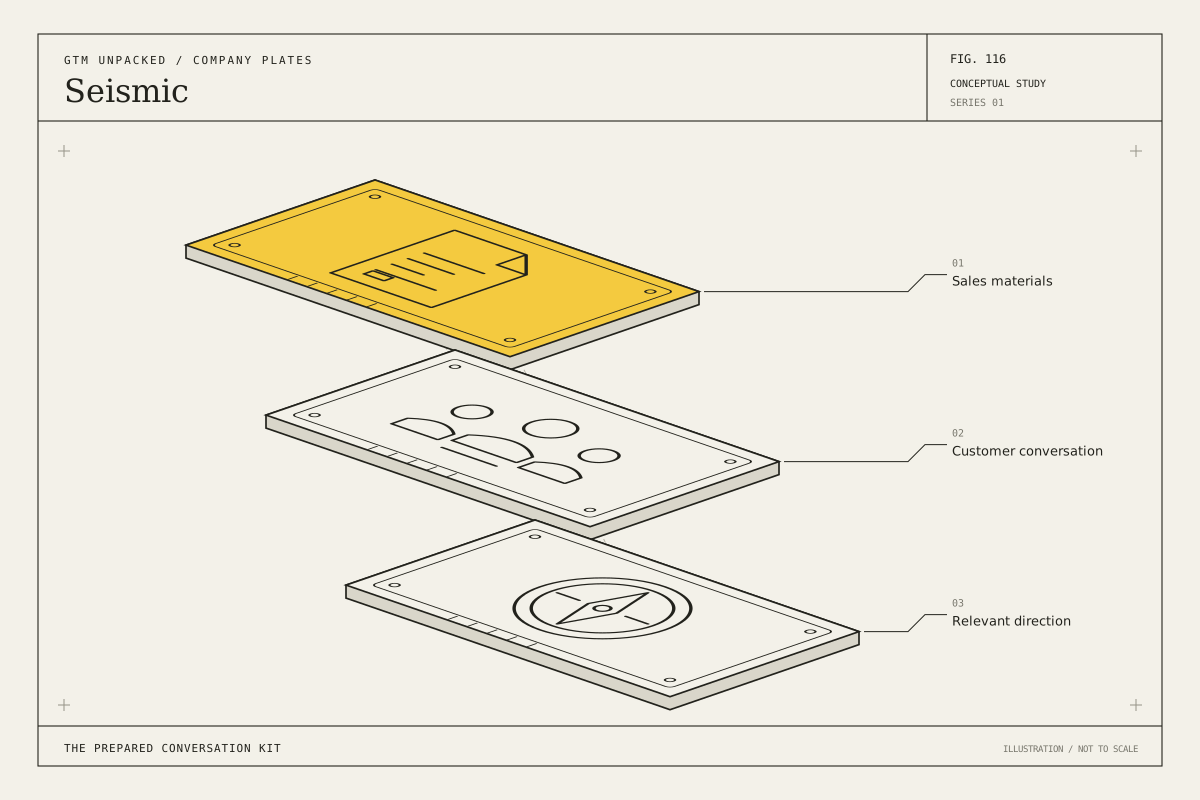
Conceptual illustration for Seismic: a document, grouped figures, and a compass evoke sales content gathered for a purposeful customer discussion, without representing verified technical architecture.
- Company
- Seismic · Sales enablement · seismic.com
- Conversion motions
- [Inference] This research classifies Seismic as Human Led and Partner Led.
- Seismic beachhead
- Financial-services content personalization
- Seismic target customer
- Enterprise sales, marketing and enablement organizations
- Product complexity
- High content governance and workflow complexity
- Decision-making unit
- [Inference] Sales/marketing champion, IT, compliance and procurement
- Market at entry
- No clear sales-enablement category at inception
- Market today
- [Inference] Mature, consolidating category expanding toward AI revenue performance
- Evidence
- Source-backed brief · 4 linked sources · research date · method and limitations
The ten-step Revenue Engine reading map
These links locate relevant evidence. A linked section does not imply every detail of the step is publicly established.
- Acquire Your First Customers: Founder Led Sales Read first customers
- Embrace GTM Experimentation Read experiments & lessons
- Understand Your GTM Motion Options Read GTM motion
- Pick Your GTM Motion Read beachhead & buyer · Read product & market
- Generate a Lead Read GTM motion · Read experiments & lessons
- Turn Leads into Paying Customers Read GTM motion · Read people & process
- Retain and Grow Your Customers Read retain & expand
- Build Your GTM Team Read people & process
- Plan Your Tech Stack Read experiments & lessons · Read people & process · Read product & pricing archive
- Optimize and Scale Through Metrics Read pricing & economics
Seismic origin and first customers: Origin & first customers
Ed Calnan’s Science of Scaling interview gives a concrete first sale: an introduction to a GE CIO led to a $6,000 commitment after nearly a year pursuing the first paying customer. The CIO had that amount left in the budget. [1] Doug Winter’s separate interview describes a 2010 basement startup deliberately targeting enterprises from the beginning because the founders already knew those buyers. [2]
[1] [2]Seismic beachhead and buyer: Beachhead & buyer
The founding story describes financial advisors assembling pitchbooks manually, with outdated charts and sometimes another client’s information. [3] [Inference] This made financial services a strong wedge: personalization, accuracy and controlled content were economically meaningful. The first contract could be small without implying a small target account. The important variable was the attainable account footprint after proving a narrowly scoped use case.
[3]Seismic GTM motion: GTM motion & lead conversion
Calnan’s interview describes asking an initial business unit to sponsor introductions to other divisions. [1] Winter explains that small pilots became larger agreements by proving value and adjusting the roadmap without turning every requirement into custom software. [2] [Inference] This is founder-led enterprise selling followed by account expansion. It depends on internal advocacy and reusable product capabilities, not just a large theoretical total addressable market.
[1] [2]Seismic product and market: Product, market & buying complexity
[Inference] Content assembly looks simple until brand, compliance, personalization, source data and seller workflow must all work together. Procurement also evaluates a young vendor’s survival and security posture. A useful pilot therefore has two jobs: demonstrate time saved for users and show that the supplier can operate within enterprise constraints. Ignoring the second can leave a technically successful demo unable to convert.
Seismic people and process: People & operating process
The official story names five founders: Doug Winter, Ed Calnan, Fred Xie, Nasser Barghouti and Marc Romano. [3] Winter and Calnan had enterprise selling experience; the founder interviews explain why they felt comfortable beginning with large companies. [2] [Inference] Their prior customer knowledge made the early motion more plausible than it would be for a team with no access to enterprise buyers or experience navigating their approval processes.
[2] [3]Seismic retention and expansion: Customer success & expansion
[Inference] Expansion into another division requires more than copying a contract. The account team needs a reference use case, a sponsor, deployment capacity and a plan for local content owners. The early stories support this sponsor-driven expansion pattern, but do not identify the first CSM hire or a complete renewal-ownership model. The absence of those details should not be filled with a generic SaaS success playbook. [1][2]
[1] [2]Seismic pricing and economics: Pricing & economic constraints
The $6,000 first deal was a founder-reported entry contract, not a sustainable standard enterprise price. [1] [Inference] A deliberately inexpensive pilot can be rational if it has explicit boundaries and realistic expansion potential. It becomes dangerous when high service effort is subsidized indefinitely or when the promised larger purchase never materializes. Customer-level acquisition cost, delivery margin and current pricing were not verified.
[1]Seismic experiments and lessons: Experiments, lessons & critique
Winter recounts serious setbacks: buyers struggled to categorize Seismic, compliance teams worried about startup viability, and a cloud-provider issue spoiled an executive demo shortly before a major pipeline deal was lost. [2] [Inference] The strategic response was persistence plus disciplined scope, not assuming a polished product removed enterprise risk. A stronger early process would test procurement and security requirements before investing heavily in a late-stage demonstration.
[2]Seismic website and pricing history: Positioning & pricing evolution
Seismic completed its Highspot merger in August 2026 and the combined company operates under Seismic, led by Rob Tarkoff. [4] This is current corporate context, separate from Winter and Calnan’s early GTM story. [Inference] The category has moved from explaining what enablement is to demonstrating measurable performance across a larger platform. Historical pricing-page screenshots were not verified; no reconstructed page is presented as authentic.
[4]Seismic economics at a glance: Pricing is only half the story.
First GE commitment reportedly $6,000; not a standard current price. [1]
Enterprise subscriptions and services
[Inference] Small pilots need bounded delivery cost and a credible expansion path.
Not publicly verified
Not publicly verified
The people in the Seismic GTM story: People & capabilities.
Doug Winter
Co-founder and former CEOEnterprise-software and sales background described in his founder interview.
Chose enterprise customers early and maintained product scope through expansion. [2]
[2]Marc Romano
Co-founderTechnical founder named in the company history.
Built early product versions. [3]
[3]Rob Tarkoff
Combined-company CEO, 2026Named CEO in the completed-merger announcement.
Leads Seismic following the Highspot combination. [4]
[4]Seismic GTM: critical reading and analysis: Why it worked.
Where it breaks.
What worked—and why
[Inference] Enterprise experience and internal sponsors supported large-account expansion. [1][2]
What did not work
Founder reports category confusion, procurement risk concerns and a failed critical demo. [2]
What could have been better
[Inference] Qualify procurement and security early in the pilot.
What another founder can use
[Inference] A small first contract can fit enterprise GTM when the next expansion step is specific and earned.
Seismic go-to-market FAQ: The questions that matter.
How did Seismic find its GTM motion?
Calnan’s interview describes asking an initial business unit to sponsor introductions to other divisions. [1] Winter explains that small pilots became larger agreements by proving value and adjusting the roadmap without turning every requirement into custom software. [2] [Inference] This is founder-led enterprise selling followed by account expansion. It depends on internal advocacy and reusable product capabilities, not just a large theoretical total addressable market.
What can founders learn from Seismic?
[Inference] A small first contract can fit enterprise GTM when the next expansion step is specific and earned.
Seismic sources and open questions: Follow the sources.
- Scaling to enterprise with Ed Calnan HubSpot / Science of Scaling · interview · 2025-04-30
- Enterprise sales from a basement SaaS Club · interview · 2022-10-13
- Seismic founding story Seismic · primary
- Seismic completes merger with Highspot Seismic / Highspot · primary · 2026-08-18
What remains unverified
No verified historical website screenshot was available for this brief.
Early CRM, sales engagement and enablement tools were not verified; product integrations are not treated as internal GTM tools.
Exact first paid contract and early funnel conversion are not publicly verified in the inspected sources.
No verified visual capture is attached to this entry. A current screenshot is not a substitute for a historical capture.