Source numbers link to evidence. [Inference] marks analytical judgment, including motion classifications and causal explanations. Public evidence does not establish every internal decision or metric.
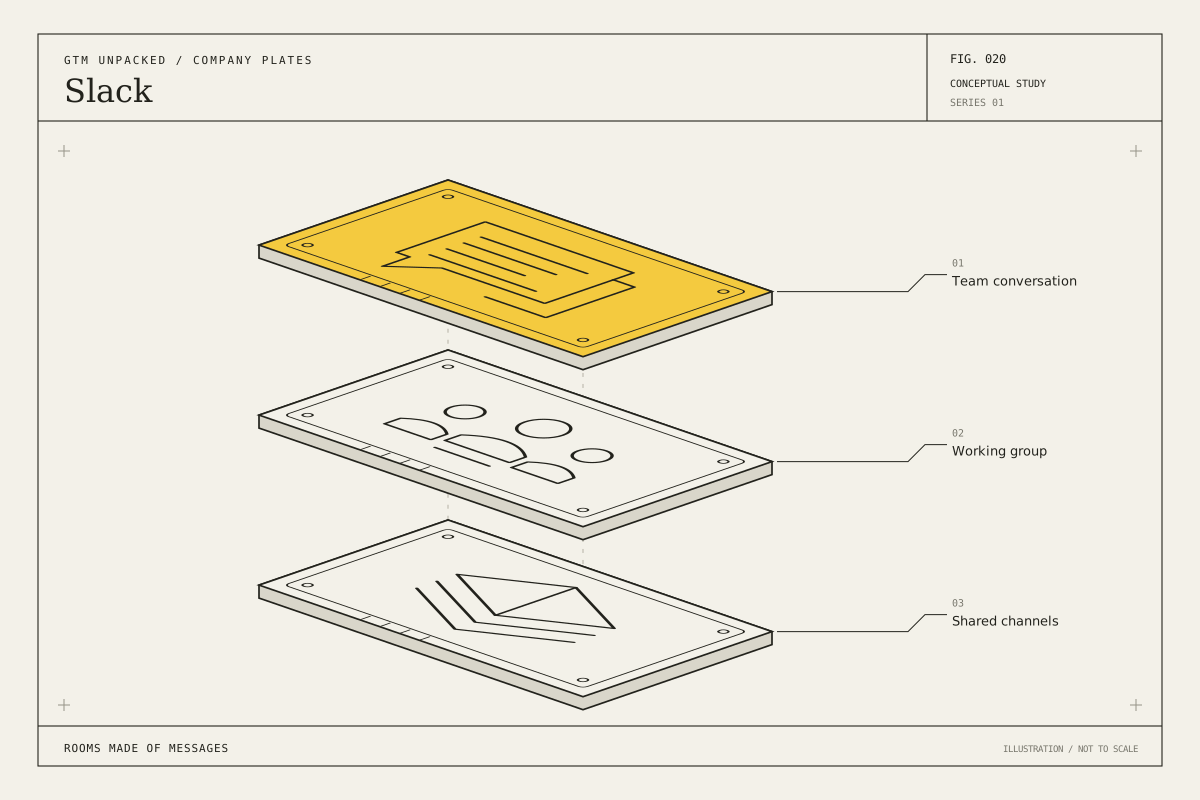
Conceptual illustration for Slack: message bubbles, grouped figures, and layered sheets evoke team communication arranged into a shared digital space, without representing verified technical architecture.
- Company
- Slack · Collaboration software · slack.com
- Conversion motions
- [Inference] This research classifies Slack as Product Led, Human Led and Marketing Led.
- Slack beachhead
- Small working teams that could change their communication habits together; early pilots included Cozy and Rdio. [1]
- Slack target customer
- Teams first; enterprise-wide deployments added executive, security and procurement stakeholders. [1][2]
- Product complexity
- [Inference] Low-friction entry but a complex organizational product: channels, history, integrations and information architecture require team learning.
- Decision-making unit
- [Inference] A small initial buying group can still face many user vetoes; organization-wide adoption is a much more complex decision. [1][2]
- Market at entry
- [Inference] Messaging existed, but many prospects did not recognize their collection of email, chat and texts as a distinct software category. [1]
- Market today
- [Inference] Team communication is an established budget category; expansion must demonstrate workflow value and justify administration and support costs. Current market shares are not established in this brief.
- Evidence
- Source-backed brief · 3 linked sources · research date · method and limitations
The ten-step Revenue Engine reading map
These links locate relevant evidence. A linked section does not imply every detail of the step is publicly established.
- Acquire Your First Customers: Founder Led Sales Read first customers
- Embrace GTM Experimentation Read experiments & lessons
- Understand Your GTM Motion Options Read GTM motion
- Pick Your GTM Motion Read beachhead & buyer · Read product & market
- Generate a Lead Read GTM motion · Read experiments & lessons
- Turn Leads into Paying Customers Read GTM motion · Read people & process
- Retain and Grow Your Customers Read retain & expand
- Build Your GTM Team Read people & process
- Plan Your Tech Stack Read experiments & lessons · Read people & process · Read product & pricing archive
- Optimize and Scale Through Metrics Read pricing & economics
Slack origin and first customers: Origin & first customers
Butterfield said the team used Slack internally by March 2013, then recruited roughly six to ten companies through friends. Cozy and Rdio were named pilots. At Rdio, adoption spread from front-end developers to engineering and eventually its approximately 120-person organization. That exposed channel-discovery problems a small founding team had not experienced. [1]
[1]Slack beachhead and buyer: The team was the initial unit of adoption
[Inference] Slack’s beachhead was an organizational behavior rather than a tightly bounded industry: a team able to shift daily communication together. Butterfield described users as potential veto holders, so winning one enthusiastic individual was insufficient. Department-level adoption nevertheless avoided an immediate company-wide buying committee. [1]
[1]Slack GTM motion: From founder intervention to hybrid growth
The August 2013 preview used press coverage and invitations; Butterfield reported 8,000 requests on its first day. The subsequent beta iterated onboarding before a wider release. By 2019, the filing described self-service, direct sales and an expanding field organization. [1][2]
[Inference] The scalable motion did not erase human selling. It moved human effort from persuading every individual to helping teams adopt and larger organizations standardize.
[1] [2]Slack product and market: Activation required shared usage
Butterfield’s team used 2,000 exchanged messages as an empirical indicator that a team had really tried Slack. This was an observed activation proxy, not a universal product-market-fit rule. [1]
[Inference] The important unit was a functioning communication network. An account creation or a downloaded app would have overstated activation because a silent workspace delivers little recurring value.
[1]Slack people and process: Founder responsiveness as a product capability
Butterfield brought prior Flickr founding experience and personally handled about half of incoming feedback for a period. His interview emphasizes tagging and retaining feedback rather than merely answering tickets. [1]
[Inference] That combined customer contact with product prioritization. A founder can hear objections directly, but scaling this practice requires a common feedback system and decision process; heroics alone do not constitute an operating model.
[1]Slack retention and expansion: Education and expansion became explicit functions
The 2019 S-1 describes customer experience serving free and paid users, educating users, quantifying feedback and supporting conversion and renewal. It separately names customer success, education and direct sales as investments to expand usage within organizations. [2]
[Inference] This makes expansion a joint product-and-service task: help an internal champion make adoption successful, then address governance and deployment requirements that exceed the champion’s authority.
[2]Slack pricing and economics: Expansion evidence, not an invented CAC
Slack reported 88,000 paid customers, 575 paying more than $100,000 annually and 143% net dollar retention as of January 31, 2019. The same filing explains that retention declined as older accounts became more penetrated. [2]
[Inference] Net expansion made initial team adoption economically attractive, but NDR is not gross margin, CAC or proof of short payback. Free-user infrastructure and support consume resources before conversion.
[2]Slack experiments and lessons: What the early story actually demonstrates
Slack emerged after the team’s multiplayer game effort failed, according to Butterfield. Rdio’s rollout then revealed a product usability problem that the founders corrected by improving channel descriptions and membership visibility. [1]
[Inference] The transferable experiment is progressively larger real teams, with observable usage and feedback. The press launch amplified a product already undergoing customer learning; it should not be treated as a substitute for it.
[1]Slack website and pricing history: Website and pricing evidence
The pricing page reviewed in November 2026 offered a free plan with limited history and integrations, paid Pro and Business+ tiers, and an enterprise sales path. This is a dated current snapshot; a verified historical screenshot and price-change series remains incomplete. [3]
[3]Slack economics at a glance: Pricing is only half the story.
November 2026 localized page displayed US-dollar annual rates: Pro $7.25 and Business+ $15 per user/month; historical launch pricing remains unestablished. [3]
Free entry with paid organizational subscriptions and enterprise expansion. [2]
[Inference] Free users, support, integrations and enterprise deployment add acquisition and delivery costs.
Not established by the sources reviewed.
143% net dollar retention as of January 31, 2019, company-reported. [2]
The people in the Slack GTM story: People & capabilities.
Stewart Butterfield
Co-founder; CEO during the period studiedPreviously co-founded Flickr. [1]
Recruited external pilot teams and personally processed customer feedback. [1]
[1]Slack GTM: critical reading and analysis: Why it worked.
Where it breaks.
What worked—and why
[Inference] Recruiting complete teams made the product test realistic; usage then supplied evidence for enterprise expansion.
What did not work
The preceding game business failed; pilot usage also exposed channel-discovery friction. [1]
What could have been better
[Inference] Explicit champion enablement and security readiness should develop alongside team adoption, so organic expansion does not stall at procurement.
What another founder can use
[Inference] Use a behavior-based activation measure for collaborative products; do not copy Slack’s numerical threshold without testing your own cohorts.
Slack go-to-market FAQ: The questions that matter.
How did Slack get its first customers?
Butterfield said the team used Slack internally by March 2013, then recruited roughly six to ten companies through friends. Cozy and Rdio were named pilots. At Rdio, adoption spread from front-end developers to engineering and eventually its approximately 120-person organization. That exposed channel-discovery problems a small founding team had not experienced. [1]
Which go-to-market motions is Slack classified under?
[Inference] This research classifies Slack as Product Led, Human Led and Marketing Led. Motion labels describe routes across segments and periods, not measured revenue shares.
Slack sources and open questions: Follow the sources.
- Slack founder launch interview First Round Review · interview · 2015-02-26
Butterfield identifies pilot customers, team adoption, feedback handling and activation threshold.
- Slack S-1 Slack / SEC · primary · 2019-04-26
Self-service and enterprise sales, CX/CS organization, customer counts and net dollar retention.
- Slack pricing Slack · primary
Current localized pricing page, free limits and paid plans; reviewed November 2026.
What remains unverified
Named early AEs and CSMs, their biographies and training are not established by the sources reviewed.
Historical website screenshots, current pricing and complete pricing evolution remain unverified in this brief.
Acquisition cost, payback and channel attribution are not established by the sources reviewed.
No verified visual capture is attached to this entry. A current screenshot is not a substitute for a historical capture.