Source numbers link to evidence. [Inference] marks analytical judgment, including motion classifications and causal explanations. Public evidence does not establish every internal decision or metric.
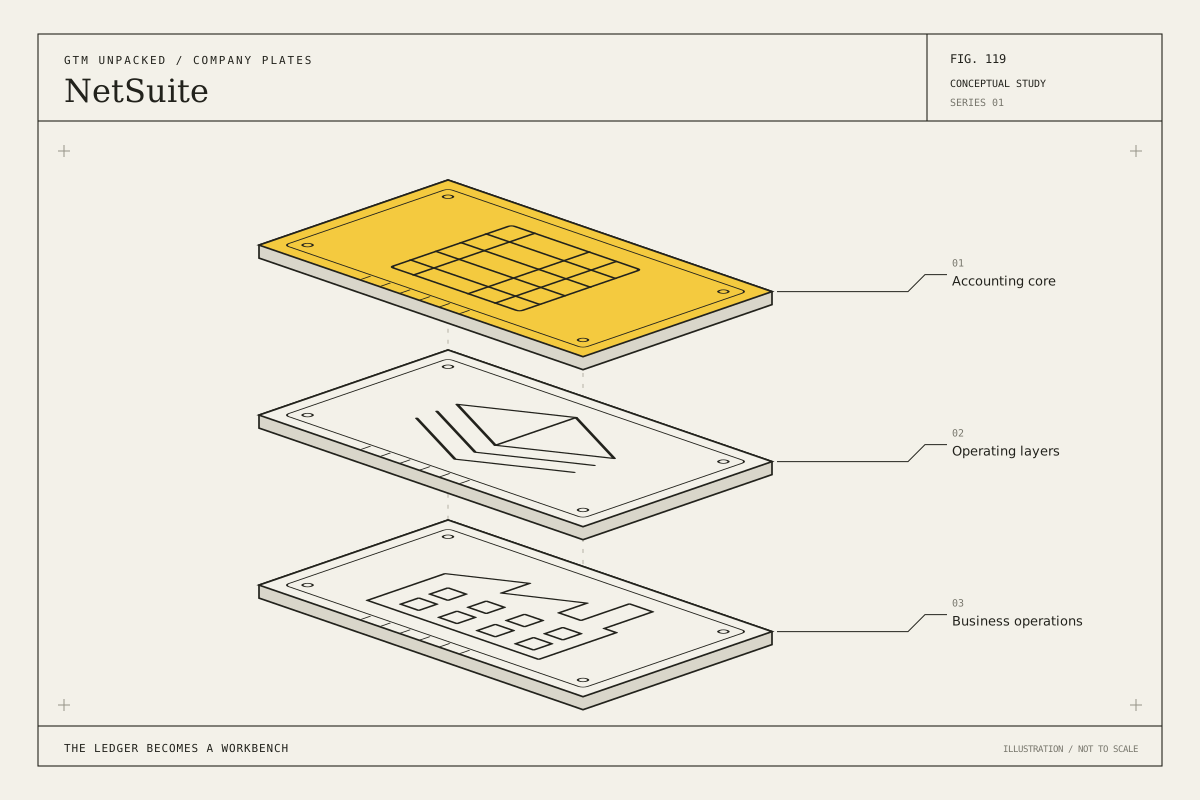
Conceptual illustration of a ledger, layered panels, and operations building, broadening the visual context around accounting without depicting an actual enterprise-resource-planning architecture.
- Company
- NetSuite · Cloud ERP · netsuite.com
- Conversion motions
- [Inference] This research classifies NetSuite as Human Led and Partner Led.
- NetSuite beachhead
- Small businesses needing web-based accounting
- NetSuite target customer
- Growing midmarket businesses and enterprise divisions
- Product complexity
- High financial, inventory and business-process integration
- Decision-making unit
- [Inference] Finance, operations, IT, executives and implementation partners
- Market at entry
- Cloud business software was novel; on-premise applications established
- Market today
- [Inference] Mature cloud ERP market where implementation and industry fit matter
- Evidence
- Source-backed brief · 6 linked sources · research date · method and limitations
The ten-step Revenue Engine reading map
These links locate relevant evidence. A linked section does not imply every detail of the step is publicly established.
- Acquire Your First Customers: Founder Led Sales Read first customers
- Embrace GTM Experimentation Read experiments & lessons
- Understand Your GTM Motion Options Read GTM motion
- Pick Your GTM Motion Read beachhead & buyer · Read product & market
- Generate a Lead Read GTM motion · Read experiments & lessons
- Turn Leads into Paying Customers Read GTM motion · Read people & process
- Retain and Grow Your Customers Read retain & expand
- Build Your GTM Team Read people & process
- Plan Your Tech Stack Read experiments & lessons · Read people & process · Read product & pricing archive
- Optimize and Scale Through Metrics Read pricing & economics
NetSuite origin and first customers: Origin & first customers
NetSuite’s official history traces its 1998 start to a conversation between Evan Goldberg and Larry Ellison. [1] The 2007 filing records the 1999 release of NetLedger, focused on accounting. [2] Goldberg’s later interview explains that running an earlier small software company exposed the pain of disconnected business applications. [3] These sources establish the origin and initial product; the exact first paying customer and contract were not verified.
[1] [2] [3]NetSuite beachhead and buyer: Beachhead & buyer
[Inference] Accounting was a useful entry point because it sits close to a business’s financial truth and creates recurring work. For growing firms, the next pain often involves connecting orders, inventory, customer records and financial reporting. The wedge could therefore expand into a suite, but only if the data and operating processes were integrated well enough to justify replacing multiple existing systems.
NetSuite GTM motion: GTM motion & lead conversion
The IPO-era filing positioned an integrated on-demand suite for smaller businesses, combining ERP, CRM and ecommerce. It documents customers using several functions together, including retailer Saffron Rouge. [2] [Inference] This is a human-led and partner-supported implementation sale. Online delivery removes server ownership from the customer’s task, but does not remove decisions about accounting configuration, migration or operating responsibility.
[2]NetSuite product and market: Product, market & buying complexity
[Inference] ERP has a complicated decision unit because the product changes how money, inventory and orders move through the business. A founder or finance leader may champion the purchase, while operations and IT must accept the workflow. A good first scope prioritizes critical processes and clean data. Promising to replace everything immediately can increase selling appeal while making the actual deployment harder to complete.
NetSuite people and process: People & operating process
Goldberg had product-development experience at Oracle before founding NetSuite. The historical annual report names Zach Nelson as CEO and James Ramsey as worldwide sales and distribution leader. [4] [Inference] The founding technical insight needed a distribution and operating organization suited to growing businesses. The inspected sources do not provide the first AE’s training or a sufficiently detailed biography of the early customer-success leadership.
[4]NetSuite retention and expansion: Customer success & expansion
Current SuiteSuccess documentation organizes the customer lifecycle into Build, Engage, Consume and Optimize. It describes industry-specific practices, phased adoption and ongoing collaboration, services and education. [5] A ScienceLogic case describes going live in April 2017 using SuiteSuccess and consulting partner MorganFranklin alongside NetSuite’s expertise. [6] [Inference] Services and partners make the suite consumable; expansion follows the next capability the business is ready to adopt.
[5] [6]NetSuite pricing and economics: Pricing & economic constraints
[Inference] Integrated-suite economics can benefit from a larger customer relationship, but the implementation cost is real. Contract value should be considered together with presales work, partner fees, migration, training and ongoing support. Neither the number of modules nor the importance of finance establishes a reliable CAC estimate. Actual early and current negotiated prices, cohort retention and delivery margins were not verified in this brief.
NetSuite experiments and lessons: Experiments, lessons & critique
[Inference] NetSuite’s strategic advantage was connecting workflows around a common business record, beginning with a function customers already needed. The risk is making integration a slogan while customers experience a costly implementation project. A stronger commercial process should align what the salesperson promises with the phased delivery plan and quantify the next operational milestone. SuiteSuccess explicitly attempts that lifecycle alignment, but vendor methodology is not independent proof of every deployment’s outcome. [5]
[5]NetSuite website and pricing history: Positioning & pricing evolution
The change from NetLedger accounting in 1999 to a broader NetSuite suite is documented in the filing and official history. [1][2] Later SuiteSuccess materials show more explicit industry and adoption packaging. [5] No authenticated historical screenshot sequence was available. [Inference] The transferable lesson is to pair a powerful integrated product with a staged implementation motion that lets a customer grow into it.
[1] [2] [5]NetSuite economics at a glance: Pricing is only half the story.
Negotiated subscription and implementation rates not verified.
Cloud ERP subscription with implementation and ecosystem services
[Inference] Integration, migration and training strongly affect total customer economics.
Not publicly verified
Not publicly verified
The people in the NetSuite GTM story: People & capabilities.
Evan Goldberg
FounderFormer Oracle product-development leader; earlier small-business operator.
Turned fragmented business-software experience into a cloud-suite thesis. [3][4]
[3] [4]Zach Nelson
CEO during the major independent scaling periodHistorical CEO named in the annual report.
Led the business during enterprise-suite growth. [4]
[4]James Ramsey
Worldwide sales and distribution leader, historicalNamed in the historical annual report.
Commercial distribution leadership. [4]
[4]NetSuite GTM: critical reading and analysis: Why it worked.
Where it breaks.
What worked—and why
[Inference] Accounting created a foundation for adjacent business workflows. [2]
What did not work
No specific failed early channel was established in the inspected sources.
What could have been better
[Inference] Tie the sale to phased operational milestones and realistic implementation scope.
What another founder can use
[Inference] A suite becomes easier to buy when the adoption sequence is as clear as the product vision.
NetSuite go-to-market FAQ: The questions that matter.
How did NetSuite find its GTM motion?
The IPO-era filing positioned an integrated on-demand suite for smaller businesses, combining ERP, CRM and ecommerce. It documents customers using several functions together, including retailer Saffron Rouge. [2] [Inference] This is a human-led and partner-supported implementation sale. Online delivery removes server ownership from the customer’s task, but does not remove decisions about accounting configuration, migration or operating responsibility.
What can founders learn from NetSuite?
[Inference] A suite becomes easier to buy when the adoption sequence is as clear as the product vision.
NetSuite sources and open questions: Follow the sources.
- NetSuite company overview and history NetSuite · primary
- NetSuite S-1 SEC / NetSuite · primary
- Evan Goldberg: three decades and two platform shifts Hg · interview
- NetSuite 2008 annual report NetSuite · primary · 2008-12-31
- SuiteSuccess NetSuite · primary
- ScienceLogic implementation case NetSuite · primary
What remains unverified
No verified historical website screenshot was available for this brief.
Early CRM, sales engagement and enablement tools were not verified; product integrations are not treated as internal GTM tools.
Exact first paid contract and early funnel conversion are not publicly verified in the inspected sources.
No verified visual capture is attached to this entry. A current screenshot is not a substitute for a historical capture.