
Source numbers link to evidence. [Inference] marks analytical judgment, including motion classifications and causal explanations. Public evidence does not establish every internal decision or metric.
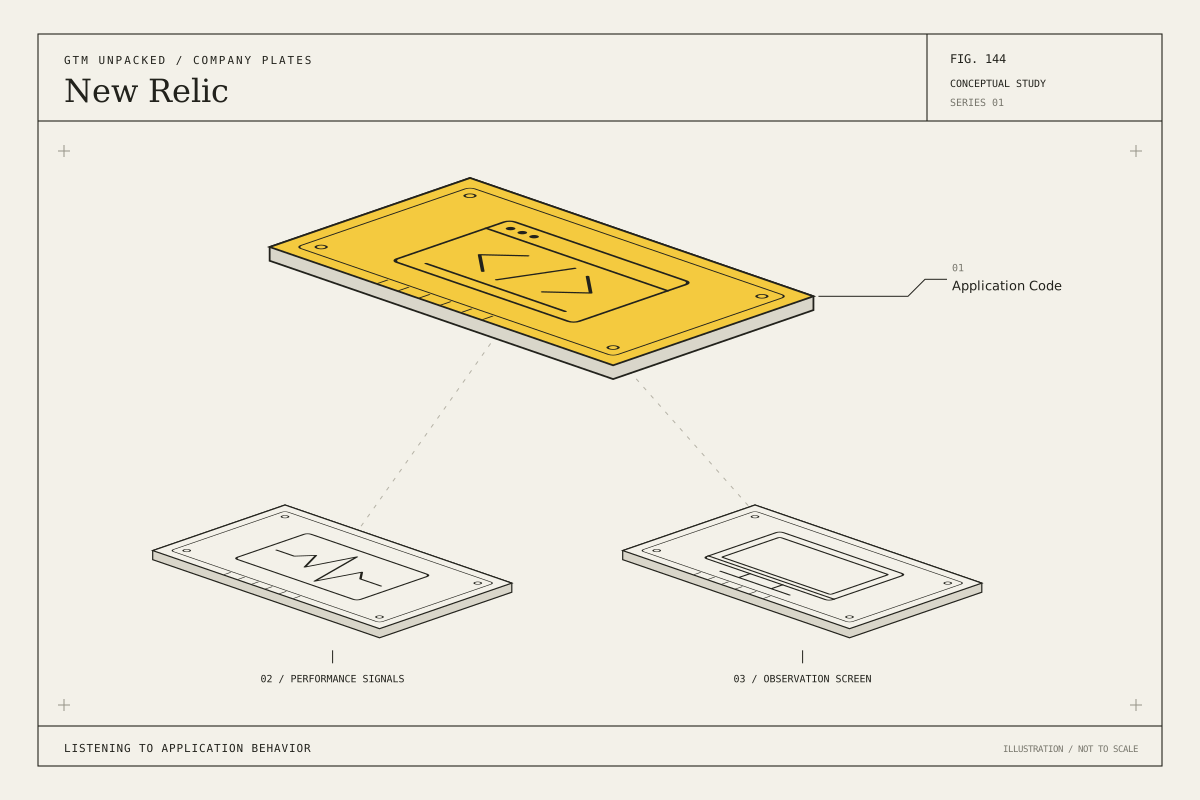
Conceptual illustration of application behavior made visible through code, a pulse and a screen, showing observation as a separate layer around software work.
- Company
- New Relic · Developer tools and communities · newrelic.com
- Conversion motions
- [Inference] This research classifies New Relic as Product Led, Human Led and Partner Led.
- New Relic beachhead
- Ruby on Rails developers operating production applications. [1]
- New Relic target customer
- Engineering teams and larger organizations buying observability. [4]
- Product complexity
- [Inference] Rapid agent installation lowers entry friction; broad telemetry and incident analysis remain technical. [2][4]
- Decision-making unit
- [Inference] A developer starts; platform leaders and security buyers govern expansion. [4]
- Market at entry
- The initial market was a growing Rails ecosystem, distinct from the mature high-ticket Java monitoring market. [1]
- Market today
- Current packaging covers many observability capabilities and consumption choices. [4]
- Evidence
- Source-backed brief · 4 linked sources · research date · method and limitations
The ten-step Revenue Engine reading map
These links locate relevant evidence. A linked section does not imply every detail of the step is publicly established.
- Acquire Your First Customers: Founder Led Sales Read first customers
- Embrace GTM Experimentation Read experiments & lessons
- Understand Your GTM Motion Options Read GTM motion
- Pick Your GTM Motion Not established in this entry
- Generate a Lead Read GTM motion · Read experiments & lessons
- Turn Leads into Paying Customers Read GTM motion
- Retain and Grow Your Customers Read retain & expand
- Build Your GTM Team Not established in this entry
- Plan Your Tech Stack Read experiments & lessons
- Optimize and Scale Through Metrics Read pricing & economics
New Relic origin and first customers: Second-time founder, deliberately different buying experience
New Relic’s May 2008 announcement identifies Lew Cirne as a former Wily founder and creator of Introscope. Its initial product was subscription-based Rails performance management in private beta. Cirne had already experienced enterprise software commercialization; New Relic was not the story of a first-time developer discovering that businesses buy software. [1]
In his SaaStr interview, Cirne said a partnership supplied the first several hundred customers, after which arrivals slowed. The initial launch had no free tier. A September 2008 release added a free Lite product alongside higher-priced functionality, which he credits with improved growth. The exact first paid buyer is not named. [2]
[1] [2]New Relic GTM motion: Free was an experiment, not the founding dogma
[Inference] The narrow language ecosystem made distribution and product fit easier to understand. The partner supplied reach, while the product’s quick setup made that reach usable. Later, free access reduced the barrier to experiencing the value, rather than substituting a generic free plan for a clear reason to adopt. [1][2]
Cirne describes deliberately reducing the human work required to get a customer to value, informed by the heavy implementation burden of his earlier business. He also describes adding sales incrementally as it could accelerate growth. This is a hybrid design decision, not a claim that enterprise sales was unnecessary. [2]
[2]New Relic retention and expansion: Make the first useful diagnostic easy
The company’s 2012 RailsConf announcement shows sustained community investment: a founder panel with practitioners from Groupon, Zendesk and other companies, plus events with Blue Box Group and Pivotal Labs. The product had expanded beyond Rails into multiple languages. Company-reported customer totals do not distinguish free from paid accounts in that announcement. [3]
[Inference] Useful education and visible practitioner examples can shorten the path from installation to diagnosis. Expansion into more applications requires consistent instrumentation and useful analysis, not simply more data. The inspected sources do not name a historical customer-success owner or provide a causal estimate for conference spending. [3][4]
[3] [4]New Relic pricing and economics: The pricing basis changed with the platform
The live page offers a free allowance of 100 GB monthly ingestion and one full-platform user, with paid editions for larger teams and support needs. It also offers an optional full-consumption path without user licenses. Current prices are requested through sales rather than represented here by an assumed historical host rate. [4]
[Inference] Ingestion and user models create different incentives. Data-driven expansion can grow revenue as applications scale, but buyers need control over telemetry that adds cost without diagnostic value. Neither the founder’s emphasis on low-friction activation nor a free tier gives enough evidence to calculate CAC, support cost or contribution margin. [4]
[4]New Relic experiments and lessons: What did not work as expected
The founder’s account explicitly challenges the idea that a good product would continue attracting customers unaided after launch. Partnership-led access did not by itself establish a perpetual acquisition engine; the free-tier experiment and subsequent commercial adaptation mattered. [2]
[Inference] The transferable lesson is to isolate the bottleneck: awareness, activation and organizational buying are different problems. A better measurement system would track each, including which free users become active production accounts. The current evidence is insufficient to rank all channels by return or declare a particular paid campaign unsuccessful. [2][4]
[2] [4]New Relic economics at a glance: Pricing is only half the story.
Free ingestion and user allowance; paid editions and optional full-consumption pricing. [4]
See the dated pricing analysis.
[Inference] The relevant costs and conversion frictions are discussed in the analysis; no invented margin model is supplied.
Not verified in this brief.
No cohort retention figure verified in this brief.
The people in the New Relic GTM story: People & capabilities.
Peter Fenton
Early investor and board memberBenchmark general partner in the 2008 announcement.
Supported the early business; the source does not establish individual sales ownership. [1]
[1]New Relic GTM: critical reading and analysis: Why it worked.
Where it breaks.
What worked—and why
[Inference] Focused ecosystem distribution and fast activation reinforced each other. [1][2]
What did not work
Founder says post-partnership acquisition was slow before later experiments. [2]
What could have been better
[Inference] Measure production activation separately from free registrations.
What another founder can use
[Inference] A narrow Rails wedge and a free-tier experiment made enterprise monitoring easier to adopt.
New Relic go-to-market FAQ: The questions that matter.
How did New Relic find its GTM motion?
A narrow Rails wedge and a free-tier experiment made enterprise monitoring easier to adopt. See the sourced account and explicitly labeled analysis above.
New Relic sources and open questions: Follow the sources.
- New Relic Secures $3.5 Million Investment From Benchmark Capital New Relic · primary · 2008-05-01
Inspected for the facts attributed in this brief; current pages observed November 10, 2026.
- Scaling Even Faster The Second Time SaaStr · interview
Inspected for the facts attributed in this brief; current pages observed November 10, 2026.
- New Relic to Celebrate 20,000 Customer Milestone at RailsConf New Relic · primary · 2012-04-17
Inspected for the facts attributed in this brief; current pages observed November 10, 2026.
- Transparent Pricing New Relic · primary
Inspected for the facts attributed in this brief; current pages observed November 10, 2026.
What remains unverified
First paid account and its original contract were not verified.
Named early sales and customer-success hires, training, compensation and individual account assignments remain incompletely documented.
No verified CAC, payback, funnel conversion or numerical retention series in this brief.
Historical website/pricing screenshots were not captured for this company; dated textual evidence is distinguished from current pages.
No verified visual capture is attached to this entry. A current screenshot is not a substitute for a historical capture.