
Source numbers link to evidence. [Inference] marks analytical judgment, including motion classifications and causal explanations. Public evidence does not establish every internal decision or metric.

Conceptual illustration of web research centered on a search lens, with documents and a globe framing the relationship between a question and its sources.
- Company
- Perplexity · AI search & agents · perplexity.ai
- Conversion motions
- [Inference] This research classifies Perplexity as Product Led, Partner Led and Human Led.
- Perplexity beachhead
- People doing frequent, substantive web research; early technical audiences helped test the prototype and spread awareness. [1]
- Perplexity target customer
- Consumers and professional researchers, enterprise knowledge workers and developers building with search APIs. [7][8][11]
- Product complexity
- [Inference] A single cited answer is easy to experience; connected organizational workflows require permissions, configuration and adoption work. [6]
- Decision-making unit
- [Inference] Individual purchase is simple. Enterprise buying adds IT, security, knowledge owners, budget holders and administrators. [2][6]
- Market at entry
- [Inference] Search was mature; generative answer interfaces were emerging. Users understood the underlying job before understanding the new method. [10]
- Market today
- [Inference] Search, assistants and multi-step work overlap. A durable position depends on repeatable work outcomes and distribution, not just answering a novel query.
- Evidence
- Deep research · 14 linked sources · research date · method and limitations
The ten-step Revenue Engine reading map
These links locate relevant evidence. A linked section does not imply every detail of the step is publicly established.
- Acquire Your First Customers: Founder Led Sales Read first customers
- Embrace GTM Experimentation Read experiments & lessons
- Understand Your GTM Motion Options Read GTM motion
- Pick Your GTM Motion Read beachhead & buyer · Read product & market
- Generate a Lead Read GTM motion · Read experiments & lessons
- Turn Leads into Paying Customers Read GTM motion · Read people & process
- Retain and Grow Your Customers Read retain & expand
- Build Your GTM Team Read people & process
- Plan Your Tech Stack Read experiments & lessons · Read people & process · Read product & pricing archive
- Optimize and Scale Through Metrics Read pricing & economics
Perplexity GTM timeline: From wedge to engine.
Public answer engine
Founder dates launch to December 7. [1]
Enterprise Pro
A separate organizational package and seat price. [2]
Channel program
Jorgens announces partners and internal-data capabilities. [5]
Japan enterprise resale
SoftBank becomes an authorized reseller. [3]
Retention and business sales
Executives describe a shift away from ad-deal exploration. [9]
Perplexity origin and first customers: Origin & first customers
Aravind Srinivas told Lex Fridman that early work translated natural-language questions into SQL over Twitter data. Demonstrations to people including Yann LeCun, Jeff Dean and Andrej Karpathy helped attract attention and relationships. He described users asking about themselves and sharing screenshots. Those episodes demonstrate discovery and social proof; they do not identify first paying customer contracts. [1]
The same interview dates public launch to December 7, 2022. Srinivas recalled unexpectedly persistent holiday use, then adding conversational follow-ups and suggested questions after New Year. He associated those changes with growth. That is a founder’s causal interpretation, not an experiment with a published control group. [1]
[1]Perplexity beachhead and buyer: From curiosity to a budgeted job
[Inference] The initial promise reduced the work between a question and a usable answer. A person could test it on a real task without installing an enterprise system. The economically promising user was therefore someone with recurring research work, rather than someone impressed by a one-off demonstration. Frequency, source checking and consequential use would be stronger qualification signals than simple registration.
The April 2024 Enterprise Pro announcement named organizations including Stripe, Zoom, Bridgewater, Snowflake, Databricks, Vercel and Replit among early adopters. It packaged team administration, security and privacy with research capability. A listed company is evidence of reported adoption, not disclosure of its contract value, seat count or renewal history. [2]
[2]Perplexity GTM motion: Three conversion paths, three economics
Enterprise Pro launched at $40 per user monthly or $400 annually. Consumer self-serve use could therefore coexist with a distinct organizational purchase. [2]
SoftBank announced Japan enterprise resale in March 2025, following a consumer promotion offering a year of Pro from June 2024. Resale adds a partner to the buying journey; a promotional bundle subsidizes user acquisition. Neither should be counted as ordinary full-price direct conversion. [3]
PayPal’s September 2025 announcement similarly offered eligible users early Comet access and a twelve-month Pro trial. [Inference] The decisive channel test is what happens after the offer: activation, repeated use, paid renewal and gross profit after any commercial payments to the partner. The announcement does not disclose those outcomes. [12]
[2] [3] [12]Perplexity product and market: Complexity moved downstream
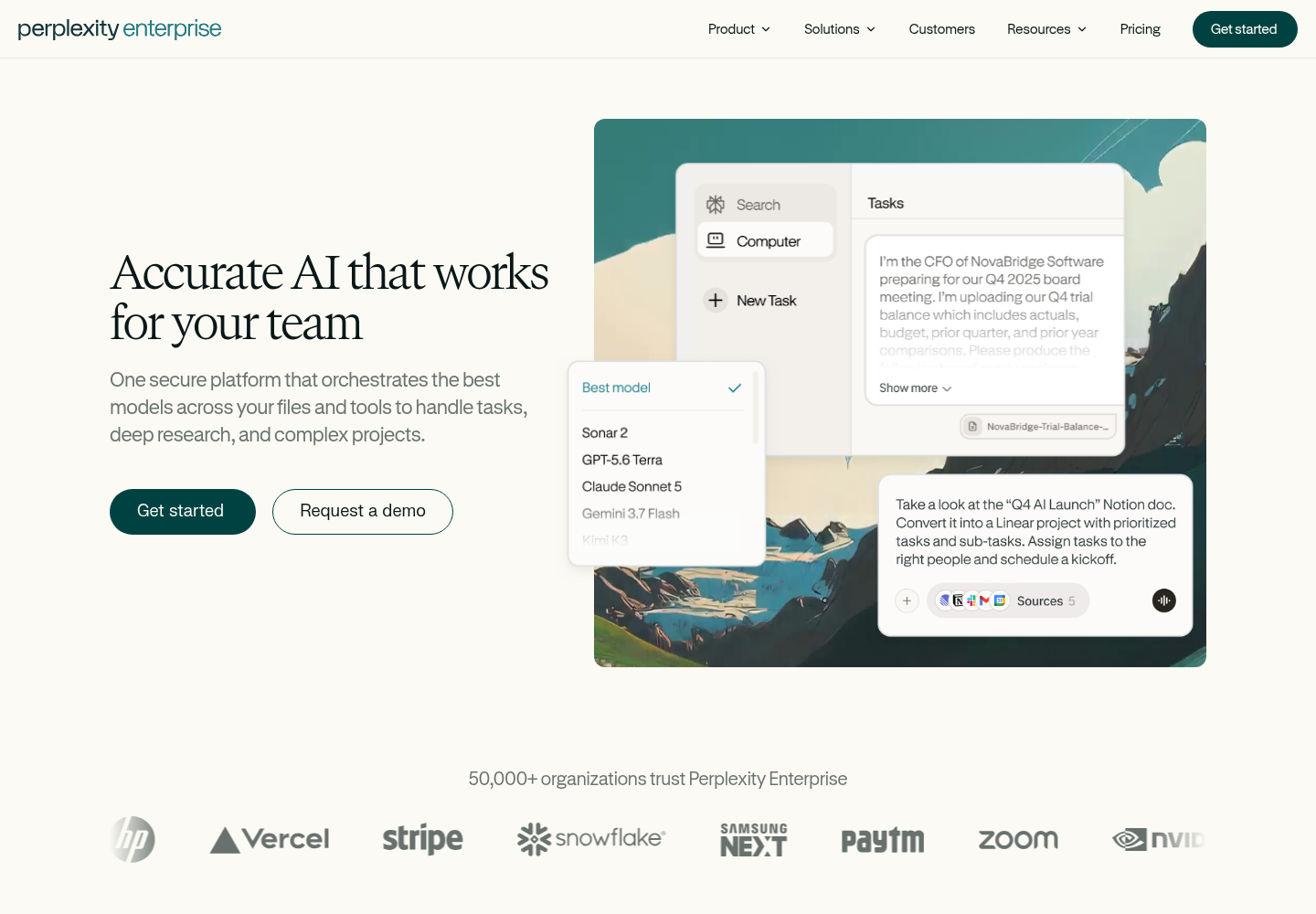
The current enterprise page emphasizes Computer, connected workflows, administrative controls and a wider suite of tools. This is a materially broader promise than a single search box. It is the company’s current positioning, not proof that every advertised workflow is deployed successfully in every customer. [11]
[Inference] Connecting an answer engine to internal work changes the decision-making unit. The user wants speed; the administrator needs access control; the business owner needs a result; procurement needs a supportable commercial arrangement. Human assistance becomes valuable when those interests must align. Adding a sales team cannot substitute for a clearly bounded first workflow and a credible adoption owner.
[11]Perplexity people and process: Research credibility meets distribution craft
AWS’s founder account names four co-founders: Srinivas, previously an OpenAI researcher; Denis Yarats, formerly at Meta; Johnny Ho, previously an engineer at Quora; and Databricks co-founder Andy Konwinski. [10]
Dmitry Shevelenko’s 2025 conference biography identifies him as CBO leading business growth and partnerships. It lists founding Tortoise, business-development and product leadership at Uber, LinkedIn and Meta, and an anthropology BA from Columbia. The biography is self-provided. [Inference] His relevant complement to a research-heavy founding team is experience negotiating distribution and operating across large platforms. [4]
Emily Jorgens publicly announced joining as Head of Enterprise Partnerships in March 2024. Her October channel announcement named Stripe, Kruze Consulting, Inteleos, Crunchbase and FactSet, and collaborators including AJ Audino and Frank te Pas. These named contributions are documented; their educational or sales-training histories were not verified in the inspected primary material. [5][13]
[4] [5] [10] [13]Perplexity retention and expansion: How expansion becomes an operating discipline
A current Customer Success Lead posting assigns gross and net retention, renewal forecasting and account health to CS, with expansion targets shared with Sales. It distinguishes high-touch enterprise, scaled smaller accounts and technical API customers. It also calls for identifying self-serve users ready for enterprise, and names Salesforce for account reporting. This is a hiring specification, not proof that all described processes already operate well. [7]
The Enablement Specialist posting separately assigns workshops, office hours, role-based journeys and technical guidance. It says CS retains account, adoption and expansion ownership while enablement helps customers become self-sufficient. Proposed measures include activation, time to first value, repeated use and sustained consumption. [6]
[Inference] This division is sound if each intervention addresses a diagnosed blocker. A usage decline caused by missing permissions needs a different response from a weak use case or poor answer quality. Treating all three as a training problem would disguise churn risk rather than resolve its cause.
[6] [7]Perplexity pricing and economics: Subscription economics with a variable-cost core
Observed November 10, 2026, official materials price consumer Pro at $20 monthly or $200 annually. The Max help article lists $200 monthly or $2,000 annually, with higher access and support; API usage is billed separately. Enterprise launch prices above are historical and should not be assumed to cover every current enterprise package. [8][14]
[Inference] A search subscription has variable retrieval and inference costs. Higher use can strengthen habit while consuming more resources. Partner trials additionally create a gap between distributed entitlements and paying subscribers. Public sources do not reveal enough to calculate contribution margin, fully loaded CAC, lifetime value or partner-channel payback. The unverified $500M label in this project’s starting list is not treated here as verified ARR.
[8] [14]Perplexity experiments and lessons: What did not translate automatically
Business Insider reported in February 2026 that executives were shifting emphasis toward subscriptions and enterprise selling, with five enterprise sellers at that point. They said they were not exploring ad deals and would emphasize revenue retention. The advertising experiment had stalled, and Taz Patel had left. [9]
AWS’s November 2024 customer account identifies SageMaker, S3 and wider AWS infrastructure, plus early Activate credits and technical support. This is evidence about a dated infrastructure stack; it should not be mistaken for the sales technology stack. [10]
[Inference] A useful answer does not automatically create a trusted advertising environment. The monetization experiment exposes tension between perceived impartiality and paid placement. The practical lesson is to test willingness to pay and advertiser demand independently, with explicit trust measures, before extrapolating search-query volume into advertising revenue.
[9] [10]Perplexity website and pricing history: The storefront became a work platform
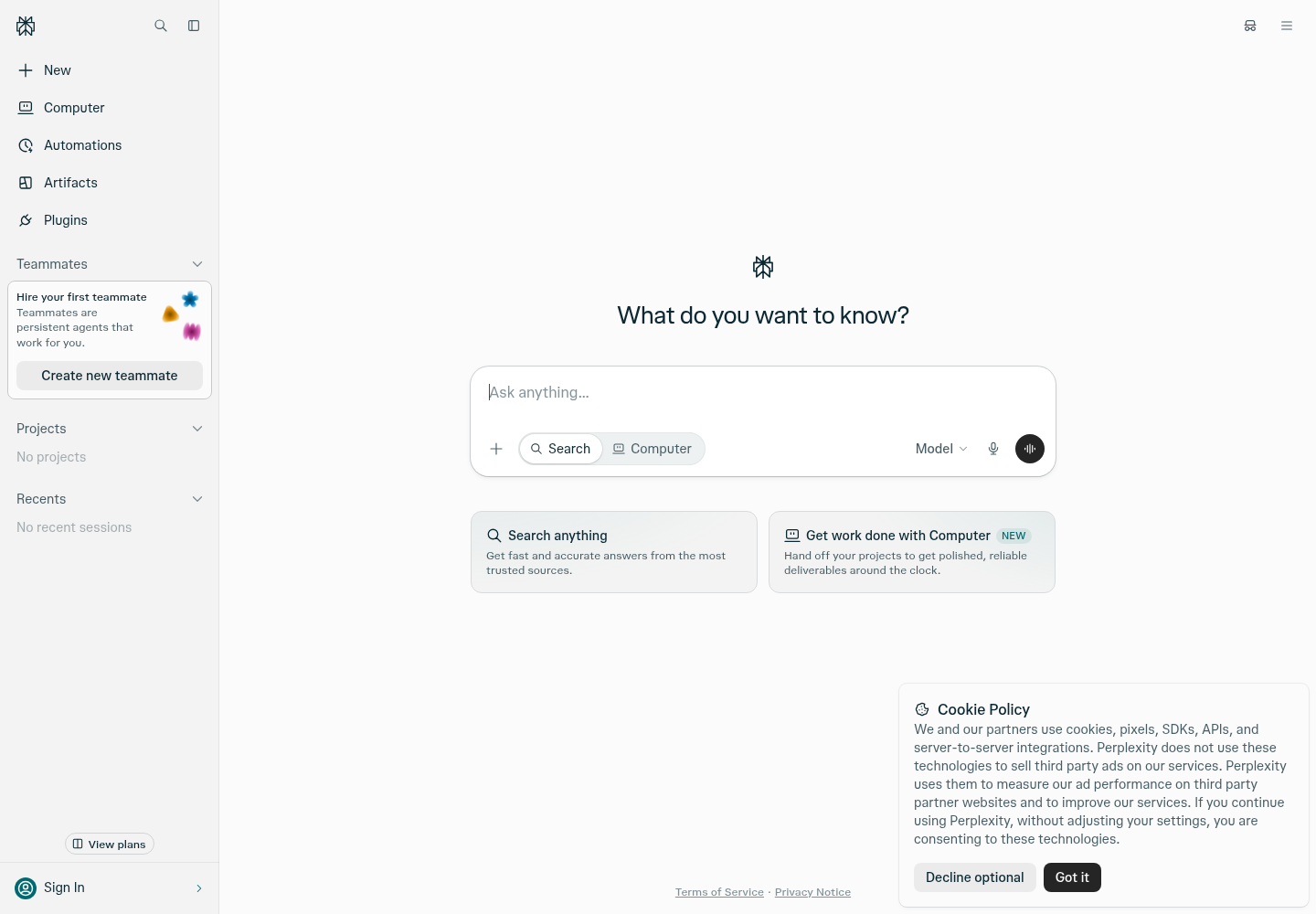
The current homepage and enterprise page screenshots show separate consumer and organizational entry points. The April 2024 announcement anchors the first inspected enterprise pricing milestone. The requested early Wayback capture returned an empty application shell, so it is excluded from the visual evidence. No historical interface has been reconstructed or presented as an authentic screenshot. [2][11]
[2] [11]Perplexity economics at a glance: Pricing is only half the story.
Consumer Pro $20/month or $200/year; Max $200/month or $2,000/year. Enterprise Pro launched April 2024 at $40/seat/month or $400/year. [2][8][14]
Freemium subscriptions, organizational seat agreements, partner distribution and separately billed API usage.
[Inference] Retrieval, model inference, support and promotional distribution costs must be subtracted before estimating channel profitability.
Not publicly verified; partner reach is not a CAC disclosure.
Current hiring assigns GRR/NRR ownership but no actual cohort result is verified. [7]
The people in the Perplexity GTM story: People & capabilities.
Aravind Srinivas
Co-founder and CEOPreviously an AI researcher at OpenAI. [10]
Described early demos, launch learning and conversational product iteration. [1]
[1] [10]Denis Yarats
Co-founder and CTOPreviously an AI researcher at Meta. [10]
Explained search architecture, infrastructure choices and early AWS support. [10]
[10]Andy Konwinski
Co-founderCo-founder of Databricks. [10]
Brought prior data-infrastructure company-building experience. [10]
[10]Dmitry Shevelenko
Chief Business OfficerTortoise founder; Uber, LinkedIn and Meta business/product roles; Columbia anthropology BA. Self-provided conference biography. [4]
Leads business growth and strategic consumer and enterprise partnerships. [4]
[4]Emily Jorgens
Enterprise partnerships leaderPublicly announced the role in March 2024; earlier training not independently verified here. [13]
Named lead in channel-partner and data-integration launch. [5]
[5] [13]Perplexity GTM: critical reading and analysis: Why it worked.
Where it breaks.
What worked—and why
[Inference] Immediate answers made the new interface understandable before a sales conversation.
[Inference] Enterprise governance creates a reason for organizations to buy beyond isolated employee experimentation. [2]
What did not work
The ad experiment stalled, according to February 2026 executive reporting. [9]
What could have been better
[Inference] Publish activation and paid renewal by acquisition source, particularly after bundled trials.
[Inference] Keep a clear first-workflow promise as the suite expands, with accountable adoption milestones.
What another founder can use
[Inference] Partner distribution can accelerate reach, but its economics must be judged at paid retention, not entitlement issuance.
Perplexity website and pricing captures: Product, positioning & pricing.
Captures and image sources are dated individually. Historical gaps are kept explicit. Explore the visual archive
Perplexity go-to-market FAQ: The questions that matter.
How did Perplexity get its first users?
The founder describes technical demos followed by a public answer-engine launch and conversational iteration. First paid customers were not identified. [1]
Perplexity: Who owns enterprise expansion?
The current CS leadership specification assigns retention to CS and shared expansion targets with Sales; enablement is a separate supporting function. [6][7]
Which go-to-market motions is Perplexity classified under?
[Inference] This research classifies Perplexity as Product Led, Partner Led and Human Led. Motion labels describe routes across segments and periods, not measured revenue shares.
Perplexity sources and open questions: Follow the sources.
- Aravind Srinivas, Lex Fridman Podcast #434 transcript Lex Fridman · interview · 2024-06
Founder account of Twitter SQL prototype, launch and follow-up questions.
- Introducing Enterprise Pro Perplexity · primary · 2024-04-23
Early enterprise users, initial seat pricing and security features.
- SoftBank becomes first authorized Enterprise Pro reseller in Japan SoftBank · primary · 2025-03-17
Consumer promotion and enterprise resale are different motions.
- Dmitry Shevelenko speaker biography Milken Institute · primary · 2025-05-05
Self-provided biography: CBO, prior companies and education.
- Channel partners and data integrators Emily Jorgens · primary · 2024-10
Primary account of channel launch and named collaborators.
- Enablement Specialist, Perplexity Computer Perplexity · primary · 2026-11-10
Hiring specification: differentiated onboarding, technical workshops, metrics and ownership.
- Customer Success Lead Perplexity · primary · 2026-11-10
Hiring specification: retention, expansion, Salesforce and account coverage.
- Perplexity Max Perplexity · primary · 2026-09-14
Consumer Max pricing and separation from API billing.
- Perplexity shifts toward subscriptions and business sales Business Insider · reporting · 2026-02-18
Executive comments about ads, enterprise sales and revenue retention.
- Reimagining search with Perplexity AWS / Denis Yarats · primary · 2024-11-18
Founder backgrounds and confirmed 2024 infrastructure stack.
- Perplexity Enterprise Perplexity · primary · 2026-11-10
Current enterprise workflow and administrative positioning.
- PayPal and Venmo users receive Comet access and Pro offer PayPal · primary · 2025-09-03
Partner promotion: twelve-month Pro trial; not retained paid conversion.
- Joining Perplexity as Head of Enterprise Partnerships Emily Jorgens · primary · 2024-03
Self-reported role announcement.
- Perplexity product and pricing information Perplexity · primary · 2026-11-10
Pro pricing and general product positioning.
What remains unverified
First paying consumer and first signed enterprise contract were not identified.
Partner commercial terms, renewal cohorts, CAC and gross margins are not public in the inspected sources.
Current job descriptions show intended responsibilities, not evidence every vacancy is filled.
No usable early archived screenshot was recovered.