
Source numbers link to evidence. [Inference] marks analytical judgment, including motion classifications and causal explanations. Public evidence does not establish every internal decision or metric.
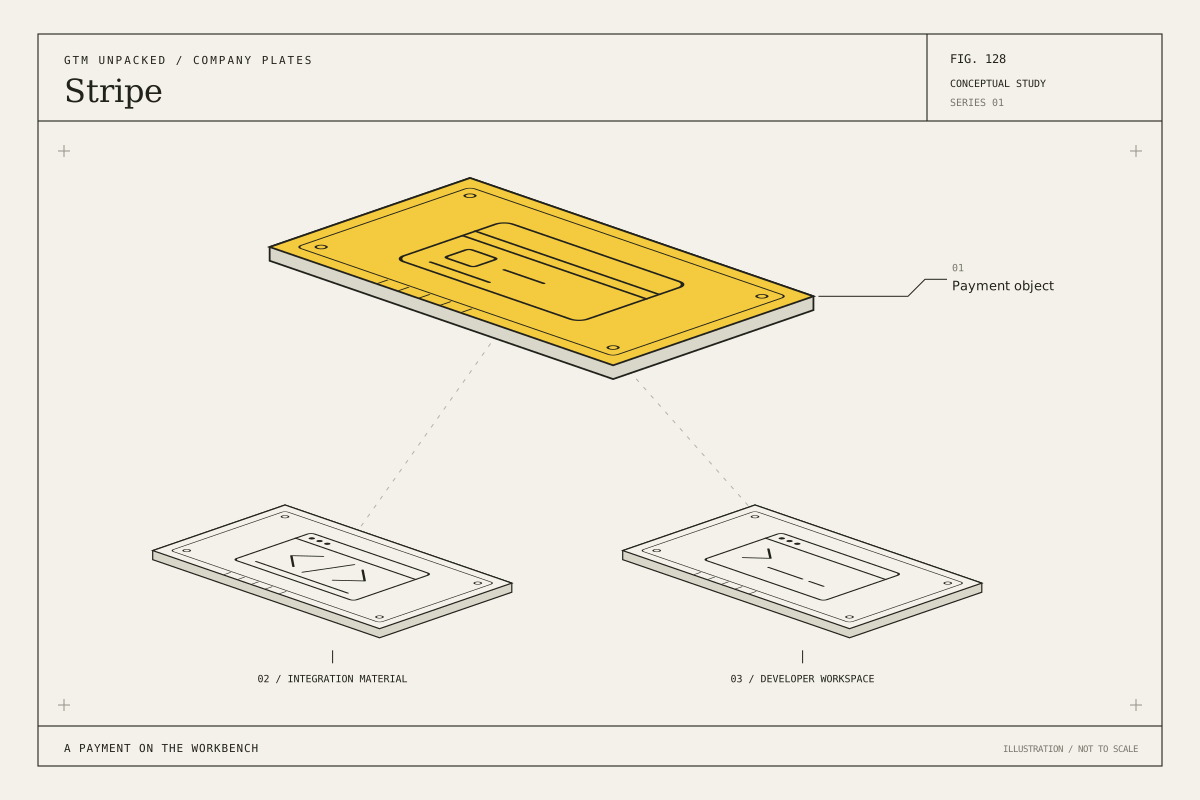
Conceptual illustration of a payment card, code marks, and terminal, placing a commercial object within a developer workbench without showing a real payment sequence.
- Company
- Stripe · Payments infrastructure · stripe.com
- Conversion motions
- [Inference] This research classifies Stripe as Product Led and Human Led.
- Stripe beachhead and target customer
- [Inference] Initially technical startup teams needing to accept online payments.
- Product and buying complexity
- [Inference] A developer can evaluate an integration, while commercial scale introduces finance, risk and operational requirements.
- Market at entry
- [Unverified] This focused brief does not establish the full market conditions at first sale.
- Evidence
- Evidence brief · 2 linked sources · research date · method and limitations
The ten-step Revenue Engine reading map
These links locate relevant evidence. A linked section does not imply every detail of the step is publicly established.
- Acquire Your First Customers: Founder Led Sales Read first customers
- Embrace GTM Experimentation Read experiments & lessons
- Understand Your GTM Motion Options Read GTM motion
- Pick Your GTM Motion Not established in this entry
- Generate a Lead Read GTM motion · Read experiments & lessons
- Turn Leads into Paying Customers Read GTM motion
- Retain and Grow Your Customers Read retain & expand
- Build Your GTM Team Not established in this entry
- Plan Your Tech Stack Read experiments & lessons
- Optimize and Scale Through Metrics Not established in this entry
Stripe: Origin and evidence boundary
The inspected eyewitness account documents direct founder recruitment and installation among YC startups. [1]
Paul Graham’s July 2013 account describes Stripe recruiting fellow Y Combinator startups directly. When someone agreed to try the service, the Collison brothers took the prospect’s laptop and installed it immediately. This establishes hands-on founder acquisition and activation, but the account does not identify the first paying customer or distinguish every trial from a paid account. [1]
[1]Stripe: Motion and buyer logic
[Inference] Initially technical startup teams needing to accept online payments.
[Inference] A developer can evaluate an integration, while commercial scale introduces finance, risk and operational requirements.
[1]Stripe: Retention and expansion hypothesis
[Inference] A customer’s transaction growth can increase payment volume; additional services require their own evidence of value and buyer approval.
[Unverified] Individual CSM ownership, enablement conversion and renewal cohorts were not established in this brief.
Stripe: Critical reading
[Inference] Remove the gap between verbal interest and first useful setup. Founder assistance is valuable learning, but it needs to become an efficient onboarding process as the customer base grows.
[Unverified] The inspected material does not establish failed-channel experiments or a complete causal account of growth.
Stripe economics at a glance: Pricing is only half the story.
Exact current pricing was not verified in this brief.
[Inference] A customer’s transaction growth can increase payment volume; additional services require their own evidence of value and buyer approval.
[Inference] Remove the gap between verbal interest and first useful setup. Founder assistance is valuable learning, but it needs to become an efficient onboarding process as the customer base grows.
Not publicly verified in this brief.
Not publicly verified in this brief.
The people in the Stripe GTM story: People & capabilities.
Patrick and John Collison
People identified in the sourcePatrick Collison — co-founder and CEO; John Collison — co-founder and president. [2]
See the source-backed account above; additional skills and training are not inferred as fact.
[1] [2]Stripe GTM: critical reading and analysis: Why it worked.
Where it breaks.
What worked—and why
[Inference] Remove the gap between verbal interest and first useful setup. Founder assistance is valuable learning, but it needs to become an efficient onboarding process as the customer base grows.
What did not work
No substantiated failed experiment established in the inspected evidence.
What could have been better
[Inference] Validate the proposed growth mechanism with paid conversion, implementation cost and retained customer outcomes.
What another founder can use
[Inference] A customer’s transaction growth can increase payment volume; additional services require their own evidence of value and buyer approval.
Stripe go-to-market FAQ: The questions that matter.
What does this case establish about Stripe?
The inspected source supports the specific product, people or distribution facts in the origin section; a full chronological reconstruction remains incomplete. [1]
Is the full GTM history of Stripe verified?
No. This is a focused evidence brief. The page distinguishes inspected claims from analytical hypotheses and lists the remaining gaps.
Which go-to-market motions is Stripe classified under?
[Inference] This research classifies Stripe as Product Led and Human Led. Motion labels describe routes across segments and periods, not measured revenue shares.
Stripe sources and open questions: Follow the sources.
- Do things that do not scale Paul Graham, Y Combinator · primary · 2013-07
Origin, product, team or current commercial route described in the source; narrower claims are attributed in the text.
- Stripe newsroom: company information and leadership Stripe · primary
Patrick and John Collison identified as co-founders.
What remains unverified
Evidence brief rather than a full historical GTM reconstruction.
First contracts, complete hiring sequence, pricing history, CAC and retention require further source verification.
No historical website screenshot or named account expansion is represented as verified.
No verified visual capture is attached to this entry. A current screenshot is not a substitute for a historical capture.