
Source numbers link to evidence. [Inference] marks analytical judgment, including motion classifications and causal explanations. Public evidence does not establish every internal decision or metric.
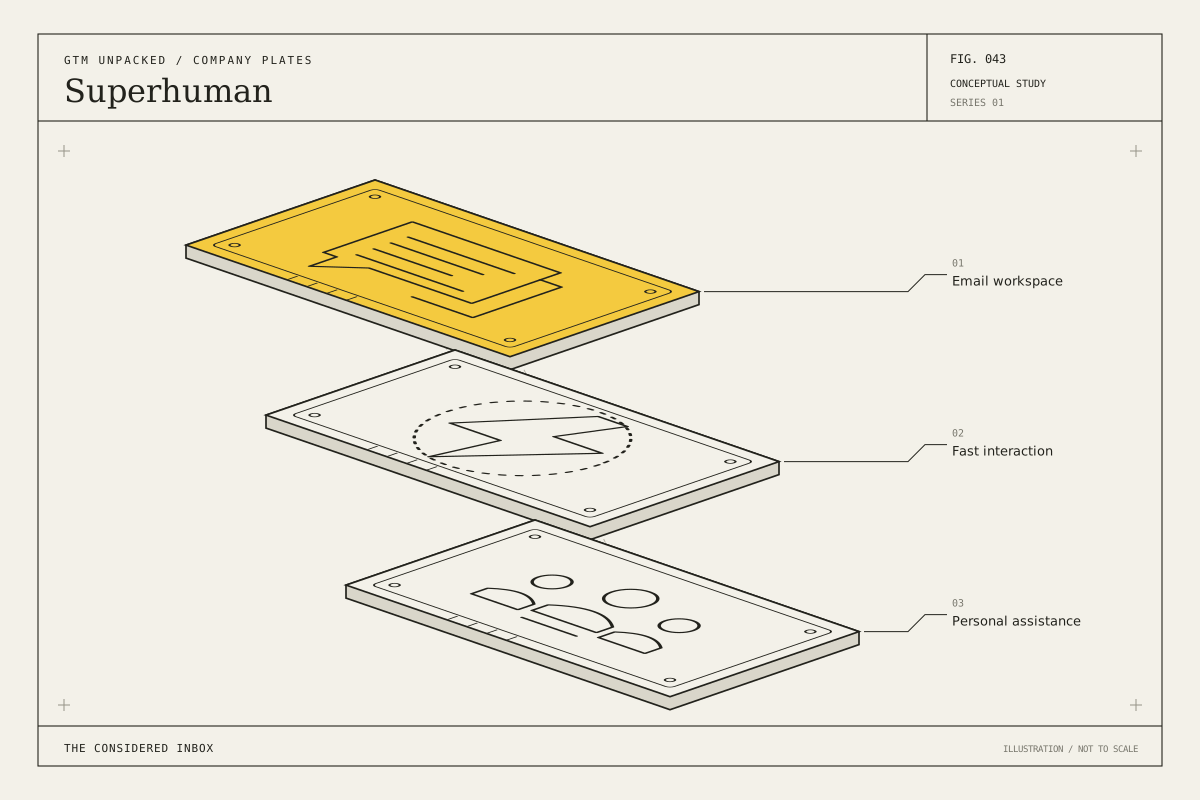
Conceptual illustration for Superhuman: a message panel, lightning bolt, and people form a considered inbox metaphor, balancing brisk interaction with human attention.
- Company
- Superhuman · Email productivity · superhuman.com
- Conversion motions
- [Inference] This research classifies Superhuman as Human Led and Product Led.
- Superhuman beachhead
- Time-sensitive founders and executives; the PMF analysis also identified managers and business-development users. [1][2]
- Superhuman target customer
- Individuals and teams seeking email productivity, with enterprise security and account service. [3]
- Product complexity
- [Inference] Email is familiar, but changing keyboard habits and migrating years of work create adoption complexity.
- Decision-making unit
- [Inference] A founder can buy individually; team deployment adds administrators and security evaluation.
- Market at entry
- The founders competed with established email experiences, including a readily available Gmail fallback. [2]
- Market today
- The current Mail offer combines AI, collaboration and enterprise controls within a broader product suite. [3]
- Evidence
- Source-backed brief · 3 linked sources · research date · method and limitations
The ten-step Revenue Engine reading map
These links locate relevant evidence. A linked section does not imply every detail of the step is publicly established.
- Acquire Your First Customers: Founder Led Sales Read first customers
- Embrace GTM Experimentation Read experiments & lessons
- Understand Your GTM Motion Options Read GTM motion
- Pick Your GTM Motion Read beachhead & buyer
- Generate a Lead Read GTM motion · Read experiments & lessons
- Turn Leads into Paying Customers Read GTM motion · Read people & process
- Retain and Grow Your Customers Read retain & expand
- Build Your GTM Team Read people & process
- Plan Your Tech Stack Read experiments & lessons · Read people & process · Read product & pricing archive
- Optimize and Scale Through Metrics Read pricing & economics
Superhuman origin and first customers: Product-market fit was measured before broad scaling
Rahul Vohra’s account dates development to 2015 and describes sustained launch pressure in 2017. A Typeform survey initially found only 22% of responding users would be very disappointed without the product. Segmenting enthusiastic users and adjusting the roadmap helped the reported score reach 58% within three quarters. [1]
[Inference] The survey supplied a decision tool, not proof of market size. Changing the sampled audience can improve the score independently of improving the product; both effects matter when interpreting the result.
[1]Superhuman beachhead and buyer: Email intensity made time savings valuable
[Inference] An executive with a heavy inbox has repeated opportunities to experience a speed improvement and a reason to pay for it. The same person may later influence team purchasing. This is a plausible expansion mechanism, but individual enthusiasm should not be treated as an enterprise contract.
Superhuman GTM motion: Human learning was eventually transferred into the product
Gaurav Vohra reports personally onboarding hundreds of users, building a specialist team, then spending several years productizing onboarding. Personal help was subsequently concentrated on higher-value prospects and B2B buyers. [2]
[Inference] The durable asset was the knowledge of where customers struggled. A company copying only the mandatory call would copy the expense without necessarily acquiring the learning discipline.
[2]Superhuman people and process: Two distinct commercial contributions
Rahul previously founded Rapportive, which LinkedIn acquired. [1] Gaurav led growth, product, marketing and analytics work and built the onboarding system. [2]
[Inference] The documented capabilities combine segmentation, experimentation and direct customer coaching. Their roles should not be conflated, and the sources reviewed do not establish a detailed biography of the first specialist hire.
[1] [2]Superhuman retention and expansion: Coaching remains part of the offer
Current Starter packaging includes group productivity coaching; Enterprise adds a customer success manager, team analytics, priority support and VIP coaching. [3]
[Inference] Coaching sells a changed working habit as well as access to software. Team analytics can make adoption visible, but measured renewal or expansion lift is not established by the pricing page.
[3]Superhuman pricing and economics: A rare explicit onboarding-capacity model
Gaurav’s retrospective estimates 40 completed calls weekly over 45 weeks at the then-$30 monthly price: approximately $650,000 in annualized subscription value enabled per specialist. He gives a $60,000–$130,000 fully loaded specialist cost range. This is a capacity model, not recognized revenue, profit or verified CAC. [2]
Current annual-billed Mail prices are $25 per member monthly for Starter and $33 for Business; Enterprise is quoted. [3]
[2] [3]Superhuman experiments and lessons: Required calls carried a real tradeoff
The onboarding account describes optional-call attendance falling to about 15%, supply/demand mismatch and eventual movement to self-service. It also acknowledges selection bias in activation comparisons. [2]
[Inference] A more defensible evaluation compares retained paid cohorts and all delivery costs, including no-shows and management time. Mandatory onboarding can improve learning while excluding otherwise capable users.
[2]Superhuman website and pricing history: Keep the Mail case separate from the later suite
The 2018 product-fit account concerns the email startup; the current page includes Mail within a wider suite. [1][3] Historical page captures and the complete acquisition/corporate timeline remain outside this brief.
[1] [3]Superhuman economics at a glance: Pricing is only half the story.
Current Mail: $25 Starter/$33 Business per member monthly on annual billing; Enterprise quoted. [3]
Paid subscriptions, team expansion and differentiated coaching. [3]
[Inference] Specialist capacity estimates are not CAC or profit; no-shows, managerial overhead and retention change the result.
Not established by the sources reviewed.
Not established by the sources reviewed.
The people in the Superhuman GTM story: People & capabilities.
Rahul Vohra
FounderPreviously founded Rapportive, acquired by LinkedIn. [1]
Developed the documented segmentation and PMF feedback process. [1]
[1]Gaurav Vohra
Growth and onboarding leaderLed growth, product, marketing and analytics functions. [2]
Built the specialist onboarding operation and its self-service successor. [2]
[2]Superhuman GTM: critical reading and analysis: Why it worked.
Where it breaks.
What worked—and why
[Inference] Direct onboarding generated reusable knowledge, and the audience was defined by demonstrated value.
What did not work
Optional onboarding attendance fell substantially; human capacity later became an efficiency constraint. [2]
What could have been better
[Inference] Compare retained cohorts and all-in service costs before extending mandatory calls to every segment.
What another founder can use
[Inference] Productizing a proven coaching process can preserve learning while changing its delivery economics.
Superhuman go-to-market FAQ: The questions that matter.
How did Superhuman get its first customers?
Rahul Vohra’s account dates development to 2015 and describes sustained launch pressure in 2017. A Typeform survey initially found only 22% of responding users would be very disappointed without the product. Segmenting enthusiastic users and adjusting the roadmap helped the reported score reach 58% within three quarters. [1]
Which go-to-market motions is Superhuman classified under?
[Inference] This research classifies Superhuman as Human Led and Product Led. Motion labels describe routes across segments and periods, not measured revenue shares.
Superhuman sources and open questions: Follow the sources.
- How Superhuman built an engine to find product-market fit Rahul Vohra / Superhuman · primary · 2018-11-27
Founder account, Typeform survey and prior Rapportive experience.
- Superhuman onboarding playbook Gaurav Vohra / First Round Review · interview
First-person onboarding history, capacity/cost assumptions and test limitations.
- Superhuman Mail plans Superhuman · primary
Current prices, coaching and customer-success packaging.
What remains unverified
First named payer and specialist-hire biography not established by sources reviewed.
Independent CAC, retention cohorts and historical screenshots remain incomplete.
No verified visual capture is attached to this entry. A current screenshot is not a substitute for a historical capture.