
Source numbers link to evidence. [Inference] marks analytical judgment, including motion classifications and causal explanations. Public evidence does not establish every internal decision or metric.
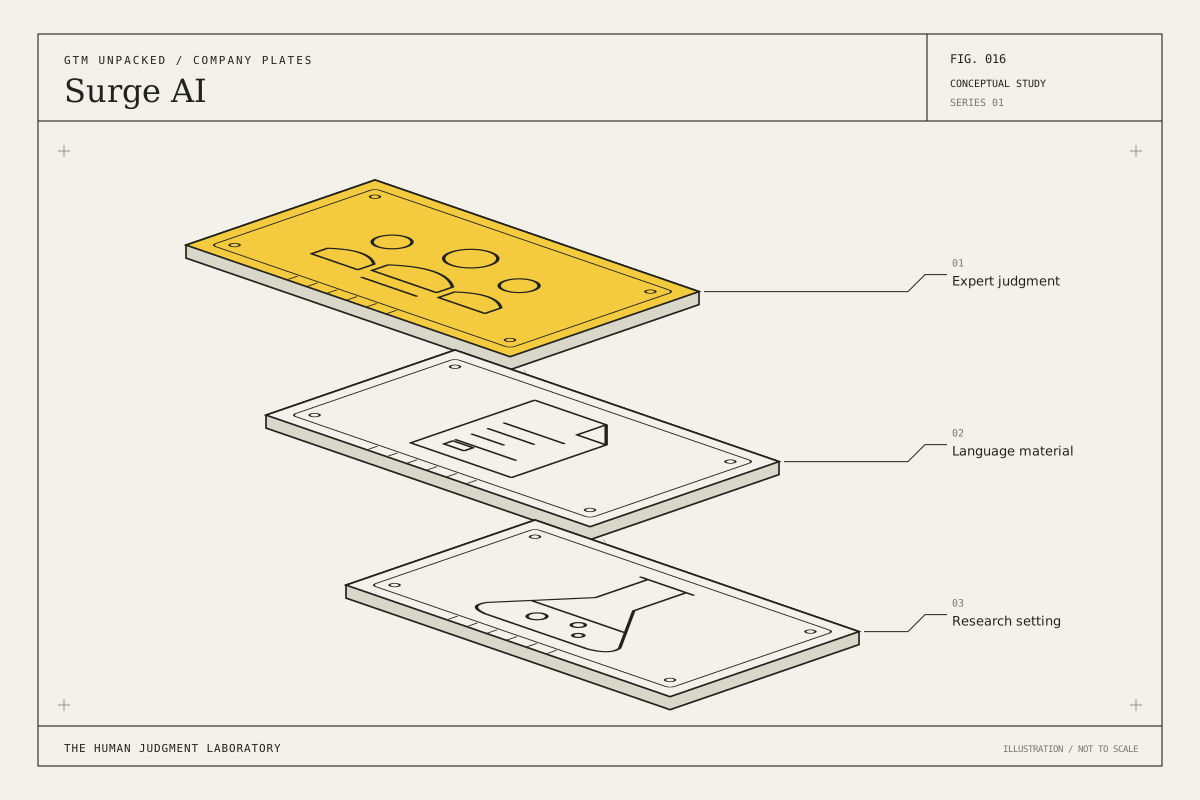
Conceptual illustration placing people markers, a document, and flask in a research-themed assembly, presenting judgment and language material as distinct editorial subjects.
- Company
- Surge AI · AI training data · surgehq.ai
- Conversion motions
- [Inference] This research classifies Surge AI as Human Led.
- Surge AI beachhead
- Language and moderation teams dissatisfied with cheap, low-context data labeling. [1][2]
- Surge AI target customer
- AI researchers and frontier labs purchasing expert data, evaluation, RLHF and agent environments; enterprise data teams also appear in the offer. [6]
- Product complexity
- [Inference] Simple submission interfaces sit above a complex service: task design, human selection, context-sensitive rubrics and quality control. [1][2]
- Decision-making unit
- [Inference] Researchers can champion a project, but large proprietary-data contracts bring commercial, security and legal stakeholders into the decision. No formal buying map is public. [3][7]
- Market at entry
- In 2021 Chen positioned Surge against existing crowdsourcing tools and spreadsheet-heavy internal processes. NLP quality was the wedge before the mainstream generative-AI boom. [1][2]
- Market today
- The current offer spans expert multimodal data, evaluations and reinforcement-learning environments. Buyers can use multiple vendors or internal teams, making quality an ongoing contest. [3][6]
- Evidence
- Deep research · 10 linked sources · research date · method and limitations
The ten-step Revenue Engine reading map
These links locate relevant evidence. A linked section does not imply every detail of the step is publicly established.
- Acquire Your First Customers: Founder Led Sales Read first customers
- Embrace GTM Experimentation Read experiments & lessons
- Understand Your GTM Motion Options Read GTM motion
- Pick Your GTM Motion Read beachhead & buyer · Read product & market
- Generate a Lead Read GTM motion · Read experiments & lessons
- Turn Leads into Paying Customers Read GTM motion · Read people & process
- Retain and Grow Your Customers Read retain & expand
- Build Your GTM Team Read people & process
- Plan Your Tech Stack Read experiments & lessons · Read people & process · Read product & pricing archive
- Optimize and Scale Through Metrics Read pricing & economics
Surge AI GTM timeline: From wedge to engine.
Launch the NLP quality proposition
Founder publishes the original platform introduction. [1]
Explain the quality methodology
Interview details interfaces, APIs and context-sensitive review. [2]
Archived NLP positioning
Verified Wayback capture preserves the earlier site vocabulary and leadership biography. [9]
A formal paid-pilot boundary
Published enterprise pilot terms define evaluation rights and commercial progression. [7]
Surge AI origin and first customers: Acquire the first customers through technical credibility
Chen’s December 2021 launch essay described frustration with slow, unreliable datasets during his work at Google and Facebook. He presented Surge as a modern successor to Mechanical Turk, with APIs, flexible interfaces and optional managed workers. It named OpenAI, Airbnb and Amazon as users at launch; it did not disclose their contract dates or identify the very first paying customer. [1]
Forbes later reported that Chen’s data-science blog attracted early clients including Airbnb, Twitch and Twitter. Its account describes a Google researcher’s referral leading to a Saturday-night conversation in May 2023 and an eventual contract exceeding $100 million annually. That figure comes from reported sources, not a public contract. [3]
[Inference] Founder-led selling worked through demonstrated technical taste: show a researcher that you understand why their current labels are wrong, then make a small, credible commitment to improve them. The sale depended on relevant expertise, not merely access to a prestigious network. The identity of the first signed buyer remains unverified. [1][3]
[1] [3]Surge AI beachhead and buyer: A quality wedge where context changes the answer
In a 2022 interview Chen contrasted nuanced labeling with spreadsheet workflows and bespoke internal tooling. He emphasized template interfaces, APIs, ML-assisted quality control and human review. His examples distinguished linguistic context from simplistic keyword rules: profanity can convey enthusiasm, while apparently ordinary language can still be abusive. Surge also published an analysis claiming errors in 30% of a 1,000-comment sample from GoEmotions; that is Surge’s evaluation, not an independent audit. [2]
[Inference] The beachhead was attractive because a researcher could see the defect in a sample and connect it to downstream work. Generic claims of a larger labor pool would be less persuasive. A buyer with an expensive training run has a reason to value judgment over the cheapest individual annotation, provided the quality difference survives a meaningful evaluation. [2]
[2]Surge AI GTM motion: Human-led conversion with content and referrals upstream
In his Lenny interview, Chen describes research relationships and word of mouth as central to growth. The accessible public episode summary and transcript describe hands-on scientific diagnosis, rather than a conventional high-volume sales funnel. Forward-deployed researchers work with customers on gaps, evaluation and data requirements. The interview does not disclose an audited attribution split between referrals, founder contacts and other channels. [4][5]
October 2026 enterprise pilot terms provide a concrete commercial stage: an order form sets a paid evaluation, ordinarily limited to 90 days, with staff available for questions. The license permits inspection and testing of the delivered dataset but expressly excludes using it to train, fine-tune or evaluate models. Broader rights require a commercial agreement. This is a contractual conversion boundary, not evidence of a frictionless free trial. [7]
[Inference] Content generates interest; a scoped technical relationship converts it. Calling the business marketing led because Chen wrote a popular blog would confuse lead generation with the buying mechanism. Likewise, an API does not make a bespoke expert-data engagement product led. [1][4][5][7]
[1] [4] [7] [5]Surge AI product and market: From labeling language to supplying expert judgment
The live product catalog includes supervised fine-tuning, human evaluations, RLHF, expert tasks, multimodal data, and reinforcement-learning environments with rubrics and verifiers. Surge markets professional expertise and more than 70 languages. These are company descriptions of service capabilities, not independent evidence that every advertised offering produces better models. [6]
[Inference] This expansion follows a changing customer problem: when easy labels become less scarce, the valuable work shifts toward designing demanding tasks and evaluating difficult answers. The operating burden rises with domain specificity. Quality must be demonstrated task by task; a historical reputation for language labeling does not automatically validate every professional or agent workflow. [2][6]
[2] [6]Surge AI people and process: Hire for judgment as well as throughput
Chen’s own biography records MIT study in mathematics, computer science and linguistics, and research roles at Google, Facebook and Twitter. His combination of quantitative and linguistic experience is directly relevant to Surge’s initial quality thesis. It does not establish formal sales training. [8]
A verified April 20, 2025 Wayback capture of Surge’s Andrew Mauboussin biography says he oversaw engineering and machine learning, previously worked on Twitter’s spam and integrity systems, and studied computer science at Harvard. The archived page is concrete evidence of how the company presented its technical leadership, rather than a reconstruction from today’s website. [9]
Forbes profiles Scott Heiner, a former drummer and tour manager hired as employee five, and Juliet Stanton, a linguistics professor who became a contractor and then employee. [3]
[Inference] The unusual backgrounds fit a business that must recognize nuance, motivate people and coordinate uncertain work. The transferable principle is to assess the actual judgment a task requires; copying unconventional résumés without a work sample would miss the mechanism. [2][3]
[2] [3] [8] [9]Surge AI retention and expansion: Research partnership is the account-management layer
The Lenny conversation describes forward-deployed researchers working directly with customers, separate from internal research. That provides a public account of enablement through diagnosis and dataset design. It does not establish a named account manager for each lab, renewal quotas, coverage ratios or a standardized customer-success playbook. [4][5]
[Inference] A plausible expansion loop is identify a model weakness, scope a dataset or evaluation, verify its usefulness with the customer and extend into additional domains. The renewal argument is fresh technical value. Buyers who constantly change models can reallocate spending quickly, so a large contract is not equivalent to durable software lock-in. [4][5][6]
[Inference] Account management should capture the buyer’s acceptance criteria and the reason work was rejected, not merely the volume delivered. Otherwise, an impressive workforce or revenue run rate can conceal deteriorating usefulness. This is a recommendation; Surge’s internal scorecards were not disclosed. [2][7]
[2] [4] [6] [7] [5]Surge AI pricing and economics: Premium service economics, with important blanks
The inspected product pages do not publish a comparable rate card. Pilot and enterprise pricing are set in order forms. Forbes reported approximately $1.2 billion of 2024 revenue and Chen’s assertion of early profitability; neither is an audited ARR statement. [3][7]
[Inference] Costs include experts, recruiting, task preparation, review, rework and customer-facing researchers. Revenue per corporate employee alone omits much of the delivery workforce and therefore exaggerates apparent software-like efficiency. The right unit is a usable, accepted deliverable after all delivery costs—not a raw annotation or an internal headcount. [1][4][5][6]
[Inference] A premium is defensible when it lowers a customer’s total cost of failed experiments or improves a valuable model behavior. That hypothesis needs comparative evaluation; neither the founder’s conviction nor a famous customer logo proves it. Published evidence is insufficient to calculate CAC, payback, contribution margin or net retention. [2][6]
[1] [2] [3] [4] [6] [7] [5]Surge AI experiments and lessons: A strong strategy with visible limits
Forbes reported that OpenAI no longer worked with Surge and that Cohere moved most annotation in-house. These are documented limits to the retention narrative; the article also says Meta continued using Surge. It does not provide a complete churn ledger or establish a single cause for each departure. [3]
[Inference] The core experiment was that careful human judgment could command more value than commodity labeling. Early customer references and later expansion support commercial relevance, but do not isolate causality. In-house alternatives, synthetic data and competing specialists can erode value in specific tasks. A provider should sell validated outcomes while preparing for categories of work to shrink. [1][3][6]
[1] [3] [6]Surge AI website and pricing history: The archived site exposes the positioning change
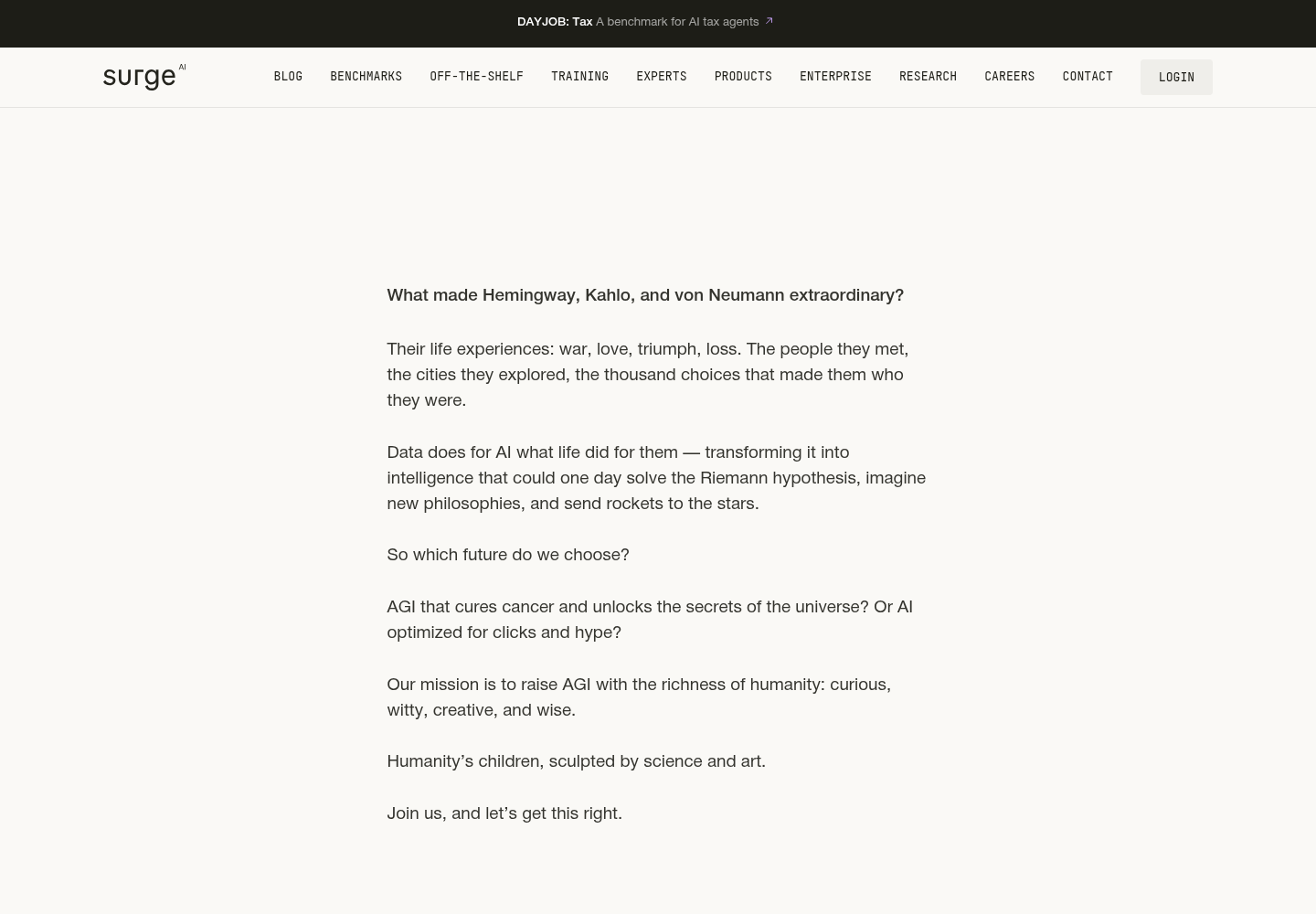
The launch essay called Surge a modern NLP data-labeling platform. The verified April 2025 archived author page still used human infrastructure for NLP and linked pricing, Python SDK and API documentation. The current homepage instead emphasizes humanity’s experiences and expertise in building AI. This is a real change in presentation, not proof of a precise date when every commercial contract changed. [1][9][10]
A live homepage screenshot was captured. The archive supplied inspectable historical text, but a historical screenshot and a dated historical price schedule were not retrieved. The presence of a pricing navigation link is not evidence of the prices that it once contained. [9][10]
[1] [9] [10]Surge AI economics at a glance: Pricing is only half the story.
Custom order-form pricing; no validated public historical rate series. [7]
Enterprise data and research-service engagements with scoped pilots.
[Inference] Expert labor, curation and review mean gross billings cannot be equated with software margin.
Not publicly verified.
No cohort NRR; customer departures are reported, but a complete churn rate is unavailable. [3]
The people in the Surge AI GTM story: People & capabilities.
Edwin Chen
Founder and CEOMIT mathematics, computer science and linguistics; research roles at Google, Facebook and Twitter, according to his own biography.
Personally articulated the quality thesis and served as a technical counterpart to customers. [Inference] Domain credibility was a commercial asset.
[8] [4]Andrew Mauboussin
Engineering and ML leader in archived Surge biographyHarvard computer-science background; previously Twitter spam and integrity.
Led the technical systems supporting data-quality and service delivery; individual sales ownership is not public.
[9]Scott Heiner
Early employeeFormer musician and tour manager.
An example of hiring outside standard software profiles; exact account ownership is unverified.
[3]Juliet Stanton
Linguistics specialistFormer NYU linguistics professor.
Brought linguistic expertise to the operation; no public commercial quota or customer assignment verified.
[3]“a modern data labeling platform for NLP”Edwin Chen, launch essay [1]
Surge AI GTM: critical reading and analysis: Why it worked.
Where it breaks.
What worked—and why
[Inference] Technical content demonstrated the exact judgment that buyers were being asked to purchase. [1][2]
[Inference] Founder and research involvement made complex scoping part of the product. [4]
What did not work
Reported OpenAI and Cohere departures contradict a blanket assumption of customer loyalty. [3]
What could have been better
[Inference] Publish controlled, reproducible outcome evidence by task type rather than relying chiefly on prestige and aggregate growth.
[Inference] Reduce key-person dependence by documenting diagnostic and acceptance standards; no public evidence establishes how completely Surge has already done so.
What another founder can use
[Inference] A founder’s specialist reputation can generate qualified demand when the buyer can inspect the work.
[Inference] Premium human services require continuous proof of judgment, and are least defensible where acceptable output becomes cheap and standardized.
Surge AI website and pricing captures: Product, positioning & pricing.
Captures and image sources are dated individually. Historical gaps are kept explicit. Explore the visual archive
Surge AI go-to-market FAQ: The questions that matter.
Surge AI sources and open questions: Follow the sources.
- Surge AI: A Modern Data Labeling Platform for NLP Edwin Chen · primary · 2021-12-29
Founder launch, initial capabilities and named users.
- 5 Q’s for Edwin Chen, CEO of Surge AI Center for Data Innovation · interview · 2022-09-26
Founder explains quality, workflows and evaluation examples.
- How a Google alum became a low-key AI billionaire Forbes Australia · reporting · 2025-09-17
Early customers, people, revenue reporting and customer departures.
- The 100-person AI lab that became Anthropic and Google’s secret weapon Lenny’s Podcast · interview · 2025-12-07
Public episode summary; research-led selling and operating philosophy. Full paid written notes not accessed.
- Lenny interview with Edwin Chen: transcript Musixmatch · interview · 2025-12-07
Automatic transcript used for paraphrase, not verbatim quotations; forward-deployed researcher discussion.
- Products Surge AI · primary
Current service catalog observed November 10, 2026.
- Enterprise Pilot Terms of Sale Surge AI · primary · 2026-10-21
Paid pilot, evaluation window and contractual usage boundary.
- Edwin Chen Edwin Chen · primary
Founder’s self-published professional background.
- Andrew Mauboussin: archived author biography Surge AI via Internet Archive · primary · 2025-04-20
Verified capture timestamp, technical biography and historical navigation.
- Surge AI homepage Surge AI · primary
Current positioning and live screenshot.
What remains unverified
First signed customer and original paid contract not established.
The $1.4B figure in this project’s starting list is not verified here as recurring revenue.
Private prices, CAC, payback, gross margin, win rates and numerical NRR remain unavailable.
No named early quota-carrying AE or individual account manager was established.
No historical screenshot or rate card retrieved; historical archive text is available.