
Source numbers link to evidence. [Inference] marks analytical judgment, including motion classifications and causal explanations. Public evidence does not establish every internal decision or metric.
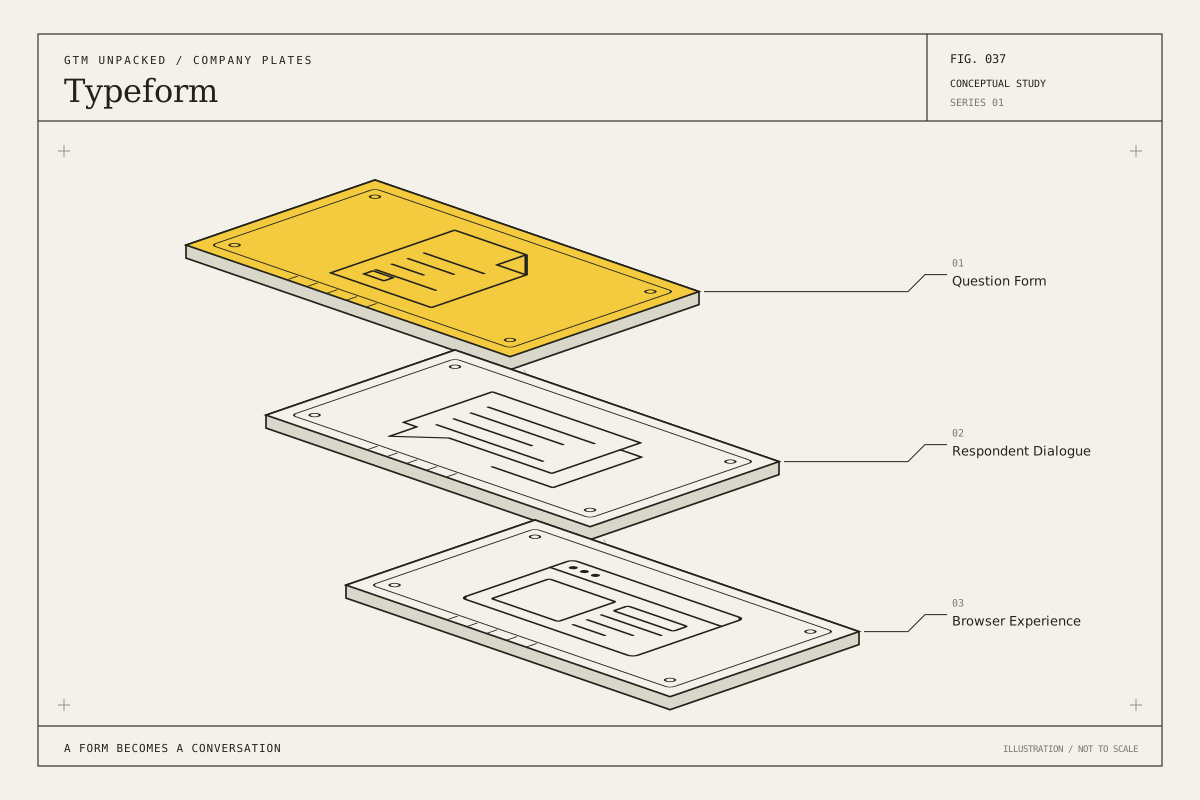
Conceptual illustration of a form taking conversational shape, with a document and message inside a broader browser context that remains deliberately schematic.
- Company
- Typeform · Forms and customer interaction · typeform.com
- Conversion motions
- [Inference] This research classifies Typeform as Product Led and Human Led.
- Typeform beachhead
- A Roca showroom contact form was the originating client project; the SaaS product then targeted broader form creation. [1]
- Typeform target customer
- Individuals and teams collecting information, with enterprise governance and scale needs. [3]
- Product complexity
- [Inference] Easy-to-understand interaction, with complexity in logic, integrations, data governance and response workflows.
- Decision-making unit
- [Inference] One creator can start; organization-wide data collection requires broader controls and ownership.
- Market at entry
- The founders entered an existing forms market with a different interaction design. [1]
- Market today
- Enterprise documentation now combines response capacity, team size, administration and service. [3]
- Evidence
- Source-backed brief · 3 linked sources · research date · method and limitations
The ten-step Revenue Engine reading map
These links locate relevant evidence. A linked section does not imply every detail of the step is publicly established.
- Acquire Your First Customers: Founder Led Sales Read first customers
- Embrace GTM Experimentation Read experiments & lessons
- Understand Your GTM Motion Options Read GTM motion
- Pick Your GTM Motion Read beachhead & buyer · Read product & market
- Generate a Lead Read GTM motion · Read experiments & lessons
- Turn Leads into Paying Customers Read GTM motion · Read people & process
- Retain and Grow Your Customers Read retain & expand
- Build Your GTM Team Read people & process
- Plan Your Tech Stack Read experiments & lessons · Read people & process · Read product & pricing archive
- Optimize and Scale Through Metrics Read pricing & economics
Typeform origin and first customers: A client brief became a product
David Okuniev’s Mixergy interview identifies Roca, a Barcelona bathroom company and Robert Muñoz’s agency client, as the original showroom-form project. The founders developed a conversational interaction rather than a conventional list of fields. [1]
[Inference] Roca is evidence of the originating job, not necessarily the first subscription customer. Keeping that distinction avoids turning a service project into an invented SaaS sale.
[1]Typeform beachhead and buyer: Differentiate the experience both sides see
[Inference] Most form software must serve a creator and a respondent. Better respondent experience can improve the creator’s result while exposing a new audience to the product. That makes interface quality commercially relevant beyond aesthetic preference.
Typeform GTM motion: The form travels farther than the account
In the SaaS Club interview, Okuniev describes a prelaunch landing page promoted through BetaList, collecting roughly 5,000 addresses. Users then created and shared forms, bringing recipients into contact with Typeform. [2]
[Inference] The loop produces exposure, not automatic conversion. It depends on some recipients also having a reason to create forms and on their reaching a successful result.
[2]Typeform product and market: A horizontal product still has distinct jobs
[Inference] Lead capture, research and event registration share a form interface but differ in urgency, frequency and willingness to pay. A broad market does not remove the need to segment activation and retention by job.
Typeform people and process: Design-agency experience shaped the product
Okuniev and Muñoz operated small design agencies before developing Typeform. [1] Okuniev later described accountability and execution problems as the company grew beyond approximately 150 people. [2]
[Inference] The capabilities needed to invent an interaction are not identical to those needed to coordinate a larger operating company. Growth requires explicit decision ownership.
[1] [2]Typeform retention and expansion: Enterprise service complements self-service
The current Enterprise help page describes tailored team/response capacity, centralized administration, individualized onboarding and training, and a dedicated CSM. It warns that plan experiments can make details vary by offer. [3]
[Inference] This service layer addresses organizational adoption and data workflows. It should be evaluated against successful launches and useful responses, not just account setup.
[3]Typeform pricing and economics: Usage and team scope both matter
Enterprise packaging adjusts response limits and team size, while lower plans are self-service. [3]
[Inference] Response volume is a plausible value/cost signal, but occasional projects can create uneven retention. No historical CAC, contribution margin or cohort retention is verified in this brief.
[3]Typeform experiments and lessons: A real organizational limitation
Okuniev’s interview links reduced execution speed to insufficient accountability as headcount grew. [2]
[Inference] A product-led acquisition loop does not substitute for operating discipline. Clear ownership should preserve product craft while reducing the cost of making decisions.
[2]Typeform website and pricing history: Chronology requires care
The interviews support a client-project-to-beta-to-paid-product sequence. [1][2] Some published summaries disagree on exact beta/paid launch dates, so this brief does not assert a precise year-by-year pricing chronology.
[1] [2]Typeform economics at a glance: Pricing is only half the story.
Self-service plans and customized enterprise capacity/service; exact dated prices not audited. [3]
Freemium forms with paid capacity, features and enterprise contracts. [3]
[Inference] Project-based use and response volume require segmented retention analysis.
Not established by the sources reviewed.
Not established by the sources reviewed.
The people in the Typeform GTM story: People & capabilities.
Robert Muñoz
Co-founderRan the agency serving Roca. [1]
Brought the originating client project and co-developed the product. [1]
[1]Typeform GTM: critical reading and analysis: Why it worked.
Where it breaks.
What worked—and why
[Inference] The output of the product was also a distribution surface.
What did not work
The founder describes accountability and execution problems at larger headcount. [2]
What could have been better
[Inference] Measure retained form creators and useful response collection separately from viral exposure.
What another founder can use
[Inference] Design for the recipient when recipients are also the route to future customers.
Typeform go-to-market FAQ: The questions that matter.
How did Typeform get its first customers?
David Okuniev’s Mixergy interview identifies Roca, a Barcelona bathroom company and Robert Muñoz’s agency client, as the original showroom-form project. The founders developed a conversational interaction rather than a conventional list of fields. [1]
Which go-to-market motions is Typeform classified under?
[Inference] This research classifies Typeform as Product Led and Human Led. Motion labels describe routes across segments and periods, not measured revenue shares.
Typeform sources and open questions: Follow the sources.
- How Typeform was built Mixergy · interview
Founder transcript: agency background and Roca origin.
- Typeform product-led growth SaaS Club · interview
Founder transcript: BetaList, shared-form distribution and accountability problems.
- Enterprise plan Typeform · primary
Custom capacity, training, CSM and plan-experiment caveat.
What remains unverified
Named first subscriber and early AE/CSM biographies not established.
Exact early launch dates, historical screenshots and pricing migrations need reconciliation.
No verified visual capture is attached to this entry. A current screenshot is not a substitute for a historical capture.