Source numbers link to evidence. [Inference] marks analytical judgment, including motion classifications and causal explanations. Public evidence does not establish every internal decision or metric.
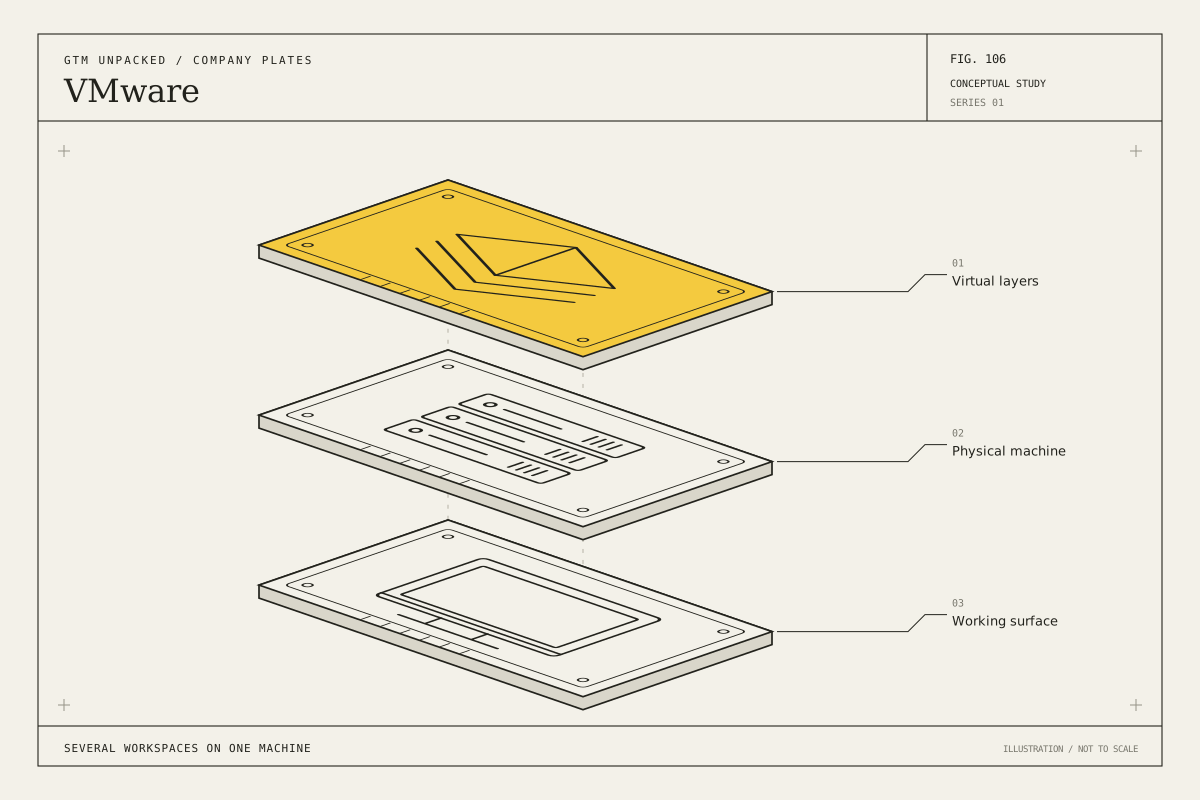
Conceptual illustration of layered panels, a server, and a display, exploring multiple working surfaces around computing hardware without specifying a real virtualization configuration.
- Company
- VMware · Virtualization and private cloud · vmware.com
- Conversion motions
- [Inference] This research classifies VMware as Product Led, Partner Led and Human Led.
- VMware beachhead
- Science professors and technical workstation users
- VMware target customer
- Enterprise infrastructure and private-cloud teams
- Product complexity
- High technical complexity; demonstrable consolidation value
- Decision-making unit
- [Inference] Infrastructure, application owners, security, procurement and executive sponsors
- Market at entry
- Server virtualization was unfamiliar to many buyers; dot-com spending weakened efficiency urgency
- Market today
- [Inference] Mature virtualization category with commercial model transition under Broadcom
- Evidence
- Source-backed brief · 4 linked sources · research date · method and limitations
The ten-step Revenue Engine reading map
These links locate relevant evidence. A linked section does not imply every detail of the step is publicly established.
- Acquire Your First Customers: Founder Led Sales Read first customers
- Embrace GTM Experimentation Read experiments & lessons
- Understand Your GTM Motion Options Read GTM motion
- Pick Your GTM Motion Read beachhead & buyer · Read product & market
- Generate a Lead Read GTM motion · Read experiments & lessons
- Turn Leads into Paying Customers Read GTM motion · Read people & process
- Retain and Grow Your Customers Read retain & expand
- Build Your GTM Team Read people & process
- Plan Your Tech Stack Read experiments & lessons · Read people & process · Read product & pricing archive
- Optimize and Scale Through Metrics Read pricing & economics
VMware origin and first customers: Origin & first customers
Diane Greene’s Masters of Scale interview describes an initially unsuccessful pitch: saving money on servers did not resonate during the dot-com spending boom. Early users instead included college science professors. [1] [Inference] This is an unusually useful example of a valuable technology failing to match immediate buying motivation. The founders found receptive technical users before the enterprise cost-saving argument became broadly compelling; no exact first paid contract was established in this research.
[1]VMware beachhead and buyer: Beachhead & buyer
[Inference] Technical users could experiment with running multiple systems on a workstation and understand the advantage directly. Large infrastructure teams faced more perceived risk because production reliability and compatibility mattered as much as savings. The beachhead therefore reduced organizational approval requirements while exposing the product to demanding users. It created learning and credibility, but it was not itself proof that large datacenter purchases would follow.
VMware GTM motion: GTM motion & lead conversion
In a 2005 CRN interview, Greene said prospective resellers appeared as soon as Workstation 1.0 was available online. VMware built channels early, compensated sellers neutrally between direct and partner business, and focused on avoiding channel conflict. [2] [Inference] Product adoption generated partner demand, while commercial rules protected the distribution system. Partner-led growth required deliberate incentives, not simply a reseller registration page.
[2]VMware product and market: Product, market & buying complexity
[Inference] Virtualization’s technical value became commercially powerful when a buyer could trust it with production workloads. The sales task changed from demonstrating a clever capability to proving operational safety, support and integration. A larger account could expand from isolated use cases into strategic infrastructure, increasing revenue potential but also increasing the consequences of downtime and the number of stakeholders involved.
VMware people and process: People & operating process
Greene’s background included technical leadership at Silicon Graphics, Tandem and Sybase, and CEO experience at VXtreme before VMware. Her 2005 account also discusses joint solutions with IBM and Citrix and the use of EMC office infrastructure for international growth. [2] [Inference] Her relevant GTM capability combined technical credibility, prior company-building and an ability to align complementary vendors. Detailed early AE and success-manager biographies remain unverified.
[2]VMware retention and expansion: Customer success & expansion
VMware’s 2024 partner-support clarification describes arrangements in which qualified partners with technical-support infrastructure work with Broadcom support centers to serve end customers. [3] [Inference] This carries the channel beyond initial acquisition into service continuity. For complex infrastructure, expansion depends on trusted operational support; weak handoffs can damage renewals even when technical performance is strong.
[3]VMware pricing and economics: Pricing & economic constraints
The January 2024 licensing notice describes the end of availability of perpetual licensing and a shift to a simplified subscription portfolio, with customers directed to representatives or partners at renewal. [4] [Inference] Such a change can improve recurring monetization but changes the customer’s economic comparison. Existing deployment depth may create switching friction, yet it should not be confused with customer enthusiasm or a permanently protected retention rate.
[4]VMware experiments and lessons: Experiments, lessons & critique
[Inference] The original enterprise pitch failed because efficiency was not an urgent priority for the intended buyers. The successful adjustment was to learn from actual users and emerging reseller demand. The modern risk is the opposite: strong installed-base dependence can encourage commercial changes faster than customers perceive additional value. A better renewal discipline would explain workload-level economics and migration choices with enough time for genuine planning. [1][4]
[1] [4]VMware website and pricing history: Positioning & pricing evolution
The evidence establishes a real journey from workstation adoption to partner-supported infrastructure and subscription consolidation. [2][4] It does not establish a complete year-by-year pricing history or historical screenshot sequence. [Inference] A founder should copy the adaptive discovery process, not assume that the current economics of a mature infrastructure platform are available to a new vendor without comparable technical trust and installed adoption.
[2] [4]VMware economics at a glance: Pricing is only half the story.
2024 shift from perpetual licensing to subscription portfolio; specific rates not verified. [4]
Subscriptions and partner-delivered services
[Inference] Production support and channel economics constrain gross-to-net value.
Not publicly verified
Not publicly verified
The people in the VMware GTM story: People & capabilities.
Diane Greene
Co-founder and founding CEOTechnical leadership at SGI, Tandem and Sybase; former VXtreme CEO.
Adapted buyer targeting and established channel-friendly commercial rules. [1][2]
[1] [2]VMware GTM: critical reading and analysis: Why it worked.
Where it breaks.
What worked—and why
[Inference] Early user demand revealed a route around an unpersuasive enterprise pitch. [1]
What did not work
Initial server-efficiency pitch met disinterest, per Greene. [1]
What could have been better
[Inference] Explain renewal economics and protect partner/customer trust during packaging changes.
What another founder can use
[Inference] A technically excellent product still needs a buyer whose problem is urgent now.
VMware go-to-market FAQ: The questions that matter.
How did VMware find its GTM motion?
In a 2005 CRN interview, Greene said prospective resellers appeared as soon as Workstation 1.0 was available online. VMware built channels early, compensated sellers neutrally between direct and partner business, and focused on avoiding channel conflict. [2] [Inference] Product adoption generated partner demand, while commercial rules protected the distribution system. Partner-led growth required deliberate incentives, not simply a reseller registration page.
What can founders learn from VMware?
[Inference] A technically excellent product still needs a buyer whose problem is urgent now.
VMware sources and open questions: Follow the sources.
- Look for the ideas that come at you sideways Masters of Scale · interview · 2017-11-10
- Interview with Diane Greene CRN · interview
- Clarifying partner-provided technical support VMware · primary · 2024-09-03
- End of availability of perpetual licensing VMware · primary · 2024-01-22
What remains unverified
No verified historical website screenshot was available for this brief.
Early CRM, sales engagement and enablement tools were not verified; product integrations are not treated as internal GTM tools.
Exact first paid contract and early funnel conversion are not publicly verified in the inspected sources.
No verified visual capture is attached to this entry. A current screenshot is not a substitute for a historical capture.