
Source numbers link to evidence. Motion classifications, causal explanations and the critique are this site’s analysis. Public evidence does not establish every internal decision or metric.
- Company
- Airbyte · Data integration & AI infrastructure · airbyte.com
- Conversion motions
- This research classifies Airbyte as Product Led and Human Led.
- Airbyte beachhead
- Data teams whose existing integration vendor left a long tail of sources to maintain themselves. [4][6]
- Product complexity
- A simpler connector interface conceals difficult maintenance, schema and reliability work. [6]
- Decision-making unit
- Individual evaluation is accessible; production deployment introduces data access, security, infrastructure and budget decisions. [5]
- Market at entry
- Existing data-integration products validated demand, while unsupported connectors left a specific opening. [4][6]
- Market today
- Integration is an established category; Airbyte now competes on reliability, deployment control, cost structure and agent-context requirements. [4][5]
- Evidence
- Source-backed brief · 7 linked sources · research date · method and limitations
The ten-step Revenue Engine reading map
These links locate relevant evidence. A linked section does not imply every detail of the step is publicly established.
- Acquire Your First Customers: Founder Led Sales Read first customers
- Embrace GTM Experimentation Read experiments & lessons
- Understand Your GTM Motion Options Read GTM motion
- Pick Your GTM Motion Read beachhead & buyer · Read product & market
- Generate a Lead Read GTM motion · Read experiments & lessons
- Turn Leads into Paying Customers Read GTM motion · Read people & process
- Retain and Grow Your Customers Read retain & expand
- Build Your GTM Team Read people & process
- Plan Your Tech Stack Read experiments & lessons · Read people & process · Read product & pricing archive
- Optimize and Scale Through Metrics Read pricing & economics
Airbyte GTM timeline: From wedge to engine.
Airbyte origin and first customers: Origin & first customers
The founders entered Y Combinator with Daxtarity, a marketing-oriented product. John Lafleur’s March 2020 account describes interviews with about 45 companies, a Google Analytics proof of concept and manual onboarding before self-service was ready. This was a real founder-selling episode, but it predates the infrastructure product now called Airbyte. [1][2]
Michel Tricot dates the infrastructure pivot to July 27, 2020, after COVID disrupted interest in the earlier product. The later open-source launch should therefore not inherit the earlier product’s first-paying-customer claim. The first paid Airbyte infrastructure contract is not identified in the reviewed evidence. [1]
[1] [2]Airbyte beachhead and buyer: Beachhead & target segment
Airbyte’s retrospective describes teams that already used commercial integration software but still maintained their own pipelines for uncovered sources. The founders chose a community-extensible connector catalog. This addressed a specific incomplete workflow rather than requiring teams to replace every part of their data stack immediately. [4][6]
The useful beachhead was defined by an integration gap and an engineering burden. A small data team could evaluate one missing source, observe whether the connector stayed dependable and then consider broader adoption. “Every company with data” would have been too broad to explain that entry point.
[4] [6]Airbyte GTM motion: How the GTM motion developed
GitHub and the connector development kit enabled independent adoption. Managed cloud added paid operations; enterprise buyers could request capacity and deployment quotations. [5][6]
This is a mixed Product Led and Human Led system. Open-source participation generates discovery and product feedback; it does not establish paid conversion. The sales-assisted route becomes more relevant when deployment boundaries, support expectations and annual capacity require agreement among several stakeholders.
[5] [6]Airbyte product and market: Product, buying committee & market maturity
Core self-hosting, managed cloud and enterprise-controlled deployment differ in identity controls, sync frequency and support. Agent-data capabilities extend the original integration offer. [4][5]
Market maturity changed the burden of proof. Early adopters could tolerate a promising missing connector; production buyers compare operational reliability, security and ownership costs. A technically easy initial trial can therefore lead to a complex decision without the product having changed its fundamental job.
[4] [5]Airbyte people and process: People, capabilities & selling process
Michel Tricot’s biography describes engineering work at FactSet and seven years at LiveRamp, including large-scale connector development. The current site calls the other founder Jean Lafleur; historical posts use John Lafleur. His biography lists École Polytechnique, Cambridge and prior entrepreneurship, while historical posts document his customer-discovery and community work. [2][3][4]
The pairing combined integration experience with direct market learning. Their public writing is useful evidence of operating choices, not proof of an individual’s causal contribution to revenue. The reviewed record does not identify the first infrastructure account executive or a complete later sales-training program.
[2] [3] [4]Airbyte retention and expansion: Enablement, success & expansion
In April 2021, Airbyte described welcoming each Slack member personally, recording connector needs in Orbit and returning when requested connectors became available. It tracked response and resolution time, and described a User Success Engineer role for technical problem-solving. These are documented support processes, not inferred website technologies. [3]
The expansion mechanism begins with remembering the customer’s next unmet source. Connecting a new release to an existing need creates a specific reason to re-engage. Enterprise support and solution-architecture assistance add a different service layer, but public materials do not establish renewal ownership or an expansion revenue rate. [5]
[3] [5]Airbyte pricing and economics: Pricing & implied economics
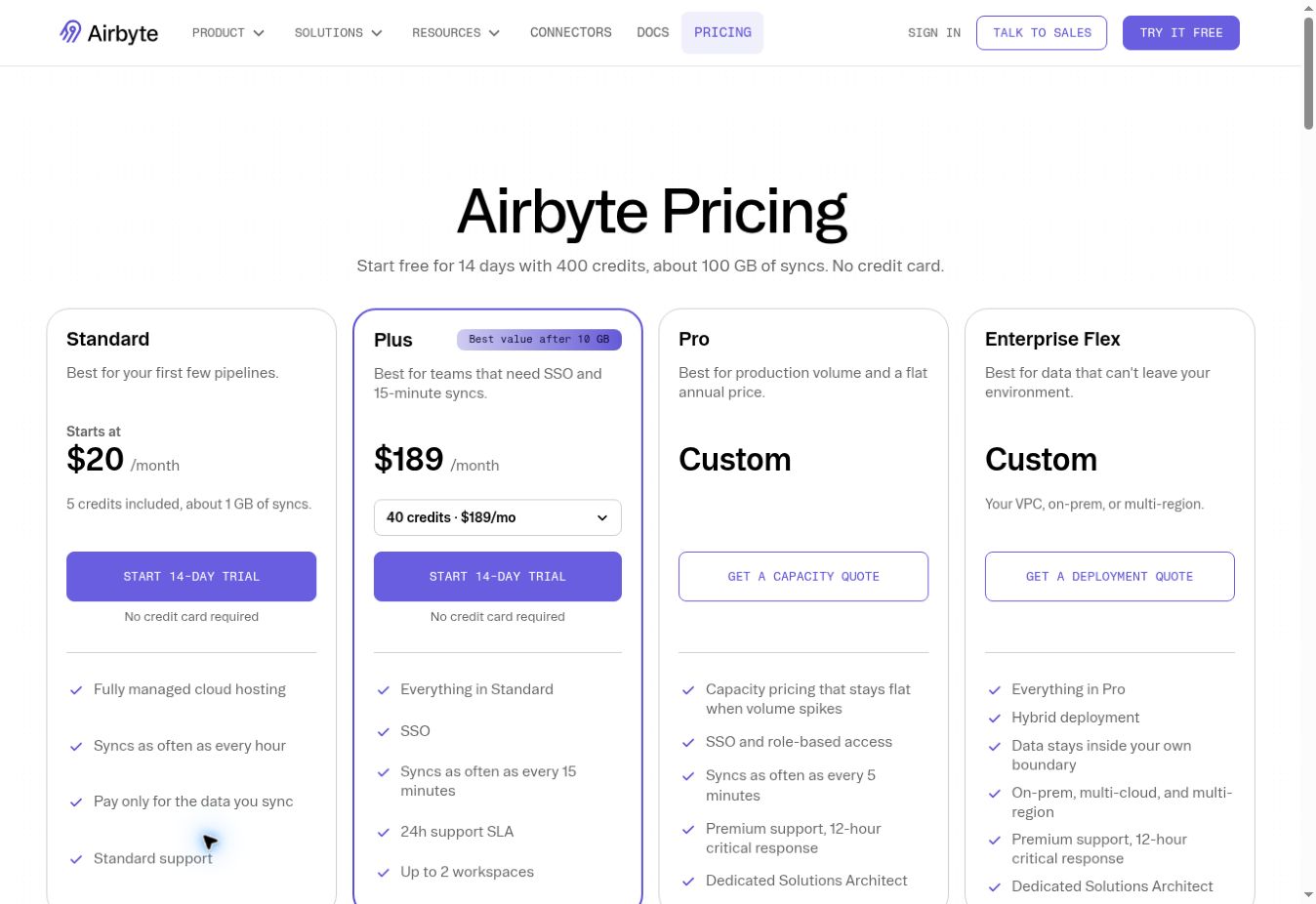
Observed November 18, 2026: Standard from $20/month, Plus from $189/month; Pro and Enterprise Flex require capacity quotations. These are list-price entry points. [5]
The economic tradeoff is maintenance and support intensity against repeatable connector reuse. A large free audience can still be expensive if production reliability requires persistent engineering work. Public sources reviewed here do not establish CAC, gross margin, cohort retention or whether community acquisition offsets that service burden.
[5] [6]Airbyte experiments and lessons: Experiments, mistakes & operating tools
The 2024 retrospective acknowledges that early emphasis on catalog expansion produced connectors below customer expectations. The team shifted attention toward reliability and performance, and learned that managed-cloud users expected more than open-source experimenters. [6]
A better experiment would measure successful recurring production use for a narrow connector set alongside catalog size. The founders’ earlier use of conditional order forms also illustrates why a prospect’s interest and a procurement-tested commitment are different signals. It should not be presented as legal advice or as evidence that every Airbyte buyer followed that process. [2]
[2] [6]Airbyte website and pricing history: Website, product & pricing evolution
The source record moves from a March 2020 marketing-product sales narrative, through the July infrastructure pivot, to managed-cloud and enterprise packaging. Current messaging adds AI-agent context. Historical articles contain links to airbyte.io; those links support treating that domain as historical identity context rather than another independently researched business. [1][2][4][6]
Dated posts establish the chronology; incomplete captures and inconsistent retrospective connector counts limit historical comparisons. [5][6]
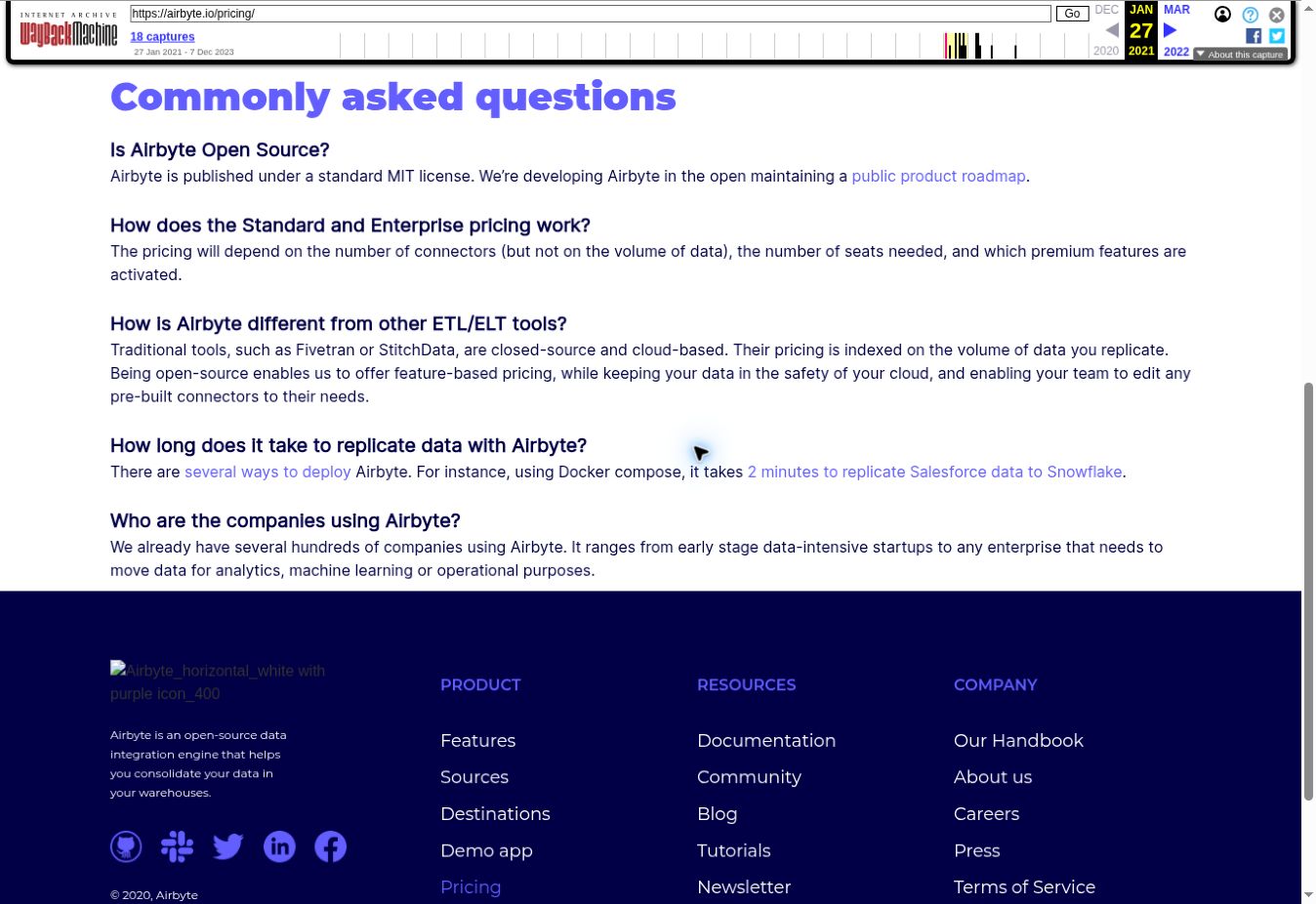
The January 27, 2021 pricing archive positioned Airbyte as self-hosted. Its FAQ said Standard and Enterprise pricing would depend on connectors, seats and premium features, rather than data volume. That differs from the current managed Standard and Plus credit packages; current Pro and Enterprise offers still require capacity quotes. The archive describes an offer, not proof of a signed enterprise contract. [5][7]
[1] [2] [4] [5] [6] [7]Airbyte economics at a glance: Pricing is only half the story.
Current list-price entry points appear above. [5]
Managed integration and enterprise deployments. [5]
Connector maintenance and technical support must be covered by paid usage or capacity revenue.
Not publicly verified in reviewed sources.
No verified cohort retention or NRR.
The people in the Airbyte GTM story: People & capabilities.
Airbyte GTM: critical reading and analysis: Why it worked.
Where it breaks.
What worked—and why
A missing-connector problem made technical community support relevant to a real adoption barrier. [3][4]
What did not work
Early connector quality disappointed users. [6]
What could have been better
Gate expansion by dependable production use and support load, not connector count alone.
What another founder can use
Community-led discovery works best when contributions solve a repeated customer problem and a clear paid operating responsibility remains.
Airbyte website and pricing captures: Product, positioning & pricing.
Captures and image sources are dated individually. Historical gaps are kept explicit. Explore the visual archive
Airbyte go-to-market FAQ: The questions that matter.
How did Airbyte find its first customers?
The founders sold a pre-pivot marketing product through interviews, POCs and manual onboarding. Infrastructure adoption later developed through open source and technical community support; the first paid infrastructure contract is not established. [1][2][3]
Which go-to-market motions is Airbyte classified under?
This research classifies Airbyte as Product Led and Human Led. Motion labels describe routes across segments and periods, not measured revenue shares.
Airbyte sources and open questions: Follow the sources.
- Airbyte turns two! airbyte.com · primary · 2022-07-27
Daxtarity marketing product lost demand during COVID; July 27, 2020 pivot to data infrastructure; original airbyte.io links establish historic domain.
- How to Go from Idea to First Clients in 6 Weeks airbyte.com · primary · 2020-03-18
Pre-pivot founder discovery, Google Analytics POC, conditional order forms and manual onboarding.
- How User Success Helps Us Become the Most Active Slack Community airbyte.com · primary · 2021-04-27
Personal Slack welcomes, use-case tracking through Orbit, connector follow-ups, engineering support and response metrics.
- About Airbyte airbyte.com · primary
Current founder biographies, LiveRamp experience, John/Jean name variation, agent-context positioning and customer examples.
- Airbyte Pricing airbyte.com · primary
Standard starts $20/month; Plus $189/month; Pro and Enterprise Flex custom capacity quotes; trial, support and deployment distinctions.
- Airbyte’s journey until 1.0 airbyte.com · primary · 2024-09-16
GitHub launch, connector development kit, April 2022 cloud release and admitted reliability problems. Retrospective contains inconsistent early connector counts, which are not repeated.
- Airbyte pricing, archived 27 January 2021 Airbyte / Internet Archive · primary archive · 2021-01-27
Archived HTML and visible replay FAQ describe self-hosted positioning and intended connector-, seat- and feature-dependent commercial pricing rather than data-volume pricing. Some visual assets did not render.
What remains unverified
First paid infrastructure customer and contract value not verified.
Early AE, AM, renewal ownership and internal sales training not established.
CAC, gross margin and net retention not verified.
Founder name appears as John in historical posts and Jean on the current company page; treated as the same co-founder based on shared company role and narrative.
The January 2021 Wayback replay is incomplete: pricing-card visuals and some assets did not render, but the pricing FAQ and original HTML were readable. No early commercial contract price is established by this archive.