
Source numbers link to evidence. [Inference] marks analytical judgment, including motion classifications and causal explanations. Public evidence does not establish every internal decision or metric.
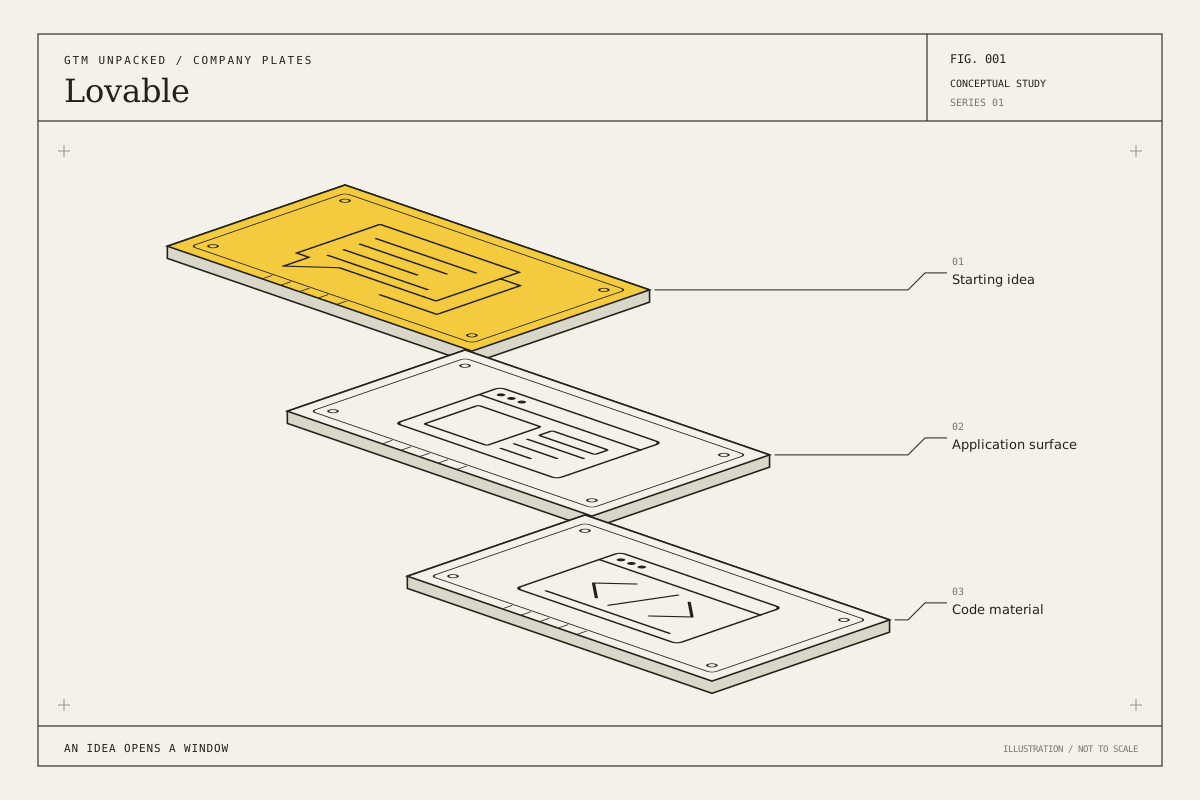
Conceptual illustration of a conversation bubble, browser window, and code brackets, bringing an idea and application materials together without depicting an actual generation pipeline.
- Company
- Lovable · AI app builders · lovable.dev
- Conversion motions
- [Inference] This research classifies Lovable as Product Led, Human Led and Partner Led.
- Lovable beachhead
- [Inference] Greenfield web-app builders with a concrete idea and limited engineering capacity; an existing open-source audience supplied the first distribution pool. [1][2]
- Lovable target customer
- Founders, product managers, designers and domain experts; enterprise departments and organization-wide builders in the later offer. [4][8]
- Product complexity
- [Inference] Simple first interaction, technically complex delivered outcome: chat hides code generation, deployment, data and security. [1][4]
- Decision-making unit
- [Inference] A solo builder can buy directly; enterprise governance and deployment introduce IT/security and budget owners. [4]
- Market at entry
- [Inference] An emerging post-ChatGPT category: interest was high, but reliability and the definition of an AI app builder were still developing. [1][2]
- Market today
- [Inference] Competition has shifted toward complete business infrastructure, enterprise controls and durable production use rather than the first generated screen alone. [1][4][8]
- Evidence
- Deep research · 11 linked sources · research date · method and limitations
The ten-step Revenue Engine reading map
These links locate relevant evidence. A linked section does not imply every detail of the step is publicly established.
- Acquire Your First Customers: Founder Led Sales Read first customers
- Embrace GTM Experimentation Read experiments & lessons
- Understand Your GTM Motion Options Read GTM motion
- Pick Your GTM Motion Read beachhead & buyer · Read product & market
- Generate a Lead Read GTM motion · Read experiments & lessons
- Turn Leads into Paying Customers Read GTM motion · Read people & process
- Retain and Grow Your Customers Read retain & expand
- Build Your GTM Team Read people & process
- Plan Your Tech Stack Read experiments & lessons · Read people & process · Read product & pricing archive
- Optimize and Scale Through Metrics Read pricing & economics
Lovable GTM timeline: From wedge to engine.
GPT Engineer establishes an audience
Osika releases the open-source project; later commercial development follows. [1] [1]
Waitlist and community proof
Archived GPT Engineer website features chat-based building, Product Hunt and GitHub. [3] [3]
Lovable origin and first customers: Origin & first customers
Anton Osika dates GPT Engineer to spring 2023: a public GitHub project that generated a codebase from an instruction. The March 2025 Lenny interview page describes its 52,000 GitHub stars as the community base preceding Lovable’s subscription product. That is evidence of audience formation; it is not a paid-customer count. [1][2]
The archived August 8, 2024 GPT Engineer site asked visitors to join a waitlist, showed a Product Hunt badge and linked GitHub stars. Its pitch joined chat, building, version-control connection and deployment. The site already used public community proof before the Lovable name became the core brand. [3]
No retrieved source identifies the first paying customer, the first founder-sold contract or a repeatable early outbound script. The supported founder-led story is product building, public explanation and close feedback—not a fabricated first enterprise deal. [1][2][3]
[1] [2] [3]Lovable beachhead and buyer: Beachhead, personas & the trigger to buy
The product’s initial technical scope was deliberately narrow: new applications and an opinionated stack. Osika says the team removed an early frontend-stack selector. The buyer did not need a migration tool for arbitrary legacy software; the job was to turn a new idea into an application. [1]
[Inference] This is a useful beachhead distinction. ‘Everyone who cannot code’ is an expansive vision, whereas someone with a new web-app idea and no available engineer is a more actionable entry segment. The first successful preview lets that person evaluate value directly, without a budget committee. [1][2][3]
The later customer evidence is more specific. Lovable’s Nursa story follows VP of Product Nenad Ivanovic building a nursing-school product over a weekend, showing CEO Curtis Anderson, and widening adoption across more than 200 employees. The story is vendor-published; it establishes a reported expansion path, not a controlled productivity study. [8]
[1] [2] [3] [8]Lovable GTM motion: How the GTM motion changed
[Inference] Product Led is the primary entry motion: try the builder, obtain a visible artifact, then pay for capacity or controls. Marketing amplifies that experience through demos and customer examples; the archived Product Hunt and GitHub proof show the early audience channels. [2][3][4]
By December 2025, head of growth Elena Verna described giving away product as a major growth lever and emphasized new capabilities over conventional funnel optimization. The public Lenny episode page makes that argument; its paid takeaways were not accessed. The claim should be attributed to Verna, not treated as a universal law of AI growth. [5]
The current Enterprise offer requires a demo and includes a named CSM, onboarding, deployment support and a custom SLA. That establishes a human-assisted enterprise layer around a self-serve core. Public evidence here does not establish the split between inside and field sellers or their quotas. [4]
Partnership and affiliate links, a partner directory, and an education offer with imagi appear on current official pages. These demonstrate channel infrastructure, but no retrieved evidence quantifies partner-sourced bookings. [4][8]
[2] [3] [4] [5] [8]Lovable product and market: Product complexity, buying complexity & market timing
[Inference] Lovable reduces interaction complexity more than underlying system complexity. A buyer can start with plain language, but production software still requires operational ownership, permission design and security review. The resulting GTM needs two promises: a fast first outcome and a credible path to dependable operation. [1][4]
The current homepage sells an end-to-end platform spanning hosting, authentication, payments and integrations. It also uses customer stories about replacing purchased SaaS. This is a broader commercial position than the 2024 rapid-prototyping page. [3][9]
[Inference] The market matured unevenly: first-time builders may still need basic education, while enterprise champions need governance and accountability. Treating both as the same onboarding problem would make a consumer funnel an inadequate enterprise adoption system. [4][8]
[1] [3] [4] [8] [9]Lovable people and process: People, capabilities & operating process
KTH’s founder profile identifies Osika’s engineering-physics studies, his early role at Sana and his Depict co-founder/CTO experience. Fabian Hedin studied industrial economics, started TenFast and led frontend work at Depict. These are relevant prior experiences, not proof that pedigree caused growth. [6]
[Inference] Osika brought an audience-generating technical artifact and prior AI product experience; Hedin’s frontend background was well matched to making generated software visually legible. Together their backgrounds fit a product whose demonstration is also its sales conversation. [1][2][6]
Verna’s prior roles include growth leadership at Amplitude, Miro, SurveyMonkey and Malwarebytes, according to Amplitude’s author biography. Her Lovable role adds monetization and distribution experience to a founder-heavy product organization. The March 2025 founder interview also describes work trials, generalists and hiring for product care and speed. [2][5][7]
Cecilia Stallsmith is identified as Lovable’s CMO in a 2026 marketing interview; it describes her prior Slack developer-ecosystem work and Calyx Consulting. Her contribution is category narrative across technical users, nontechnical founders and enterprises. No named early account executive or CSM was verified in the sources used here. [10]
[1] [2] [5] [6] [7] [10]Lovable retention and expansion: Enablement, account management & expansion
The published offer makes the service ladder explicit: community support for Free, email for Pro, priority support for Business, then named customer success and deployment support for Enterprise. [4]
The Nursa case shows expansion through an internal champion and executive sponsorship rather than only additional developer seats. The reported sequence moves from a new product to prototyping and then tools built by finance and compliance employees, including Josh Richards and Ryan Moyes. [8]
[Inference] Unlimited collaborators make invitation cheaper psychologically; revenue can grow through shared consumption and upgraded controls. A CSM should therefore be measured on useful deployed workflows and durable adoption, not merely invitations. That measurement prescription is analysis; Lovable’s internal scorecard was not available. [4][8]
[4] [8]Lovable pricing and economics: Pricing & what the economics can support
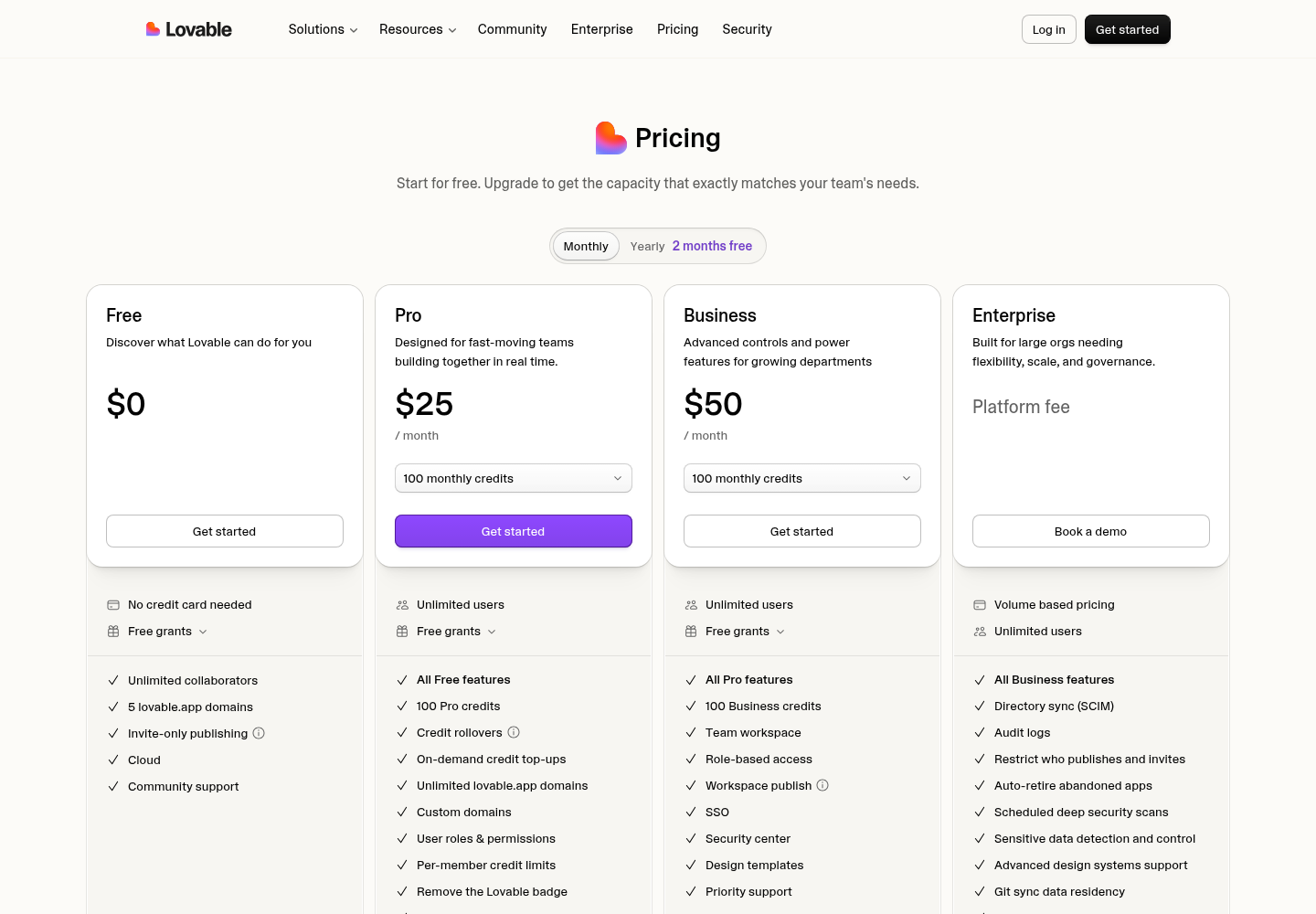
On November 10, 2026, official pricing showed Free, Pro at $25 per month and Business at $50 per month, with 100 monthly credits in each paid starting plan; Enterprise used a platform fee and volume pricing. Credits and grants have plan-specific rules. Plans were not priced per collaborator. [4]
[Inference] This aligns monetization with activity while retaining a low-cost trial. It also exposes the business to variable model and runtime costs. A subscription amount alone cannot establish gross margin, CAC payback or customer lifetime value. Those metrics were not publicly verified in this research. [1][4]
The March 2025 Lenny page reported $4 million ARR in four weeks and $10 million in two months; the December 2025 episode reported $200 million. These are dated interview claims. They do not validate the undated, unverified $500 million figure in this project’s starting list. [2][5]
[1] [2] [4] [5]Lovable experiments and lessons: Concrete experiments, tools & mistakes
Osika’s November 2026 retrospective describes abandoning an over-autonomous agent design when it became less dependable, then using a constrained edit flow and retrieved knowledge files before later restoring more autonomy. He credits the reliability work with the late-2024 takeoff. This is a founder’s causal account, not an independently isolated experiment. [1]
The historical page explicitly listed React, Vite, GitHub and Tailwind among its technology choices. Those are product technologies, not evidence of Lovable’s internal CRM or sales-enablement stack. The latter remains unverified. [3]
[Inference] The transferable experiment was scope reduction: choose a job and stack where outputs can be tested, then broaden capability as reliability improves. The mistake was assuming a more autonomous system would automatically create a better customer outcome. [1]
[1] [3]Lovable website and pricing history: Website & pricing evolution
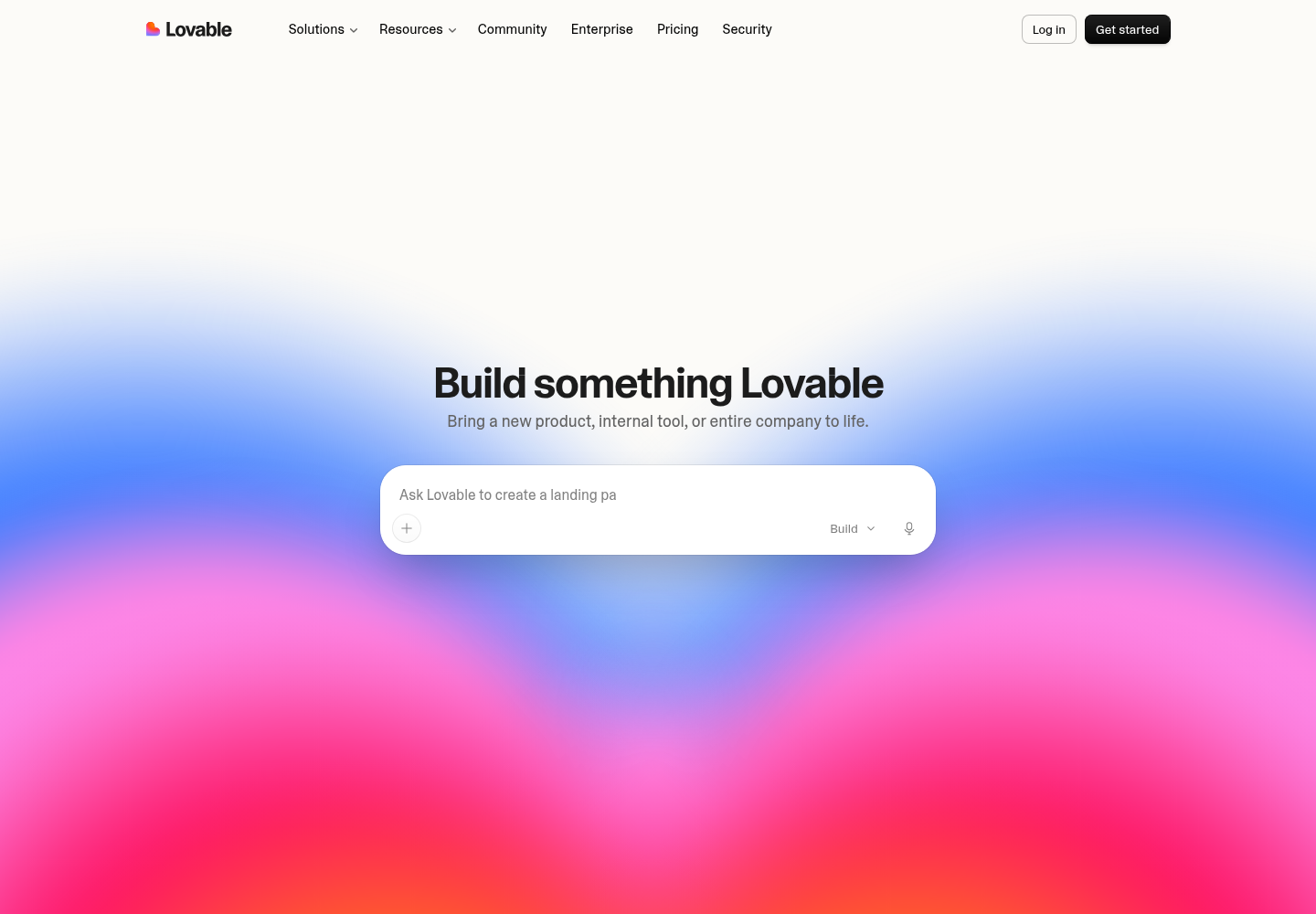
The August 2024 archived page text describes a waitlist-driven rapid-building proposition with developer-community proof. Its main body did not render in the screenshot, so that visual is excluded. The November 2026 homepage presents a broad platform promise with enterprise logos and customer business outcomes. These records establish selected endpoints rather than every intervening redesign. [3][9]
Current pricing places administrative controls and service alongside usage. The homepage capture and the additional November 2024 pricing capture below document two distinct parts of that history. [3][4]
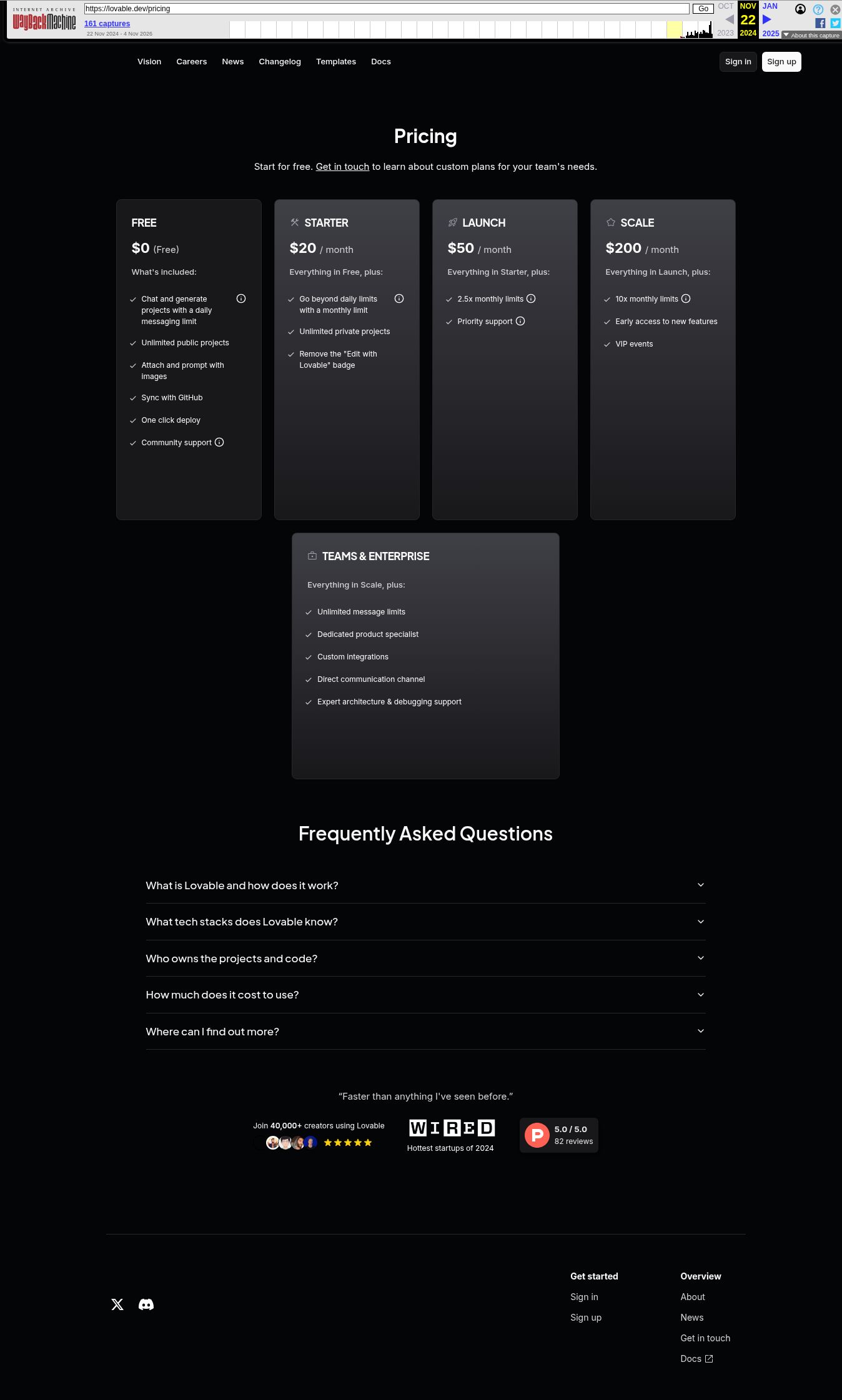
The November 22, 2024 pricing capture shows a free tier, Starter at $20/month, Launch at $50/month, Scale at $200/month, and a Teams & Enterprise offer. That enterprise offer already advertised a product specialist, custom integrations, direct communication, and architecture/debugging assistance. The page establishes what was offered, not how many enterprise contracts had closed. [11]
[Inference] Human help was part of the commercial ladder early. The later enterprise story is therefore an expansion and formalization of assistance, not evidence that all human service appeared only after self-serve growth. [11]
[3] [4] [9] [11]Lovable economics at a glance: Pricing is only half the story.
2026-11-10: Pro $25/month; Business $50/month; Enterprise platform fee plus volume terms. [4]
Shared usage credits, unlimited collaborators, paid governance and service. [4]
[Inference] Model inference, hosted applications and support create variable cost-to-serve; enterprise onboarding adds human cost. [1][4]
Not publicly verified.
Cohort retention and NRR not publicly verified.
The people in the Lovable GTM story: People & capabilities.
Anton Osika
Co-founder & CEOEngineering physics at KTH; early Sana employee; Depict co-founder/CTO. [6]
Created GPT Engineer; describes product narrowing and reliability work. [1] [Inference] His technical artifact also created a distribution asset.
[1] [6]Fabian Hedin
Co-founderIndustrial economics at KTH; TenFast founder; led frontend work at Depict. [6]
[Inference] Prior frontend and product-building experience fit the challenge of making AI outputs usable and visible. [6]
[6]Elena Verna
Head of Growth, as identified in December 2025 interviewFormer growth executive at Amplitude, Miro, SurveyMonkey and Malwarebytes. [7]
Publicly explains Lovable’s free-product distribution and shift toward capability creation. [5]
[5] [7]Cecilia Stallsmith
Chief Marketing Officer, 2026 interviewFormer Slack developer-ecosystem operator and co-founder of Calyx Consulting. [10]
Explains positioning for multiple buyer audiences in an emerging category. [10]
[10]“Chat to build real web apps. Really fast.”GPT Engineer homepage, archived August 8, 2024 [3]
Lovable GTM: critical reading and analysis: Why it worked.
Where it breaks.
What worked—and why
[Inference] Community distribution preceded the polished commercial product, reducing the need to create an audience from nothing. [2][3]
[Inference] Constraining the initial job made a dramatic demo more repeatable, supporting self-serve acquisition. [1]
What did not work
The founder documents an early agent approach that became less dependable with greater autonomy and was largely removed. [1]
The public record does not reveal campaign-level failed experiments, acquisition spend or churn cohorts.
What could have been better
[Inference] Publish cohort outcomes for applications that remain active after 90 days, separating experiments from durable production use.
[Inference] Make the handoff from nontechnical champion to technical owner an explicit onboarding milestone before sensitive workflows launch. [4][8]
Lovable website and pricing captures: Product, positioning & pricing.
Captures and image sources are dated individually. Historical gaps are kept explicit. Explore the visual archive
Lovable go-to-market FAQ: The questions that matter.
How did Lovable acquire its earliest users?
The documented route began with GPT Engineer’s open-source audience, followed by a waitlist and community proof for its browser product. A first paying customer is not identified in these sources. [1][2][3]
Is Lovable purely product-led?
Its self-serve entry is paired with demo-led Enterprise purchasing, named CSMs and deployment support. [4]
Lovable sources and open questions: Follow the sources.
- How we built Lovable, and why we keep rebuilding it Lovable / Anton Osika · primary · 2026-11-04
Open-source origin, greenfield scope, opinionated stack and reliability-driven architectural reversals.
- Building Lovable: $10M ARR in 60 days with 15 people Lenny’s Newsletter · interview · 2025-03-09
Public episode page on community origin, early growth and hiring.
- GPT Engineer archived homepage Internet Archive / GPT Engineer · primary · 2024-08-08
Timestamped waitlist, Product Hunt/GitHub proof, positioning and stack.
- Lovable Pricing Lovable · primary · 2026-11-10
Live capture of pricing, usage rules, support ladder and enterprise services.
- The new AI growth playbook for 2026 Lenny’s Newsletter · interview · 2025-12-18
Public episode summary; paid takeaways not accessed.
- Anton Osika and Fabian Hedin — KTH Innovation Award 2025 KTH · primary · 2025-09-24
Founder education, prior roles and origins; sidebar details also returned in search.
- Elena Verna — Former Head of Growth Amplitude · primary
Prior growth and product leadership roles.
- How Nursa built a new product in 48 hours Lovable · primary
Vendor-published champion, executive sponsorship and cross-department expansion story.
- Lovable homepage Lovable · primary · 2026-11-10
Current full-stack business positioning and customer proof.
- From Developer Marketing to the Builder Economy with Ceci Stallsmith Future of Marketing · interview
CMO role, Slack/Calyx background and multi-audience positioning; public search excerpt.
- Lovable archived pricing — 2024-11-22 Lovable / Internet Archive · primary · 2024-11-22
Timestamped pricing page inspected during research. Rendering limits are stated in the case.
What remains unverified
First paying customer and first signed founder-led deal not identified.
Exact CAC, gross margin, cohort retention and NRR not verified.
No named early account executives or CSMs, sales quotas or internal CRM stack verified.
Some people evidence comes from public interview summaries rather than full audio/transcripts.
The August 2024 GPT Engineer archive exposed a header but its main content did not render in the visual capture; that screenshot is excluded. The November 2024 pricing capture is usable.