
Source numbers link to evidence. [Inference] marks analytical judgment, including motion classifications and causal explanations. Public evidence does not establish every internal decision or metric.
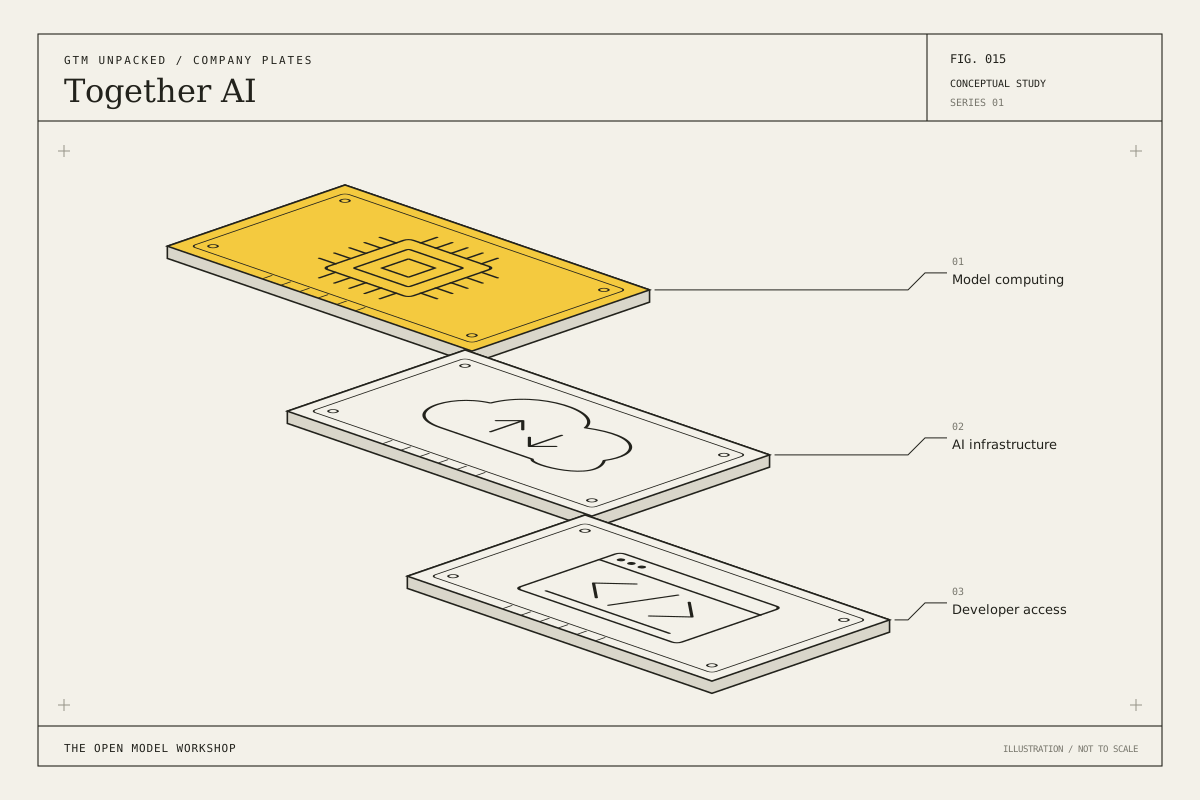
Conceptual illustration for Together AI: a chip, a cloud, and code brackets evoke model-based computing situated within a developer workshop, without representing verified technical architecture.
- Company
- Together AI · AI infrastructure · together.ai
- Conversion motions
- [Inference] This research classifies Together AI as Product Led and Human Led.
- Together AI beachhead
- [Inference] Builders and ML researchers seeking usable open models without constructing the entire GPU serving stack; a technical use case rather than an industry vertical. [1]
- Together AI target customer
- Developers, AI-native application companies and enterprise AI teams; later production workloads, dedicated compute and model customization. [3][10]
- Product complexity
- [Inference] A simple API entry conceals a complex infrastructure service. Production adoption adds latency, utilization, fine-tuning, capacity and reliability decisions. [4][7]
- Decision-making unit
- [Inference] A developer can initiate usage; larger deployments plausibly involve ML/platform leads, security, procurement and finance. The public sources do not disclose a formal buying-committee map. [4]
- Market at entry
- In 2023 the company framed open-model access and expensive compute as barriers, and used public research releases to attract developers. [1]
- Market today
- By July 2026 its positioning centered on production inference economics and an integrated open-AI cloud. Company claims of model cost savings are workload-specific marketing evidence. [10]
- Evidence
- Deep research · 11 linked sources · research date · method and limitations
The ten-step Revenue Engine reading map
These links locate relevant evidence. A linked section does not imply every detail of the step is publicly established.
- Acquire Your First Customers: Founder Led Sales Read first customers
- Embrace GTM Experimentation Read experiments & lessons
- Understand Your GTM Motion Options Read GTM motion
- Pick Your GTM Motion Read beachhead & buyer · Read product & market
- Generate a Lead Read GTM motion · Read experiments & lessons
- Turn Leads into Paying Customers Read GTM motion · Read people & process
- Retain and Grow Your Customers Read retain & expand
- Build Your GTM Team Read people & process
- Plan Your Tech Stack Read experiments & lessons · Read people & process · Read product & pricing archive
- Optimize and Scale Through Metrics Read pricing & economics
Together AI GTM timeline: From wedge to engine.
Open research precedes broad platform access
Seed announcement documents public model projects and a forthcoming cloud platform. [1]
Integrate into developer workflows
Company reports 45,000 registrations and names developer-tool integrations. [2]
Add commercial specialization
Kai Mak appointed CRO with a developer and enterprise growth mandate. [3]
Production cloud and capacity
Company announces financing and capacity commitments supporting production workloads. [10]
Together AI origin and first customers: Acquire the first customers: research before a sales machine
The May 2023 seed announcement traces Together to the previous year. Vipul Ved Prakash and his cofounders released GPT-JT, OpenChatKit and RedPajama while developing a specialized cloud. They reported substantial developer attention before promising broader platform availability. This documents audience formation, not an identified first paid contract. Neither the first customer nor a founder’s first negotiated sale could be established from inspected sources. [1]
[Inference] Open research gave prospective technical users something concrete to evaluate and share. The likely commercial advantage was credibility with engineers who could distinguish a substantive systems contribution from a generic model wrapper. This is founder-led technical market development; it should not be embellished into an unsupported cold-email success story. [1][9]
[1] [9]Together AI beachhead and buyer: Pick a beachhead where open models solve an operational problem
By March 2024 Together reported 45,000 registered developers and integrations with LangChain, Vercel, LlamaIndex, MongoDB and EmbedChain. These were embedded distribution surfaces in existing developer workflows. Registered developers are not equivalent to paying organizations. Its compute network included Crusoe, Lambda, Oracle Cloud, Vultr, Applied Digital and ClusterPower. [2]
[Inference] The initial job was to make a technical experiment practical. The next job was to make that experiment economical and dependable in production. This creates a natural segmentation boundary: lightweight users can buy metered access, while high-volume teams merit commercial and engineering attention. A broad cloud pitch alone would have obscured this progression. [2][4]
[2] [4]Together AI GTM motion: Convert product activity into relevant human conversations
The pricing page explicitly describes a serverless-to-dedicated path. Together hired Kai Mak as CRO in September 2024 with a mandate spanning PLG and enterprise GTM. Its announcement named Zomato, DuckDuckGo and The Washington Post, and identified Cognition and Zoom in custom training work. Those later references should not be retroactively called its first customers. [3][4]
An undated Unify case study describes Jonathan Liu’s sales-operations team enriching platform users, identifying relevant buyer roles and running tailored outbound sequences. Previously, representatives exported Salesforce data into spreadsheets and another email tool. Five initial automated plays surfaced more than 500 high-intent contacts; the vendor reports over 30 rep-hours saved monthly. Neither closed revenue nor conversion rate is published. This is evidence of warm outbound built on product activity, not proof that cold prospecting caused overall growth. [6]
[Inference] The useful qualification signal is the intersection of actual usage and organizational fit. A Head of AI Infrastructure at an enterprise warrants a different offer from a solo experimenter. Human selling becomes economical when deployment size, organizational complexity or commitment makes expert guidance valuable. [4][6]
[3] [4] [6]Together AI product and market: Turn systems research into a buying reason
Tri Dao joined as chief scientist in July 2023 while releasing FlashAttention-2. The announcement tied an open implementation to the ability to fine-tune through Together’s API. It also disclosed Stanford doctoral training under Christopher Ré and Stefano Ermon. This is a specific example of research, developer content and a product call to action appearing together. [9]
By July 2026 Together named Cognition, Decagon, ElevenLabs, Cursor and Suno among customers, and presented inference, training and post-training as one platform. It reported $800 million of financing and more than 500 MW of separately financed capacity commitments. These are capital and capacity figures, not customer revenue. [10]
[Inference] Open-source distribution creates a challenge as well as an advantage: useful research can benefit competitors. Monetization therefore depends on implementation, operations and service quality remaining attractive after the code itself is freely available. [9][10]
[9] [10]Together AI people and process: Build the bridge from technical reputation to repeatable GTM
Together described Mak as its first C-level appointment outside the founders. His previous role combined global sales and customer success at Webflow; he also served as interim CMO and led support. Earlier experience included Xamarin and Microsoft. The stated hiring rationale was therefore broader than adding a senior closer: the remit connected acquisition, conversion and retained customer value. [3]
[Inference] The complementary team design matters: founder credibility creates access; research validates differentiation; commercial operations identify opportunities; technical success makes adoption durable. Public sources establish these functions and several leaders, but do not disclose account assignments, sales compensation or a standardized qualification methodology. [3][5][6][9]
[3] [5] [6] [9]Together AI retention and expansion: Retention is an engineering workflow
Pylon’s case study names Sarung Tripathi as VP of Customer Experience. It reports that the previous B2C-oriented support system lost tickets and lacked observability integrations. Support was concentrated in Slack and Discord. Pylon combined those conversations with Grafana signals and account information, while solution architects’ evaluation work became visible alongside support. Monthly executive reviews used account health and revenue context. [5]
The vendor describes one deployment optimization that led to a new API endpoint within 24 hours, with a claimed two-to-threefold performance improvement. It reports better retention but provides no GRR or NRR percentages. A current GPU-cluster support role separately requires customer-facing infrastructure expertise in Kubernetes, Slurm, networking and incident communication. [5][7]
[Inference] Expansion follows realized workload value: resolve a performance constraint, support a larger deployment, then earn additional usage or capacity commitments. This is expensive technical enablement. Treating it as a generic low-cost help desk would misunderstand what customers are buying. [4][7]
[4] [5] [7]Together AI pricing and economics: Measure the right denominator
Observed on November 10, 2026, pricing meters serverless models by tokens and infrastructure by GPU-hours. For example, the page listed gpt-oss-120B at $0.15 per million input tokens and $0.60 per million output tokens; H100 cluster on-demand compute at $3.99 per GPU-hour. Dedicated inference and reserved cluster products have different rates and must not be compared as identical services. [4]
[Inference] The economic question is contribution after compute, capacity commitments and technical service, not merely revenue per employee. Serving more tokens can increase revenue while price compression or poor utilization weakens margin. Public data does not allow a credible CAC-payback calculation, utilization model or enterprise-versus-self-serve margin split. [4][10]
[4] [10]Together AI experiments and lessons: What scaled—and where the process broke
[Inference] Together’s most legible sequence is open research, developer integrations, self-service usage, role-aware sales assistance and production optimization. The Unify implementation is a bounded operational experiment with a measured prospecting output; it is not an audited growth attribution study. [1][2][6]
The support tooling mismatch is a documented operational failure in a vendor-published customer account. The company moved beyond a ticket queue as technical and enterprise needs expanded. This is stronger evidence than guessing which advertising channels failed: no inspected source establishes a failed paid-acquisition experiment. [5]
[1] [2] [5] [6]Together AI website and pricing history: Website and offer evolution
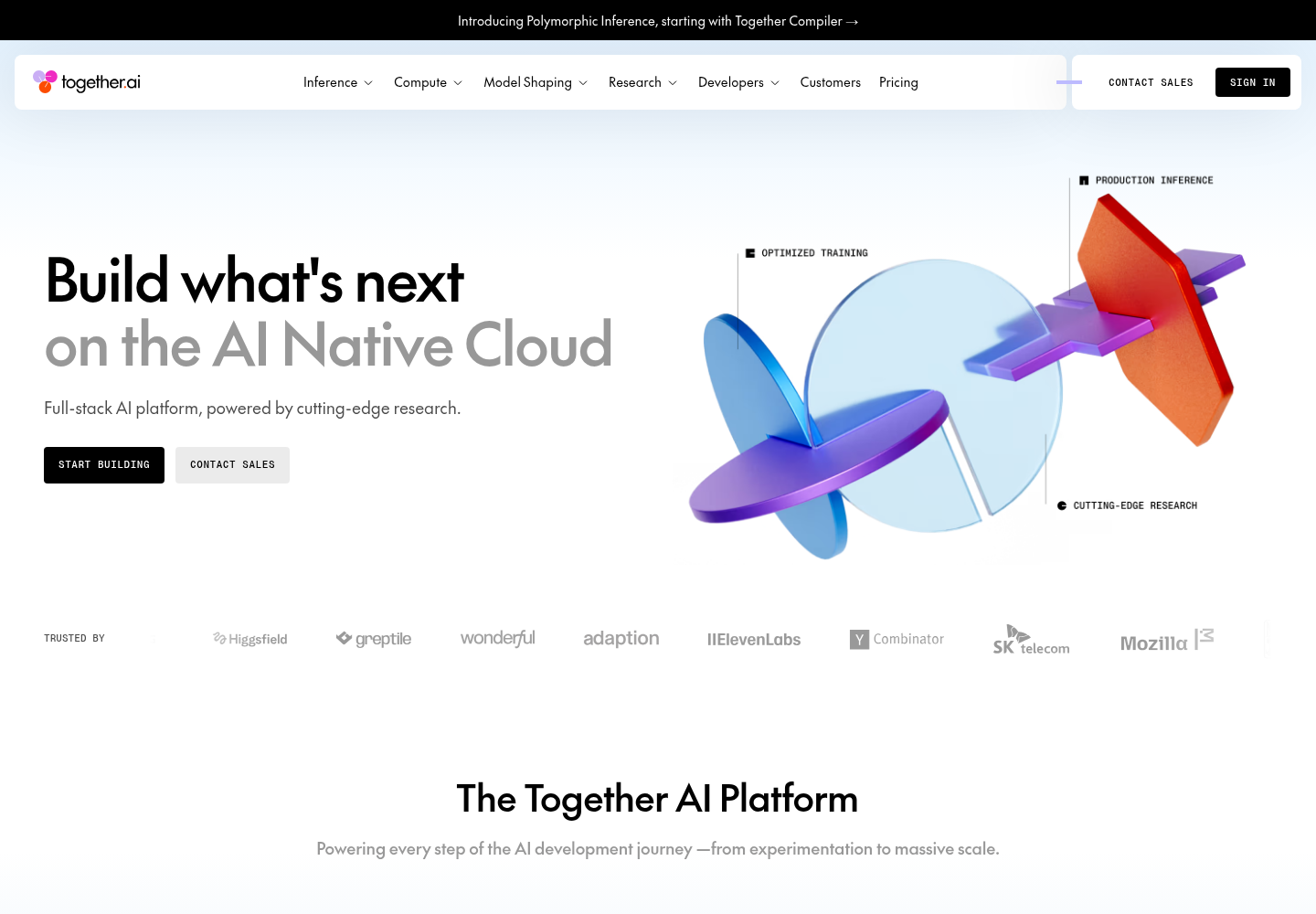
The 2023 announcement offered an open-source thesis and forthcoming platform access. The 2024 commercial narrative combined accelerating developer adoption with enterprise capabilities. The current website presents an AI-native cloud, while the pricing page visibly separates self-service inference, customization and capacity. A live homepage capture is preserved in the evidence collection. Dated historical pricing screenshots were not retrieved; current prices must not be projected backward. [1][3][4][11]
[1] [3] [4] [11]Together AI economics at a glance: Pricing is only half the story.
November 2026: token-metered models, GPU-hour infrastructure, reservations and negotiated enterprise deployment. [4]
Usage plus infrastructure commitments.
[Inference] Compute utilization, capacity obligations and specialist support determine contribution economics.
Not publicly verified.
Pylon claims improvement; no numerical cohort retention or NRR verified. [5]
The people in the Together AI GTM story: People & capabilities.
Vipul Ved Prakash
Cofounder and CEOHis speaker-supplied Milken biography records cofounding Cloudmark in 2001 and founding Topsy in 2007, later acquired by Apple.
[Inference] Prior infrastructure entrepreneurship helps explain the decision to commercialize open research through a managed cloud. A specific first sale is unverified.
[8]Jonathan Liu
Head of Sales Operations in Unify case studyPrior roles and education not verified.
Helped turn existing product users into enriched, persona-specific sales prospects.
[6]Sarung Tripathi
VP Customer Experience in Pylon case studyPrior employment and training not verified.
Led the support-platform redesign connecting technical signals and account context.
[5]“Most teams start with serverless inference and move to dedicated endpoints at scale.”Together AI pricing page [4]
Together AI GTM: critical reading and analysis: Why it worked.
Where it breaks.
What worked—and why
[Inference] Research and integrations reduced the credibility barrier for technical users before enterprise selling expanded. [1][2][9]
[Inference] Usage-informed outreach ties sales effort to observable demand. [6]
What did not work
A vendor case study documents lost tickets and fragmented support context in the earlier service stack. [5]
What could have been better
[Inference] Report production-active organizations, conversion by workload and contribution after support to distinguish audience growth from durable economics.
[Inference] Tie serverless-to-dedicated recommendations to customer workload economics, rather than making larger commitments the default success metric.
What another founder can use
[Inference] Use product adoption as a qualification input when the production deployment is sufficiently valuable to justify expert selling.
[Inference] In infrastructure, customer success needs engineering authority and operational telemetry.
Together AI website and pricing captures: Product, positioning & pricing.
Captures and image sources are dated individually. Historical gaps are kept explicit. Explore the visual archive
Together AI go-to-market FAQ: The questions that matter.
Together AI sources and open questions: Follow the sources.
- Together’s $20M seed funding to build open-source AI and cloud platform Together AI · primary · 2023-05-15
Origin, open releases and initial platform plans.
- Announcing $106M round led by Salesforce Ventures Together AI · primary · 2024-03-13
Developer registrations, integrations and capacity partners.
- Together AI welcomes Kai Mak as CRO Together AI · primary · 2024-09-10
Commercial leadership appointment, background and mandate.
- Pricing Together AI · primary
Live rates and serverless-to-dedicated path observed November 10, 2026.
- Together AI consolidated support and success Pylon · primary
Vendor-authored customer interview; named CX leader and support architecture.
- Together AI scales outbound Unify · primary
Vendor-authored case study; Salesforce, warm outreach and activity results.
- Technical Support Engineer, GPU Clusters Together AI · primary
Current hiring requirements illustrate technical service scope, not proof every role was filled.
- Vipul Ved Prakash Milken Institute · primary · 2026-05-04
Speaker-supplied founder biography and portrait.
- Introducing Chief Scientist Tri Dao and FlashAttention-2 Together AI · primary · 2023-07-17
Research hire, education and product connection.
- Announcing our $800M Series C Together AI · primary · 2026-07-01
Production strategy, customers and separately financed capacity commitments.
- Together AI homepage Together AI · primary
Current positioning and live screenshot.
What remains unverified
First paying customer, original contract and founder-led closing anecdote not verified.
The unverified $1B figure in this project’s starting list is not independently established as annual recurring revenue.
No verified CAC, payback, gross margin, sales cycle, win rate or numerical NRR.
No historical pricing screenshot or complete archive sequence retrieved.
No verified biographies or portraits for the named individual customer-success and sales-operations leaders.