Source numbers link to evidence. [Inference] marks analytical judgment, including motion classifications and causal explanations. Public evidence does not establish every internal decision or metric.
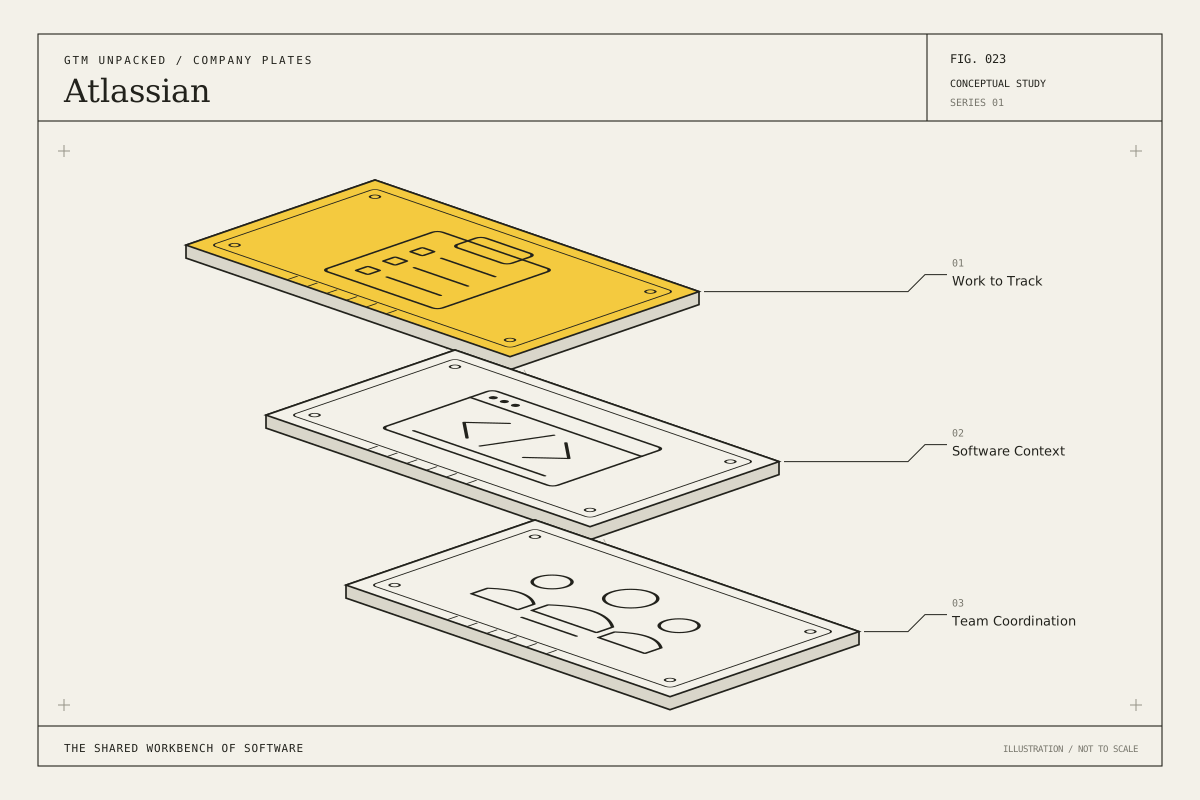
Conceptual illustration of a shared software workbench, with a task board, code marks and a group of people arranged as complementary tools.
- Company
- Atlassian · Developer and work-management software · atlassian.com
- Conversion motions
- [Inference] This research classifies Atlassian as Product Led, Partner Led and Human Led.
- Atlassian beachhead
- Software teams adopting Jira and related collaboration tools. [1]
- Atlassian target customer
- Teams initially; larger deployments required operational and technical coordination. [1]
- Product complexity
- [Inference] Easy to evaluate compared with negotiated enterprise software, but deployments and integrations can be complex.
- Decision-making unit
- [Inference] Team purchases can be simple; organization-wide adoption involves technical and operational stakeholders.
- Market at entry
- [Inference] Issue tracking was an established job, while buying enterprise software entirely online was a meaningful commercial departure.
- Market today
- A 2025 CEO interview explicitly describes a substantial enterprise sales and customer-success organization. [3]
- Evidence
- Source-backed brief · 3 linked sources · research date · method and limitations
The ten-step Revenue Engine reading map
These links locate relevant evidence. A linked section does not imply every detail of the step is publicly established.
- Acquire Your First Customers: Founder Led Sales Read first customers
- Embrace GTM Experimentation Read experiments & lessons
- Understand Your GTM Motion Options Read GTM motion
- Pick Your GTM Motion Read beachhead & buyer · Read product & market
- Generate a Lead Read GTM motion · Read experiments & lessons
- Turn Leads into Paying Customers Read GTM motion · Read people & process
- Retain and Grow Your Customers Read retain & expand
- Build Your GTM Team Read people & process
- Plan Your Tech Stack Read experiments & lessons · Read people & process · Read product & pricing archive
- Optimize and Scale Through Metrics Read pricing & economics
Atlassian origin and first customers: Bootstrapping shaped the route to market
Mike Cannon-Brookes wrote in 2010 that he and Scott Farquhar started eight years earlier using $10,000 on credit cards to buy computers and write code. [2] In a 2025 interview, he recalled an unsolicited $800 American Airlines credit-card fax roughly six months into the business. That is a named early purchase, not a verified claim that it was the first customer. [3]
[2] [3]Atlassian beachhead and buyer: A product a technical team could evaluate
The 2015 filing describes customers evaluating, buying and setting up Jira from a transparent list price without speaking with a salesperson. [1]
[Inference] This fits buyers who can test a technical tool themselves and have enough authority to make an initial purchase. It is less transferable to products whose value cannot be demonstrated without a cross-functional implementation.
[1]Atlassian GTM motion: Low-touch acquisition, differentiated assistance
At IPO, online evaluation and purchasing were central. The filing also describes hundreds of specialists supporting deployment; by 2025 the CEO explicitly acknowledged enterprise sales and customer success. [1][3]
[Inference] “No salespeople” is a statement about a period and a transaction design, not a permanent rule that humans never help customers buy.
[1] [3]Atlassian product and market: Buying friction and product complexity are different
[Inference] Removing a negotiation does not remove administration, integration or user training. Atlassian’s model made these costs visible in a surrounding service ecosystem rather than embedding every service in an initial enterprise sales process.
Atlassian people and process: Founders set the commercial constraints
Cannon-Brookes and Farquhar are the co-founders identified in the primary company retrospective. [2]
[Inference] Capital constraints favored a model where the product and website answered routine buying questions. Their later willingness to employ enterprise sellers shows adaptation when deal complexity changed.
[2]Atlassian retention and expansion: TAMs and partner services supported scale
The 2015 filing describes technical account managers as escalation and coordination points, including quarterly onsite strategic reviews. More than 350 Experts offered training, add-ons, deployment work and agile coaching; over 50 Enterprise Partners handled complex integrations and upgrades. [1]
[1]Atlassian pricing and economics: Efficiency through standardization
The filing documents list pricing and automated distribution. [1]
[Inference] Standardization can spread acquisition infrastructure across many transactions, while partner delivery can reduce internal implementation intensity. But partner availability is not proof of channel-sourced pipeline, and a low sales headcount alone does not establish CAC or contribution margin.
[1]Atlassian experiments and lessons: An enduring slogan can hide a changed organization
The 2025 interview discusses enterprise sales and customer success despite the company’s early self-service reputation. [3]
[Inference] The strategic risk is letting a celebrated origin story constrain the present organization. Large customers may need assistance precisely because they already rely on the product broadly.
[3]Atlassian website and pricing history: Then and now
The 2010 founder retrospective, 2015 filing and 2025 interview provide three dated perspectives. [1][2][3] Archived pricing screenshots and a complete current plan comparison are not included in this brief.
[1] [2] [3]Atlassian economics at a glance: Pricing is only half the story.
Transparent online list prices in the 2015 model; exact current tier amounts not audited. [1]
Product subscriptions/licenses with support and partner-delivered services. [1]
[Inference] Enterprise deployment and integration effort persists even when initial purchasing is automated.
Not established by the sources reviewed.
Not asserted in this brief.
The people in the Atlassian GTM story: People & capabilities.
Scott Farquhar
Co-founderCo-founder identified in the 2010 primary retrospective. [2]
Shared founding and early product-building responsibilities; precise individual GTM attribution is not established. [2]
[2]Atlassian GTM: critical reading and analysis: Why it worked.
Where it breaks.
What worked—and why
[Inference] Buyers could test and purchase without waiting for qualification, while specialist services addressed more complex deployments.
What did not work
A specific failed campaign is not established by these sources.
What could have been better
[Inference] Measure the complete customer deployment cost, including partner work, instead of treating sales efficiency as equivalent to customer ease.
What another founder can use
[Inference] Self-service acquisition can coexist with a substantial human support and enterprise-sales layer.
Atlassian go-to-market FAQ: The questions that matter.
How did Atlassian get its first customers?
Mike Cannon-Brookes wrote in 2010 that he and Scott Farquhar started eight years earlier using $10,000 on credit cards to buy computers and write code. [2] In a 2025 interview, he recalled an unsolicited $800 American Airlines credit-card fax roughly six months into the business. That is a named early purchase, not a verified claim that it was the first customer. [3]
Which go-to-market motions is Atlassian classified under?
[Inference] This research classifies Atlassian as Product Led, Partner Led and Human Led. Motion labels describe routes across segments and periods, not measured revenue shares.
Atlassian sources and open questions: Follow the sources.
- Atlassian F-1/A Atlassian / SEC · primary · 2015-11-27
Online purchasing, TAMs and Expert/Enterprise partner service structure.
- The Atlassian Adventure Continues Atlassian · primary · 2010-07-14
Co-founder account of credit-card-funded origins.
- Interview with Mike Cannon-Brookes Stratechery · interview
Early American Airlines purchase and modern enterprise sales described in accessible interview excerpts.
What remains unverified
Detailed early customer sequence, sales training and named TAM biographies need further research.
Historical website screenshot and pricing series remains incomplete.
No verified visual capture is attached to this entry. A current screenshot is not a substitute for a historical capture.