
Source numbers link to evidence. [Inference] marks analytical judgment, including motion classifications and causal explanations. Public evidence does not establish every internal decision or metric.
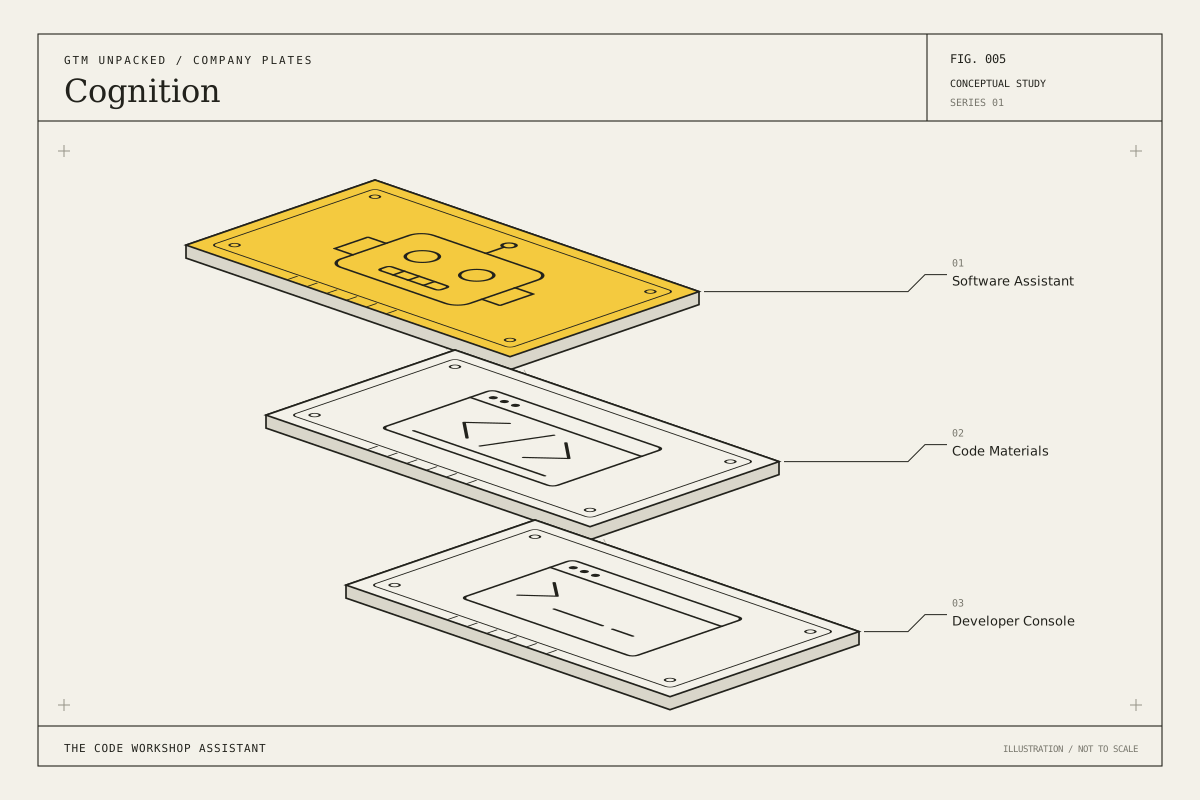
Conceptual illustration of a software assistant at a code workshop, pairing a robot with code marks and a terminal as conceptual working materials.
- Company
- Cognition · AI developer tools · cognition.com
- Conversion motions
- [Inference] This research classifies Cognition as Human Led, Product Led and Partner Led.
- Cognition beachhead
- Engineering teams with bounded, reviewable backlog tasks; later financial-services modernization and complex enterprise codebases. [5][7]
- Cognition target customer
- Individual developers through self-service, engineering teams, large enterprises and IT-services firms delivering to their own customers. [6][8][9]
- Product complexity
- High: repository and environment setup, tools and permissions, long-running execution, human review, integrations, spend controls and deployment choices. [9]
- Decision-making unit
- [Inference] Simple for a personal trial; complicated for enterprise rollout involving engineering leadership, platform teams, security, procurement and business owners. On-site deployment and partner programs explicitly address this complexity. [7][8]
- Market at entry
- [Inference] Copilots were familiar in 2024, but delegating complete engineering tasks was less established; benchmarks and demos introduced an autonomy category before dependable operating practices were settled. [1]
- Market today
- [Inference] Agentic coding has developed self-serve tiers, enterprise governance, services ecosystems and measurement programs; reliability still varies by task and oversight. [5][9][10]
- Evidence
- Deep research · 19 linked sources · research date · method and limitations
The ten-step Revenue Engine reading map
These links locate relevant evidence. A linked section does not imply every detail of the step is publicly established.
- Acquire Your First Customers: Founder Led Sales Read first customers
- Embrace GTM Experimentation Read experiments & lessons
- Understand Your GTM Motion Options Read GTM motion
- Pick Your GTM Motion Read beachhead & buyer · Read product & market
- Generate a Lead Read GTM motion · Read experiments & lessons
- Turn Leads into Paying Customers Read GTM motion · Read people & process
- Retain and Grow Your Customers Read retain & expand
- Build Your GTM Team Read people & process
- Plan Your Tech Stack Read experiments & lessons · Read people & process · Read product & pricing archive
- Optimize and Scale Through Metrics Read pricing & economics
Cognition GTM timeline: From wedge to engine.
Devin and early-access waitlist
Launch demonstrations introduce the autonomous-engineer thesis. [1] [2]
Team general availability
$500 entry includes onboarding and engineering support. [3]
$20 self-serve entry
Devin 2.0 adds planning, search, wiki and an interactive IDE. [4]
Windsurf acquisition
Adds IDE, customers and commercial team; acquired revenue is separately attributed. [6]
Services partners and London
Infosys, Cognizant and regional customer engineering expand deployment reach. [7] [8] [13]
Enterprise revenue leadership
Chris Degnan joins as CRO; Chad Peets/RPT named GTM-building partners. [15]
Cognition origin and first customers: The launch generated demand; the first sale is less visible
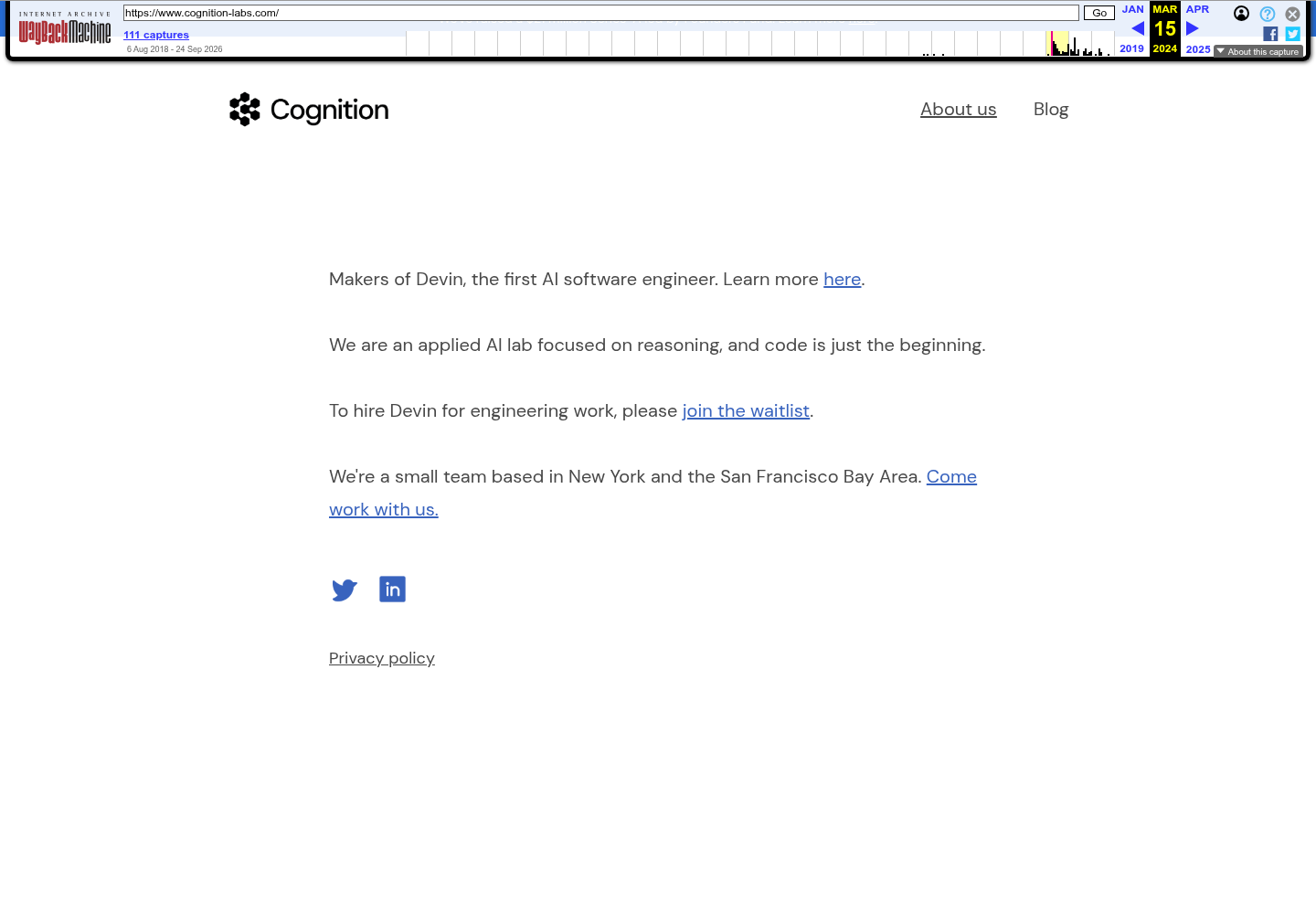
Cognition's March 12, 2024 introduction presented Devin with its own shell, editor and browser, able to plan and execute multi-step coding work. The page demonstrated software tasks and advertised early access. The March 15 archive preserves a spare site, funding announcement and waitlist. Demonstrated Upwork tasks are not evidence of a repeatable paid customer-acquisition process. No first paying account or founder's first signed contract was verified. [1][2]
Scott Wu's Stripe interview describes a background in competitive programming, three IOI gold medals, Harvard competition experience and his prior startup Lunchclub. That is evidence of technical and entrepreneurial preparation, not proof of sales skill. Cognition's own team page emphasizes an unusually founder-heavy initial team: 21 of its first 35 employees had previously started companies. [11][12]
[Inference] The first-customer chapter is only partially observable. A compelling category launch created conversations and a waitlist; it cannot establish which prospects had urgent workloads, what founders promised in pilots, or how those trials converted. This gap matters because a demo's audience is much broader than the eventual production buyer.
[1] [2] [11] [12]Cognition beachhead and buyer: The practical wedge was bounded engineering work
Cognition's November 2025 performance review describes Devin as strongest on clear, verifiable tasks comparable to four to eight hours of junior-engineer work. Examples include migrations, vulnerability fixes from SonarQube or Veracode, tests and small tickets. It also states that ambiguous projects and mid-task changes remain difficult, and that human review is necessary. Those are the company's own observations of product behavior, not universal capability guarantees. [5]
The January 2026 London announcement identifies finance as a clear use case: large codebases, security constraints and modernization demand. It names Goldman Sachs, Santander, Citi and BNY among relationships, and explicitly describes going to customer offices and building a local customer-engineering team. A later vertical concentration is supported; a claim that finance was the first paying segment is not. [7]
[Inference] This is a workload beachhead before it is an industry beachhead. A sufficiently large backlog of similar, testable changes creates an opportunity to amortize setup and instruction. A one-off ambiguous project may consume substantial oversight while producing little reusable learning.
[5] [7]Cognition GTM motion: Four routes to revenue developed in sequence
The December 2024 release notes introduced general availability from $500 per month, with unlimited seats, API and Slack access, onboarding and direct engineering support. This was a team purchase with human assistance already attached. April 2025's Devin 2.0 added a plan starting at $20 and a more interactive IDE, planning, search and wiki experience. [3][4]
The July 2025 Windsurf acquisition added a different product surface and commercial organization. Scott Wu's announcement attributed $82 million ARR and more than 350 enterprise customers to Windsurf, and explicitly emphasized its GTM team. Those are acquired-company figures at the announced deal date, not Devin's organic growth. [6]
Infosys's January 2026 partnership describes three roles: internal usage, embedding Devin in client services and managing it within customer environments. Cognizant's collaboration likewise combines its customer reach with Cognition's forward-deployed engineers. These are concrete partner-led deployment routes layered onto product-led trials and human-led enterprise sales. [8][13]
[Inference] The mix fits the economics and buying process. Low-friction entry can identify enthusiasts; enterprise contracts justify deployment labor, workflow redesign and executive selling. The partner does more than send a lead: it supplies domain knowledge, implementation capacity and ongoing operational responsibility.
[3] [4] [6] [8] [13]Cognition product and market: Production deployment requires more than code generation
Current Devin packaging lists Slack, Teams, Linear, Jira and repository integrations, along with administration and enterprise deployment features. Dedicated account management and engineering support are explicitly part of Enterprise. These product integrations should not be confused with Cognition's internal CRM or sales-operations stack, which was not established. [9]
Cognition's productivity methodology moves beyond tokens and lines of code. Its June 2026 account uses completed-session evidence, filters for useful output and estimates the human effort associated with it. The disclosed validation dataset contains 258 sessions from 126 enterprise users. The company acknowledges that engineering-hours estimates are not direct business ROI. [14]
[Inference] The decision-making unit becomes complicated when the agent touches real code and credentials. A developer can assess convenience, but security must assess access and an economic buyer must assess value. A plausible proof of concept should exit on accepted work, review burden and cost, rather than an attractive generated artifact.
[9] [14]Cognition people and process: A technical founding team bought and hired GTM capacity
Wu told Stripe that the Windsurf deal came together over a weekend after Cognition reached out cold. He described Cognition as stronger in research and engineering than its other functions, making Windsurf's intact commercial functions complementary. This is a particularly direct founder explanation of buying organizational capacity. [11]
Cognition's September 2026 public announcement welcomes Chris Degnan as CRO and names Chad Peets and RPT as partners in building its GTM team. Degnan had been Snowflake's first sales hire and later CRO. Snowflake's 2024 SEC proxy verifies his earlier EMC and Aveksa sales roles and a University of Delaware BA in Human Resources. This supplies a documented sales-development career, rather than a guessed list of personal traits. [15][16]
Russell Kaplan's speaker-provided Milken biography identifies him as co-founder and president, formerly leader of machine learning at Scale after its acquisition of Helia, and a Tesla Autopilot scientist. It lists Stanford BS/MS computer science and work in Fei-Fei Li's lab. Milken explicitly says biographies are supplied by speakers and not independently verified. [17]
[Inference] These backgrounds address different constraints: technical credibility and product development, enterprise-sales organization, and implementation across sophisticated customer environments. Hiring a proven CRO does not itself disclose rep productivity, pipeline coverage, incentives or win rates.
[11] [15] [16] [17]Cognition retention and expansion: Account expansion through people in the workflow
Cognizant's partnership announcement says Cognition will embed forward-deployed AI engineers to select projects, enable engineers and measure ROI. This is concrete customer-success work tied to deployment, rather than a generic promise of support. The partner already used Windsurf and planned to extend both products across its own engineers and client accounts. [13]
Scott Wu's June 2026 'AI Productivity Guarantee' announcement describes customer-facing teams identifying projects, pair-programming on backlogs and teaching users to manage multiple agents. Under the advertised enterprise program, estimated engineering value is compared with consumption near annual-contract end and credits of up to $10 million may apply. This is a named commercial offer with conditions, not a guarantee by this report. [10]
[Inference] The expansion mechanism is deeper workload coverage plus wider organizational deployment. Onboarding a repository and teaching good task scoping creates assets that can be reused across more work. The important unanswered economics question is whether that expansion outpaces forward-deployed engineering, support and inference costs. No verified account-level contribution margins or retention cohorts were found.
[10] [13]Cognition pricing and economics: The company openly corrected a high team entry point
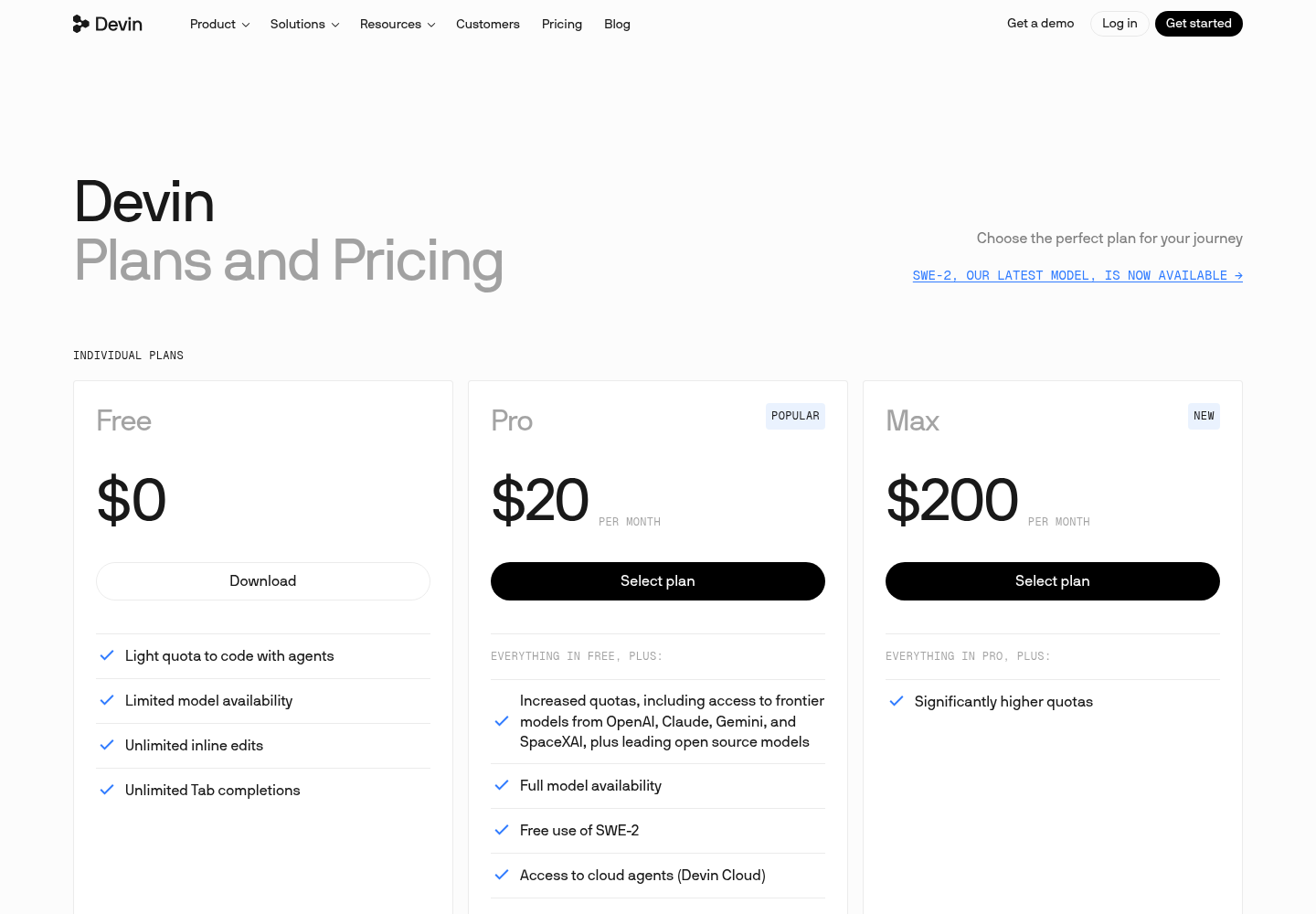
In April 2026 Cognition retired its former Core and Team plans and acknowledged that the old $500 Team minimum was too high for many teams. The replacement ladder introduced Free, $20 Pro, $200 Max and Teams with an $80 minimum, while moving self-serve overages into dollars. It also began charging for compute-heavy experiences previously free or in preview. The company acknowledged that some light users would face a higher commitment. [18]
The November 10, 2026 price-page capture shows Free, Pro at $20, Max at $200, Teams at an $80 base plus $40 per full user monthly, and custom Enterprise. Enterprise retains dedicated support and deployment arrangements. These are current advertised terms; the $20 April 2025 offer and December 2024 team launch are separately dated. [3][4][9]
[Inference] Seat fees, workload consumption and annual enterprise commitments serve different buying situations. A low entry price can broaden experimentation, while expensive autonomous sessions make unlimited consumption risky for the provider. No reviewed source verifies CAC, gross margin, payback or NRR, and the unverified $500 million figure in this project's starting list is not treated as audited ARR.
[3] [4] [9] [18]Cognition experiments and lessons: From autonomy claims toward scoped, measurable work
Devin 2.0's interactive planning gives the user a chance to correct the agent's proposed approach before execution. Its search and wiki features address codebase understanding, an important complement to task execution. The first commercial release notes also acknowledged stuck or hanging sessions and offered ACU refunds for those issues. [3][4]
The 2025 performance review's admission about ambiguous requirements and iterative scope changes narrows the original autonomy narrative. Meanwhile, Cognition's newer estimator attempts to identify productive output rather than simply reward more usage. Its technical methodology discusses imperfect proxies and differences between task effort and business value. [5][14]
[Inference] The best counterfactual is earlier task-specific qualification: identify which jobs are suitable, what successful output means, and when a human should stop a run. A reported increase in PR merge rate is useful, but does not by itself reveal escaped defects, reviewer time or incremental business value. Those belong in an account's expansion decision.
[3] [4] [5] [14]Cognition website and pricing history: From a waitlist to a multi-product enterprise platform
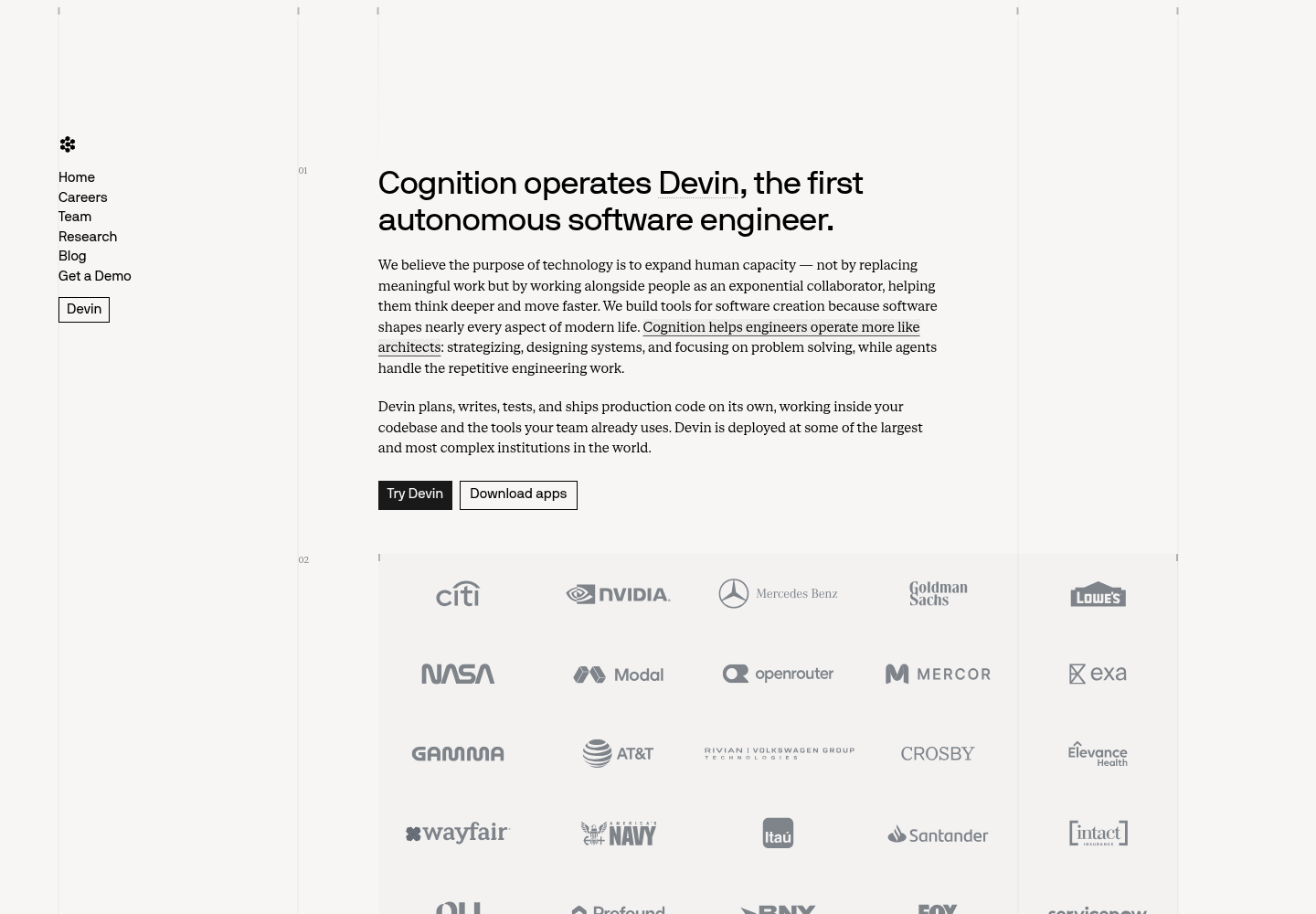
The saved March 15, 2024 Wayback capture records the original lab site and waitlist. Current Cognition and Devin pricing captures document a much wider product and buying surface. The website evolution matches a shift from explaining a new category to supporting ongoing commercial use. [2][9]
[Inference] Cognition's distinctive lesson is that autonomy made implementation more important, not less. The path from attention to repeatable revenue depended on suitable tasks, explicit human review, customer engineering, an acquired GTM organization and partners that could carry the product into enterprise workflows. The remaining test is durable value after all those service and compute costs.
[6] [7] [8] [9]Cognition economics at a glance: Pricing is only half the story.
Nov 10, 2026: Free; Pro $20/month; Max $200; Teams $80 base plus $40/full user monthly; Enterprise custom. [9]
Subscriptions, workload usage and enterprise agreements; pricing evolved through ACUs and dollar-denominated self-serve overages.
[Inference] Inference, cloud environments, retries, human review and deployed engineers affect the economics of accepted work.
Not publicly verified.
No verified NRR or cohort churn; acquired Windsurf ARR is separated from organic Devin growth.
The people in the Cognition GTM story: People & capabilities.
Steven Hao and Walden Yan
Founding technical/product teamNamed as founders in company research; individual education and prior-role details not independently established for this case.
Technical and product founding roles; no individual first-customer sale verified.
[19]Russell Kaplan
Co-founder and presidentSpeaker-provided biography: Scale ML leadership, Helia founder, Tesla Autopilot scientist, Stanford CS BS/MS and Vision Lab research.
[Inference] Applied-ML and acquired-startup experience complements the company's technical and enterprise orientation.
[17]Chris Degnan
Chief Revenue OfficerSnowflake first sales hire and later CRO; earlier EMC/Aveksa sales leadership; BA Human Resources, University of Delaware.
Hired to scale global revenue; brings a documented journey from first seller to public-company sales executive.
[15] [16]Chad Peets
RPT partner supporting GTM team buildoutCognition announcement identifies him as Degnan's collaborator in building Snowflake's sales team.
Named external partner in recruiting/building Cognition's GTM organization; not relabeled as an employee.
[15]“There’s only one boat and we’re all in it together.”Scott Wu, Windsurf acquisition note [6]
Cognition GTM: critical reading and analysis: Why it worked.
Where it breaks.
What worked—and why
[Inference] Bounded, repeated engineering work gives the agent a verifiable value proposition and spreads setup cost over many tasks. [5]
[Inference] Windsurf added an IDE audience and commercial capacity; services partners supplied enterprise implementation reach. [6][8][13]
What did not work
Cognition acknowledged the former $500 team entry point was too high for many teams. [18]
The company's own review identifies ambiguity and mid-task scope changes as weaknesses; initial release notes document stuck sessions. [3][5]
What could have been better
[Inference] Qualify tasks and proof-of-concept exit criteria before selling broad autonomy; include review effort and defect rates in the value model.
[Inference] Report organic product expansion separately from acquired revenue, and pair usage growth with deployment labor and contribution margin.
What another founder can use
[Inference] High product autonomy can require high human implementation effort. Match the sales motion to the customer's operational change, not just the interface.
[Inference] Buying GTM capacity can accelerate a technical organization, but requires an explicit integration and customer-value plan. [6][11]
Cognition website and pricing captures: Product, positioning & pricing.
Captures and image sources are dated individually. Historical gaps are kept explicit. Explore the visual archive
Cognition go-to-market FAQ: The questions that matter.
How did Cognition first attract customers?
Its March 2024 launch used demonstrations and an early-access waitlist. A specific first paid account was not verified. [1][2]
Cognition: Why does an autonomous coding product need customer engineers?
Cognition documents project selection, enablement and ROI work in enterprise deployments; repository and organizational setup remain substantial. [7][13]
Cognition: What changed in Devin pricing?
A $500 team entry in December 2024 was followed by a $20 entry in April 2025 and a broader self-serve ladder in April 2026. [3][4][18]
Which go-to-market motions is Cognition classified under?
[Inference] This research classifies Cognition as Human Led, Product Led and Partner Led. Motion labels describe routes across segments and periods, not measured revenue shares.
Cognition sources and open questions: Follow the sources.
- Introducing Devin Cognition · primary · 2024-03-12
Launch, sandbox tools, demonstrations and early-access waitlist.
- Cognition homepage — March 15, 2024 archive Cognition via Internet Archive · primary · 2024-03-15
Actual early homepage capture with lab positioning and waitlist.
- Devin 2024 release notes Cognition · primary · 2024-12-24
$500 general availability, seats, onboarding and support; stuck-session acknowledgement.
- Devin 2.0 Cognition · primary · 2025-04-03
$20 entry, interactive planning, parallel IDEs, Search and Wiki.
- Devin's 2025 Performance Review Cognition · primary · 2025-11-14
Task-fit observations, human review and stated limits; company-reported performance.
- Cognition's acquisition of Windsurf Cognition · primary · 2025-07-14
Acquired product, $82M ARR claim, 350+ enterprise accounts and GTM team.
- Cognition opens its London office Cognition · primary · 2026-01-28
Finance use cases, named accounts and on-site customer engineering.
- Infosys partners with Cognition Cognition · primary · 2026-01-07
Internal, services and MSP deployment routes, vertical expertise and enablement.
- Devin pricing Cognition · primary
Current plans, integrations, deployment and dedicated account support; captured November 10, 2026.
- Introducing the AI Productivity Guarantee Cognition · primary · 2026-06-04
Enterprise commercial offer, embedded teams, workshops, measurement and credit conditions.
- Scott Wu on the evolution of AI coding agents Stripe · interview
Founder background and first-person Windsurf deal/complementarity account; Stripe products listed.
- About Cognition Cognition · primary
Team background and first-35 founder count, as company claims.
- Cognizant partners with Cognition Cognition · primary · 2026-01-28
Forward-deployed engineers, project selection, enablement and ROI measurement.
- Estimating the Productivity of an Autonomous AI Software Engineer Cognition · primary · 2026-06-04
Validation dataset, useful-output filtering and distinction between hours and business value.
- Cognition welcomes Chris Degnan as CRO Cognition · primary · 2026-09-30
Company post names Degnan and Chad Peets/RPT GTM collaboration.
- Snowflake 2024 proxy statement Snowflake / SEC · primary · 2024-05-10
Degnan executive history and University of Delaware degree.
- Russell Kaplan speaker biography Milken Institute · primary
Speaker-submitted background, explicitly not independently verified by organizer.
- New self-serve plans for Devin Cognition · primary · 2026-04-14
Team minimum problem, new plans and compute-linked monetization.
- Cognition company research Contrary Research · reporting
Founding team identification; detailed individual biography not treated as verified here.
What remains unverified
No verified first paying customer or founder-led sales transcript.
No CAC, gross margin, payback, audited NRR, deal-size distribution or funnel conversion.
Named customer engineers and account managers with verified career histories were not located.
Founders' technical achievements do not establish sales ability; ability interpretations are marked as inference.
Acquired Windsurf metrics are not counted as organic Devin growth.