
Source numbers link to evidence. [Inference] marks analytical judgment, including motion classifications and causal explanations. Public evidence does not establish every internal decision or metric.
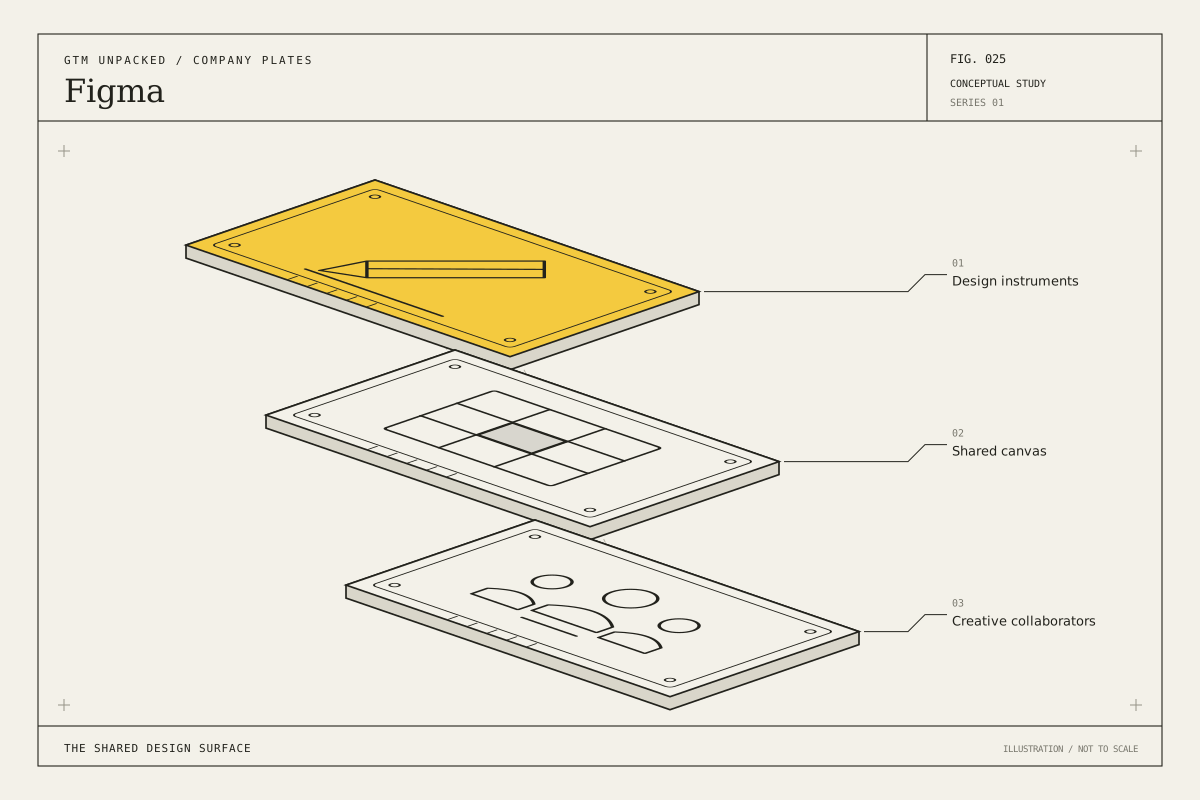
Conceptual illustration for Figma: a pen, a ruled grid, and grouped figures evoke collaborative design around a common working surface, without representing verified technical architecture.
- Company
- Figma · Collaborative design software · figma.com
- Conversion motions
- [Inference] This research classifies Figma as Product Led, Human Led and Marketing Led.
- Figma beachhead
- Designers and their immediate collaborators; Microsoft’s Xamarin team is discussed as an early internal foothold in Butler’s interview. [1]
- Figma target customer
- Individual designers, design teams and governed organizational deployments. [1][4]
- Product complexity
- [Inference] High professional depth, low link-sharing friction.
- Decision-making unit
- [Inference] Individual evaluation can be simple; design systems and organization-wide standardization require broader agreement.
- Market at entry
- [Inference] An established design-tool market, with a different browser-based collaboration model.
- Market today
- Current plans include differentiated seats, organizational tiers and multiple adjacent products. [4]
- Evidence
- Source-backed brief · 4 linked sources · research date · method and limitations
The ten-step Revenue Engine reading map
These links locate relevant evidence. A linked section does not imply every detail of the step is publicly established.
- Acquire Your First Customers: Founder Led Sales Read first customers
- Embrace GTM Experimentation Read experiments & lessons
- Understand Your GTM Motion Options Read GTM motion
- Pick Your GTM Motion Read beachhead & buyer · Read product & market
- Generate a Lead Read GTM motion · Read experiments & lessons
- Turn Leads into Paying Customers Read GTM motion · Read people & process
- Retain and Grow Your Customers Read retain & expand
- Build Your GTM Team Read people & process
- Plan Your Tech Stack Read experiments & lessons · Read people & process · Read product & pricing archive
- Optimize and Scale Through Metrics Read pricing & economics
Figma origin and first customers: Early GTM was a specialist role
Lenny’s 2023 episode identifies Claire Butler as Figma’s first GTM hire and tenth employee, taking the company from stealth through monetization. The discussion covers winning individual contributors, the Microsoft/Xamarin foothold and spreading adoption inside organizations. [1]
[1]Figma beachhead and buyer: Win the practitioner before the organization
[Inference] A designer has the expertise to evaluate a professional tool, but does not necessarily control enterprise deployment. That creates two distinct tasks: establish practitioner trust and equip a champion to make colleagues successful.
Figma GTM motion: Advocacy connected product and sales
Butler’s own writing says her first marketing hire was a designer advocate, drawn from passionate power users. She describes consulting advocates to understand feature value and how to communicate it credibly. [3]
[Inference] Advocacy is more than influencer marketing. Practitioners can diagnose workflow objections, teach the product and feed learning into development while supporting a buying process.
[3]Figma product and market: Shared work is the distribution surface
[Inference] Browser-based collaboration reduces the cost of exposing colleagues to the tool. But a design organization also needs reusable components, standards and workflow agreement; these requirements explain why individual satisfaction alone does not finish the enterprise sale.
Figma people and process: A named practitioner became enablement capacity
Figma’s 2018 community announcement says Tom Lowry had been a senior UX designer at OpenText, wrote Figma tutorials, built a Material Design kit and created a Skillshare class. Zach Grosser and Namnso Ukpanah were also named advocates in different regions. [2]
[Inference] Lowry’s relevant capability was demonstrated customer-side implementation and teaching, not simply a marketing title.
[2]Figma retention and expansion: Learning infrastructure at community scale
The 2018 launch followed meetups in eight cities across four continents, then introduced local communities in more than 20 cities with regional advocate support. [2]
[Inference] Peer learning can make adoption less dependent on a central support team. Enterprise customer success still needs to address design-system ownership, permissions and rollout; those staffing and account-management details are not established here.
[2]Figma pricing and economics: Charge for professional depth and organizational needs
The current pricing page offers Starter, Professional, Organization and Enterprise, with differentiated Full, Dev and Collab seats and AI-related allowances. [4]
[Inference] Different participant roles create expansion opportunities while preserving collaboration. They also add packaging complexity: customers need to understand who requires which seat.
[4]Figma experiments and lessons: Specialist credibility is the mechanism
Butler continued to rely on advocates such as Lowry and Rogie King for community-facing creative work. [3]
[Inference] Hiring a respected user can improve message accuracy and customer teaching. The test should be successful adoption and informed conversion, not only social engagement or event attendance.
[3]Figma website and pricing history: Documented organizational evolution
The 2018 local-community announcement, Butler’s 2023 retrospective and current pricing page show a progression from practitioner education toward a broader product and seat portfolio. [1][2][4] Historical website captures and exact pricing migration dates remain incomplete.
[1] [2] [4]Figma economics at a glance: Pricing is only half the story.
Multiple plan tiers and differentiated seat types on the current official page; exact billing-option prices not compared here. [4]
Free entry; professional seats and organization-level capabilities. [4]
[Inference] Specialist education and enterprise adoption require human investment even when initial discovery is product-led.
Not established by the sources reviewed.
Not asserted in this brief.
The people in the Figma GTM story: People & capabilities.
Namnso Ukpanah
Designer advocate, AfricaNamed in Figma’s regional advocate team. [2]
Supported local communities; further biography not established. [2]
[2]Figma GTM: critical reading and analysis: Why it worked.
Where it breaks.
What worked—and why
[Inference] Practitioner advocates supplied credibility and implementation knowledge across product, marketing and customer adoption.
What did not work
A specific failed acquisition experiment is not established by these sources.
What could have been better
[Inference] Make role-based packaging and champion rollout guidance explicit, so collaborative access does not produce confusing seat obligations.
What another founder can use
[Inference] Hire demonstrated practitioners when technical credibility and teaching are central buying constraints.
Figma go-to-market FAQ: The questions that matter.
How did Figma get its first customers?
Lenny’s 2023 episode identifies Claire Butler as Figma’s first GTM hire and tenth employee, taking the company from stealth through monetization. The discussion covers winning individual contributors, the Microsoft/Xamarin foothold and spreading adoption inside organizations. [1]
Which go-to-market motions is Figma classified under?
[Inference] This research classifies Figma as Product Led, Human Led and Marketing Led. Motion labels describe routes across segments and periods, not measured revenue shares.
Figma sources and open questions: Follow the sources.
- Figma GTM with Claire Butler Lenny’s Podcast · interview · 2023-09-07
Episode description and timestamps identify early role, Microsoft case, advocates and enterprise expansion.
- Multiplayer, IRL Figma Design / Claire Butler · primary · 2018-09-27
Regional advocate team, biographies and local-community launch.
- On marketing to a niche audience Claire Butler · primary
First-person account of hiring designer advocates and working with Lowry and Rogie King.
- Plans and pricing Figma · primary
Current plans and differentiated seat packaging.
What remains unverified
The full first-customer chronology, early AEs, CS account process and unit economics need further evidence.
The cited Lenny page is episode metadata and description; it is not represented as a full transcript read.
Historical site and pricing screenshots remain incomplete.
No verified visual capture is attached to this entry. A current screenshot is not a substitute for a historical capture.