Source numbers link to evidence. [Inference] marks analytical judgment, including motion classifications and causal explanations. Public evidence does not establish every internal decision or metric.
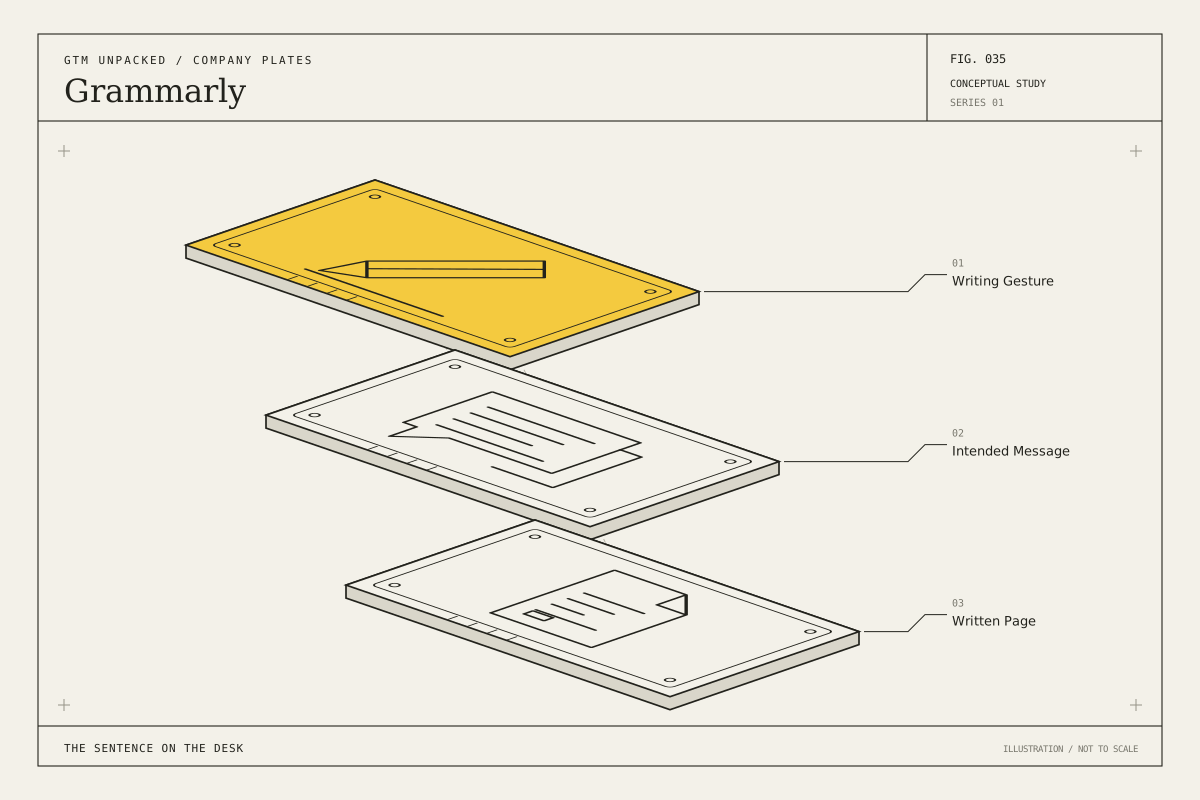
Conceptual illustration of a sentence taking shape between a pen, a message and a page, presenting writing as both expression and refinement.
- Company
- Grammarly · Writing assistance · grammarly.com
- Conversion motions
- [Inference] This research classifies Grammarly as Product Led and Human Led.
- Grammarly beachhead
- Students improving grammar and spelling; institutions were an early documented customer group. [1][3]
- Grammarly target customer
- Individuals, professional teams and enterprises. [4]
- Product complexity
- [Inference] Simple suggestion acceptance hides complex language technology; organizational deployment adds security and policy concerns.
- Decision-making unit
- [Inference] Individual adoption is simple; institutional and enterprise purchases require administrators and budget owners.
- Market at entry
- [Inference] Grammar checking existed, while continuous assistance across web applications changed where users could obtain value.
- Market today
- The official about page reports acquisitions of Coda and Superhuman Mail in 2025 and a corporate evolution to Superhuman. [5]
- Evidence
- Source-backed brief · 5 linked sources · research date · method and limitations
The ten-step Revenue Engine reading map
These links locate relevant evidence. A linked section does not imply every detail of the step is publicly established.
- Acquire Your First Customers: Founder Led Sales Read first customers
- Embrace GTM Experimentation Read experiments & lessons
- Understand Your GTM Motion Options Read GTM motion
- Pick Your GTM Motion Read beachhead & buyer · Read product & market
- Generate a Lead Read GTM motion · Read experiments & lessons
- Turn Leads into Paying Customers Read GTM motion · Read people & process
- Retain and Grow Your Customers Read retain & expand
- Build Your GTM Team Read people & process
- Plan Your Tech Stack Read experiments & lessons · Read people & process · Read product & pricing archive
- Optimize and Scale Through Metrics Read pricing & economics
Grammarly origin and first customers: The original buyer was narrower
Grammarly’s 2021 SOC 3 system description says the company initially supported students’ grammar and spelling through a subscription product. [1] A March 2014 company release names University of Phoenix, Walden University and University of Technology Sydney among institutional licensees. These are early documented customers, not a verified first-customer sequence. [3]
[1] [3]Grammarly beachhead and buyer: Education made the benefit legible
[Inference] Students and educators have a concrete reason to improve written work, with recurring documents to evaluate. Institutional distribution can aggregate many users, but procurement and classroom adoption differ from a consumer purchase.
Grammarly GTM motion: A distribution change accompanied a pricing change
Max Lytvyn’s retrospective dates the free browser extension and freemium shift to 2015. The product moved from a separate writing destination toward assistance where people already worked. [2]
[Inference] Free access alone does not explain the growth mechanism. Reduced context switching makes repeated use more likely, and repeated utility creates opportunities to sell deeper capability.
[2]Grammarly product and market: Trust is part of the product
[Inference] A writing assistant sees sensitive communications and must fit the user’s intended meaning. Enterprise buyers therefore evaluate governance and deployment as well as suggestion quality. Individual enthusiasm cannot answer every organization-level objection.
Grammarly people and process: Founders articulated the product direction
The company identifies Max Lytvyn, Alex Shevchenko and Dmytro Lider as its founders. Lytvyn wrote the product-history account. [1][2]
[Inference] Their relevant demonstrated contribution here is expanding the context in which writing assistance works. Specific degrees, prior roles and sales-hiring attribution are not established by these reviewed primary sources.
[1] [2]Grammarly retention and expansion: Personal learning and organizational rollout
Current pages provide writing guides, a help center and enterprise sales access. [4]
[Inference] The ongoing suggestion interface itself teaches individual users, while enterprise success must address rollout, adoption and policy. The reviewed sources do not establish named CSMs, renewal ownership or a complete account-expansion playbook.
[4]Grammarly pricing and economics: Free entry broadens the service population
The current plan page separates Free, Pro and Enterprise. [4]
[Inference] The free tier increases the population consuming inference and support resources. Sustainable economics depend on paid conversion, retention and organizational value; no numerical CAC, gross margin or payback is verified here.
[4]Grammarly experiments and lessons: Do not confuse expansion with proof of every channel
[Inference] The documented change is a free in-workflow product, not proof that all acquisition became organic. A critical assessment would compare extension activation, retained writing activity and upgrade cohorts before attributing results to freemium alone. A specific failed campaign is not established.
Grammarly website and pricing history: Preserve the corporate and product distinction
The 2015 freemium milestone belongs to Grammarly’s product history. The later acquisitions and corporate naming change belong to a broader company strategy. [2][5] They should not be collapsed into a single unchanged GTM motion.
[2] [5]Grammarly economics at a glance: Pricing is only half the story.
Free, Pro and Enterprise plans; no billing-basis price comparison asserted. [4]
Freemium assistance and organization-level contracts. [4]
[Inference] Free usage creates delivery costs before paid conversion.
Not established by the sources reviewed.
Not established by the sources reviewed.
The people in the Grammarly GTM story: People & capabilities.
Max Lytvyn
Co-founderNamed in official founding records. [1]
Authored the account of the extension/freemium transition. [2]
[1] [2]Alex Shevchenko
Co-founderNamed in official founding records. [1]
Co-founded the writing-assistance business; individual sales attribution remains unverified. [1]
[1]Dmytro Lider
Co-founderNamed in official founding records. [1]
Co-founded the product; separate biography remains incomplete. [1]
[1]Grammarly GTM: critical reading and analysis: Why it worked.
Where it breaks.
What worked—and why
[Inference] Assistance moved into existing writing workflows, reducing the need to visit a separate application.
What did not work
No specific failed acquisition experiment established.
What could have been better
[Inference] Separate consumer activation from enterprise value realization when evaluating the freemium transition.
What another founder can use
[Inference] A pricing change is more powerful when accompanied by a meaningful reduction in usage friction.
Grammarly go-to-market FAQ: The questions that matter.
How did Grammarly get its first customers?
Grammarly’s 2021 SOC 3 system description says the company initially supported students’ grammar and spelling through a subscription product. [1] A March 2014 company release names University of Phoenix, Walden University and University of Technology Sydney among institutional licensees. These are early documented customers, not a verified first-customer sequence. [3]
Which go-to-market motions is Grammarly classified under?
[Inference] This research classifies Grammarly as Product Led and Human Led. Motion labels describe routes across segments and periods, not measured revenue shares.
Grammarly sources and open questions: Follow the sources.
- Grammarly SOC 3 report Grammarly · primary
Management system description covering student subscription origins and founders.
- A History of Innovation at Grammarly Max Lytvyn / Grammarly · primary · 2022-11-09
Founder account of the free browser extension and product evolution.
- Grammarly gains momentum among colleges Grammarly / PR Newswire · primary · 2014-03-03
Named institutional licensees.
- Grammarly plans Grammarly · primary
Current free, paid and enterprise packaging.
- About Grammarly Grammarly · primary
2025 acquisitions and corporate evolution.
What remains unverified
First payer, early seller biographies and account-management staffing not established.
Historical screenshot and price-change series remain incomplete.
No verified visual capture is attached to this entry. A current screenshot is not a substitute for a historical capture.