
Source numbers link to evidence. [Inference] marks analytical judgment, including motion classifications and causal explanations. Public evidence does not establish every internal decision or metric.
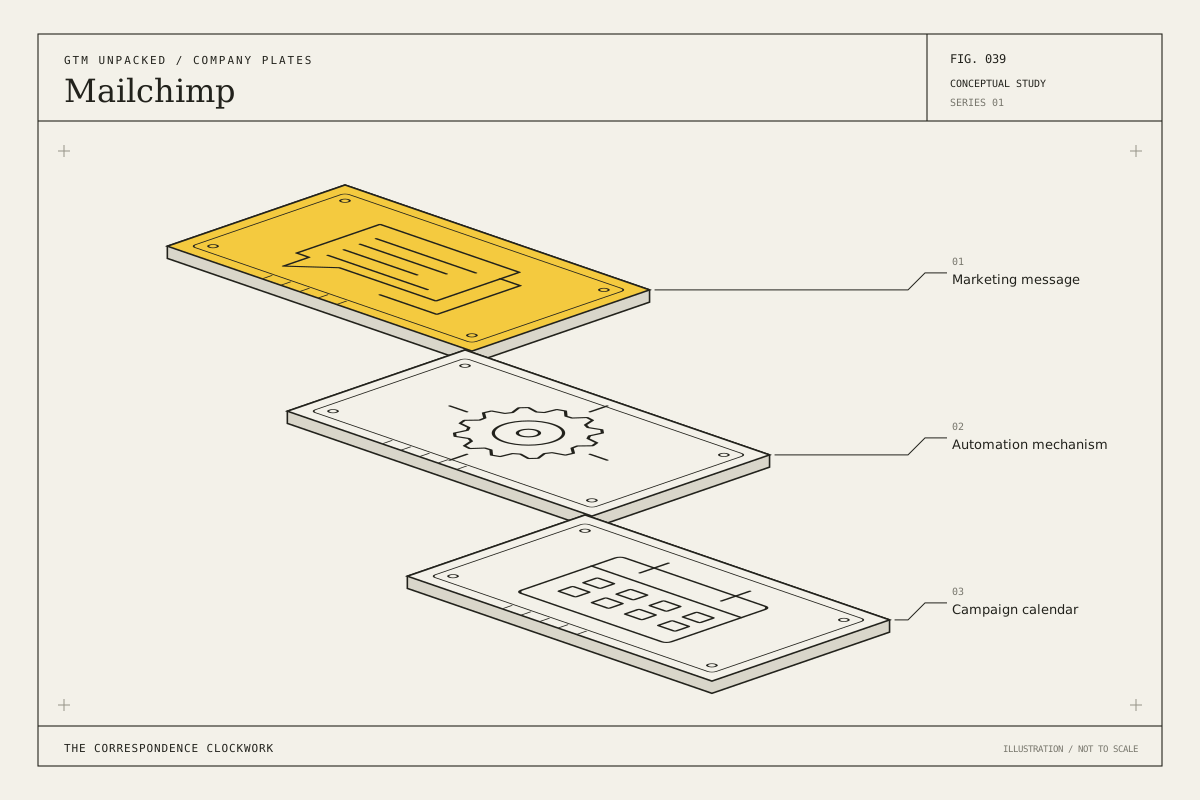
Conceptual illustration for Mailchimp: a message panel, gear, and calendar form a small correspondence machine, combining communication with scheduling and recurring work.
- Company
- Mailchimp · Marketing automation · mailchimp.com
- Conversion motions
- [Inference] This research classifies Mailchimp as Product Led and Human Led.
- Mailchimp beachhead
- Small businesses underserved by expensive email tools; the service began alongside an agency serving larger corporate clients. [1]
- Mailchimp target customer
- Small and growing businesses marketing through email and adjacent channels, with managed service for qualifying accounts. [3][4]
- Product complexity
- [Inference] Sending a campaign is accessible; segmentation, automation and deliverability increase operating complexity.
- Decision-making unit
- [Inference] An owner can buy initially; larger accounts add marketing operations, data and finance stakeholders.
- Market at entry
- The founders positioned against oversized and expensive email software. [1]
- Market today
- Current plans package multichannel marketing and automation, with onboarding and success management. [3][4]
- Evidence
- Source-backed brief · 4 linked sources · research date · method and limitations
The ten-step Revenue Engine reading map
These links locate relevant evidence. A linked section does not imply every detail of the step is publicly established.
- Acquire Your First Customers: Founder Led Sales Read first customers
- Embrace GTM Experimentation Read experiments & lessons
- Understand Your GTM Motion Options Read GTM motion
- Pick Your GTM Motion Read beachhead & buyer · Read product & market
- Generate a Lead Read GTM motion · Read experiments & lessons
- Turn Leads into Paying Customers Read GTM motion · Read people & process
- Retain and Grow Your Customers Read retain & expand
- Build Your GTM Team Read people & process
- Plan Your Tech Stack Read experiments & lessons · Read people & process · Read product & pricing archive
- Optimize and Scale Through Metrics Read pricing & economics
Mailchimp origin and first customers: An agency side product became the business
The official history dates Mailchimp to Atlanta in 2001. Chestnut and Kurzius ran the Rocket Science Group web-design agency, with email software for small businesses as a side service. [1]
[Inference] This provided an existing environment for observing customer work. It is not proof that every agency client bought the software or that agency referrals alone produced early growth; the first named paying customer is not established here.
[1]Mailchimp beachhead and buyer: A smaller buyer with a recurring job
[Inference] Small businesses need repeated customer communication but often cannot support specialist implementation teams. A useful campaign editor and transparent entry offer can shorten the path to value. Their budgets and survival rates also constrain how quickly free usage can become durable revenue.
Mailchimp GTM motion: The free plan was not the original model
In a SaaStr interview, Chestnut describes the earlier paid-only offer and the subsequent freemium launch around 2009. He reports a sharp demand increase and server outages. He also says attempts to force conversion at a single point did not work well for small businesses that needed time to grow. [2]
[Inference] The commercial insight is the conversion horizon: a small business can become valuable later rather than immediately. This requires cohort patience and capacity planning, not simply removing the price.
[2]Mailchimp product and market: The product must help customers become better marketers
[Inference] Campaign delivery is only part of the customer’s outcome. List quality, content, targeting and frequency influence results. Product education therefore serves both activation and retention, while the platform has to preserve trust when customers outgrow an entry plan.
Mailchimp people and process: Agency experience shaped the initial offer
Chestnut and Kurzius brought direct web-design agency experience to the small-business software problem. [1]
[Inference] The evidence supports practical exposure to business customers, but does not establish their detailed sales training, early account-manager biographies or the causal contribution of a particular hiring playbook.
[1]Mailchimp retention and expansion: Human help is explicitly segmented
Current pricing gives Standard one onboarding session and Premium four sessions with a dedicated specialist. The customer-success page advertises strategic assessments and milestone meetings for selected custom plans starting at $299 per month. [3][4]
[Inference] This makes service capacity part of packaging. Higher expected revenue can fund deeper account attention; ongoing planning can reveal expansion opportunities, although a measured expansion lift is not disclosed by these sources.
[3] [4]Mailchimp pricing and economics: Contacts, sending and service create several expansion paths
The current free plan includes 250 contacts and 500 monthly sends; paid tiers increase capability and limits, with SMS credits sold separately. [3]
[Inference] More contacts and channels can increase account spend, but send volume also creates cost. No verified CAC, gross margin or retention cohort is provided here, so the economic argument remains directional.
[3]Mailchimp experiments and lessons: Rapid adoption created operational strain
Chestnut’s account links the free launch to capacity problems and describes unsuccessful attempts to accelerate conversion. [2]
[Inference] A better operating design would measure service cost and conversion by business age and use case, avoiding a single upgrade tactic for every free user. This is a proposed improvement, not an observed Mailchimp experiment.
[2]Mailchimp website and pricing history: Read the early and current offers separately
The paid-first origin, later freemium transition and present success thresholds are distinct stages. [1][2][4] Historical page captures and exact intervening pricing changes remain incomplete.
[1] [2] [4]Mailchimp economics at a glance: Pricing is only half the story.
Free contact/send allowance, paid marketing tiers and separately priced SMS credits. [3]
[Inference] Small-business conversion can take time; free sending and personalized service both consume resources.
Not established by the sources reviewed.
Not established by the sources reviewed.
The people in the Mailchimp GTM story: People & capabilities.
Ben Chestnut
Co-founderCo-ran Rocket Science Group, a web-design agency. [1]
Explained the shift from paid-only to freemium and its operating consequences. [2]
[1] [2]Dan Kurzius
Co-founderCo-ran the agency from which Mailchimp emerged. [1]
Helped establish the small-business service; detailed individual sales attribution is not established. [1]
[1]Mailchimp GTM: critical reading and analysis: Why it worked.
Where it breaks.
What worked—and why
[Inference] A paid business supplied customer knowledge before freemium broadened distribution.
What did not work
The founder describes outages after the free launch and unsuccessful efforts to force quicker conversion. [2]
What could have been better
[Inference] Plan infrastructure and conversion cohorts around customer maturity rather than treating all free users alike.
What another founder can use
[Inference] Freemium can change the timing of monetization; it does not remove the need to understand customer economics.
Mailchimp go-to-market FAQ: The questions that matter.
How did Mailchimp get its first customers?
The official history dates Mailchimp to Atlanta in 2001. Chestnut and Kurzius ran the Rocket Science Group web-design agency, with email software for small businesses as a side service. [1]
Which go-to-market motions is Mailchimp classified under?
[Inference] This research classifies Mailchimp as Product Led and Human Led. Motion labels describe routes across segments and periods, not measured revenue shares.
Mailchimp sources and open questions: Follow the sources.
- About Mailchimp Mailchimp · primary
Agency origins, founders, initial segment and 2001 founding.
- SaaStr podcast with Ben Chestnut SaaStr · interview
Founder account of freemium, capacity problems and conversion timing.
- Marketing plans and pricing Mailchimp · primary
Contact/send limits, paid tiers and onboarding.
- Customer success management Mailchimp · primary
Eligibility threshold, strategic assessment and milestone meetings.
What remains unverified
First named payer and early sales/customer-success hires not established by sources reviewed.
Historical screenshots, acquisition cohorts and account-expansion performance remain incomplete.
No verified visual capture is attached to this entry. A current screenshot is not a substitute for a historical capture.