
Source numbers link to evidence. [Inference] marks analytical judgment, including motion classifications and causal explanations. Public evidence does not establish every internal decision or metric.
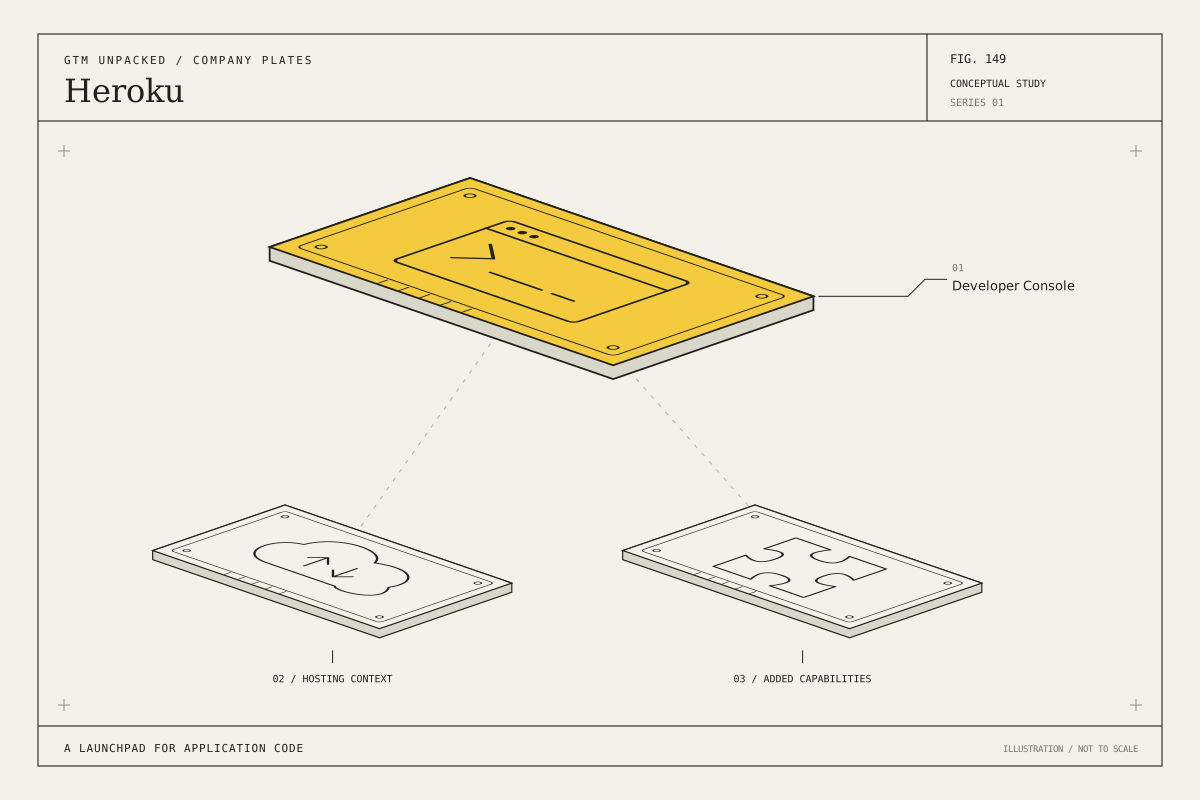
Conceptual illustration of application deployment as a small launchpad, pairing a terminal, cloud and puzzle piece to express code, hosting and extensibility.
- Company
- Heroku · Developer tools and communities · heroku.com
- Conversion motions
- [Inference] This research classifies Heroku as Product Led, Partner Led and Human Led.
- Heroku beachhead
- Ruby on Rails developers trying to get an application running without operating infrastructure. [1]
- Heroku target customer
- Application developers and teams using managed runtimes, data and platform services. [2]
- Product complexity
- [Inference] Fast deployment fronts complex production infrastructure.
- Decision-making unit
- [Inference] Prototype adoption is individual; production reliability and integration create a broader decision.
- Market at entry
- The 2007 pitch addressed setup and deployment friction around Rails applications. [1]
- Market today
- The 2026 platform operates within Salesforce, with a changed enterprise contracting policy. [4]
- Evidence
- Source-backed brief · 5 linked sources · research date · method and limitations
The ten-step Revenue Engine reading map
These links locate relevant evidence. A linked section does not imply every detail of the step is publicly established.
- Acquire Your First Customers: Founder Led Sales Read first customers
- Embrace GTM Experimentation Read experiments & lessons
- Understand Your GTM Motion Options Read GTM motion
- Pick Your GTM Motion Not established in this entry
- Generate a Lead Read GTM motion · Read experiments & lessons
- Turn Leads into Paying Customers Read GTM motion
- Retain and Grow Your Customers Read retain & expand
- Build Your GTM Team Not established in this entry
- Plan Your Tech Stack Read experiments & lessons
- Optimize and Scale Through Metrics Read pricing & economics
Heroku origin and first customers: The first audience was close to the builders
Adam Wiggins’s October 2007 kickoff describes building the service with James and Orion and showing it to friends, relatives, colleagues and their networks. The original proposition was a hosted Rails development environment that removed setup and deployment obstacles. This establishes direct founder distribution and feedback; it does not identify the first paid invoice. [1]
[Inference] Rails was a specific enough community for the product’s benefit to be demonstrated quickly. A broad promise to run every application would have increased both implementation scope and explanation cost. Early awareness followed a concrete developer job, rather than a large-company platform procurement brief. [1]
[1]Heroku GTM motion: Product experience and partners increased the useful surface
The current platform offers managed runtimes, data services and the Elements marketplace of add-ons, integrations and buildpacks. Dev Center provides deployment documentation, while Heroku Success describes differentiated support. These are observable mechanisms for activation, complementary purchases and production assistance, not verified historical channel-contribution percentages. [2]
[Inference] The add-on model lets a developer assemble a working stack within an existing workflow. That can make partners a distribution and retention mechanism, provided configuration and responsibility stay clear. A database problem still feels like an application problem to a customer even when several vendors participate. [2]
[2]Heroku pricing and economics: A paid resource ladder replaced the old free entry
Observed November 2026, Eco is $5 monthly and Basic starts at $7; Eco workloads can sleep after inactivity, whereas Basic supports always-on applications. Standard compute and managed data add further charges. The 2022 announcement ended free product plans effective November 28, citing abuse and the cost of operating them. The live blog now shows a later update date, so that must not be confused with the event date. [2][3]
[Inference] Monetizing an inexpensive entry can improve cost recovery while weakening a familiar educational funnel. The decision cannot be judged solely from disappointed free users or from theoretical server savings. The relevant evidence would include paid conversion, abuse cost, support load and long-run developer adoption; those series were not retrieved. [3]
[2] [3]Heroku retention and expansion: The present-day policy matters
In February 2026, Nitin T Bhat announced a sustaining-engineering focus and said new Enterprise Account contracts would cease, while existing enterprise renewals and credit-card purchases remained available. March and October updates subsequently described platform improvements. It would therefore be inaccurate to call Heroku shut down or claim it stopped all development. [4][5]
[Inference] Existing customers now need precise contractual and roadmap guidance. Growth analysis must distinguish self-service acquisition, existing-account retention and the restricted new-enterprise route. A historical enterprise expansion playbook is not automatically a description of the current motion. [4][5]
[4] [5]Heroku experiments and lessons: A successful wedge can still face strategic limits
[Inference] Heroku’s transferable insight is that removing operational steps can be a compelling developer product. The constraint is economic and organizational: the convenience premium must remain defensible as workloads become larger and customer alternatives improve. Clear capacity guidance and transparent ownership of support can help customers expand without feeling trapped. [2]
[Inference] Better communication would consistently reconcile maintenance-oriented strategy with subsequently announced features, so buyers can evaluate investment horizons. The record supports a change in commercial policy, but not a quantified causal claim that any single pricing or ownership decision produced the current position. [4][5]
[2] [4] [5]Heroku economics at a glance: Pricing is only half the story.
Paid compute and managed-service usage; Eco $5/month and Basic from $7 observed November 2026. New Enterprise Account contracts ended in February 2026. [2][4]
See the dated pricing analysis.
[Inference] The relevant costs and conversion frictions are discussed in the analysis; no invented margin model is supplied.
Not verified in this brief.
No cohort retention figure verified in this brief.
The people in the Heroku GTM story: People & capabilities.
Adam Wiggins
CofounderDeveloper and author of the original launch account.
Articulated the Rails setup problem and introduced the early service through personal networks. [1]
[1]Nitin T Bhat
Executive author of the 2026 updateDetailed earlier career not verified here.
Clarified support continuity and the end of new Enterprise Account contracts. [4]
[4]Heroku GTM: critical reading and analysis: Why it worked.
Where it breaks.
What worked—and why
[Inference] A narrow developer workflow supported a broader platform and add-on market.
What did not work
The company cited abuse and operating cost when ending free plans. [3]
What could have been better
[Inference] Make roadmap and contracting boundaries explicit for prospective production users.
What another founder can use
[Inference] A Rails deployment wedge grew through developer experience and an add-on ecosystem.
Heroku go-to-market FAQ: The questions that matter.
How did Heroku find its GTM motion?
A Rails deployment wedge grew through developer experience and an add-on ecosystem. See the sourced account and explicitly labeled analysis above.
Heroku sources and open questions: Follow the sources.
- The Big Kickoff Heroku · primary · 2007-10-31
Inspected for the facts attributed in this brief; current pages observed November 10, 2026.
- Pricing Heroku · primary
Inspected for the facts attributed in this brief; current pages observed November 10, 2026.
- Heroku’s Next Chapter Heroku · primary
Inspected for the facts attributed in this brief; current pages observed November 10, 2026.
- An Update on Heroku Heroku · primary · 2026-02-06
Inspected for the facts attributed in this brief; current pages observed November 10, 2026.
- October 2026 Update Heroku · primary · 2026-10-07
Inspected for the facts attributed in this brief; current pages observed November 10, 2026.
What remains unverified
First paid account and its original contract were not verified.
Named early sales and customer-success hires, training, compensation and individual account assignments remain incompletely documented.
No verified CAC, payback, funnel conversion or numerical retention series in this brief.
Historical website/pricing screenshots were not captured for this company; dated textual evidence is distinguished from current pages.
No verified visual capture is attached to this entry. A current screenshot is not a substitute for a historical capture.