
Source numbers link to evidence. [Inference] marks analytical judgment, including motion classifications and causal explanations. Public evidence does not establish every internal decision or metric.
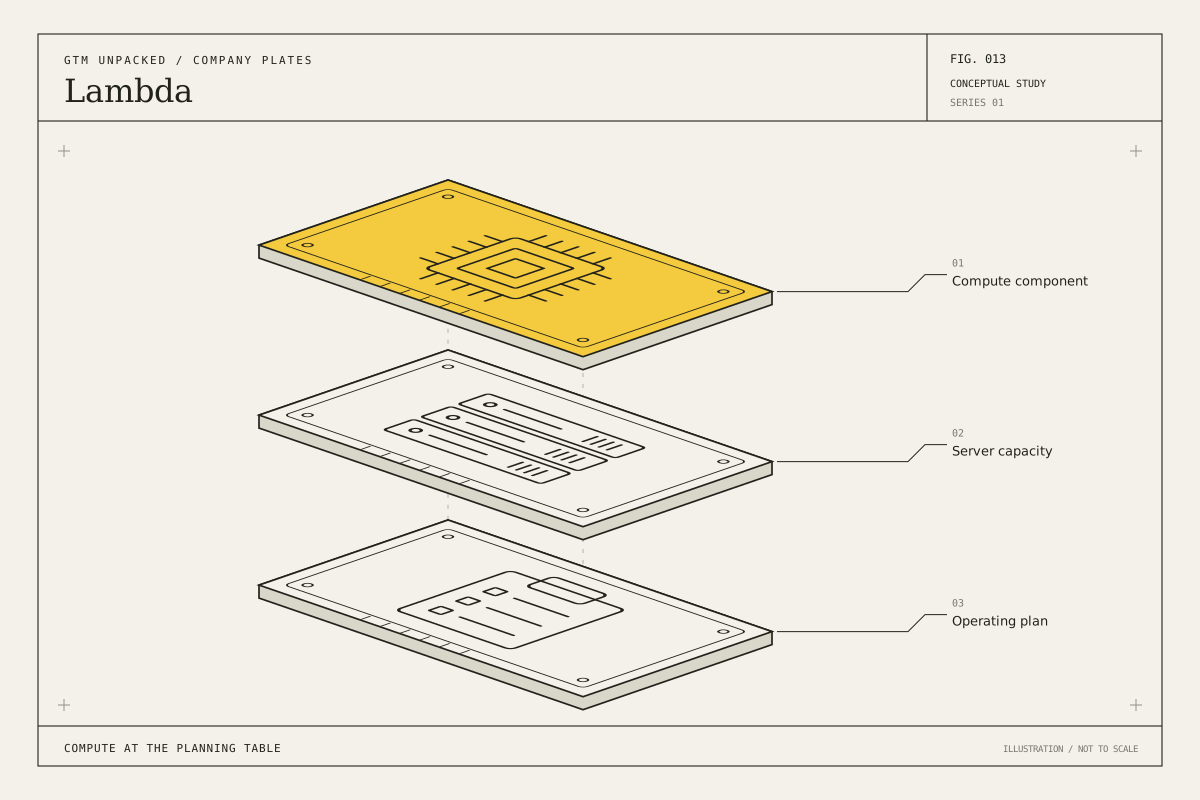
Conceptual illustration of a compute chip, server cabinet, and planning sheet, placing hardware beside operating considerations without claiming a particular infrastructure design or capacity.
- Company
- Lambda · GPU cloud infrastructure · lambda.com
- Conversion motions
- [Inference] This research classifies Lambda as Human Led and Product Led.
- Lambda target customer
- Researchers and developers for self-serve instances; frontier labs, enterprises, inference providers and hyperscalers for committed capacity. [2][4]
- Product complexity
- [Inference] Easy trial relative to physical infrastructure; operating large distributed training fleets remains complex.
- Decision-making unit
- [Inference] Engineer-led small purchases grow into founder, compute-lead, finance, procurement and legal decisions for large commitments. [2][5]
- Market at entry
- Brooks recalls educating buyers on using GPUs in 2018. [2]
- Market today
- [Inference] Capacity procurement is an established strategic activity, but supply cycles and bottlenecks remain volatile. [1][2]
- Evidence
- Deep research · 7 linked sources · research date · method and limitations
The ten-step Revenue Engine reading map
These links locate relevant evidence. A linked section does not imply every detail of the step is publicly established.
- Acquire Your First Customers: Founder Led Sales Read first customers
- Embrace GTM Experimentation Read experiments & lessons
- Understand Your GTM Motion Options Read GTM motion
- Pick Your GTM Motion Read beachhead & buyer · Read product & market
- Generate a Lead Read GTM motion · Read experiments & lessons
- Turn Leads into Paying Customers Read GTM motion · Read people & process
- Retain and Grow Your Customers Read retain & expand
- Build Your GTM Team Read people & process
- Plan Your Tech Stack Read experiments & lessons · Read people & process · Read product & pricing archive
- Optimize and Scale Through Metrics Read pricing & economics
Lambda GTM timeline: From wedge to engine.
Lambda origin and first customers: Origins & the unglamorous path to infrastructure
Stephen Balaban’s July 2026 interview says Lambda began in 2012 with a facial-recognition API, added deep-learning consulting before venture funding, and launched DreamScope in 2015 to turn photos into paintings. He describes the later move to supplying computational resources. This is a founder account; it does not identify the first paying API or consulting customer. [1]
Brooks recalls that the early infrastructure product was a gaming-style workstation with software layered on it. He joined in 2018 and had to persuade ML buyers that GPUs were useful. [2]
[Inference] The initial differentiation was practical access for a technical user, not the ability to finance a gigawatt campus. Consulting and application experiments likely exposed operating pain, but the sources do not quantify how those activities converted into the first infrastructure customers.
[1] [2]Lambda beachhead and buyer: An economic champion can sit below the VP
In the November 2026 interview, Brooks says ML engineers could have decisive influence over purchases even when their formal titles were less senior. He contrasts that early buyer with present-day founders, heads of compute and data-center construction leaders. [2]
[Inference] Persona work must map economic influence, not merely hierarchy. An ML engineer who controls model architecture can determine compute demand. As commitments grow, that champion remains valuable but is no longer the entire decision-making unit. A sales process that never updates the persona map would miss financing, security and capacity obligations.
[2]Lambda GTM motion: Self-serve demand feeds high-touch selection
The pricing page offers immediate self-serve instances, 1-Click Clusters for larger deployments, and contact-led reserved capacity. Published cluster terms range from weeks to more than a year. A current Head of Sales specification calls for ownership from pipeline through large commitments, close work with product and capacity planning, and strategic distribution channels. This describes an intended operating model, not proof of a hire having happened. [4][5] The specification’s reference to strategic distribution channels is not evidence that partners had already originated or closed customer contracts. [5]
[Inference] This is a hybrid engine: an individual can evaluate small workloads, while a large customer buys reliability and a delivery plan through a human relationship. Capacity scarcity changes qualification from who will buy to which demand is worth supporting. That can be an advantage, but it should not be mistaken for a permanent exemption from selling.
[4] [5]Lambda product and market: A more mature category with unstable bottlenecks
Balaban describes the limiting factor shifting from advanced chip packaging in 2023 toward ready data-center space, power, construction labor and equipment, with memory becoming important too. He also emphasizes the role of creditworthy offtake agreements in supporting construction. [1]
[Inference] Market maturity and operating predictability are different. Buyers increasingly understand GPU computing, while the supply stack still moves unevenly. The revenue engine therefore needs demand discovery and resource planning together. A sales organization that books commitments disconnected from engineering and finance can manufacture delivery problems rather than growth.
[1]Lambda people and process: Commercial fluency plus infrastructure operators
GTMnow’s 2024 profile traces Brooks from Charles Schwab through Stack Overflow and Tempo Automation to Lambda. It emphasizes repeated work as an early commercial hire alongside technical founders, and discusses product understanding, curiosity and full-stack account executives. The episode summary also flags a SpaceX account story; its $10 million ARR description is the publisher’s account, not independently audited here. [3]
Lambda’s May 2026 leadership announcement names Michel Combes CEO, Stephen Balaban CTO and Michael Balaban CPO. It also adds John Donovan as Chairman, alongside operators including Jerry Hunter and CFO Charles Fisher. The announcement emphasizes capital formation and infrastructure deployment experience, a different capability set from the initial developer-focused sale. [6]
[Inference] A useful division of labor is technical credibility with researchers, disciplined commercial qualification, and experienced infrastructure execution. Neither a great engineer nor a strong closer substitutes for all three. The source does not verify a specific branded sales methodology or compensation plan.
[3] [6]Lambda retention and expansion: Account ownership extends past the first machine
Brooks’s 2024 interview agenda explicitly connects sales, marketing and customer success and describes repairing a difficult customer relationship. The later interview discusses selecting customers whose businesses can scale with Lambda’s capacity. [2][3]
[Inference] Expansion requires understanding the customer’s next workload, funding position and production schedule. The practical service motion is proactive: validate expected demand, secure the appropriate hardware, prepare the customer to use it efficiently, and keep incidents from eroding trust. This is an analytical account-management blueprint, not a claim to have seen Lambda’s internal playbook.
Lambda’s 2026 leadership announcement positions Michael Balaban’s CPO role as connecting infrastructure to the developers and enterprises using it. That is relevant organizational evidence; named frontline success managers, staffing ratios and escalation SLAs were not recovered. [6]
[2] [3] [6]Lambda pricing and economics: A price can be visible before it is effective
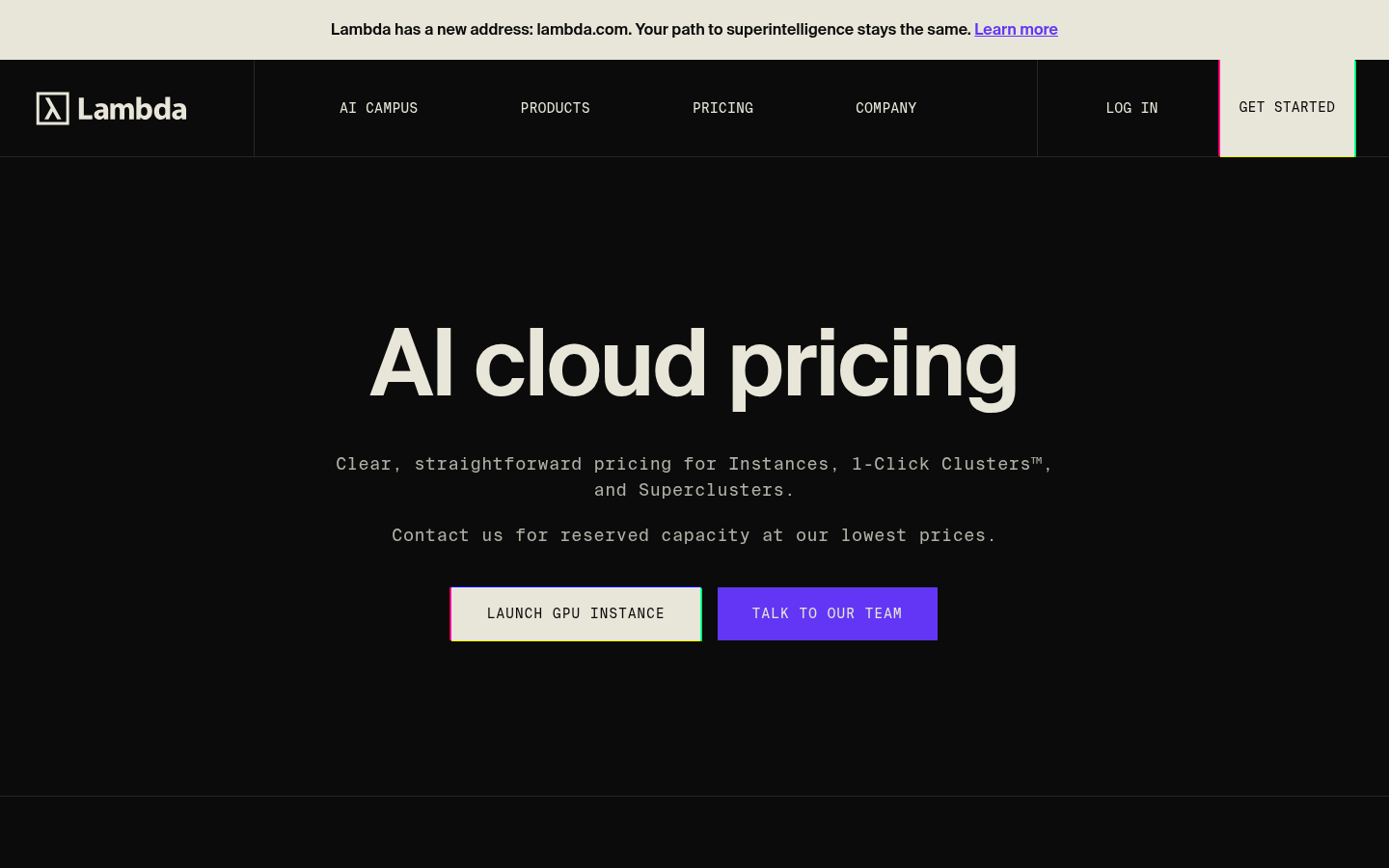
The November 10 capture of Lambda’s pricing page includes future instance rates explicitly effective November 16, 2026 at 00:00 UTC. It tells users to log in for the currently effective prices. For example, the future single-GPU H100 SXM rate is $4.89 per GPU-hour; presenting it as today’s rate would be wrong. The same page lists cluster prices by GPU count and term. [4]
[Inference] Hardware-backed consumption is exposed to utilization, capital cost, depreciation, electricity and customer concentration. Contract value, annualized run rate, committed backlog and recognized revenue answer different questions. The unverified $760 million figure in this project’s starting list is therefore not treated here as audited ARR. CAC, payback, contribution margin and cohort retention are not public in the evidence collected.
[Inference] Lower prices can accelerate adoption and still reduce total profit if utilization or financing costs deteriorate. A meaningful unit is a productive GPU-hour delivered under the required SLA, not a GPU name on a rate card. Buyers should compare networking, storage, support and capacity availability as well as the headline price.
[4]Lambda experiments and lessons: The explicit counterexample: a GPU glut
Brooks reports that Lambda faced a GPU glut in 2024 and struggled to find demand. He also describes current customer selection as closer to venture investing than ordinary hunting. The same interview reports 5,000 new company signups per month; that is an executive statement and does not tell us how many are active or paying. [2]
[Inference] The glut is the most useful corrective to a simplistic scarcity narrative. Infrastructure companies need a repeatable demand engine for periods when supply catches up. A more resilient GTM plan would segment durable production consumption from experiments and maintain channels that work without an allocation advantage.
Brooks says he found his second-in-command for GTM operations through the GTMfund community. The transcript names the prior function at Slack but not the individual; the identity is therefore left unresolved. It is a specific recruiting-channel anecdote, not evidence that any podcast sponsor’s software is used internally. [2]
[2]Lambda website and pricing history: From developer hardware to superintelligence cloud
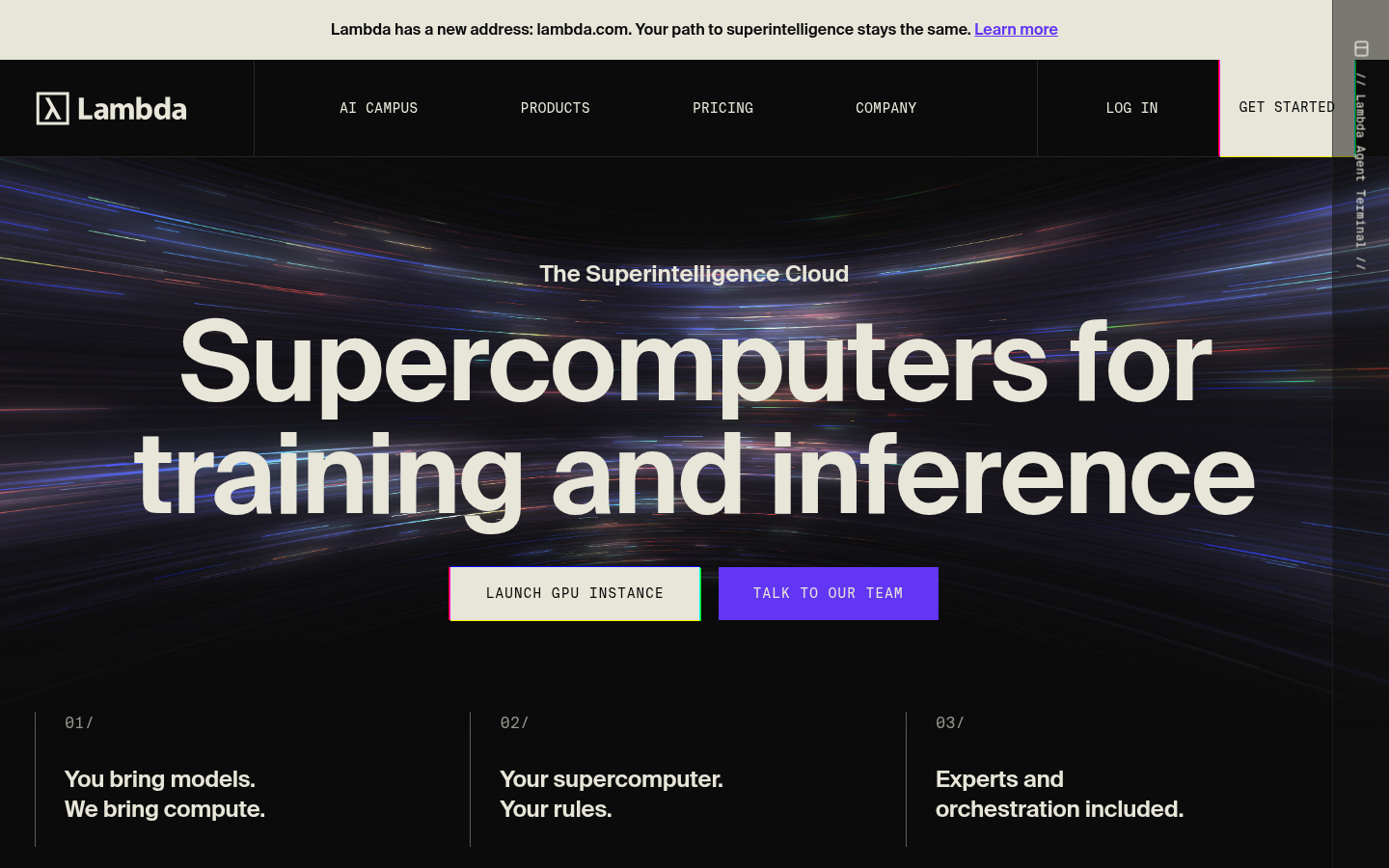
The founder’s history spans API, consulting, image application and compute infrastructure. The current captured homepage positions Lambda around large-scale training and inference and offers both launch-instance and contact-team routes. The visual and commercial emphasis now matches an infrastructure buyer, but no verified archive screenshot was available to show each redesign. [1][7]
[1] [7]Lambda economics at a glance: Pricing is only half the story.
Public capture includes instance rates effective Nov 16, 2026, not current Nov 10 rates; reservations negotiated. [4]
GPU-hour usage and committed clusters
[Inference] Capital cost, useful utilization, power, depreciation and concentration dominate.
Not publicly verified
No verified cohort NRR or gross retention
The people in the Lambda GTM story: People & capabilities.
Michael Balaban
Co-founder & CPOCo-founded Lambda and built its technical foundation. [6]
Owns the product layer connecting infrastructure to customers. [6]
[6]Michel Combes
CEO, from May 2026Former CEO of SoftBank International, Sprint and Alcatel-Lucent. [6]
Recruited for capital formation and large-scale infrastructure operations. [6]
[6]“We had a glut of GPUs and couldn’t figure out a way to give them away.”Robert Brooks, recalling 2024 [2]
Lambda GTM: critical reading and analysis: Why it worked.
Where it breaks.
What worked—and why
[Inference] Selling to the technical economic champion aligned the product with actual workload demand.
[Inference] Added infrastructure and capital-market expertise matched the growing commitment size.
What did not work
Brooks explicitly recounts a 2024 GPU glut. [2]
What could have been better
[Inference] Maintain a demand-generation plan that works through oversupply, not only scarcity.
[Inference] Score expansion opportunities on expected productive utilization and counterparty quality as well as contract size.
What another founder can use
[Inference] Re-map the DMU when contract scale changes; yesterday’s user may no longer own the whole decision.
[Inference] Separate bookings, backlog, usage revenue and gross profit before copying infrastructure growth claims.
Lambda website and pricing captures: Product, positioning & pricing.
Captures and image sources are dated individually. Historical gaps are kept explicit. Explore the visual archive
Lambda go-to-market FAQ: The questions that matter.
How did Lambda’s buyer change?
Robert Brooks describes moving from ML engineers in 2018 to founders and heads of compute for much larger commitments. [2]
Lambda: Are the displayed GPU prices already effective?
The November 10 capture explicitly marks instance rates as effective November 16, 2026; current account rates require login. [4]
Which go-to-market motions is Lambda classified under?
[Inference] This research classifies Lambda as Human Led and Product Led. Motion labels describe routes across segments and periods, not measured revenue shares.
Lambda sources and open questions: Follow the sources.
- Stephen Balaban interview Investment Reports · interview · 2026-07-02
Origins, pivots and infrastructure bottlenecks
- Inside an 11-Figure AI Compute Deal GTMnow · interview · 2026-11-04
Full transcript: changing buyer, GPU glut, signups and hiring
- Enterprise sales with Robert Brooks GTMnow · interview · 2024-06-04
Career background and published episode topics; not full transcript
- AI cloud pricing Lambda · primary
Nov 10 capture; future Nov 16 rates and cluster terms
- Head of Sales, Lambda Cloud Lambda · primary
Sales leadership job specification
- Lambda assembles leadership team Lambda · primary · 2026-05-05
May 27 update; named roles and previous infrastructure experience
- Homepage Lambda · primary
Captured Nov 10 2026; training/inference and conversion routes
What remains unverified
First API, consulting and hardware customers not verified.
No independently verified ARR, margin, CAC or retention cohort.
Identity of the GTM operations hire described in the podcast not verified.
Named CSM/AM staff, formal training and complete internal tool stack not verified.
No Wayback capture was retrieved for this case; no historical screenshot is represented as a verified archive capture.
Partner-originated or partner-closed customer conversions were not independently verified; a sales hiring specification alone does not establish a Partner Led motion.