Source numbers link to evidence. [Inference] marks analytical judgment, including motion classifications and causal explanations. Public evidence does not establish every internal decision or metric.
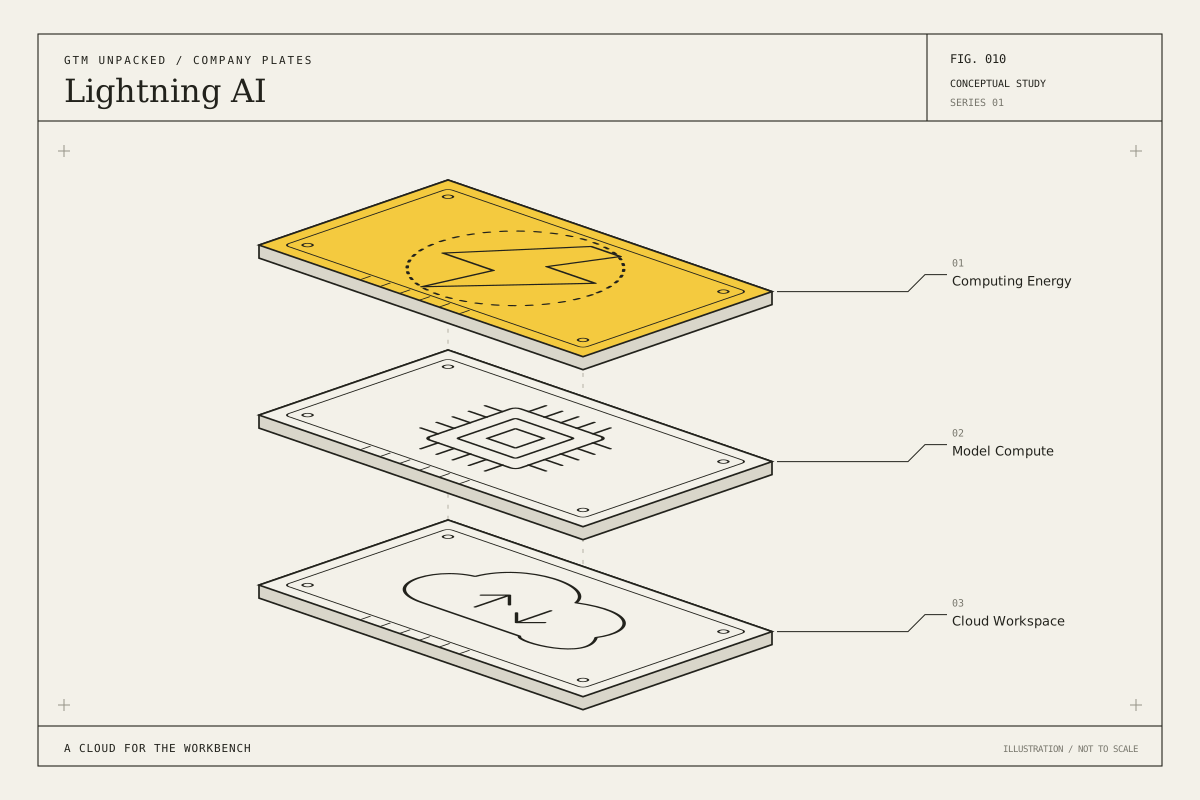
Conceptual illustration of a computing workbench beneath a cloud, with a chip and bolt creating a symbolic study of technical capacity and energy.
- Company
- Lightning AI · AI development & GPU cloud · lightning.ai
- Conversion motions
- [Inference] This research classifies Lightning AI as Product Led and Human Led.
- Lightning AI beachhead
- Researchers and ML engineers needing a cleaner way to train and scale PyTorch models. [1][2]
- Lightning AI target customer
- Individual developers and researchers, then labs, teams and security-conscious enterprises. [4]
- Product complexity
- [Inference] Accessible framework and browser experience hide a complex compute, data and deployment stack.
- Decision-making unit
- [Inference] Simple for an individual experiment; complex for private-cloud deployment, proprietary data and enterprise commitments. [4]
- Market at entry
- [Inference] The initial market was an expert-heavy ML workflow with fragmented tooling and significant setup work. [2][3]
- Market today
- [Inference] AI tooling is more broadly used, but security, continuity and compute economics remain key enterprise adoption constraints. [4][8]
- Evidence
- Deep research · 8 linked sources · research date · method and limitations
The ten-step Revenue Engine reading map
These links locate relevant evidence. A linked section does not imply every detail of the step is publicly established.
- Acquire Your First Customers: Founder Led Sales Read first customers
- Embrace GTM Experimentation Read experiments & lessons
- Understand Your GTM Motion Options Read GTM motion
- Pick Your GTM Motion Read beachhead & buyer · Read product & market
- Generate a Lead Read GTM motion · Read experiments & lessons
- Turn Leads into Paying Customers Read GTM motion · Read people & process
- Retain and Grow Your Customers Read retain & expand
- Build Your GTM Team Read people & process
- Plan Your Tech Stack Read experiments & lessons · Read people & process · Read product & pricing archive
- Optimize and Scale Through Metrics Read pricing & economics
Lightning AI GTM timeline: From wedge to engine.
Lightning AI origin and first customers: From a researcher’s framework to a company
Lightning’s current history says William Falcon began developing the framework at Columbia in 2015 and open-sourced it in 2019 during doctoral research at NYU and Facebook AI Research, advised by Kyunghyun Cho and Yann LeCun. The older Grid.ai page names Falcon and Luis Capelo as founders and dates the company to 2019. [1][2]
[Inference] Open source gave users a way to experience the technical abstraction before buying a platform. It also gave the founders a community in which to observe workflow pain. The evidence does not reveal the first paid customer, its contract size, or a reproducible founder outbound sequence. Framework downloads are not paying accounts.
[1] [2]Lightning AI beachhead and buyer: ICP: reduce the work surrounding model development
The December 2023 Studio launch describes researchers and developers coordinating many tools for code, data, training and deployment. It offers shared cloud environments, templates and scaling from CPU to GPU. The launch includes Sam Wolk of MIT’s Sustainable Design Lab, who reports a model-development task taking six hours rather than 36. This is a named launch testimonial, not a controlled benchmark or proof that the lab was the first customer. [3]
[Inference] The useful segmentation variable is time lost outside the core modeling work. A researcher who repeatedly recreates environments has an immediate reason to try the product. A company with a mature internal platform may require a more specific economic or operational case.
[3]Lightning AI GTM motion: Open-source adoption, free cloud entry, enterprise assistance
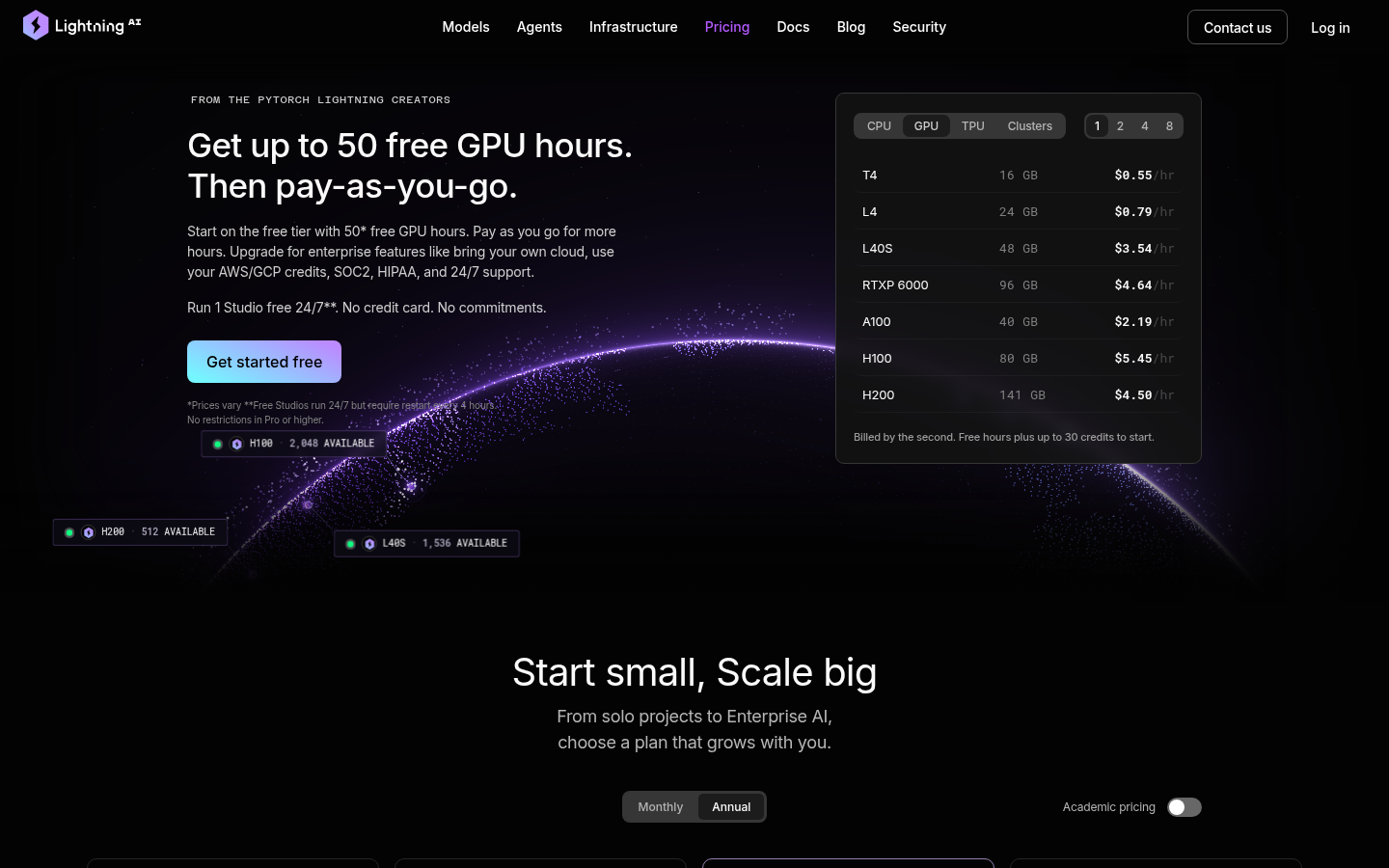
Studio launched with a free no-card entry and 15 monthly credits in December 2023. The present pricing capture retains Free, Pro, Teams and Enterprise tiers, adds usage-based compute, and reserves controls and support for larger organizations. Because the current page combines monthly, annual and academic displays, the Pro price shown is ambiguous; it is not presented as a single definitive number here. [3][4]
The 2025 marketplace announcement describes access across hyperscalers and specialized GPU providers, including Lambda. Customers could choose providers while keeping a unified development workflow. This establishes a partner-assisted supply marketplace; the retrieved evidence does not establish partners originating or closing Lightning customers. It is therefore retained as a channel and ecosystem detail rather than classified as a verified Partner Led conversion motion. [5]
[Inference] The intended expansion path is individual experiment, shared team workflow, then enterprise controls or capacity. Each step needs a new reason to pay. A large framework audience alone does not establish commercial conversion or low CAC.
[3] [4] [5]Lightning AI product and market: Market maturity changes the product promise
Lightning’s current about page describes combining with Voltage Park in 2026 and owning GPU infrastructure as well as the development layer. It reports hundreds of millions of framework downloads and hundreds of thousands of Studio users; these are company metrics with different denominators and should not be treated as revenue. [1]
[Inference] Owning capacity potentially changes pricing control and delivery accountability, but it also introduces hardware utilization and capital risk. An open-source software company and a cloud operator can share a brand while needing different operational metrics. The integration must be judged by customer experience and margin, not by adding the two organizations’ headline numbers.
[1]Lightning AI people and process: Research credibility meets commercial experience
Grid.ai’s founder page lists Falcon’s prior NYU/FAIR work, Goldman Sachs and the U.S. Navy. It identifies Capelo’s earlier Glossier, Forbes and UN work and Harvard affiliation. These are the company’s biographies; specific degree details and formal sales training are not established there. [2]
Brian Campbell’s public profile describes joining Lightning after five years at Observe and helping build GTM playbooks. It reports major revenue growth around the Voltage Park combination, but no independently reconciled organic revenue series was retrieved. [6]
[Inference] Falcon’s relevant capability is identifying developer friction from practice; Capelo brings applied organizational ML experience; Campbell brings experience building a commercial function at a technical startup. These are interpretations of documented backgrounds, not personality judgments or claims that a given hire caused a particular revenue multiple.
[2] [6]Lightning AI retention and expansion: Enablement and account expansion
The current package comparison offers community support on lower tiers and enterprise support including a dedicated Slack channel, an ML engineer, model tuning and other services. Enterprise also adds private-cloud capabilities, identity controls and stated service terms. The precise negotiated contract remains the authority for an individual account. [4]
[Inference] Expansion is more likely when the platform becomes a shared workflow than when it is only a cheap GPU rental. Templates, team spaces, shared data and predictable environments can create repeated use. Customer success should show that a team is shipping or training more effectively, then connect that outcome to collaboration, governance and capacity needs. No cohort retention or named account-manager portfolio was verified.
[4]Lightning AI pricing and economics: Separate the software subscription from compute economics
The captured price table lists Free at $0, Teams at $140 per user/month in the comparison table, and custom enterprise terms. Compute is additional and billed by the second; the page lists multiple hardware options and pricing conditions. These observations are dated November 10, 2026 and should be checked before purchase. [4]
[Inference] A free tier can be efficient acquisition if it leads to recurring productive usage; it can be expensive if it mainly subsidizes temporary experiments. Owned GPUs add utilization and depreciation risk, while third-party supply adds partner pricing risk. A valid CAC/payback calculation needs gross profit after compute and service costs, not subscription revenue alone.
[Inference] The unverified $500 million-plus number in this project’s starting list cannot be treated as the standalone software business’s organic ARR without a reconciled definition and period. The public leadership post ties its growth narrative to a merger, so comparing it with a pure SaaS ARR chart would be analytically unsafe. [6]
[4] [6]Lightning AI experiments and lessons: A material service failure qualifies the growth story
Lightning’s official incident page says unauthorized access to credentials was identified October 15, 2026 and platform access revoked early October 16. The retrieved update reports read-only Drive access restored October 28, with Studio, Jobs and Deployments access to follow. It distinguishes the affected Studio platform from GPU cluster rental and managed Kubernetes/SLURM services. This is the notice as retrieved November 10; it should not be generalized to every Lightning product. [8]
[Inference] Reliability and security are part of GTM, especially when an environment holds source code, credentials and proprietary data. An integrated workflow becomes a liability if customers cannot reach their work. The appropriate critique is to demand clear service boundaries, recovery paths and account communication—not to infer undisclosed churn or financial damage.
[Inference] The public record supports a stronger lesson than growth-at-all-costs: enterprise expansion requires operational trust to keep pace with adoption. A comprehensive post-incident account plan should reconnect promised value, actual availability and the customer’s continuity needs.
[8]Lightning AI website and pricing history: A documented progression, not reconstructed screenshots
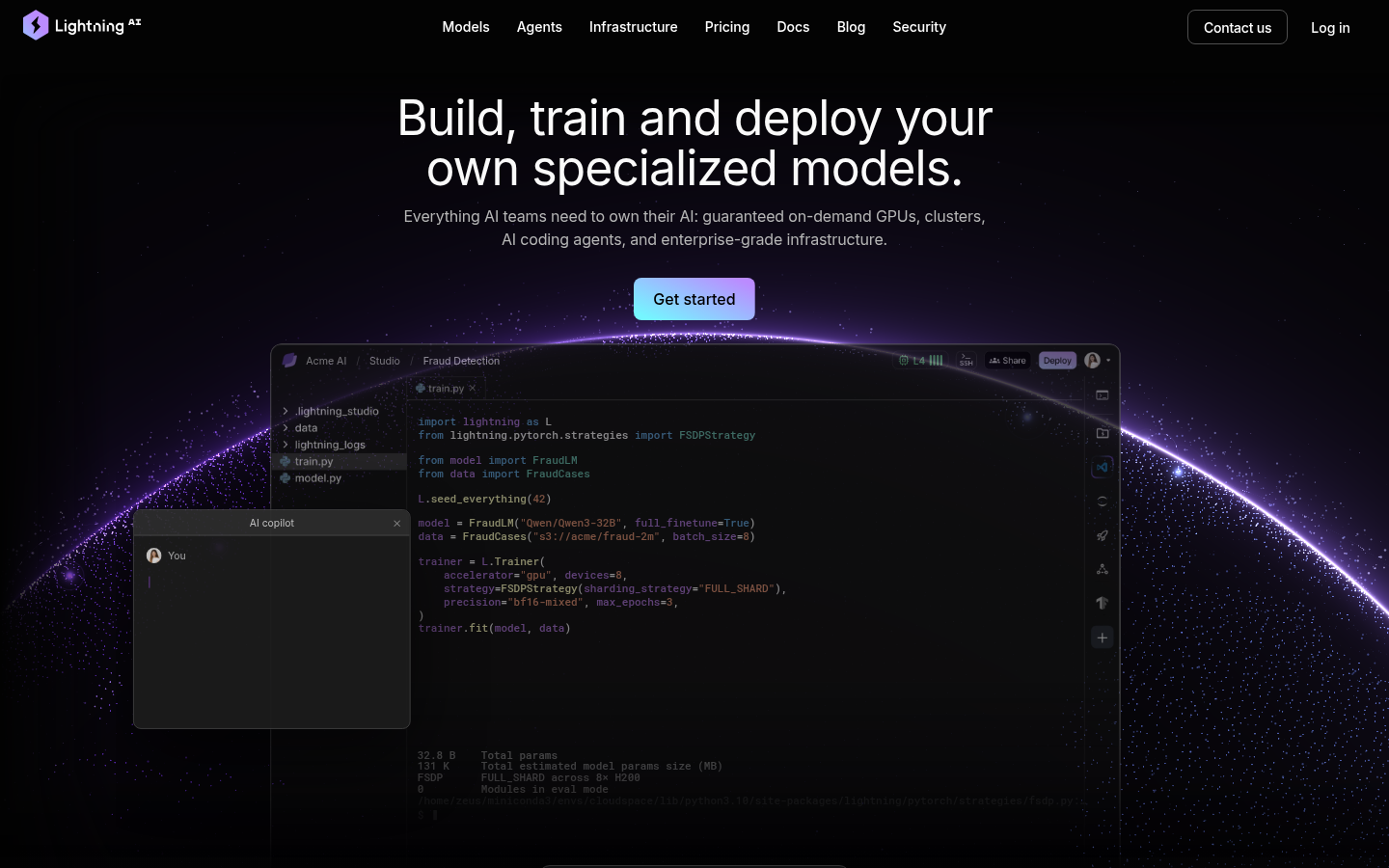
The surviving Grid.ai about page documents the original company identity. The 2023 release describes Studio and its original free credits. The 2025 marketplace announcement and 2026 about page show broader supply and infrastructure scope. Current home and pricing screenshots accompany this case; no archive capture is represented as verified. [2][3][5][1]
[1] [2] [3] [5]Lightning AI economics at a glance: Pricing is only half the story.
Dec 2023 launch: 15 free monthly credits. Nov 2026 capture: free plus paid team/enterprise and compute usage; current Pro display ambiguous. [3][4]
Subscription features plus consumption and committed GPU capacity
[Inference] Free-tier subsidy, compute utilization, hardware economics and expert support.
Not publicly verified
No independently verified cohort retention or post-incident churn
The people in the Lightning AI GTM story: People & capabilities.
Luis Capelo
Grid.ai co-founderCompany biography cites Glossier, Forbes, UN and Harvard. [2]
[Inference] Applied ML background complements research-led tooling.
[2]Brian Campbell
Commercial leaderPublic profile describes five years at Observe before Lightning. [6]
Reports building GTM teams and repeatable playbooks; exact causal effect not independently verified. [6]
[6]Lightning AI GTM: critical reading and analysis: Why it worked.
Where it breaks.
What worked—and why
[Inference] Open source demonstrated value before a buying decision.
[Inference] Team and enterprise packaging targets needs that a solo framework user does not have.
What did not work
Official October 2026 notice documents a security incident, platform access revocation and partial recovery. [8]
What could have been better
[Inference] Make continuity and recovery part of the enterprise value proposition and account review.
[Inference] Report software conversion and compute economics separately, especially after a merger.
What another founder can use
[Inference] A large community is a distribution asset, not a revenue metric.
[Inference] The more integrated the workflow, the more trust and operational resilience matter to retention.
Lightning AI website and pricing captures: Product, positioning & pricing.
Captures and image sources are dated individually. Historical gaps are kept explicit. Explore the visual archive
Lightning AI go-to-market FAQ: The questions that matter.
Lightning AI sources and open questions: Follow the sources.
- About Lightning AI Lightning AI · primary
Research origin, Studio and 2026 Voltage Park combination
- About Grid.ai Grid.ai · primary
Founders, 2019 formation and public biographies
- Lightning AI introduces Studios Lightning AI / Business Wire · primary · 2023-12-13
Launch, 15 free credits, tiers and Sam Wolk testimonial
- Pricing Lightning AI · primary
Nov 10 2026 capture, tier features and support; ambiguous Pro display noted
- Multi-Cloud GPU Marketplace Lightning AI · primary · 2025-08-21
Indexed official announcement including Lambda partnership; direct open later failed
- Brian Campbell public professional profile and posts LinkedIn · primary
Public indexed posts on Observe, GTM playbooks and merger; relative dates not treated as exact dates
- October 2026 Security Incident Lightning AI · primary
Official notice retrieved Nov 10, 2026; affected services and recovery scope
- Homepage Lightning AI · primary
Captured current positioning and routes
What remains unverified
First paying customer and founder-led sales sequence not verified.
Paid conversion, software-only ARR, gross margin and retention not verified.
First-person founder portraits and named frontline AM/CS biographies not recovered.
Marketplace source was accessible as indexed official text but direct open failed; no claim of full historical page capture.
Official incident update is time-sensitive and should be refreshed before relying on current availability.
No Wayback capture was retrieved for this case; no historical screenshot is represented as a verified archive capture.
A GPU supply marketplace is documented; partner-originated or partner-closed customer conversions were not independently verified.