
Source numbers link to evidence. [Inference] marks analytical judgment, including motion classifications and causal explanations. Public evidence does not establish every internal decision or metric.

Conceptual illustration of an energy bolt, server cabinet, and cloud outline, placing power and computing in a shared technical composition without charting infrastructure topology.
- Company
- Crusoe · AI cloud & data centers · crusoe.ai
- Conversion motions
- [Inference] This research classifies Crusoe as Human Led, Partner Led and Product Led.
- Crusoe beachhead
- Stranded-gas compute at energy-production sites; later AI builders needing GPU capacity. [1]
- Crusoe target customer
- AI-native companies, inference providers, frontier labs, hyperscalers and large infrastructure counterparties. [2][4][6]
- Product complexity
- [Inference] Very high: power, facilities, chips, networking, software and operational support must work together.
- Decision-making unit
- [Inference] A cloud trial can be engineer-led; campus and capacity commitments require technical, financial, legal, real-estate and executive participants.
- Market at entry
- [Inference] In 2018 the differentiating problem was monetizing otherwise wasted energy for intensive computing, before today’s generative-AI demand. [1]
- Market today
- [Inference] AI capacity is a competitive market where delivery timing and reliability can be as consequential as nominal GPU price. [4]
- Evidence
- Deep research · 10 linked sources · research date · method and limitations
The ten-step Revenue Engine reading map
These links locate relevant evidence. A linked section does not imply every detail of the step is publicly established.
- Acquire Your First Customers: Founder Led Sales Read first customers
- Embrace GTM Experimentation Read experiments & lessons
- Understand Your GTM Motion Options Read GTM motion
- Pick Your GTM Motion Read beachhead & buyer · Read product & market
- Generate a Lead Read GTM motion · Read experiments & lessons
- Turn Leads into Paying Customers Read GTM motion · Read people & process
- Retain and Grow Your Customers Read retain & expand
- Build Your GTM Team Read people & process
- Plan Your Tech Stack Read experiments & lessons · Read people & process · Read product & pricing archive
- Optimize and Scale Through Metrics Read pricing & economics
Crusoe GTM timeline: From wedge to engine.
Crusoe origin and first customers: Origins: sell a physical advantage before a software story
Chase Lochmiller and Cully Cavness say they founded Crusoe in 2018 around locating compute at energy-production sites. Digital Flare Mitigation used stranded natural gas that would otherwise be flared, with bitcoin mining as the early workload. Their retrospective describes an energy-led business evolving toward AI data centers and cloud services. It does not establish the first signed customer, the first sales pitch or its contract economics. [1]
[Inference] The original commercial problem was two-sided: obtain dependable energy and monetize computing. Bitcoin was a possible initial load because it was less dependent on ordinary enterprise latency requirements. That does not mean a remote mining installation could automatically satisfy a production AI buyer; the later offer required a materially different service stack.
[1]Crusoe beachhead and buyer: Beachhead & customer profile
The current website presents three connected layers: managed AI, cloud infrastructure and data centers, under an energy-first narrative. It exposes both contact-sales and trial routes. Named cloud customer evidence includes Windsurf and Fireworks; large construction evidence identifies Oracle as primary customer and strategic partner for Abilene. These are different customer types and should not be pooled into one average sales cycle. [2][4][5][6]
[Inference] The best cloud beachhead is a growing AI company where a GPU shortage, high compute cost or operational failure blocks product growth. The large-infrastructure ICP is different: a creditworthy counterparty whose commitment can support a construction and financing schedule. Revenue-engine design needs separate qualification and account ownership for those motions.
[2] [4] [5] [6]Crusoe GTM motion: Human-led for commitments; product-led entry for compute
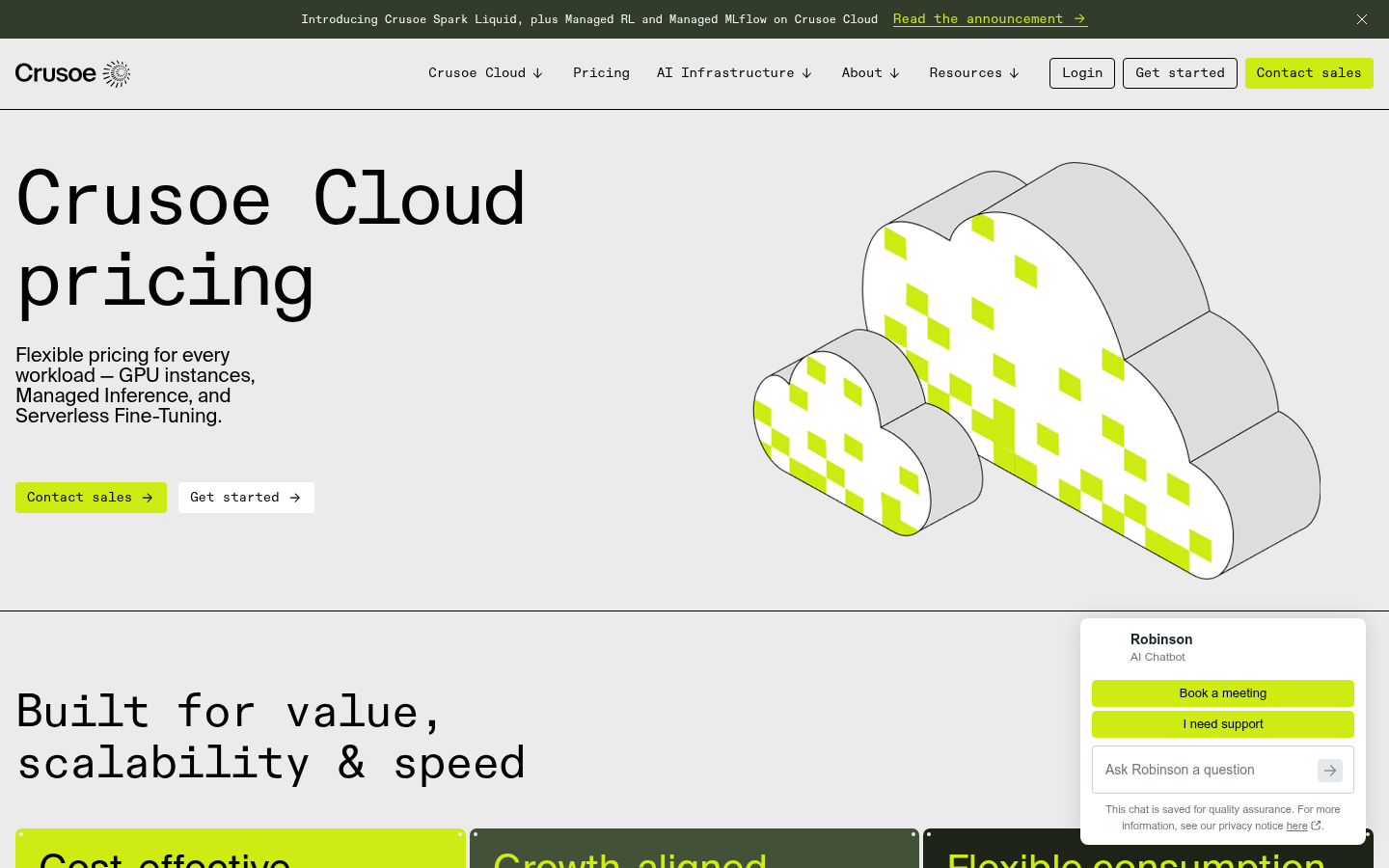
The captured pricing page offers on-demand, reserved and spot compute, self-serve model deployments, and tailored deployments involving direct benchmarking with Crusoe. It explicitly describes self-serve endpoints without a sales engagement while reserving negotiated terms for volume and commitments. That is direct evidence of a hybrid route, not a blanket claim that all revenue is sales-led. [3]
Crusoe’s current partner page describes a commercial referral program that introduces qualified customers, joint buyer targeting, and channel partners that combine Crusoe with their services and customer relationships. Those mechanisms support a present Partner Led route. The page does not disclose partner-sourced revenue or a named partner-closed first sale. Oracle’s Abilene role separately establishes a customer and infrastructure relationship, which alone would not prove partner-led conversion. [6][7]
[Inference] Infrastructure supply and sales conversion must be tracked separately. Referral and channel programs can create opportunities; power, hardware and construction partnerships make the resulting promise deliverable. The sales promise must remain constrained by actual capacity, power and region availability. An aggressive pipeline target cannot make a data center ready sooner by itself.
[3] [6] [7]Crusoe product and market: Complexity, decision-making & market maturity
Crusoe’s 2026 Fireworks case identifies NVIDIA clusters, Managed Kubernetes, Command Center and AutoClusters as the operating stack. It describes workloads spreading from short chat interactions to longer and more varied agent workloads. [4]
[Inference] The buyer is not purchasing a GPU in isolation. They are buying useful, available compute delivered when their own product needs it. A technical evaluator must test the workload; security and procurement assess risk; leadership weighs continuity and financial commitment. This naturally supports sales engineers and customer-success engineers even when the first instance can be launched online.
[4]Crusoe people and process: Who supplied the missing capabilities
The company’s leadership page identifies Jay Maloney as SVP of Cloud Sales, with previous leadership at Imply, Rockset, AWS and MapR and more than a decade at Oracle. It names Chris Dolan, co-founder and former CEO of 365 Main, as Chief Data Center Officer, and Michael Gordon, former MongoDB COO/CFO, as COO/CFO. [8]
[Inference] These hires address different constraints: Maloney translates technical products into commercial relationships; Dolan brings facilities development and operating experience; Gordon brings finance and scaling discipline. It would be misleading to credit customer growth solely to the founders’ technical insight when enterprise customers also require commercial and delivery institutions.
The captured pricing page contains metadata for Qualified’s web application. [Inference] That is evidence of an embedded website tool, not proof of which CRM Crusoe uses or how many opportunities the widget generated. No verified sales-coaching curriculum or compensation plan was recovered. [3]
[3] [8]Crusoe retention and expansion: Expansion happens in the operating room
In Crusoe’s Fireworks case, Yun Jin, Head of AI Infrastructure, describes shared monitoring, operating procedures and automated failure handling. Chenyu Zhao recounts weekend capacity discussions followed by thousands of nodes coming online shortly after signing. The source reports joint planning against regions, power and data-center roadmaps. These are vendor/customer statements, not independently audited service metrics. [4]
[Inference] The expansion mechanism is concrete: when the customer wins, its token workload grows and it needs more capacity. A support team that participates in future workload planning can see expansion before a renewal date. Conversely, fast response without reservable capacity is not enough; the account manager needs operational authority and a realistic supply plan.
Crusoe’s customer page describes a Customer Success Engineering function and reports an average first response below six minutes. Treat this as the company’s service claim, not a contractual promise. The named frontline CSMs and their individual account portfolios were not verified. [9]
[4] [9]Crusoe pricing and economics: Pricing & the economics that matter
The captured rate card separately lists compute, storage, managed Kubernetes, fine-tuning and inference. Its current-versus-new price columns announce changes beginning December 1, 2026; they must not be blended into a single current price. Persistent disk storage is listed at $0.08 per GiB per month and managed Kubernetes at $0.10 per cluster-hour in the capture. [3]
[Inference] Implied economics differ sharply from pure SaaS. Hardware depreciation or financing, electricity, facility costs, useful utilization and support all matter. Longer commitments can reduce unused capacity risk but introduce counterparty concentration. Customer cloud savings do not disclose Crusoe’s own margin. Neither CAC payback nor account-level contribution margin is verified here.
The Windsurf case reports one-day onboarding, 50% GPU savings versus traditional cloud alternatives and 99.98% cluster uptime. Those outcomes explain the economic value proposition for that named customer; they should not be generalized to every workload or confused with Crusoe’s gross margin. [5]
[3] [5]Crusoe experiments and lessons: What changed, what worked & what remains exposed
Crusoe announced the divestiture of its bitcoin and Digital Flare Mitigation operations to NYDIG in March 2025. Its founders framed this as concentrating on vertically integrated AI infrastructure while retaining the energy-first approach. A divestiture establishes a strategic change; it is not by itself proof the prior business failed. [1]
[Inference] The strongest strategic move was carrying an energy and infrastructure capability into an expanding compute market. The weak point is that a distinctive supply story can be diluted if commercial messaging outruns operating proof. Buyers need comparable benchmarks and delivered capacity, not only a sustainability narrative.
[Inference] A better management dashboard would separate signed commitments, deployed capacity, actual utilization, recognized revenue and gross profit. Those are different stages of the engine. It should also report concentration across customers and energy counterparties so that rapid bookings growth does not conceal correlated risk.
[1]Crusoe website and pricing history: Website evolution: energy origin to AI factory positioning
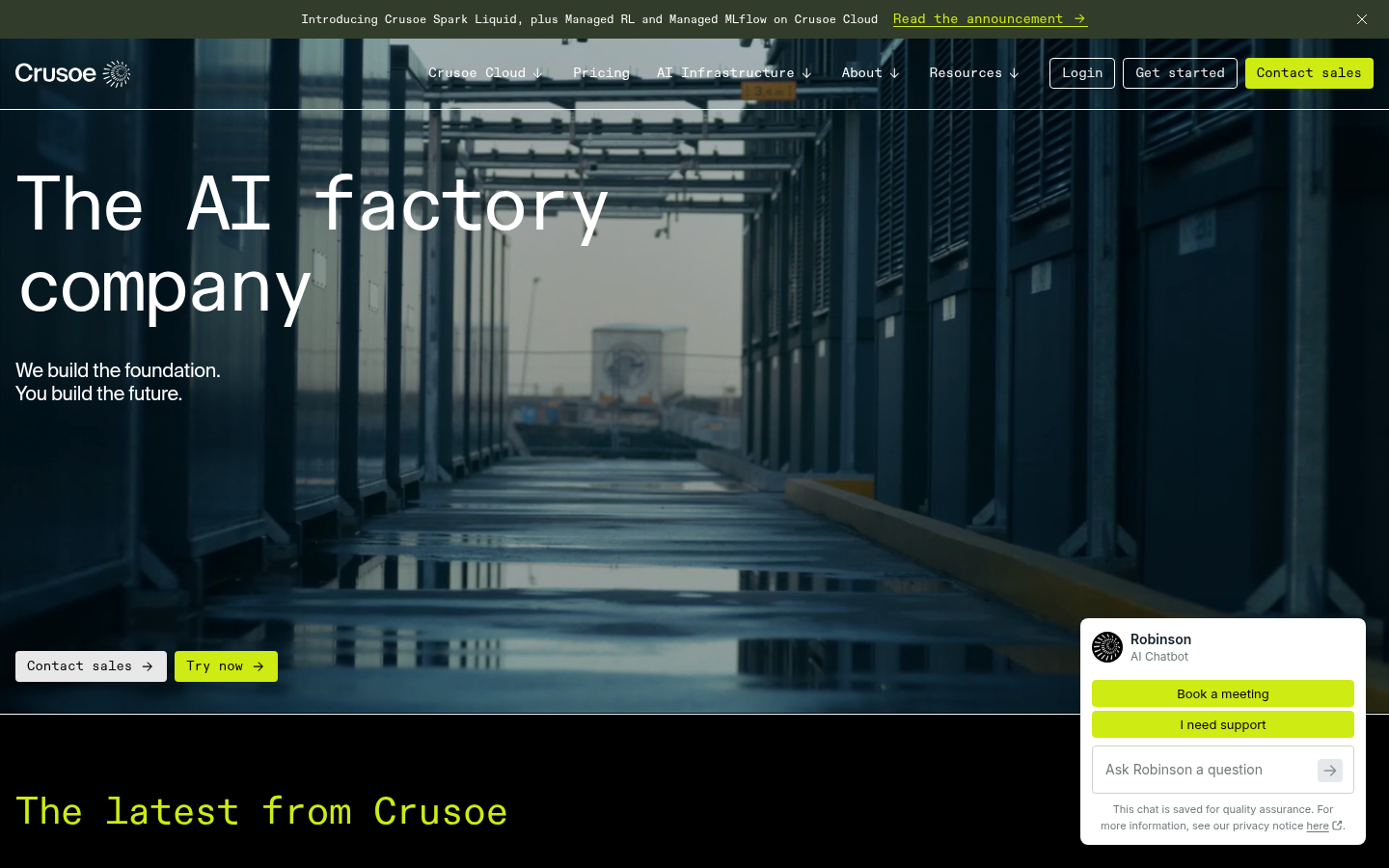
The founders’ 2025 retrospective provides a dated account of the transition from flare-gas computing to AI. The November 2026 homepage capture uses AI-factory positioning and offers managed AI and cloud services alongside physical infrastructure. This documents the change in emphasis through a dated narrative and a current capture; the additional May 2024 pricing capture below provides a directly inspected historical page. [1][2]
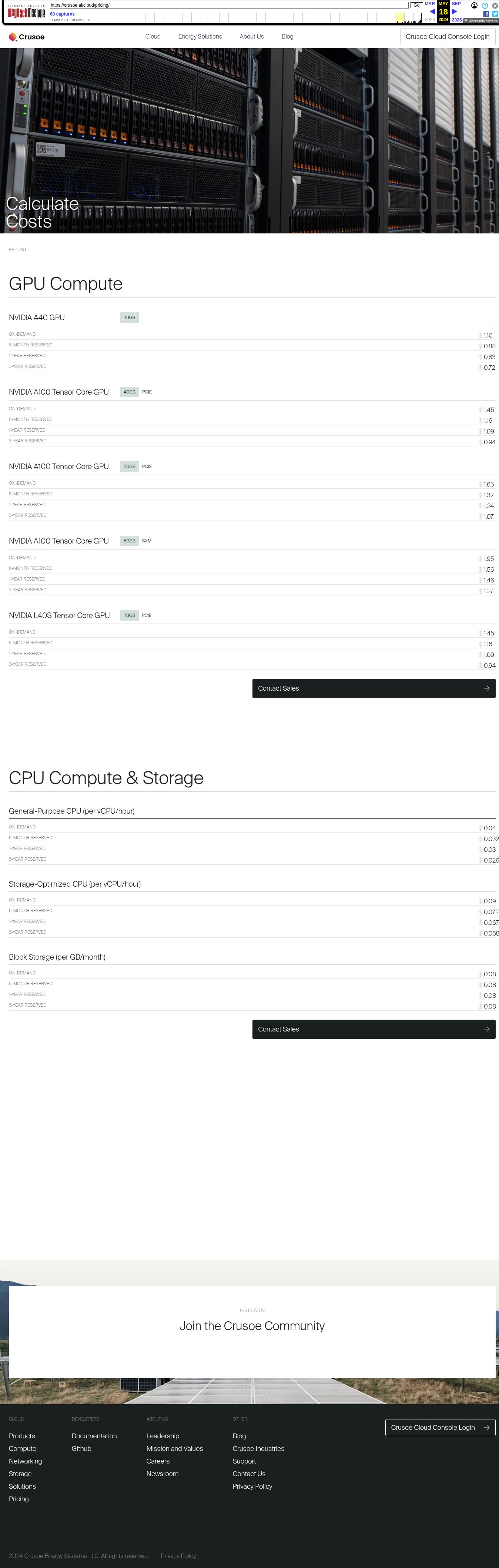
The May 18, 2024 archive presents GPU, CPU, and storage pricing with on-demand, six-month, one-year, and three-year reservations, plus a sales contact. The same capture positions the business around both cloud and energy solutions. It documents a published reservation ladder; it does not disclose realized contract margins. [10]
[Inference] Commitment length was already an economic segmentation tool. Longer commitments can improve capacity planning while asking customers to accept more demand risk; the archive alone cannot establish the size of either benefit. [10]
[1] [2] [10]Crusoe economics at a glance: Pricing is only half the story.
Hourly compute plus storage, Kubernetes and model services; future Dec 1 rates are explicitly distinguished from current rates. [3]
Consumption, reservations and negotiated infrastructure commitments
[Inference] Capital intensity, power cost, useful utilization, financing and counterparty risk.
Not publicly verified
No verified cohort retention; named expansion stories are not NRR
The people in the Crusoe GTM story: People & capabilities.
Chase Lochmiller
Co-founder & CEOCo-authors the company’s energy-first origin and transition account. Additional education and early-career detail not independently verified in this case. [1]
Set the energy-led computing thesis and AI infrastructure direction. [1]
[1]Jay Maloney
SVP, Cloud SalesPrior Imply CRO, Rockset sales VP, AWS/MapR leadership and Oracle enterprise sales; USC B.A. [8]
Leads Cloud sales and partnerships. [Inference] Experience fits a complex technical enterprise motion.
[8]“We partner with Crusoe to build the monitoring system together.”Yun Jin, Fireworks [4]
Crusoe GTM: critical reading and analysis: Why it worked.
Where it breaks.
What worked—and why
[Inference] Energy expertise created a differentiated supply capability as AI demand expanded.
[Inference] Technical customer engineering linked operational reliability to expansion.
What did not work
No verified claim of failed early sales channel was found. The bitcoin divestiture is documented, but its financial outcome is not established here. [1]
What could have been better
[Inference] Separate cloud, campus and partner economics so blended growth does not hide poor utilization or concentration.
[Inference] Tie expansion promises to capacity milestones and customer workload forecasts.
What another founder can use
[Inference] In infrastructure, the bottleneck you remove may be physical availability rather than software usability.
[Inference] A successful customer can become the best demand forecast if engineering and commercial teams share the account plan.
Crusoe website and pricing captures: Product, positioning & pricing.
Captures and image sources are dated individually. Historical gaps are kept explicit. Explore the visual archive
Crusoe go-to-market FAQ: The questions that matter.
Is Crusoe product-led or sales-led?
Its published routes combine self-serve compute with negotiated deployments and infrastructure relationships; [Inference] the motion depends on commitment size and operational complexity. [3][6]
How does Crusoe expand accounts?
The Fireworks case documents joint capacity planning and engineering as the customer’s workloads grow. [4]
Crusoe sources and open questions: Follow the sources.
- Powering the future of AI: our next chapter Crusoe · primary · 2025-03-25
Founders describe energy origin and divestiture; page also displays later update date
- Homepage Crusoe · primary
Captured 2026-11-10: AI factory, cloud and sales routes
- Cloud pricing Crusoe · primary
Captured 2026-11-10; current and future prices; self-service and tailored routes
- Fireworks scaled to thousands of nodes Crusoe · primary · 2026-09-24
Named customer operating and expansion account
- Windsurf at half the GPU cost Crusoe · primary · 2026-07-08
Company-published onboarding, cost and reliability results
- Abilene data-center award Crusoe · primary
Oracle as customer and strategic partner
- Partners Crusoe · primary
Current page explicitly describes qualified-customer referrals, joint buyer targeting, and channel solution partners, separately from technical delivery partnerships.
- Leadership Crusoe · primary
Named roles, prior employers and education
- Customer support and cases Crusoe · primary
Customer Success Engineering and reported response metric
- Crusoe archived pricing — 2024-05-18 Crusoe / Internet Archive · primary · 2024-05-18
Timestamped pricing page inspected during research. Rendering limits are stated in the case.
What remains unverified
First signed customer and founder sales process not verified.
CAC, recognized revenue, gross margins and retention cohorts not verified.
Individual CS/AM biographies and sales training details not found.
Website tooling metadata is not a complete verified GTM stack.
The partner program documents referral and channel mechanisms, but no partner-sourced revenue share or named partner-closed first sale was verified.