
Source numbers link to evidence. [Inference] marks analytical judgment, including motion classifications and causal explanations. Public evidence does not establish every internal decision or metric.
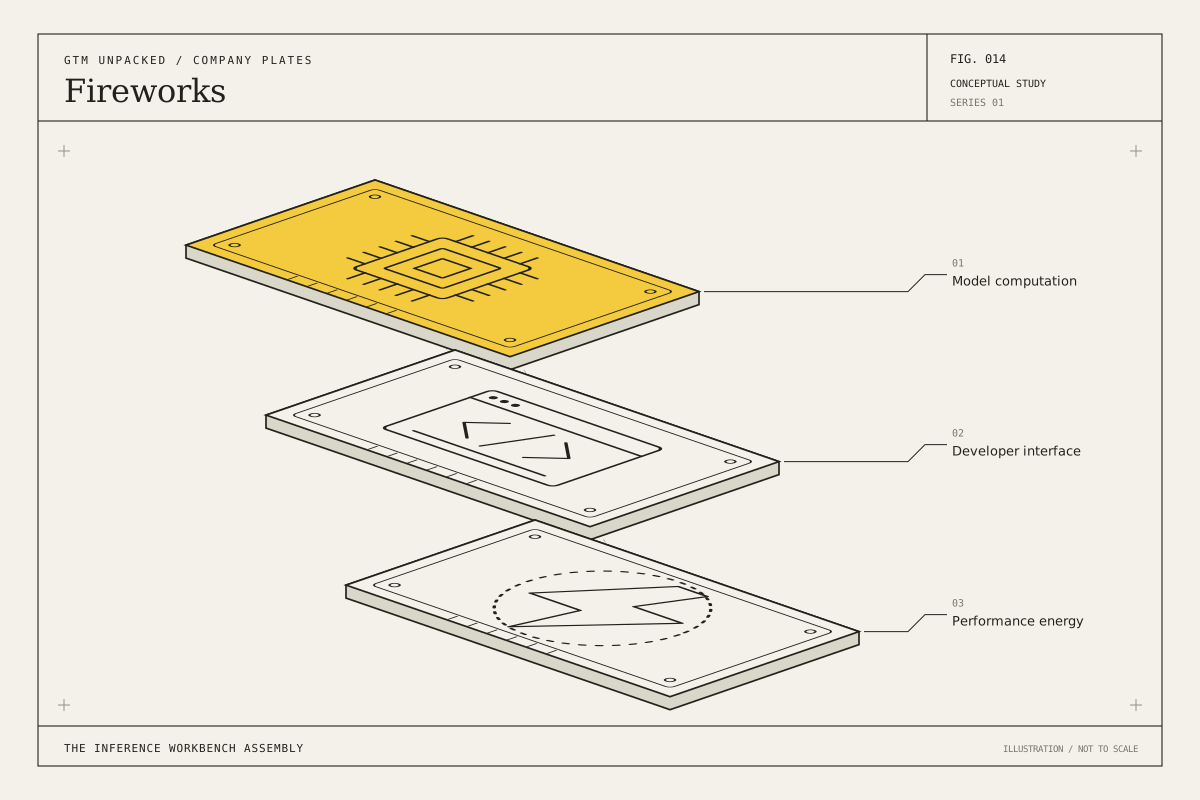
Conceptual illustration juxtaposing a chip, code brackets, and lightning bolt to express computation, developer access, and performance as metaphors rather than benchmark claims.
- Company
- Fireworks · AI inference & training · fireworks.ai
- Conversion motions
- [Inference] This research classifies Fireworks as Product Led, Human Led and Partner Led.
- Fireworks beachhead
- Developers and AI-native teams needing fast, economical serving for open models. [1]
- Fireworks target customer
- AI product builders, enterprise AI teams and organizations wanting specialized models with control over cost and deployment. [2][3]
- Product complexity
- [Inference] The API can be simple while kernels, sharding, model optimization and production operations remain highly complex. [1]
- Decision-making unit
- [Inference] Small evaluations can be developer decisions; production and sovereign deployments add executives, security, procurement and infrastructure owners.
- Market at entry
- [Inference] The company emerged as generative applications were moving from demos toward production, creating a latency and cost problem. [1][4]
- Market today
- [Inference] Specialized inference is competitive; the sales conversation increasingly includes model ownership, customization and the economics of sustained production. [3][5]
- Evidence
- Deep research · 13 linked sources · research date · method and limitations
The ten-step Revenue Engine reading map
These links locate relevant evidence. A linked section does not imply every detail of the step is publicly established.
- Acquire Your First Customers: Founder Led Sales Read first customers
- Embrace GTM Experimentation Read experiments & lessons
- Understand Your GTM Motion Options Read GTM motion
- Pick Your GTM Motion Read beachhead & buyer · Read product & market
- Generate a Lead Read GTM motion · Read experiments & lessons
- Turn Leads into Paying Customers Read GTM motion · Read people & process
- Retain and Grow Your Customers Read retain & expand
- Build Your GTM Team Read people & process
- Plan Your Tech Stack Read experiments & lessons · Read people & process · Read product & pricing archive
- Optimize and Scale Through Metrics Read pricing & economics
Fireworks GTM timeline: From wedge to engine.
Fireworks origin and first customers: Founding capability & the first-customer evidence gap
Fireworks’ official founding-team page lists Lin Qiao, Benny Chen, Dmytro Dzhulgakov, Pawel Garbacki, Dmytro Ivchenko, James Reed and Chenyu Zhao. Sequoia’s 2024 company essay connects the team’s experience to Meta’s PyTorch and Google infrastructure. [2][4]
In a Sequoia interview, Qiao describes moving Meta’s AI workloads onto PyTorch and spending years rebuilding the necessary training and serving systems. Fireworks’ stated ambition was to compress that effort for other organizations. This provides unusually direct founder-product fit; it does not reveal the first signed customer or establish that the first deal came through a former employer. [1]
[Inference] The founding advantage was tacit operating knowledge: knowing which abstractions remain usable when workloads become large. That is more specific than simply having AI credentials. The exact balance of founder outreach, developer inbound and investor introductions at the first ten accounts remains unverified.
[1] [2] [4]Fireworks beachhead and buyer: From model access to an application-level bottleneck
The early thesis described in Qiao’s interview is that production applications encounter latency and cost constraints after proving initial demand. A responsive consumer experience may be impossible if each model call is too slow or expensive. [1]
[Inference] The attractive beachhead is therefore an application with measurable serving pain and a clear reason to use an open or customized model. Selling a benchmark alone is weaker than connecting that benchmark to completion time, user experience and gross profit per task. A team still searching for any useful AI feature may generate trials without durable consumption.
[1]Fireworks GTM motion: The ladder from tokens to technical enterprise sales
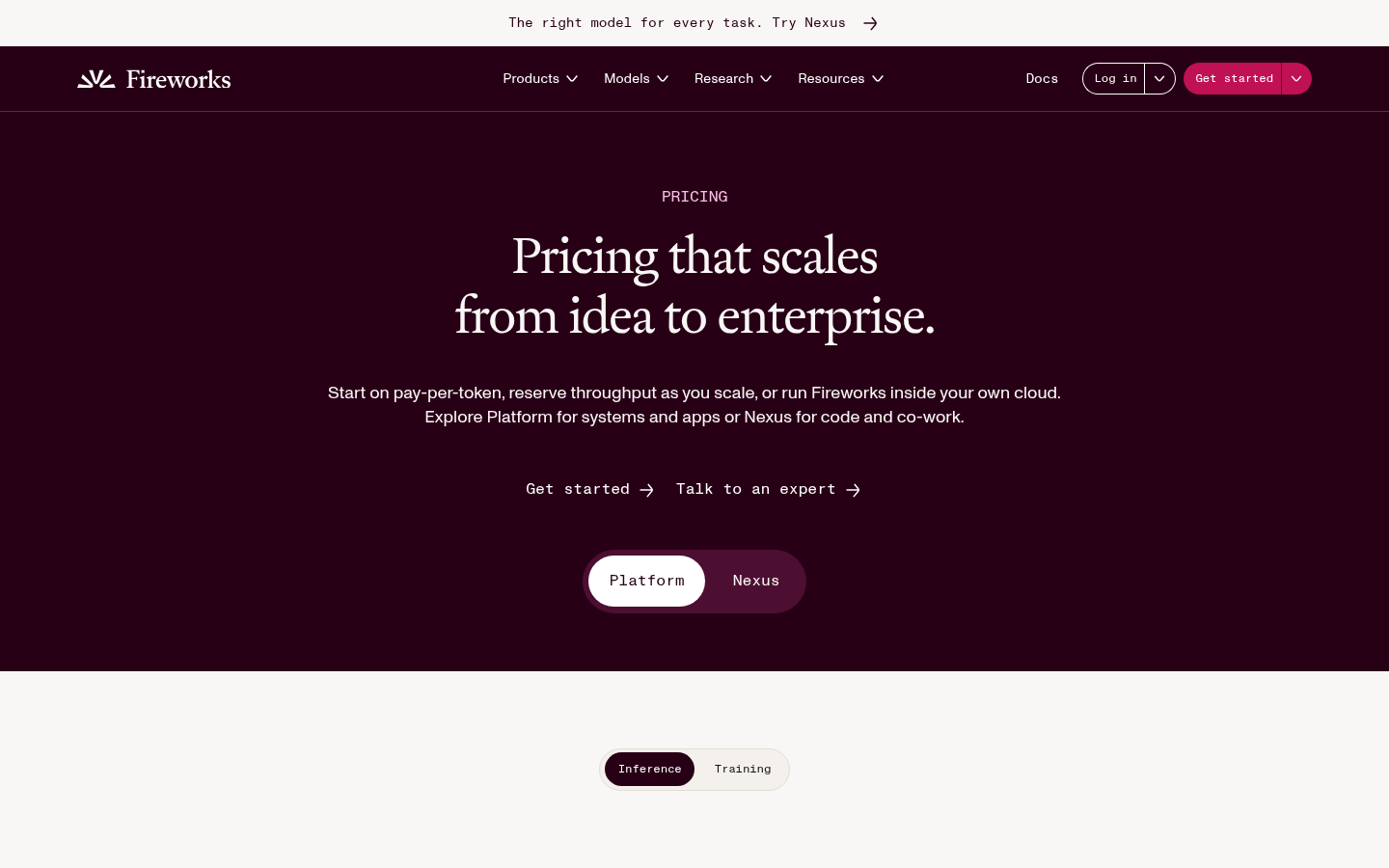
The captured rate card begins with no-commitment serverless tokens and progresses to reserved throughput, dedicated GPUs and Fireworks Sovereign inside the customer’s infrastructure boundary. It also advertises co-development with forward-deployed researchers and engineers. [3]
A November 2026 interview recap names Soumya Tulloss as SVP of Sales. It describes an in-person FIRE approach, technical selling, proof-of-value execution and CEO/board-level conversations. Role plays are part of sales hiring. The recap is a publisher summary; the underlying episode was not independently transcribed in this research. [5]
Fireworks also documents a partner-mediated purchase route: customers can buy through Microsoft Foundry under Azure billing and Microsoft’s terms, with qualifying usage counting toward existing cloud commitments. Its Microsoft page names UiPath and StackBlitz/Bolt as users of that offering. The ecosystem page separately lists AWS and Google Cloud marketplaces. These are procurement mechanisms, beyond GPU supply relationships; their share of revenue is not disclosed. [11][12]
[Inference] Product-led entry lowers the cost of a first experiment; human-led work resolves the hard production choice. These are complementary only when the account handoff preserves the developer’s context. If sales restarts discovery from zero or pitches generic AI transformation, it can destroy the speed advantage the product created.
[3] [5] [11] [12]Fireworks product and market: What looks simple must absorb real complexity
The October 2025 Deployment Shapes announcement explains that Fireworks had manually tuned GPU choice, quantization and other serving parameters with customers. It introduced preconfigured choices aimed at cost, speed or throughput. Serverless provides an easy shared configuration; dedicated deployments fit higher volume, custom models or tighter latency needs. [6]
[Inference] This is a meaningful productization step for the revenue engine. Repeated customer engineering becomes a reusable product path, reducing the effort required to expand an account. But preconfiguration has boundaries: unusual workloads still require expert work, and the public page acknowledges that typical prompt assumptions may not fit everyone. [6]
[6]Fireworks people and process: The people behind the commercial transition
Qiao’s firsthand account ties her expertise to PyTorch and production infrastructure at Meta. Dzhulgakov and the wider founding team are named on the official site; no unsupported educational credentials are assigned to them here. [1][2]
Tulloss came through Deutsche Bank finance and business operations before becoming an AE and spending seven years at Twilio. The published recap says she joined Fireworks in 2026 when its GTM group was around 20 people. [5]
[Inference] Her relevant transfer is the experience of adding enterprise selling to a platform with a developer-adoption heritage. It is not a guarantee that Twilio’s old quotas or staffing ratios fit inference economics. The analogous skill is building a technical commercial organization without losing the initial developer relationship.
[1] [2] [5]Fireworks retention and expansion: Optimization is both service and expansion
The Cursor customer case describes Fast Apply using speculative decoding. A separate FireOptimizer article reports that Cursor’s custom models saw roughly a twofold generation-latency improvement and identifies Sualeh Asif as the customer co-founder providing the testimonial. These are vendor-published customer claims, not universal benchmark results. [7][8]
[Inference] Expansion can happen without new users inside the buying company: a faster model can support more end-user traffic, more tasks or more features. That creates a distinctive account plan based on performance and workload scope. It also creates a commercial tension: lowering cost per task can reduce near-term revenue unless volume or retained share grows.
The current pricing page explicitly offers researcher/engineer co-development from evaluation design to production, priced by engagement. That gives a clear service boundary alongside token consumption. No independently verified account-management staffing ratio or cohort NRR was found. [3]
[3] [7] [8]Fireworks pricing and economics: Measure the finished task, not only the token
On November 10, 2026, Fireworks lists shared serverless pricing from $0.05 per million input tokens and separate output/cache rates by model. Its dedicated rate card lists H100 and H200 GPUs at $8 per hour, and training/co-development have distinct billing paths. These are list prices, not realized customer economics. [3]
[Inference] Effective cost depends on model choice, input/output length, caching, utilization, acceptable quality and retries. A low token price can still produce an expensive completed task. Fireworks’ own economics also depend on purchasing capacity and keeping it productively occupied; price and customer savings alone do not reveal gross margin.
Crusoe’s Fireworks case describes shared engineering, capacity planning and multi-region NVIDIA infrastructure beneath the inference service. This is evidence that supplier relationships and operating execution are part of the GTM promise. It is not evidence that Fireworks owns all its hardware. [9]
[3] [9]Fireworks experiments and lessons: Tools, repeatability & the limits of a success story
The Sequoia interview notes Fathom as a tool used by the Fireworks team for meeting summaries. The 2026 sales-interview recap separately mentions internal Deal Desk and voice role-play agents. Those are the verified tool anecdotes; the podcast’s sponsors should not be treated as Fireworks customers or its internal stack. [1][5]
The Deployment Shapes article is a documented constraint and response: manual optimizations created friction, then the company exposed repeatable configurations. No reliable evidence of a failed marketing channel or a specific lost first deal was recovered. [6]
[Inference] The next operational test is whether expert co-development scales profitably. A company can win demanding customers by donating scarce research time, but the revenue engine must learn which work is reusable and which deserves separate pricing. Track optimization hours, workload expansion and retained gross profit together.
[1] [5] [6]Fireworks website and pricing history: From inference platform to specialized intelligence
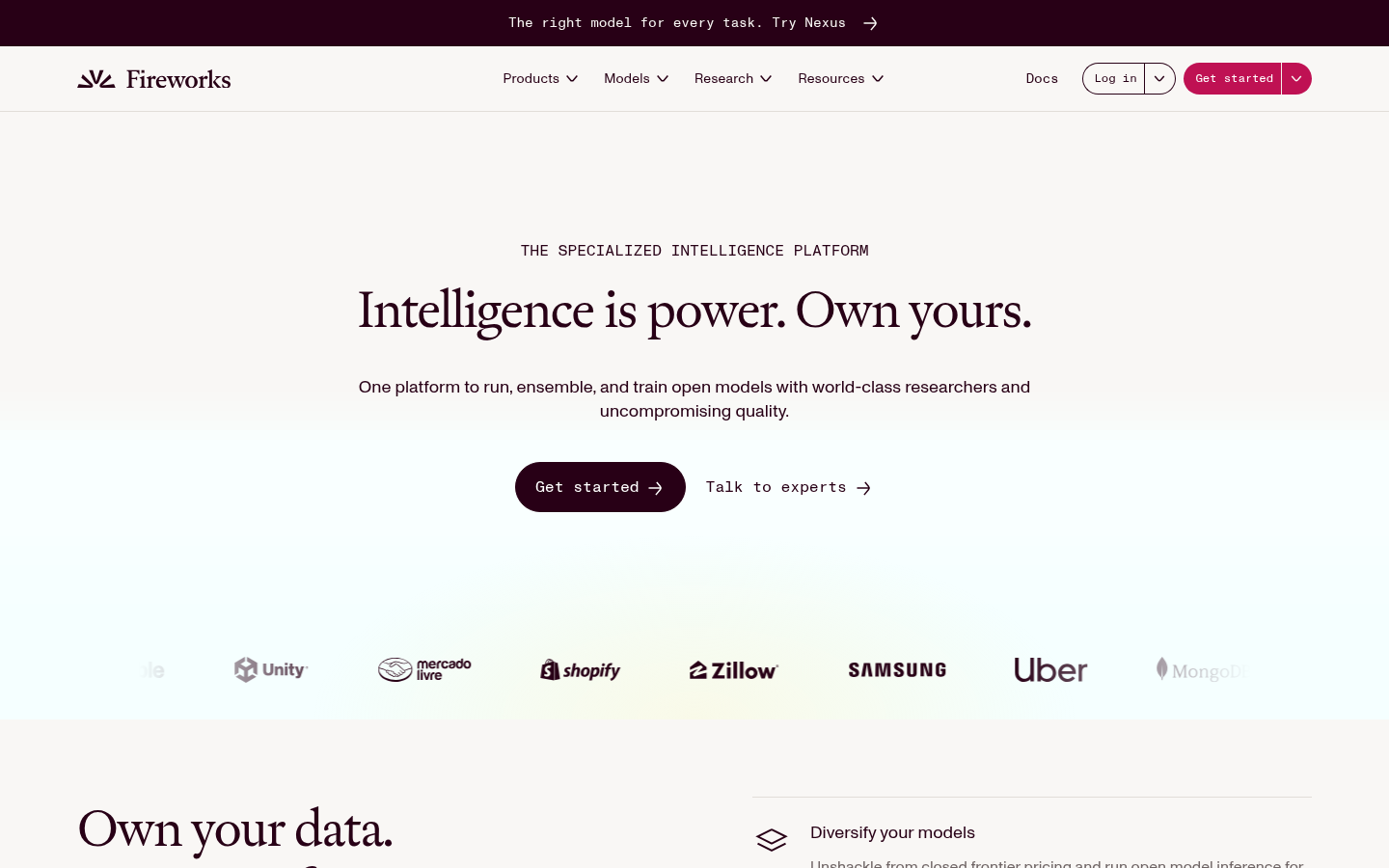
Sequoia’s July 2024 essay described production deployments for compound AI systems. The current homepage capture uses specialized-intelligence positioning, while the current rate card adds training, sovereign deployment and Nexus plans. That supports an observable broadening of the offer; it does not establish that every historical pricing or positioning experiment was successful. [4][10][3]
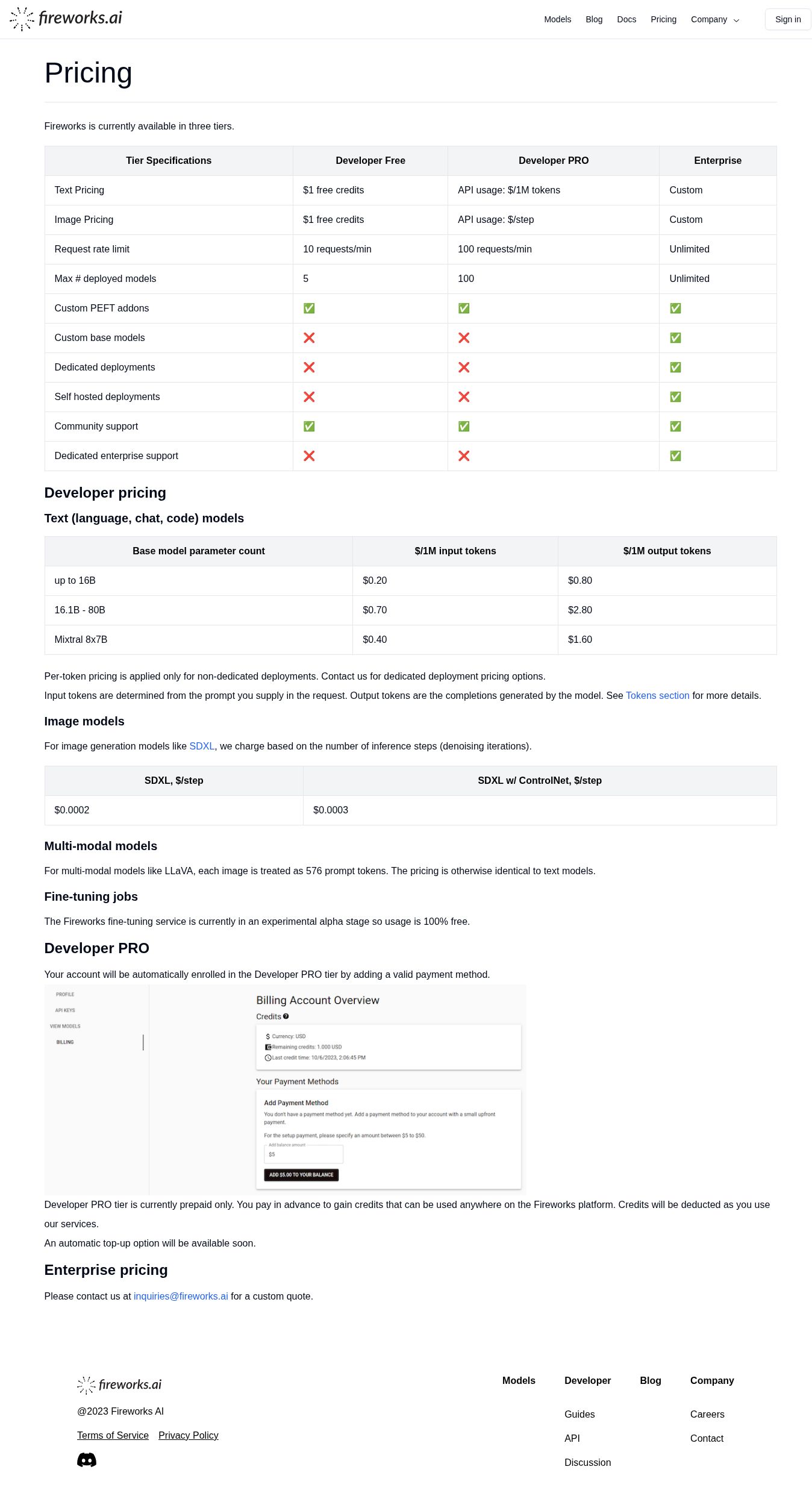
The January 24, 2024 page separates Developer Free, Developer PRO, and Enterprise. Free supplied $1 of credits; adding a payment method enabled prepaid PRO usage. Enterprise included custom base models, dedicated or self-hosted deployments, and dedicated support. Text pricing separated input and output tokens by model-size bands; fine-tuning was described as free experimental alpha usage. [13]
[Inference] This is an early example of a product-led entry feeding a human-led production decision. The commercial boundary was the deployment and support obligation, as well as higher usage. [13]
[3] [4] [10] [13]Fireworks economics at a glance: Pricing is only half the story.
Nov 10 2026 list prices: serverless from $0.05/1M input tokens; H100/H200 dedicated compute $8/GPU-hour; enterprise and co-development terms vary. [3]
Tokens, GPU consumption, commitments and priced research engagements
[Inference] Goodput, model mix, cache utilization, supplier terms and expert labor.
Not publicly verified
No independent cohort NRR verified
The people in the Fireworks GTM story: People & capabilities.
Soumya Tulloss
SVP of SalesFinance and business operations background, followed by AE and leadership experience at Twilio. [5]
Recruited to scale the technical enterprise sales motion. [5]
[5]“Simplicity scales.”Lin Qiao [1]
Fireworks GTM: critical reading and analysis: Why it worked.
Where it breaks.
What worked—and why
[Inference] Hiding infrastructure complexity behind an API makes evaluation accessible while preserving a performance advantage.
[Inference] Customer-specific optimization produces credible reference stories and expansion paths.
What did not work
Public evidence documents friction in manual deployment configuration, not a proven failed acquisition channel. [6]
What could have been better
[Inference] Separate reusable engineering from bespoke services and price the latter deliberately.
[Inference] Measure customer task economics and retained gross profit, rather than celebrating token volume alone.
What another founder can use
[Inference] Productize the repeated work your best technical customer-success people do.
[Inference] Add enterprise sellers who understand the developer’s original reason for adoption.
Fireworks website and pricing captures: Product, positioning & pricing.
Captures and image sources are dated individually. Historical gaps are kept explicit. Explore the visual archive
Fireworks go-to-market FAQ: The questions that matter.
Fireworks sources and open questions: Follow the sources.
- Training Data: Lin Qiao Sequoia · interview · 2024-08-13
Transcript on PyTorch, abstraction, serving and Fathom
- Founding team Fireworks · primary
Official names and portraits
- Pricing Fireworks · primary
Nov 10 2026 capture: token/GPU/reservation/sovereign/service packaging
- Production Deployments for the Compound AI Future Sequoia · primary · 2024-07-11
Founding-team experience and early positioning
- Inference sales with Soumya Tulloss The Crew · interview · 2026-11-04
Publisher recap: career, hiring, in-person selling and internal agents
- Deployment Shapes Fireworks · primary · 2025-10-23
Manual optimization, self-serve vs dedicated, reusable configurations
- How Cursor built Fast Apply Fireworks · primary · 2024-06-23
Named technical customer story
- FireOptimizer Fireworks · primary
Cursor latency testimonial; performance is workload-specific
- Fireworks expansion on Crusoe Crusoe · primary · 2026-09-24
Named customer/supplier co-engineering and capacity expansion
- Homepage Fireworks · primary
Captured Nov 10 2026 specialized-intelligence positioning
- Fireworks on Microsoft Foundry Fireworks · primary
Retrieved Nov 10 2026: first-party Microsoft procurement and Azure billing; cloud commitment eligibility; named UiPath and StackBlitz/Bolt testimonials.
- Fireworks Frontier Ecosystem Fireworks · primary
Retrieved Nov 10 2026: Microsoft Foundry billing and AWS/GCP marketplace purchase routes; partner referrals and developer distribution details.
- Fireworks archived pricing — 2024-01-24 Fireworks / Internet Archive · primary · 2024-01-24
Timestamped pricing page inspected during research. Rendering limits are stated in the case.
What remains unverified
First paying customer, exact founder outreach process and first contract not verified.
CAC, payback, gross margin and cohort retention not verified; the unverified $800M figure in this project’s starting list not used as verified ARR.
Full sales interview audio not transcribed; recap is labeled as such.
Named frontline AM/CS personnel and complete internal CRM stack not verified.
Cloud-partner procurement is documented, but partner-sourced revenue share and contribution to the earliest customer cohort remain unverified.