Source numbers link to evidence. [Inference] marks analytical judgment, including motion classifications and causal explanations. Public evidence does not establish every internal decision or metric.
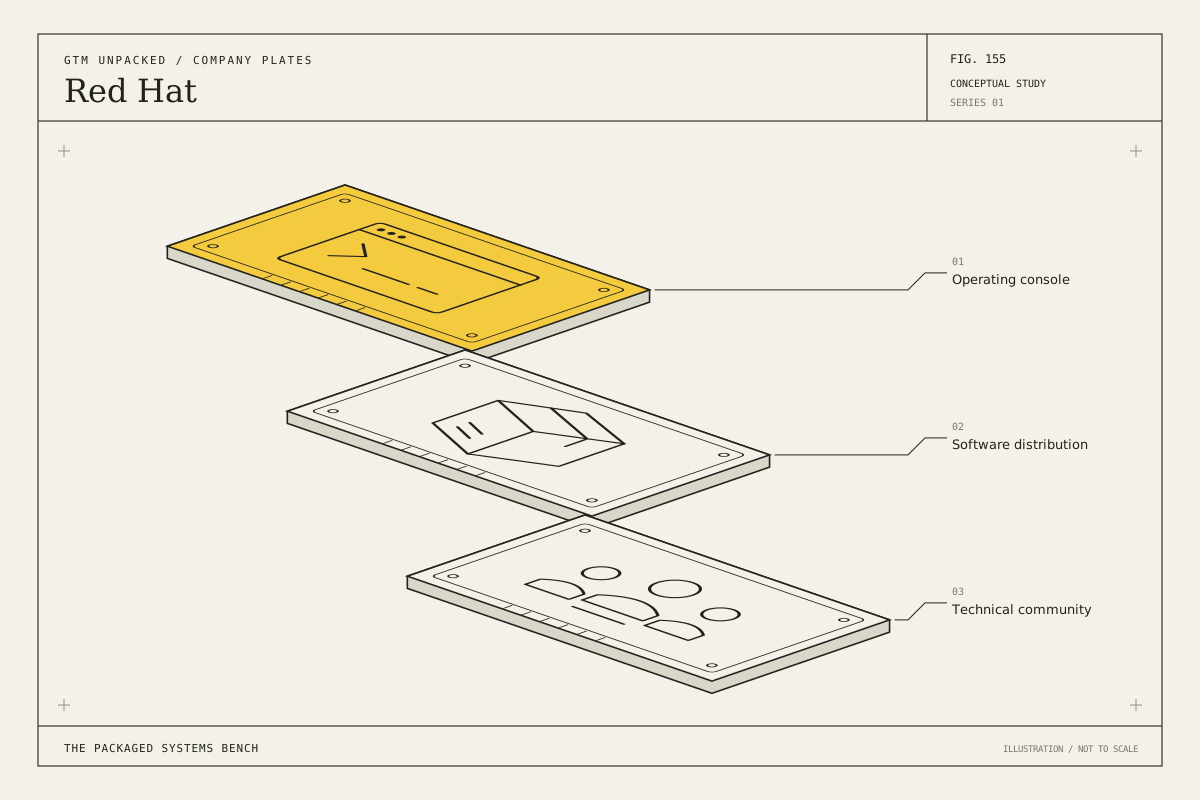
Conceptual illustration for Red Hat: a terminal, software-like package, and people form a systems workbench about making technical tools available and understandable.
- Company
- Red Hat · Developer tools and communities · redhat.com
- Conversion motions
- [Inference] This research classifies Red Hat as Partner Led, Human Led and Product Led.
- Red Hat beachhead
- Linux users buying packaged distributions through a computer-supply catalog. [1]
- Red Hat target customer
- Organizations operating supported enterprise Linux and related hybrid-cloud platforms. [3]
- Product complexity
- [Inference] Installing a distribution is bounded; operating a certified enterprise estate is complex.
- Decision-making unit
- [Inference] Enterprise infrastructure decisions involve operations, procurement, risk and application owners.
- Market today
- A mature ecosystem combines enterprise subscriptions, certifications, cloud deployment and partner services. [3][4]
- Evidence
- Source-backed brief · 5 linked sources · research date · method and limitations
The ten-step Revenue Engine reading map
These links locate relevant evidence. A linked section does not imply every detail of the step is publicly established.
- Acquire Your First Customers: Founder Led Sales Read first customers
- Embrace GTM Experimentation Not established in this entry
- Understand Your GTM Motion Options Read GTM motion
- Pick Your GTM Motion Not established in this entry
- Generate a Lead Read GTM motion
- Turn Leads into Paying Customers Read GTM motion · Read people & process
- Retain and Grow Your Customers Read retain & expand
- Build Your GTM Team Read people & process
- Plan Your Tech Stack Read people & process
- Optimize and Scale Through Metrics Read pricing & economics
Red Hat origin and first customers: A seller recognized repeated demand
Red Hat’s official history pairs Marc Ewing, who assembled Linux distributions on CDs at home, with Bob Young, who ran a computer-supply catalog. Young repeatedly sold out of Ewing’s CDs; they joined forces in 1995. This is evidence of demand observed through actual distribution, not a retrospectively invented first enterprise contract. [1]
In a founder interview, Young explained that growing sales of open-source software made him worry about competing with larger retailers. A recognizable product brand could instead turn those retailers into customers. Existing buyers recommended Ewing’s work. The commercial insight was about position in the channel as well as the quality of the software. [2]
[1] [2]Red Hat GTM motion: The paid promise moved beyond a copy of the software
The current subscription model combines software access with updates, support and an ongoing relationship. The enterprise Linux guide distinguishes deployment and subscription choices across physical, virtual and cloud environments, with support levels and add-ons. This is a service and assurance proposition around open-source technology, rather than a claim that source code must be scarce to create revenue. [3]
[Inference] Product adoption establishes technical relevance, while enterprise buying asks who will maintain, troubleshoot and support a consequential deployment. Human sales and partners fit this broader decision because the customer often needs integration and operating confidence, not only installation media. [1][3]
[1] [3]Red Hat people and process: Complementary founding capabilities mattered
Ewing supplied the technical distribution work; Young brought catalog selling and the recognition that a brand could organize demand. The official history’s account of Ewing’s recognizable red hat also shows how a personal marker became a company identity. The brief does not establish the first field salesperson, their training or a named early account owner. [1][2]
[Inference] This pairing made commercial packaging a first-class concern. A technically capable team may still need a person who understands how buyers discover, procure and trust the offering. Conversely, channel skill would not sustain renewals without credible engineering and support. [1][3]
[1] [3]Red Hat retention and expansion: Partners extend delivery as well as reach
The current partner program offers demonstration resources, subscriptions, deal registration and sales enablement, with access to partner account management. Partner benefits include role-specific training in sales, technical sales and delivery. These are concrete mechanisms for increasing the ecosystem’s ability to sell and implement products, not a verified measure of partner-sourced revenue. [4]
[Inference] Expansion can follow additional workloads and related platforms when customers trust the operating relationship. Training and certification can help make adoption repeatable across a distributed estate. The risk is inconsistent delivery between vendor and partner; clear responsibility and customer outcomes should accompany any expansion target. [3][4]
[3] [4]Red Hat pricing and economics: Subscriptions monetize maintained capability
The current Linux store offers several configurations and starting prices; the subscription guide explains that product, architecture, deployment and support choices affect entitlement. This brief does not reduce those alternatives to one universal price or project today’s store backward onto the CD business. [3][5]
[Inference] Recurring support revenue can be attractive only if engineering, maintenance and assistance costs remain supportable. Open-source availability makes trust, compatibility and service important differentiators, but does not imply zero cost or a guaranteed retention rate. No verified CAC or account-level margin is supplied. [3]
[Inference] The transferable lesson is to commercialize the missing operational job around a technology people already value. The improvement to test is whether every packaging or channel change makes the customer’s responsibilities clearer; complexity can weaken the very assurance that earns the subscription. [3][4]
[3] [4] [5]Red Hat economics at a glance: Pricing is only half the story.
Enterprise subscriptions vary by platform, deployment and support; current store configurations are not historical CD prices. [3][5]
See the dated pricing analysis.
[Inference] The relevant costs and conversion frictions are discussed in the analysis; no invented margin model is supplied.
Not verified in this brief.
No cohort retention figure verified in this brief.
The people in the Red Hat GTM story: People & capabilities.
Red Hat GTM: critical reading and analysis: Why it worked.
Where it breaks.
What worked—and why
[Inference] Distribution experience and technical credibility combined into a paid operating relationship.
What did not work
Young identified the risk of competing directly with larger retailers. [2]
What could have been better
[Inference] Keep support responsibilities and partner delivery standards clear as accounts expand.
What another founder can use
[Inference] Commercial distribution made Linux accessible; subscriptions made it operable for enterprises.
Red Hat go-to-market FAQ: The questions that matter.
How did Red Hat find its GTM motion?
Commercial distribution made Linux accessible; subscriptions made it operable for enterprises. See the sourced account and explicitly labeled analysis above.
Red Hat sources and open questions: Follow the sources.
- Red Hat History Red Hat · primary
Inspected for the facts attributed in this brief; current pages observed November 10, 2026.
- Bob Young on Red Hat’s Origins Computerworld · interview
Inspected for the facts attributed in this brief; current pages observed November 10, 2026.
- Enterprise Linux Subscription Guide Red Hat · primary
Inspected for the facts attributed in this brief; current pages observed November 10, 2026.
- Partner Program Benefits Red Hat · primary
Inspected for the facts attributed in this brief; current pages observed November 10, 2026.
- Linux Platforms Store Red Hat · primary
Inspected for the facts attributed in this brief; current pages observed November 10, 2026.
What remains unverified
First paid account and its original contract were not verified.
Named early sales and customer-success hires, training, compensation and individual account assignments remain incompletely documented.
No verified CAC, payback, funnel conversion or numerical retention series in this brief.
Historical website/pricing screenshots were not captured for this company; dated textual evidence is distinguished from current pages.
No verified visual capture is attached to this entry. A current screenshot is not a substitute for a historical capture.