Source numbers link to evidence. [Inference] marks analytical judgment, including motion classifications and causal explanations. Public evidence does not establish every internal decision or metric.
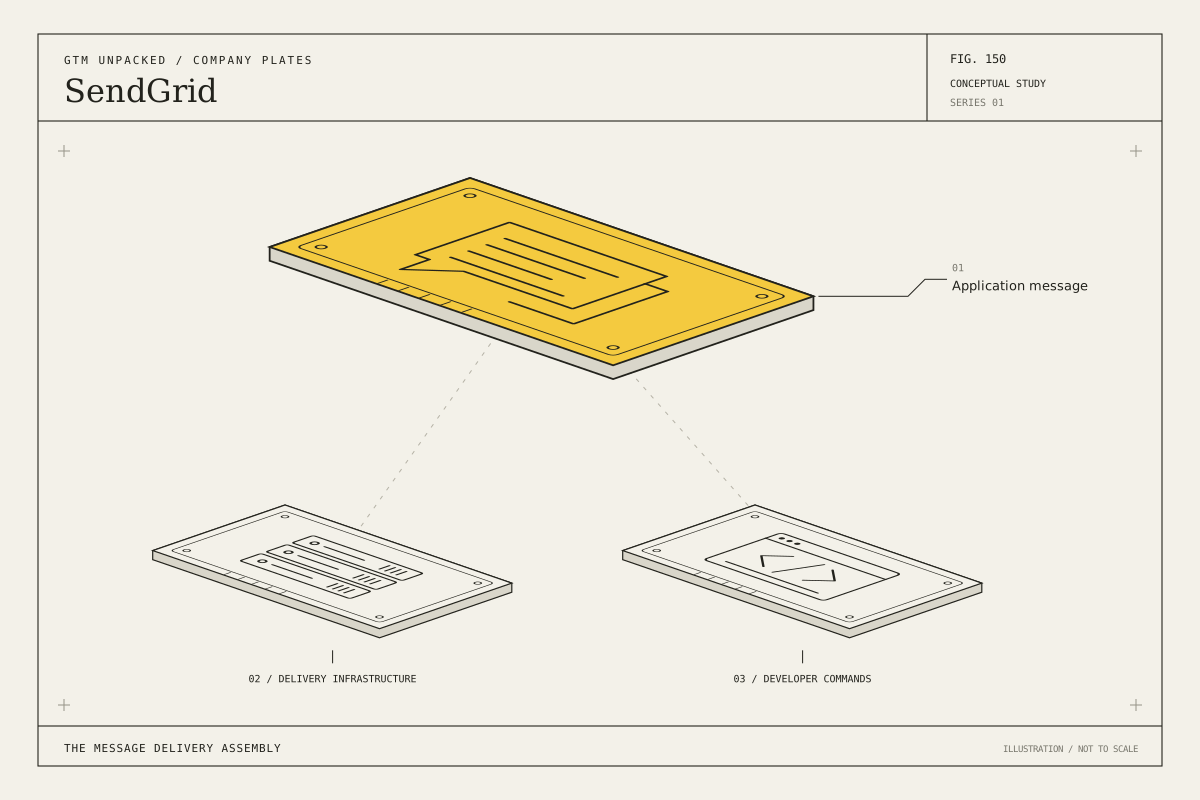
Conceptual illustration combining a message, server, and code brackets to frame application communication, without claiming delivery guarantees or diagramming the company's infrastructure.
- Company
- SendGrid · Developer tools and communities · sendgrid.com
- Conversion motions
- [Inference] This research classifies SendGrid as Human Led, Product Led and Partner Led.
- SendGrid beachhead
- Application developers whose transactional emails failed to reach recipients. [1]
- SendGrid target customer
- Developers and email-program operators requiring reliable delivery, analytics and support. [2]
- Product complexity
- [Inference] Three-setting SMTP adoption hides complex deliverability operations.
- Decision-making unit
- [Inference] A developer can start; high-volume or critical email programs bring operational and commercial approval.
- Market at entry
- Email delivery existed, but the founder found application teams struggling with evolving filters and reputation. [1]
- Market today
- The current offer spans low-volume API adoption through managed enterprise email programs. [2]
- Evidence
- Source-backed brief · 3 linked sources · research date · method and limitations
The ten-step Revenue Engine reading map
These links locate relevant evidence. A linked section does not imply every detail of the step is publicly established.
- Acquire Your First Customers: Founder Led Sales Read first customers
- Embrace GTM Experimentation Not established in this entry
- Understand Your GTM Motion Options Read GTM motion
- Pick Your GTM Motion Not established in this entry
- Generate a Lead Read GTM motion
- Turn Leads into Paying Customers Read GTM motion · Read people & process
- Retain and Grow Your Customers Read retain & expand
- Build Your GTM Team Read people & process
- Plan Your Tech Stack Read people & process
- Optimize and Scale Through Metrics Read pricing & economics
SendGrid origin and first customers: A customer financed the learning loop
Isaac Saldana told Mixergy that he found prospects in hosting forums, without an established reputation there. An early customer named Sinan, operating Inbox Bulletin in Turkey, helped fund servers while Saldana worked on delivery problems. The transcript also describes personally meeting WeGame’s Jared in San Francisco to build trust. These are founder-led sales and service, not an anonymous viral launch. [1]
Saldana said early tests lost money, prices rose as the team learned, and founders initially went unpaid. He credited Techstars with advice and introductions. The interview’s profitability language therefore needs context: server-cost coverage was not the same as a fully compensated operating profit. [1]
[1]SendGrid GTM motion: Small adoption effort lowered a large trust barrier
The original service could be tried by changing SMTP settings; Saldana emphasized that customers could reverse the change quickly. His initial approach to delivery was incomplete and improved with real traffic. The founder was selling a combination of software, operational attention and learning, not simply a mail-server instance. [1]
[Inference] The product reduced switching effort while personal contact addressed the remaining trust problem. That combination is especially relevant for infrastructure where a failed experiment can harm revenue. Low-friction installation does not eliminate the need for expert assistance when transaction volume and business criticality rise. [1][2]
[1] [2]SendGrid people and process: Technical founders learned the commercial role
Saldana described becoming more comfortable presenting through practice and relying on mentors and his board. He identified Tim Jenkins and Jose as cofounders and discussed group decisions on hiring and employee operations. These details establish practical learning, but do not verify a formal sales-training curriculum or the identity of the first account executive. [1]
The 2017 prospectus names Leandra Fishman Yanagawa as SVP of Sales and Customer Success, joining in August 2016. Her earlier roles included VP of Global Corporate Sales at Jive and VP of Sales at VMLogix. This establishes a later commercial leader, not the first account executive. [3]
[Inference] The distinctive skill was translating a technical delivery issue into a business consequence the customer could observe. Founder effort was expensive but useful before a repeatable qualification process existed. Later commercial teams would need to separate customers requiring a short setup from those needing sustained program management. [1][2]
[1] [2] [3]SendGrid retention and expansion: Support becomes part of the commercial ladder
By the 2017 IPO filing, inside sales handled inbound demand and targeted outbound, with strategic cross-selling of Marketing Campaigns and Expert Services. A dedicated customer-success group worked with larger-volume customers to grow accounts. That is a documented division of selling and expansion responsibilities. [3]
Current SendGrid packages expose documentation and client libraries alongside paid professional services, personalized support and enterprise program management. Higher tiers add dedicated IPs, subusers, analytics and other controls. These features connect expansion to the scale and complexity of the sending program rather than simply to employee headcount. [2]
[Inference] Deliverability enablement remains ongoing because sender behavior, reputation and recipient systems affect outcomes. A responsible expansion motion should link premium assistance to demonstrated operational needs. Selling a larger allowance without helping a customer maintain a healthy program can increase spend while weakening the underlying value. [2]
[2] [3]SendGrid pricing and economics: Volume pricing has operating consequences
Observed November 2026, the Email API page offers a 60-day free trial, Essentials from $19.95 monthly, Pro from $89.95 and custom Premier pricing. Email volume and selected features determine the bill; services can cost extra. This is a current rate card, not evidence that the early forum customers paid those prices. [2]
[Inference] The model combines recurring volume revenue with real delivery, monitoring and service costs. The founder’s loss-making early tests show why revenue alone is insufficient evidence of unit economics. Better experimentation would explicitly track cost per successful delivery, support effort and retention by customer type, while keeping trial reversal simple. No CAC or margin percentage is invented here. [1][2]
[1] [2]SendGrid economics at a glance: Pricing is only half the story.
Email-volume and feature tiers: 60-day trial, Essentials from $19.95/month, Pro from $89.95 and custom Premier. [2]
See the dated pricing analysis.
[Inference] The relevant costs and conversion frictions are discussed in the analysis; no invented margin model is supplied.
Not verified in this brief.
No cohort retention figure verified in this brief.
The people in the SendGrid GTM story: People & capabilities.
Isaac Saldana
CofounderTechnical founder and first-time CEO in the early interview.
Prospected in forums, personally built trust and learned sales presentation through practice and mentorship. [1]
[1]Tim Jenkins and Jose
Cofounders named in the interviewDetailed prior training not established in the inspected interview.
Shared product and company-building work; early compensation was limited. [1]
[1]Leandra Fishman Yanagawa
SVP, Sales and Customer Success (joined August 2016)Previously VP of Global Corporate Sales at Jive and VP of Sales at VMLogix. [3]
Led the sales and customer-success function described in the 2017 prospectus. [3]
[3]SendGrid GTM: critical reading and analysis: Why it worked.
Where it breaks.
What worked—and why
[Inference] Personal trust and a reversible technical trial addressed complementary adoption barriers.
What did not work
Saldana said the initial delivery approach was incomplete and early customer tests lost money. [1]
What could have been better
[Inference] Include founder labor and support in pilot economics.
What another founder can use
[Inference] The founder won trust in forums, then made a risky infrastructure switch easy to reverse.
SendGrid go-to-market FAQ: The questions that matter.
How did SendGrid find its GTM motion?
The founder won trust in forums, then made a risky infrastructure switch easy to reverse. See the sourced account and explicitly labeled analysis above.
SendGrid sources and open questions: Follow the sources.
- How Young SendGrid Delivered Emails and Profits Mixergy · interview
Inspected for the facts attributed in this brief; current pages observed November 10, 2026.
- Email API Pricing Twilio · primary
Inspected for the facts attributed in this brief; current pages observed November 10, 2026.
- SendGrid IPO Prospectus SendGrid / SEC · primary · 2017-11-14
Inspected for the attributed facts; research observed November 10, 2026.
What remains unverified
Named early sales and customer-success hires, training, compensation and individual account assignments remain incompletely documented.
No verified CAC, payback, funnel conversion or numerical retention series in this brief.
Historical website/pricing screenshots were not captured for this company; dated textual evidence is distinguished from current pages.
No verified visual capture is attached to this entry. A current screenshot is not a substitute for a historical capture.