Source numbers link to evidence. [Inference] marks analytical judgment, including motion classifications and causal explanations. Public evidence does not establish every internal decision or metric.
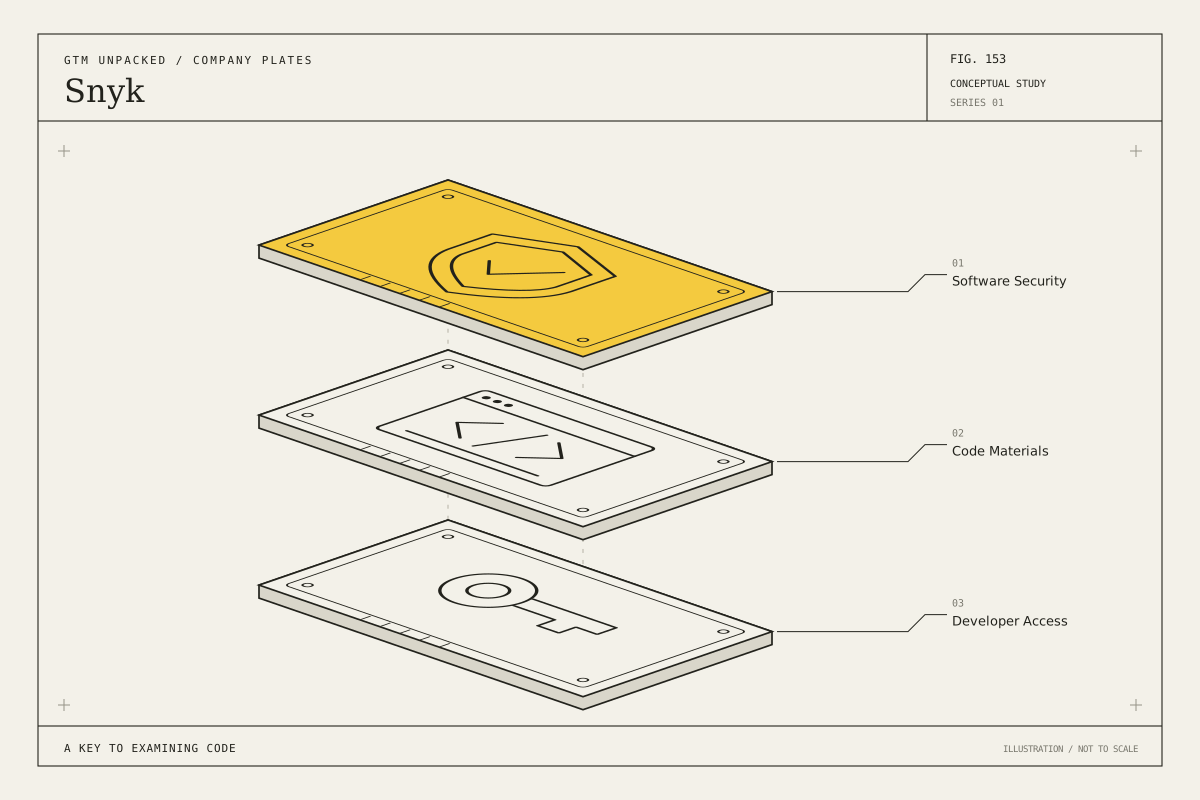
Conceptual illustration of software security as a shield beside code and a key, presenting examination and access without depicting a guaranteed protective boundary.
- Company
- Snyk · Developer tools and communities · snyk.io
- Conversion motions
- [Inference] This research classifies Snyk as Product Led, Human Led and Marketing Led.
- Snyk beachhead
- Node.js developers dealing with vulnerable open-source dependencies. [1]
- Snyk target customer
- Developers and security organizations managing application, container and infrastructure risks. [3]
- Product complexity
- [Inference] A focused scan is simple to try; organization-wide coverage and remediation are complex.
- Decision-making unit
- The founder explicitly separates the developer user from the security-team buyer. [2]
- Market at entry
- Developer-oriented security was an emerging proposition in a market dominated by security buyers. [1][2]
- Market today
- Current packaging combines developer tools with enterprise security and AI capabilities. [3]
- Evidence
- Source-backed brief · 3 linked sources · research date · method and limitations
The ten-step Revenue Engine reading map
These links locate relevant evidence. A linked section does not imply every detail of the step is publicly established.
- Acquire Your First Customers: Founder Led Sales Read first customers
- Embrace GTM Experimentation Not established in this entry
- Understand Your GTM Motion Options Read GTM motion
- Pick Your GTM Motion Not established in this entry
- Generate a Lead Read GTM motion
- Turn Leads into Paying Customers Read GTM motion · Read people & process
- Retain and Grow Your Customers Read retain & expand
- Build Your GTM Team Read people & process
- Plan Your Tech Stack Read people & process
- Optimize and Scale Through Metrics Read pricing & economics
Snyk origin and first customers: A narrow community supplied the first learning loop
An Unusual founder case study describes Guy Podjarny, Assaf Hefetz and Danny Grander building with ten design partners from their networks before launching at Velocity Amsterdam in October 2015. They chose Node.js, approached influential developers and maintainers, and used GitHub badges to make adoption visible. A remediation wizard followed user feedback. [1]
The same account says a July 2016 paywall targeting roughly $100 per developer per month produced little demand. A cloud-native company finally bought in March 2017, after substantial outbound and high-touch work; its name is not given. Free use had established interest, but not ownership of a security budget. [1]
[1]Snyk GTM motion: Monetization required a different decision-maker
In an Accel interview, Podjarny says an early trial approach failed and the company moved its initial paid tier into free. Individual developers needed depth in their own ecosystem, while enterprise buyers needed broader language and platform coverage. Snyk expanded the offering and monetized the larger organizational use case. [2]
[Inference] This was a change in commercial architecture, not merely a new price. A developer’s enthusiasm could support a security buyer’s decision, but could not substitute for it. The right qualification asks who owns risk and budget, which teams must adopt, and whether the product covers enough of their environment. [1][2]
[1] [2]Snyk people and process: Specialist credibility supported the developer promise
Hefetz brought mobile-security expertise and became CTO; Grander led security research. Podjarny concentrated outreach on developers rather than initially targeting security leaders. These complementary capabilities supported both product credibility and community conversations. The inspected sources do not identify the first enterprise account executive or customer-success manager. [1]
[Inference] The weakness in the early approach was treating a strong user experience as sufficient evidence of a purchasable organizational solution. The later motion needed people able to translate between developer workflow and security policy. That skill is distinct from generating more downloads. [1][2]
[1] [2]Snyk retention and expansion: Broader adoption requires remediation habits
The current site provides Snyk Learn, documentation, customer resources and paid services. The November 2026 price page lists Free and Team starting at $25 monthly for teams up to ten developers, plus an enterprise credit-based platform. Team includes Jira integration and next-business-day support; enterprise AI capabilities require a sales conversation. These current terms differ from the early attempted per-developer paywall. [3]
[Inference] Expansion can come from additional repositories and security capabilities, but useful retention depends on fixes entering normal engineering work. A scan that produces alerts without ownership can create workload instead of value. Enablement should establish triage, prioritization and remediation practice alongside deployment. [3]
[3]Snyk pricing and economics: The economic lesson
[Inference] Freemium delayed revenue and required resources to support nonpaying adoption. Enterprise coverage and service raised both willingness to pay and delivery cost. Public developer counts therefore cannot establish CAC efficiency or gross margin. The sources support the direction of the tradeoff, not a numerical unit-economics model. [2][3]
[Inference] A better early sequence would test the developer job and the security buyer’s minimum coverage in parallel. The case remains a strong warning against calling a paywall experiment a pricing failure when the product has not yet met the buyer’s organizational requirements. [1][2]
[1] [2] [3]Snyk economics at a glance: Pricing is only half the story.
Current free and Team entry; Team from $25/month and custom enterprise platform credits. [3]
See the dated pricing analysis.
[Inference] The relevant costs and conversion frictions are discussed in the analysis; no invented margin model is supplied.
Not verified in this brief.
No cohort retention figure verified in this brief.
The people in the Snyk GTM story: People & capabilities.
Guy Podjarny
CofounderSecurity founder focused on developer workflows; full earlier career not verified here.
Led the developer-first thesis and explained the separation between user and buyer. [1][2]
[1] [2]Assaf Hefetz
Cofounder and technical leaderMobile-security domain expertise.
Helped build the initial product and became CTO. [1]
[1]Danny Grander
CofounderEarly engineer and security researcher.
Led security research supporting the product. [1]
[1]Snyk GTM: critical reading and analysis: Why it worked.
Where it breaks.
What worked—and why
[Inference] Community credibility supported adoption and later enterprise conversations.
What did not work
The early developer paywall generated little buying because users did not control security budgets. [1][2]
What could have been better
[Inference] Validate user depth and buyer breadth simultaneously.
What another founder can use
[Inference] Developers supplied adoption; security teams supplied the budget.
Snyk go-to-market FAQ: The questions that matter.
How did Snyk find its GTM motion?
Developers supplied adoption; security teams supplied the budget. See the sourced account and explicitly labeled analysis above.
Snyk sources and open questions: Follow the sources.
- How Snyk Created a Developer-First Security Company Unusual · interview
Inspected for the facts attributed in this brief; current pages observed November 10, 2026.
- How Freemium Helped Snyk Grow Accel · interview · 2020-10-11
Inspected for the facts attributed in this brief; current pages observed November 10, 2026.
- Plans and Pricing Snyk · primary
Inspected for the facts attributed in this brief; current pages observed November 10, 2026.
What remains unverified
First paid account and its original contract were not verified.
Named early sales and customer-success hires, training, compensation and individual account assignments remain incompletely documented.
No verified CAC, payback, funnel conversion or numerical retention series in this brief.
Historical website/pricing screenshots were not captured for this company; dated textual evidence is distinguished from current pages.
No verified visual capture is attached to this entry. A current screenshot is not a substitute for a historical capture.