
Source numbers link to evidence. [Inference] marks analytical judgment, including motion classifications and causal explanations. Public evidence does not establish every internal decision or metric.
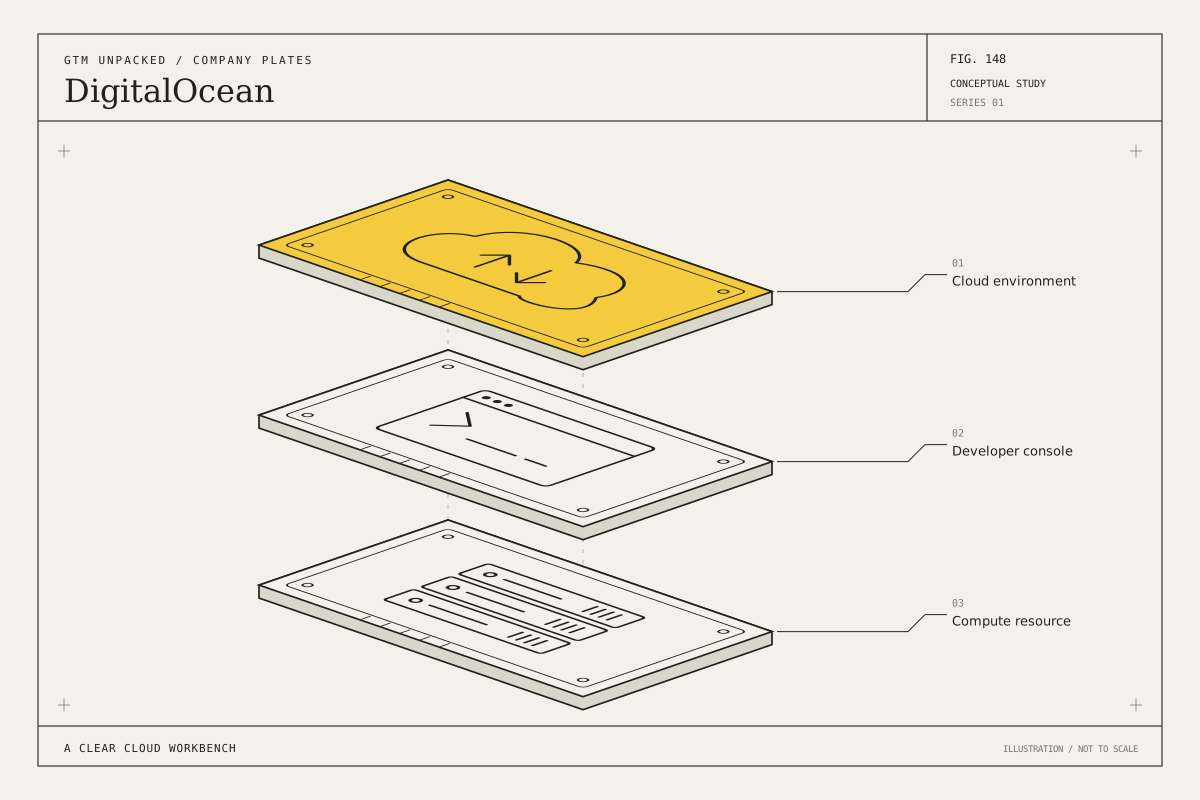
Conceptual illustration separating a cloud, terminal window, and server into a tidy developer workbench, emphasizing understandable objects rather than a literal infrastructure topology.
- Company
- DigitalOcean · Developer tools and communities · digitalocean.com
- Conversion motions
- [Inference] This research classifies DigitalOcean as Product Led, Marketing Led and Human Led.
- DigitalOcean target customer
- Individual developers, startups and growing businesses running cloud workloads. [4]
- Product complexity
- [Inference] Simple provisioning hides substantial infrastructure complexity.
- Decision-making unit
- [Inference] A developer can buy a small server; larger migrations require operational and budget approval.
- Market at entry
- Large infrastructure providers already existed; the founders sought a developer-focused alternative. [1]
- Market today
- A broad cloud market with managed databases, application platforms and business support. [4]
- Evidence
- Source-backed brief · 4 linked sources · research date · method and limitations
The ten-step Revenue Engine reading map
These links locate relevant evidence. A linked section does not imply every detail of the step is publicly established.
- Acquire Your First Customers: Founder Led Sales Read first customers
- Embrace GTM Experimentation Read experiments & lessons
- Understand Your GTM Motion Options Read GTM motion
- Pick Your GTM Motion Not established in this entry
- Generate a Lead Read GTM motion · Read experiments & lessons
- Turn Leads into Paying Customers Read GTM motion · Read people & process
- Retain and Grow Your Customers Not established in this entry
- Build Your GTM Team Read people & process
- Plan Your Tech Stack Read experiments & lessons · Read people & process
- Optimize and Scale Through Metrics Read pricing & economics
DigitalOcean origin and first customers: A second business supplied the operating knowledge
Ben Uretsky told Increment that the preceding business, ServerStack, managed about 1,000 servers with roughly 20 employees in 2011. Prospects still preferred Rackspace’s established brand. DigitalOcean pursued a different offer rather than relying only on a better specification sheet. Uretsky described an approximately 18-month incubation beginning in 2011. [1]
A founder retrospective says the company finished Techstars Boulder in 2012 with around 400 users. Launching SSD-backed servers in January 2013 increased daily signups from a few to more than 100, according to the company; the team installed hardware manually to satisfy demand. These are adoption claims, not verified paid-customer counts. [2]
[1] [2]DigitalOcean GTM motion: Simplicity had to be learned
Moisey Uretsky’s January 2012 account describes office focus groups and paid usability testing. Participants missed the signup button and did not understand the term Droplet; a stripped-down page without enough explanation was not automatically intuitive. This is unusually concrete evidence of a small product team correcting acquisition friction before scaling distribution. [3]
[Inference] The beachhead combined a recognizable task, transparent resource packaging and an operationally credible team. The SSD launch strengthened the reason to choose the service, while usability work reduced the effort of trying it. Neither finding establishes that price alone caused growth or that every developer needed an enterprise sales process. [1][2][3]
[1] [2] [3]DigitalOcean people and process: The founders’ capabilities and the scale transition
Ben brought managed-hosting operating experience; Moisey publicly documented direct customer learning. The 2018 retrospective acknowledged that the next phase needed experienced executive leadership in operations and go-to-market. That is evidence of a changing organizational requirement, not proof that the early founders lacked business ability. [1][2][3]
[Inference] When the product sells an easy beginning, support must make the first real workload successful. The live site’s documentation, community and broader service catalog supply enablement surfaces; this brief does not establish their individual contribution to conversion. Named early account managers, quota design and the first paying account remain unverified. [4]
[4]DigitalOcean pricing and economics: Resource expansion is a different motion from seat expansion
Observed November 2026, basic Droplets start at $4 monthly, managed databases at $15 and Spaces object storage at $5. Droplet billing uses seconds with a minimum charge and monthly caps. Different products have different units; these prices should not be treated as the historical launch tariff. [4]
[Inference] Account expansion follows workload growth, additional services and operational criticality. Revenue can grow without more employee seats, but compute, storage, bandwidth and support create real variable costs. A low entry price can shorten a trial decision while making high-touch selling uneconomic for the smallest accounts. No CAC or customer-level margin is inferred from the price list. [4]
[4]DigitalOcean experiments and lessons: The transferable decision
[Inference] The defensible lesson is to pair a narrow user experience with the capability to deliver its promise at scale. The early missed-button test is a warning against equating a clean interface with comprehension. A better growth scorecard would connect activated workloads and sustained consumption to signup sources, rather than celebrate inexpensive registrations alone. [2][3]
[Inference] The mature market raises a second challenge: preserve understandable deployment while adding enough managed capability for expanding customers. Broader catalogs can retain spend, but can also recreate the complexity that initially made the wedge attractive. The inspected sources do not quantify that tradeoff. [4]
[2] [3] [4]DigitalOcean economics at a glance: Pricing is only half the story.
Resource-based usage with product-specific minimums and monthly caps; November 2026 Droplets start at $4/month. [4]
See the dated pricing analysis.
[Inference] The relevant costs and conversion frictions are discussed in the analysis; no invented margin model is supplied.
Not verified in this brief.
No cohort retention figure verified in this brief.
The people in the DigitalOcean GTM story: People & capabilities.
Ben Uretsky
Cofounder; founding CEOPreviously built managed-hosting provider ServerStack.
Brought operational experience and a differentiated developer-market thesis. [1]
[1]Moisey Uretsky
CofounderDocumented early product and usability work.
Ran concrete learning loops around signup and product comprehension. [3]
[3]DigitalOcean GTM: critical reading and analysis: Why it worked.
Where it breaks.
What worked—and why
[Inference] A focused experience combined with infrastructure competence made trial credible.
What did not work
Early usability testing found that stripped-down pages and terminology confused users. [3]
What could have been better
[Inference] Track sustained workloads, contribution margin and support burden alongside signups.
What another founder can use
[Inference] Operational expertise and a sharply simpler developer offer created a wedge in cloud infrastructure.
DigitalOcean go-to-market FAQ: The questions that matter.
How did DigitalOcean find its GTM motion?
Operational expertise and a sharply simpler developer offer created a wedge in cloud infrastructure. See the sourced account and explicitly labeled analysis above.
DigitalOcean sources and open questions: Follow the sources.
- Interview with Ben Uretsky and Julia Austin Increment · interview
Inspected for the facts attributed in this brief; current pages observed November 10, 2026.
- Onward and Upward Together DigitalOcean · primary
Inspected for the facts attributed in this brief; current pages observed November 10, 2026.
- A Lean Start for DigitalOcean DigitalOcean · primary · 2012-01-05
Inspected for the facts attributed in this brief; current pages observed November 10, 2026.
- Pricing DigitalOcean · primary
Inspected for the facts attributed in this brief; current pages observed November 10, 2026.
What remains unverified
First paid account and its original contract were not verified.
Named early sales and customer-success hires, training, compensation and individual account assignments remain incompletely documented.
No verified CAC, payback, funnel conversion or numerical retention series in this brief.
Historical website/pricing screenshots were not captured for this company; dated textual evidence is distinguished from current pages.
No verified visual capture is attached to this entry. A current screenshot is not a substitute for a historical capture.