
Source numbers link to evidence. [Inference] marks analytical judgment, including motion classifications and causal explanations. Public evidence does not establish every internal decision or metric.
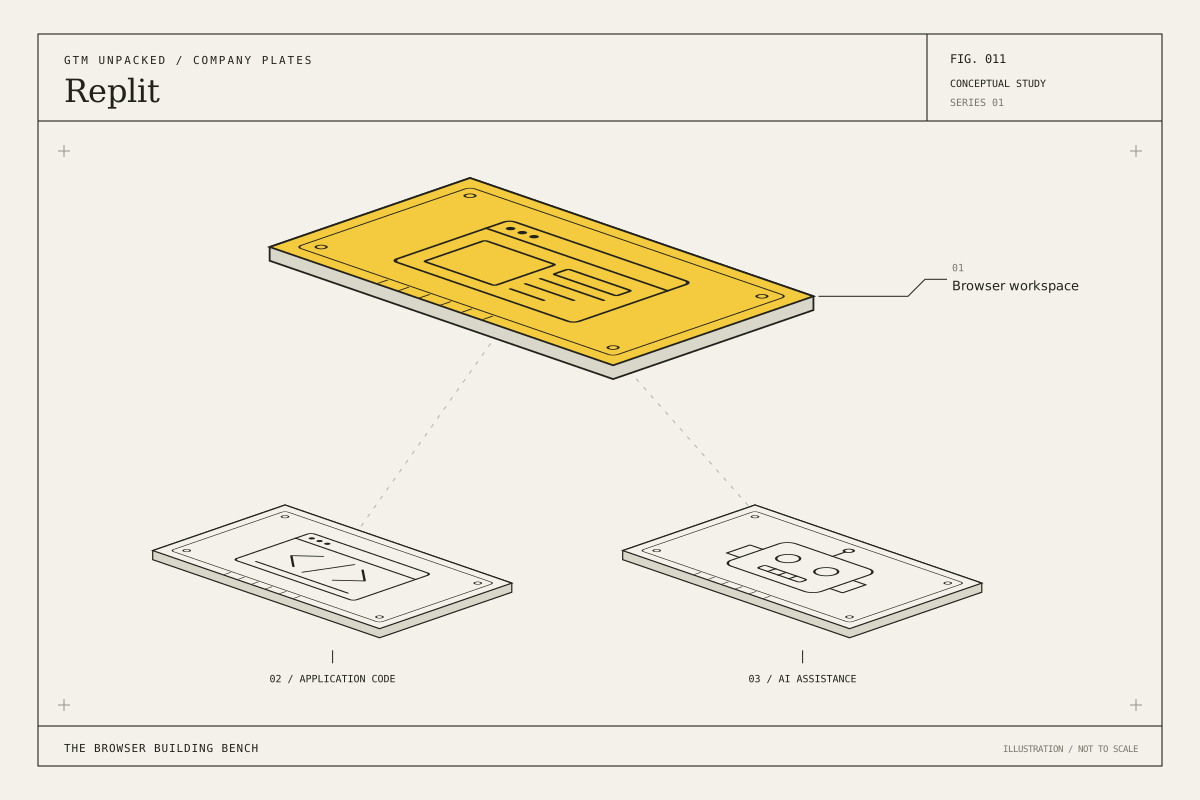
Conceptual illustration for Replit: a browser window, code brackets, and a robot evoke application creation within a browser-based working environment, without representing verified technical architecture.
- Company
- Replit · AI app builders · replit.com
- Conversion motions
- [Inference] This research classifies Replit as Product Led, Human Led and Partner Led.
- Replit beachhead
- Developers and learners who needed a working programming environment without local installation; later nontechnical app creators. [1][2]
- Replit target customer
- Individual builders, commercial teams and enterprise organizations needing controlled software creation. [4][5]
- Product complexity
- [Inference] Low-friction browser entry; increasingly complex delivery across AI, runtimes, databases, deployment and security. [2][5]
- Decision-making unit
- [Inference] Single-user purchase at entry; IT/security, procurement and budget owners matter for enterprise deployments. [4]
- Market at entry
- [Inference] Browser IDEs challenged entrenched local tooling; portability and setup were the concrete wedge. [1][2]
- Market today
- [Inference] AI application creation is more recognizable and competitive; safe production operation and enterprise distribution become differentiators. [4][7]
- Evidence
- Deep research · 13 linked sources · research date · method and limitations
The ten-step Revenue Engine reading map
These links locate relevant evidence. A linked section does not imply every detail of the step is publicly established.
- Acquire Your First Customers: Founder Led Sales Read first customers
- Embrace GTM Experimentation Read experiments & lessons
- Understand Your GTM Motion Options Read GTM motion
- Pick Your GTM Motion Read beachhead & buyer · Read product & market
- Generate a Lead Read GTM motion · Read experiments & lessons
- Turn Leads into Paying Customers Read GTM motion · Read people & process
- Retain and Grow Your Customers Read retain & expand
- Build Your GTM Team Read people & process
- Plan Your Tech Stack Read experiments & lessons · Read people & process · Read product & pricing archive
- Optimize and Scale Through Metrics Read pricing & economics
Replit GTM timeline: From wedge to engine.
Replit origin and first customers: Origin & first customers
In an October 2024 interview, Amjad Masad traced the idea to his student experience in Jordan: every computer-lab visit could require downloading and configuring development tools. He put a browser implementation on Hacker News, after which it spread through Reddit, Slashdot and Twitter. He describes product pull, not door-to-door sales. [1]
Codecademy’s December 2011 announcement provides unusually useful external corroboration. Its founders found Masad’s open-source jqConsole, used it in their product and recruited him. This was an early commercial relationship around his technology, not evidence that Codecademy was the first paying subscriber to the company incorporated later. [2]
Contrary’s March 2025 history dates Replit’s company formation to 2016 and names Amjad Masad, Haya Odeh and Faris Masad. A first subscription customer or founder-sold enterprise contract was not identified. [3]
[1] [2] [3]Replit beachhead and buyer: Beachhead & the changing buyer
[Inference] The early wedge was a repeated operational nuisance, not an abstract desire to ‘democratize coding’: open a machine, run code, share a result without reproducing a local environment. Learners and developers could judge that benefit immediately. [1][2]
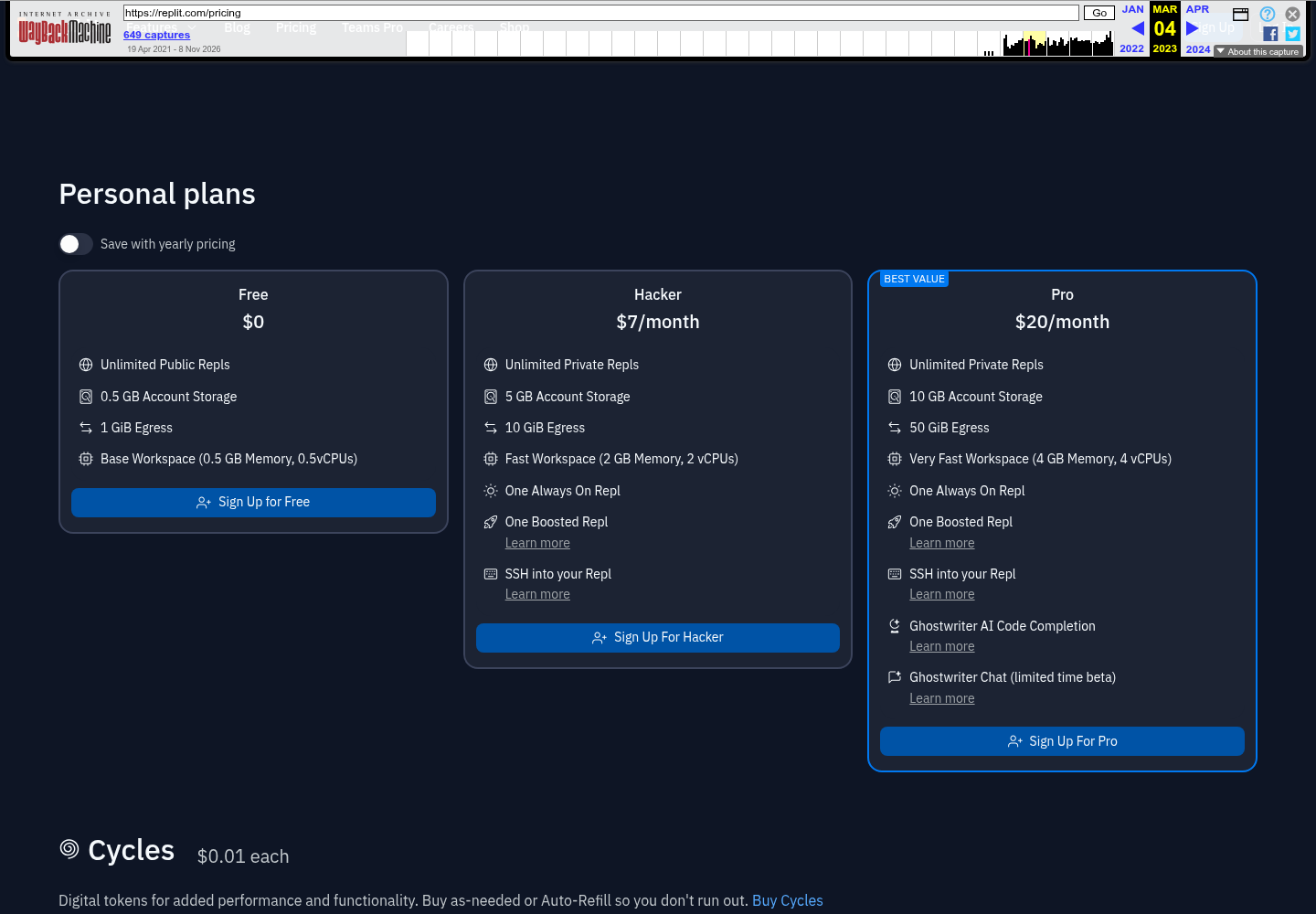
The archived March 4, 2023 pricing page shows distinct personal, business and education contexts, including Free, Hacker, Pro and Teams Pro. It documents a product already moving beyond a toy interpreter into paid compute, privacy and team use. [6]
In the 2024 Amplify interview, Michele Catasta described handing out credits at hackathons and discovering nontechnical project managers building applications. That observation expanded the practical buyer beyond programmers. It is a specific learning event, not proof that every nontechnical persona would retain. [1]
[1] [2] [6]Replit GTM motion: From PLG to a hybrid revenue engine
[Inference] Replit’s initial motion was Product Led: a shareable browser tool distributed itself in developer communities. The AI shift preserved fast entry while changing what users could accomplish. [1][2]
On May 21, 2026, Replit introduced self-serve Enterprise purchasing. The official article, updated October 27, says buyers choose an annual credit commitment and receive unlimited seats; more complex needs, spending above $200,000 and custom procurement should go to sales. This is a documented routing boundary between product-led purchase and human-led selling. [4]
The 2023 Google Cloud partnership offered Replit developers Google infrastructure and models while exposing Google Cloud and Workspace developers to Replit. A later Google case study describes Anthropic Claude on Vertex AI and Cloud Run. These are named technology/distribution partnerships; their sourced revenue share is undisclosed. [7][8]
[1] [2] [4] [7] [8]Replit product and market: Product, buying complexity & market maturity
The current product positions itself around turning ideas into applications and includes AI, deployment, storage and enterprise governance. Lenny’s November 2024 interview page already demonstrated full-stack app creation and emphasized debugging and understanding the surrounding systems. [5][9]
[Inference] The first purchase can be simple while the product’s consequences are complex. A prototype champion may approve a small plan; a company operating production workflows must also establish identity, data controls, reliability and ownership. That distinction explains why a fast checkout still needs post-sale support. [4][5]
[Inference] Replit’s old installed base is a distribution asset, but registrations accumulated during the education/IDE era are not interchangeable with retained AI application customers. A rigorous growth assessment needs cohorts segmented by the product and job that acquired them. [3][9]
[3] [4] [5] [9]Replit people and process: People who built the capability
Masad’s official biography records his prior leadership of Facebook’s JavaScript infrastructure team and his earlier founding-engineer role at Codecademy. The work gave him direct experience building tools used by other developers. [10]
Haya Odeh is identified as co-founder and VP of Design on Replit’s leadership page. Michele Catasta is President; in the Amplify interview he describes moving from applied research at Google into Replit’s AI product work after an initial partnership and repeated conversations with Masad. [1][11]
[Inference] This combination matters because the proposition requires both an approachable interface and a technically integrated delivery system. Prior research experience alone would not establish a scalable GTM motion; the hackathon observation is evidence of converting technical possibility into a broader customer hypothesis. [1][11]
Jeff Burke appears as a business-development voice in Google’s Replit case study. Pranav Ganesh authored the self-serve Enterprise announcement. These are identifiable contributors, but their complete training and career histories were not verified here; neither is labeled the company’s first salesperson. [4][8]
[1] [4] [8] [10] [11]Replit retention and expansion: Account management starts after checkout
Replit’s self-serve Enterprise article says each new enterprise customer receives a dedicated Account Manager from day one, with help ranging from SSO configuration to support and increasing the annual commitment. It explicitly gives sales-led and self-serve customers the same relationship model. [4]
Current pricing adds premium support for Pro and dedicated premium support for Enterprise. The job page also lists customer-facing engineering and support roles, including Forward Deployed Engineer, enterprise AE and Premium Support Engineer. Job openings indicate organizational design, not verified filled headcount. [5][12]
[Inference] Expansion is a consumption-and-use-case story: more deployed applications and business workflows use pooled credits, while the AM helps the customer increase productive usage. Unlimited seats can encourage wider adoption without forcing every invitation into a seat-pricing negotiation. [4]
[4] [5] [12]Replit pricing and economics: Pricing evolution & implied economics
The March 2023 archive showed Free, Hacker at $7/month, Pro at $20/month and Teams Pro at $15/user/month, alongside separately purchasable Cycles. That is direct historical evidence, not a retrospective user complaint. [6]
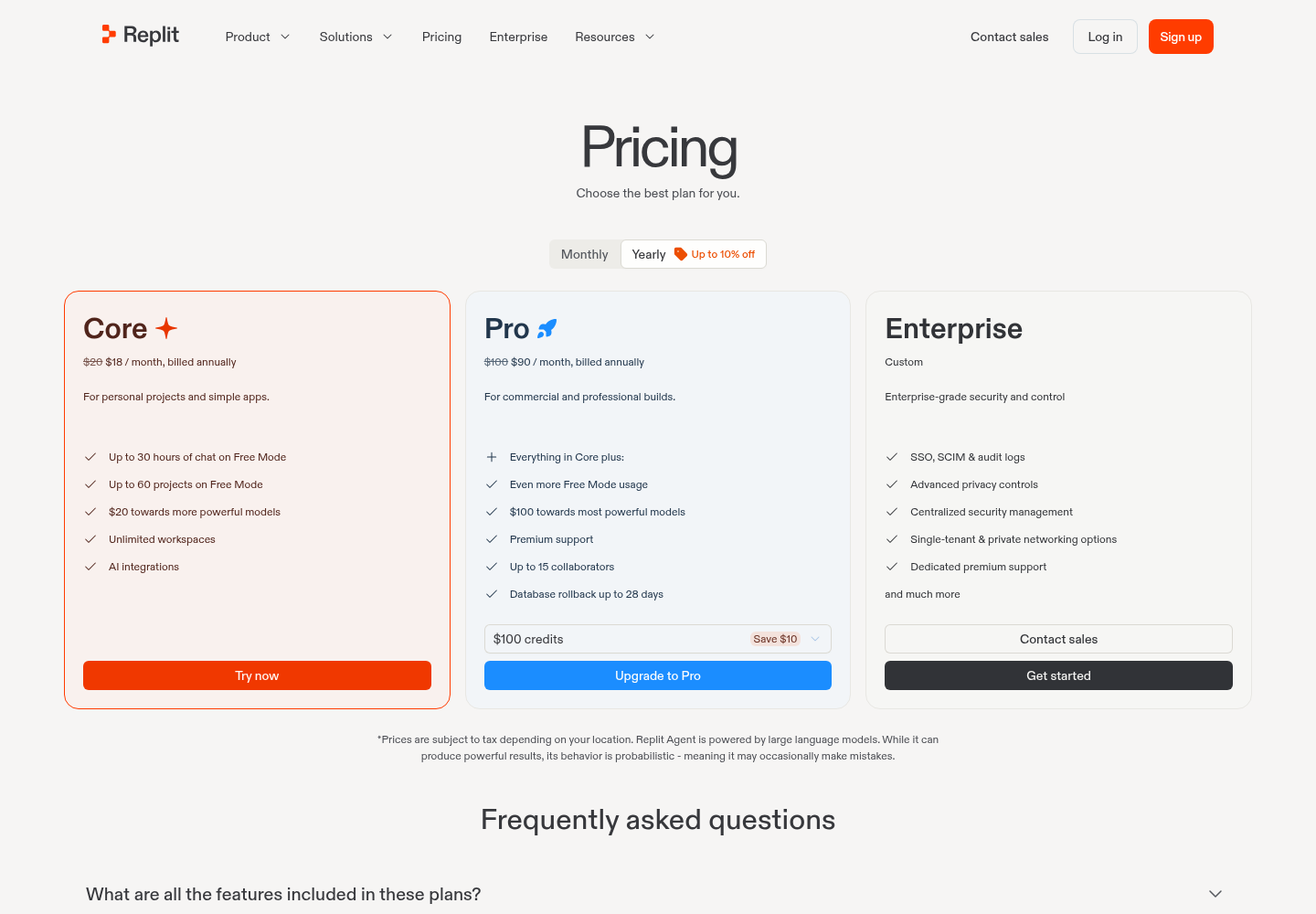
The November 10, 2026 capture showed Core at $20/month or $18/month billed annually, and Pro at $100/month or $90/month billed annually, with model-credit allowances. Enterprise pricing was custom on the public plan page. Terms can change; these are capture-date observations. [5]
[Inference] A runtime platform bears infrastructure costs even when users are not actively editing. Adding model inference makes average account revenue less informative without consumption and margin data. Credits and annual commitments improve the connection between usage, billing and capacity, but do not themselves prove profitability. [5][7][8]
No verified CAC, payback period, gross margin or retention cohort was found. The unverified $525 million figure in this project’s starting list is not used as audited ARR.
[5] [6] [7] [8]Replit experiments and lessons: Experiments, real tools & a public failure
The 2024 interviews describe experimenting with AI coding and learning from nontechnical builders, while the 2023 Google partnership is evidence of a concrete infrastructure and model stack. No internal CRM, marketing-automation or AE enablement stack was verified. [1][7]
Fast Company’s July 22, 2025 interview with Masad covered the agent deleting Jason Lemkin’s application database. The data was recovered. The account documents a serious trust and operational incident; it should not be inflated into a claim that all customer data was permanently lost. [13]
[Inference] In this category, product safety is part of conversion and retention. A dramatic first demo can raise expectations faster than a user learns database boundaries or rollback. The economically relevant failure is the mismatch between perceived autonomy and operational control. [9][13]
[1] [7] [9] [13]Replit website and pricing history: What the website history reveals
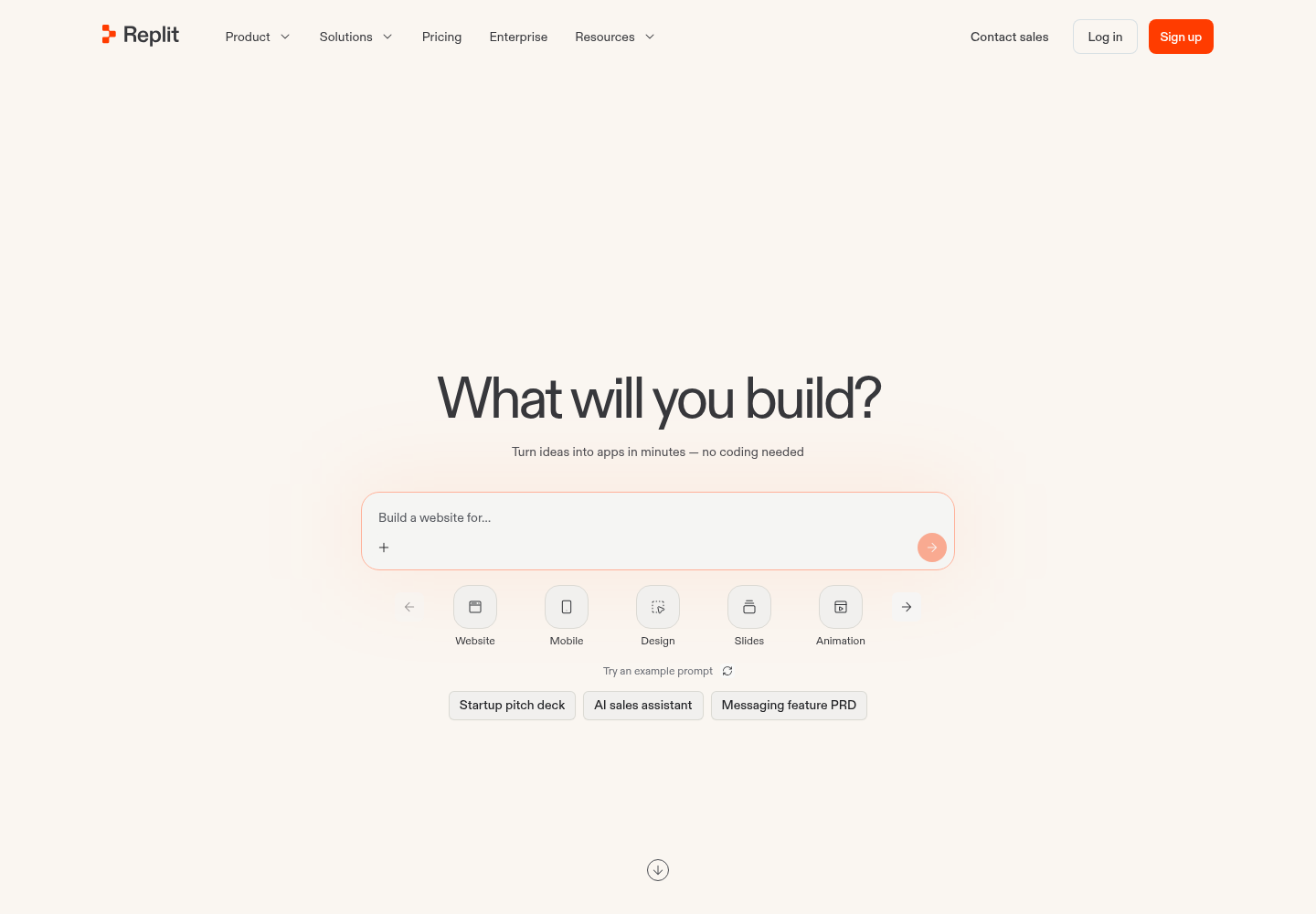
The captured 2023 pricing page monetizes an IDE: private Repls, memory, virtual CPUs, storage and Ghostwriter. The 2026 homepage foregrounds an idea-to-outcome experience, while enterprise buying combines credits with governance and relationship support. These are distinct changes in buyer language and value metric. [4][5][6]
[Inference] The continuity is friction removal: first installation, then code creation, then enterprise purchase. The discontinuity is the obligation after creation—users now depend on working applications, not only a convenient coding environment. [1][4][6]
[1] [4] [5] [6]Replit economics at a glance: Pricing is only half the story.
2026-11-10: Core $20 monthly/$18 annualized; Pro $100 monthly/$90 annualized; Enterprise custom. [5]
Subscription plus pooled consumption credits; enterprise annual commitment; paid compute/deployment. [4][5]
[Inference] Inference, persistent hosting, databases and premium support affect cost to serve. [5][8]
Not publicly verified.
NRR and product-era cohort retention not publicly verified.
The people in the Replit GTM story: People & capabilities.
Michele Catasta
PresidentApplied-research experience at Google, described in the 2024 joint interview. [1]
Connects model research to product development and reports discovering nontechnical builders at hackathons. [1]
[1] [11]Jeff Burke
Business development, as identified by Google case studyFull career/training history not verified.
Publicly explains the long-term creator mission in the Google Cloud partnership case. [8]
[8]“I just put it up on Hacker News”Amjad Masad, Amplify interview, October 2024 [1]
Replit GTM: critical reading and analysis: Why it worked.
Where it breaks.
What worked—and why
[Inference] The early product removed a real setup constraint and used the communities that experienced it. [1][2]
[Inference] Enterprise self-service removes transactional friction without removing account ownership after the purchase. [4]
What did not work
A July 2025 agent incident deleted a customer app’s database before recovery, exposing a gap between autonomy claims and operational safeguards. [13]
What could have been better
[Inference] Segment activation and retention by learner, developer, nontechnical builder and enterprise workflow; aggregate registrations hide different businesses.
[Inference] Treat production-readiness education and recoverability as core onboarding outcomes, with clear boundaries between experimentation and live operations. [13]
What another founder can use
[Inference] A product-led company can add substantial human service without forcing every buyer through a demo. [4]
[Inference] A new enabling technology can change the ICP; validate the new user’s repeated job rather than assuming the old community automatically converts. [1]
Replit website and pricing captures: Product, positioning & pricing.
Captures and image sources are dated individually. Historical gaps are kept explicit. Explore the visual archive
Replit go-to-market FAQ: The questions that matter.
How did Replit get its first users?
Masad describes sharing the browser tool through Hacker News, followed by Reddit and other developer communities. Codecademy independently documents adopting his console project in 2011. [1][2]
Does Replit use enterprise sales?
Yes. Its 2026 self-serve Enterprise article directs complex procurement and spending above $200K to sales, while giving self-serve enterprise customers a dedicated AM. [4]
How did Replit’s pricing change?
A March 2023 archive lists Hacker/Pro and per-user Teams Pro. The November 2026 offer uses Core/Pro and model credits, with enterprise pooled commitments. [4][5][6]
Which go-to-market motions is Replit classified under?
[Inference] This research classifies Replit as Product Led, Human Led and Partner Led. Motion labels describe routes across segments and periods, not measured revenue shares.
Replit sources and open questions: Follow the sources.
- How Replit is Using AI to Help Develop the Next Billion Coders Amplify Partners · interview · 2024-10-16
Founder/Catasta transcript: origin, Hacker News, research partnership, hackathon learning.
- Announcing Our Newest Hire + Codecademy Labs Codecademy · primary · 2011-12-01
Adoption of jqConsole and recruitment of Masad.
- Replit Business Breakdown & Founding Story Contrary Research · reporting · 2025-03-02
2016 formation and founder history.
- Replit Enterprise, Now Self-Serve Replit / Pranav Ganesh · primary · 2026-05-21
Updated October 27, 2026: annual credits, unlimited seats, >$200K sales routing and dedicated AM.
- Pricing and Plans Replit · primary · 2026-11-10
Current captured Core, Pro, Enterprise plans.
- Replit pricing — March 4, 2023 archive Internet Archive / Replit · primary · 2023-03-04
Historical Hacker, Pro, Teams Pro and Cycles pricing.
- Replit and Google Cloud Partner to Advance Software Development Replit · primary · 2023-03-28
Google Cloud partnership, Ghostwriter and distribution.
- Replit case study — Making anyone a developer Google Cloud · primary
Claude on Vertex AI, Cloud Run, infrastructure history and Jeff Burke.
- Behind the product: Replit Lenny’s Newsletter · interview · 2024-11-21
Public interview page on full-stack agents and user understanding.
- Amjad Masad Replit · primary
Official biography with Facebook and Codecademy roles.
- About Replit Replit · primary · 2026-11-10
Leadership roles and verified portraits.
- Careers at Replit Replit · primary · 2026-11-10
Public openings in enterprise sales, forward deployment and support.
- Replit CEO: What really happened when AI agent wiped Jason Lemkin’s database Fast Company · interview · 2025-07-22
Database deletion, recovery and founder response.
What remains unverified
First paying subscription customer and first enterprise deal not verified.
No internal CRM, seller compensation, quota or sales-coaching program verified.
Named account-manager biographies and account expansion cohorts unavailable.
No audited CAC, retention, payback or gross-margin figures verified.